Limits • Derivatives • Integrals • Applications
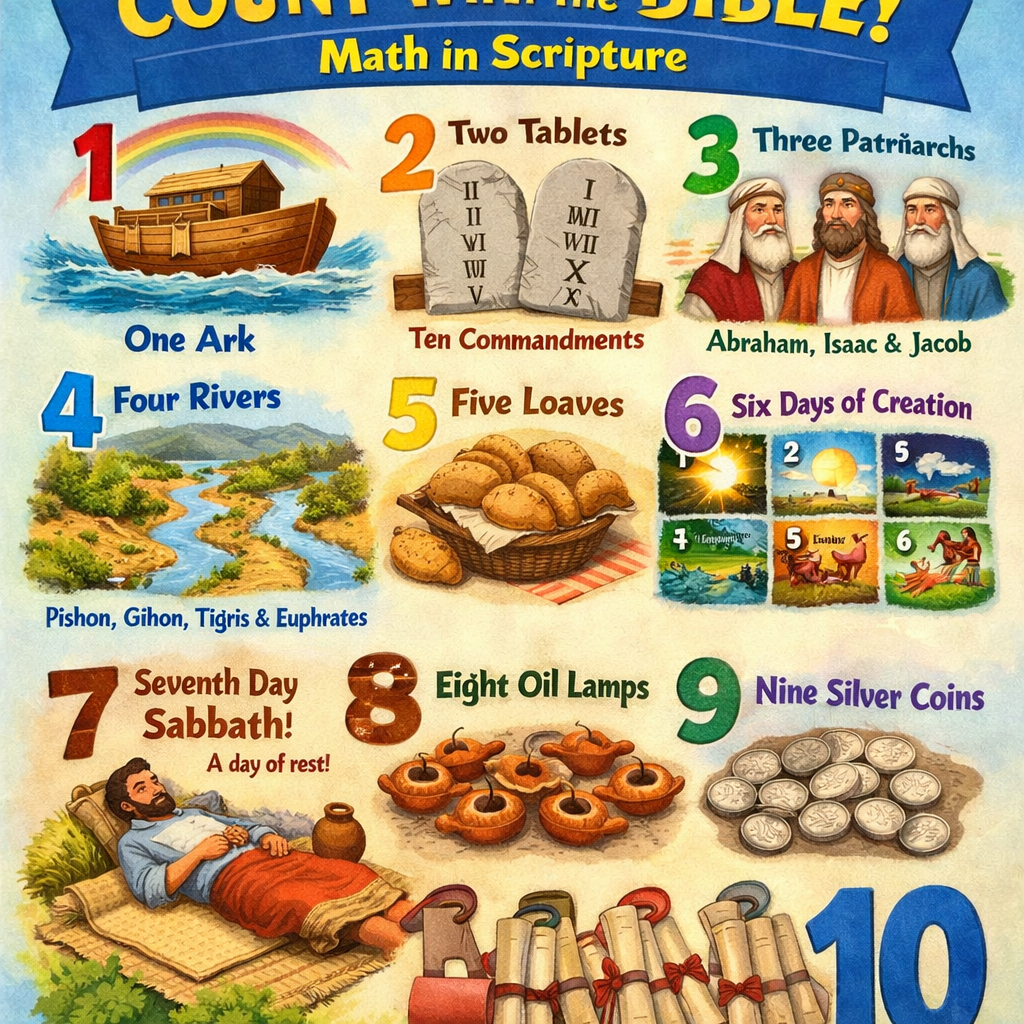
Learning to count with Yahuah!
Goal: Understand how limits lead to derivatives and integrals, master key rules, and apply calculus to real problems while recognizing the mathematical order Yahuah built into creation.
Limits describe the value a function approaches as x approaches a point.
Evaluate lim(x→2) (x² - 4)/(x-2) =
Describe in words what a limit means:
Derivative = instantaneous rate of change = slope of tangent line.
Find d/dx (3x³ - 5x + 7) =
Find d/dx (sin(3x²)) using chain rule:
A particle has s(t) = t³ - 6t² + 9t. Find when it is at rest (v=0):
d/dx (5e^x) =
d/dx (ln(3x)) =
| Function | Derivative |
|---|---|
| sin x | cos x |
| cos x | -sin x |
| tan x | sec² x |
| sec x | sec x tan x |
d/dx (sin(2x)) =
For x² + y² = 25, find dy/dx:
A balloon rises at 3 ft/s. You stand 40 ft away. How fast is the distance changing when the balloon is 30 ft high? (use Pythagorean then differentiate):
If F'(x) = f(x), then F is an antiderivative of f.
Other basics: ∫ e^x dx = e^x + C, ∫ 1/x dx = ln|x| + C
Represents signed area under a curve from a to b.
∫ (6x² - 4) dx =
Part 1: If F(x) = ∫ax f(t) dt, then F'(x) = f(x).
Part 2: ∫ab f(x) dx = F(b) - F(a) where F' = f.
FTC shows differentiation and integration are inverse processes. This elegant unity testifies to the order built into creation.
Compute ∫02 (3x²) dx using FTC:
Area between y = x² and y = 2x on [0,2]:
Does ∑n=0∞ (1/2)ⁿ converge? Sum =
A differential equation relates a function to its derivatives. Solutions are functions, not numbers.
Solve y' = 3y with y(0)=2:
How does the unity of calculus (FTC) reinforce your view of Yahuah’s order in creation?
Unit 1: Limit = 4 (factor to (x+2));
Unit 2: d/dx (3x³ - 5x +7) = 9x² -5
Unit 4: d/dx (5e^x) = 5e^x
Unit 5: d/dx sin(2x) = 2cos(2x)
Unit 7: ∫ (6x² -4) dx = 2x³ -4x + C
Unit 8: ∫₀² 3x² dx = [x³]₀² = 8
Unit 10: Geometric sum = 1/(1-1/2) = 2
Unit 11: y = 2e^{3t}