Biology: Cell Biology & DNA

Dual View: Mainstream Science vs. Intelligent Design

Grades 9-10 | Truth Carriers Academy

Table of Contents

1Introduction: The Study of Life

RECEIVE - What is Biology?
"For in Him we live, and move, and have our being." - Acts 17:28
All life exists in and through Yahuah - biology is the study of His living creation!

WHAT TEXTBOOKS TEACH

Biology is the study of life. Living things arose through naturalistic processes over billions of years. Life emerged from non-living chemicals (abiogenesis) and diversified through evolution.

WHAT SCRIPTURE SAYS

Biology is the study of Yahuah's living creation. He spoke life into existence, creating distinct "kinds" of organisms. Life comes only from life - ultimately from the Life-Giver Himself.

Characteristics of Life

PROBLEMS WITH NATURALISTIC ORIGINS

REFLECT - Questions

1. What does the Law of Biogenesis state?

2. List three characteristics of life:

a)

b)

c)
2Cell Theory & Cell Types

RECEIVE - The Basic Unit of Life

Cell Theory

  1. All living things are made of one or more cells
  2. The cell is the basic unit of life
  3. All cells come from pre-existing cells

Note: Point 3 supports the Law of Biogenesis - cells don't arise from non-living matter!

Two Types of Cells

FeatureProkaryoticEukaryotic
NucleusNo true nucleusTrue nucleus with membrane
SizeSmaller (1-10 μm)Larger (10-100 μm)
OrganellesNo membrane-bound organellesMany membrane-bound organelles
ExamplesBacteria, ArchaeaPlants, Animals, Fungi, Protists
DNACircular, in cytoplasmLinear, in nucleus

WHAT TEXTBOOKS TEACH

Prokaryotes evolved first (~3.5 billion years ago). Eukaryotes evolved later through endosymbiosis - one prokaryote engulfed another, leading to mitochondria and chloroplasts.

WHAT SCRIPTURE SAYS

Both cell types were created by Yahuah as distinct designs. "Endosymbiosis" is speculation - no one has observed a prokaryote become a eukaryote. Similarities reflect common design, not common descent.

PROBLEMS WITH ENDOSYMBIOSIS

REFLECT - Questions

1. What are the three parts of cell theory?

a)

b)

c)

2. Which type of cell has a true nucleus?

3Cell Membrane & Transport

RECEIVE - The Cell's Gatekeeper

Phospholipid Bilayer

The cell membrane is made of phospholipids arranged in two layers:

This creates a selectively permeable barrier - some things can pass, others cannot.

Types of Transport

TypeEnergy?DirectionExamples
Passive DiffusionNoHigh → Low concentrationOxygen, CO₂
OsmosisNoWater movementWater through membrane
Facilitated DiffusionNoHigh → Low (with help)Glucose via channels
Active TransportYes (ATP)Low → High concentrationSodium-potassium pump

EVIDENCE OF DESIGN: The Sodium-Potassium Pump

This molecular machine uses ATP energy to pump 3 Na⁺ ions out and 2 K⁺ ions in, maintaining the cell's electrical gradient. It:

This precision machine screams DESIGN!

REFLECT - Questions

1. What makes up the cell membrane?

2. Which type of transport requires ATP (energy)?

3. Why does the sodium-potassium pump point to intelligent design?

4Cell Organelles

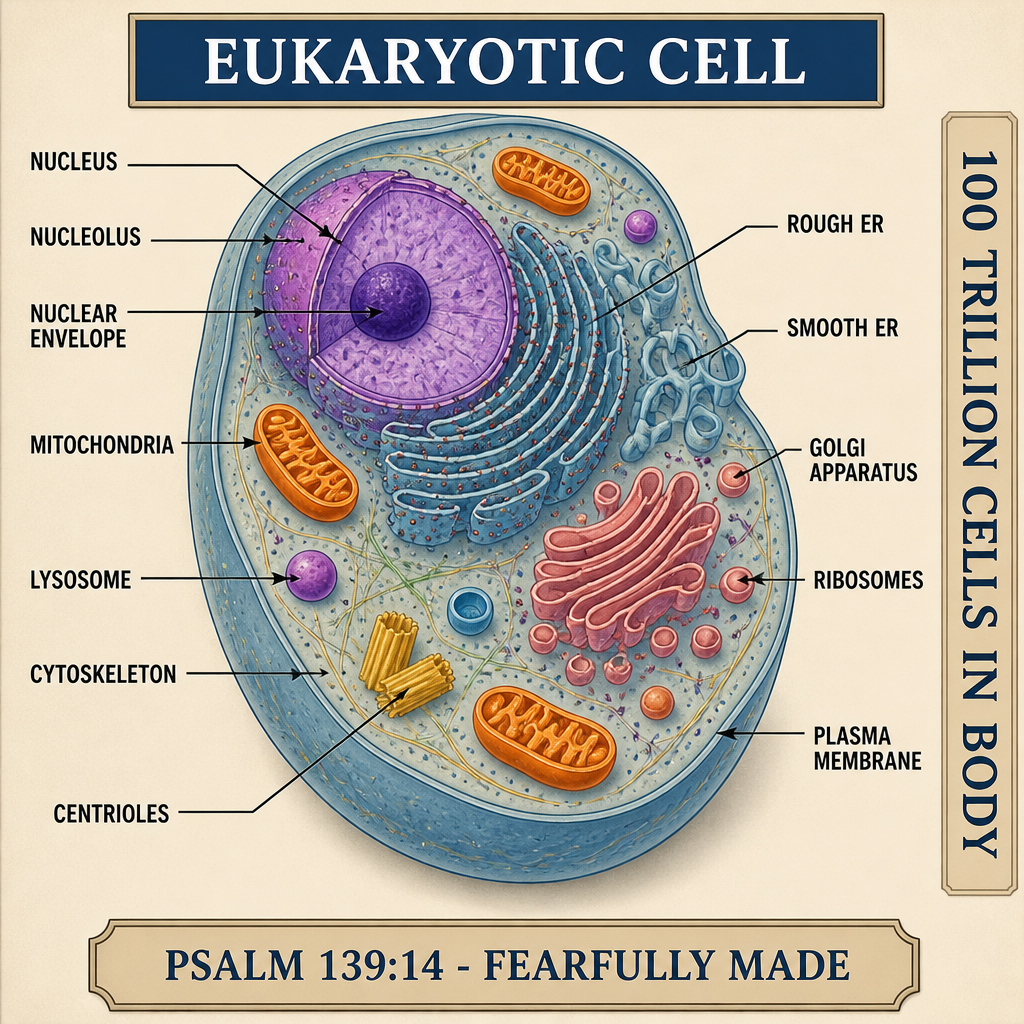
RECEIVE - The Cell's Machinery

"For You formed my inward parts; You covered me in my mother's womb." - Psalm 139:13
Yahuah designed every detail of cellular structure!

Major Organelles

OrganelleFunctionAnalogy
NucleusContains DNA, controls cellBrain/Control center
RibosomesProtein synthesisFactory workers
Endoplasmic ReticulumTransport, protein processingHighway system
Golgi ApparatusPackage and ship proteinsPost office
MitochondriaATP production (energy)Power plant
ChloroplastsPhotosynthesis (plants only)Solar panels
LysosomesDigestion, waste removalRecycling center
VacuolesStorageStorage tanks
CytoskeletonStructure, movementScaffolding

EVIDENCE OF DESIGN: The Ribosome

Ribosomes are molecular machines that read genetic code and assemble proteins:

Question for evolution: How could the first cell survive without ribosomes? But ribosomes themselves are made by... ribosomes! This is a chicken-and-egg problem that points to creation.

REFLECT - Questions

Match the organelle to its function:

1. Mitochondria:

2. Ribosome:

3. Nucleus:

4. Golgi apparatus:

5Cellular Energy: ATP

RECEIVE - The Energy Currency

ATP: Adenosine Triphosphate

ATP is the "energy currency" of all cells. It stores and transfers energy.

EVIDENCE OF DESIGN: ATP Synthase

ATP synthase is a rotary molecular motor that produces ATP:

This is a literal molecular machine! How could a turbine engine arise by chance?

REFLECT - Questions

1. What does ATP stand for?

2. How is energy released from ATP?

6Photosynthesis

RECEIVE - Capturing Light Energy

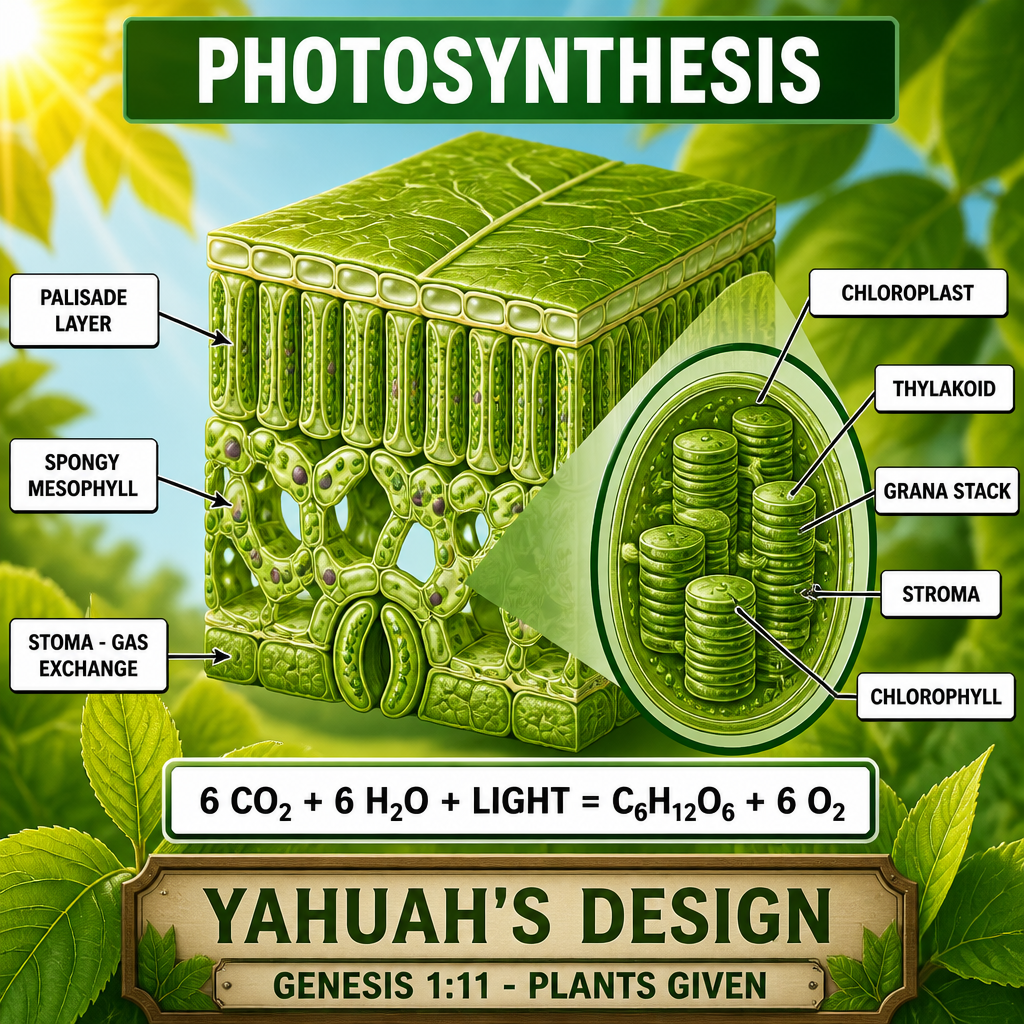
"And Elohim said, Let the earth bring forth grass, the herb yielding seed..." - Genesis 1:11
Yahuah designed plants to capture His light and sustain all life!

Photosynthesis Equation

6CO₂ + 6H₂O + Light → C₆H₁₂O₆ + 6O₂

Carbon dioxide + Water + Light energy → Glucose + Oxygen

Two Stages of Photosynthesis

1. Light-Dependent Reactions (in thylakoid membranes)

2. Calvin Cycle (in stroma)

EVIDENCE OF DESIGN

Chlorophyll precision: Absorbs exact wavelengths of light needed for maximum energy capture

Oxygen byproduct: "Waste" oxygen is essential for animal life - perfect system!

Carbon cycle: Plants use CO₂ animals exhale; animals use O₂ plants release

REFLECT - Questions

1. Write the photosynthesis equation:

2. Where do the light-dependent reactions occur?

7Cellular Respiration

RECEIVE - Releasing Energy from Food

Cellular Respiration Equation

C₆H₁₂O₆ + 6O₂ → 6CO₂ + 6H₂O + ATP

Glucose + Oxygen → Carbon dioxide + Water + Energy

Notice: This is the reverse of photosynthesis!

Three Stages

StageLocationATP Produced
1. GlycolysisCytoplasm2 ATP (net)
2. Krebs CycleMitochondrial matrix2 ATP
3. Electron Transport ChainInner mitochondrial membrane~34 ATP

Total: ~36-38 ATP per glucose molecule

EVIDENCE OF DESIGN: Perfect Balance

Photosynthesis and cellular respiration form a perfect cycle:

This interdependent system couldn't have evolved separately - both had to exist from the beginning!

REFLECT - Questions

1. Which stage produces the most ATP?

2. How does the relationship between photosynthesis and respiration show design?

8The Cell Cycle & Mitosis

RECEIVE - Cell Division

The Cell Cycle

Interphase (90% of cycle):

M Phase (Mitosis + Cytokinesis)

Stages of Mitosis (PMAT)

StageWhat Happens
ProphaseChromosomes condense, nuclear envelope breaks down
MetaphaseChromosomes line up at cell's equator
AnaphaseSister chromatids separate, move to opposite poles
TelophaseNuclear envelopes reform, chromosomes decondense

Cytokinesis: Cytoplasm divides → two daughter cells

EVIDENCE OF DESIGN: Checkpoints

The cell cycle has built-in checkpoints that ensure accuracy:

These quality control systems prevent errors - evidence of intelligent programming!

REFLECT - Questions

1. What does PMAT stand for (stages of mitosis)?

P = M = A = T =

2. During which phase does DNA replication occur?

9DNA Structure

RECEIVE - The Molecule of Heredity

"Your eyes saw my substance, being yet unformed; and in Your book they all were written, the days fashioned for me, when as yet there were none of them." - Psalm 139:16
Yahuah wrote our genetic "book" - DNA is His language of life!

DNA Structure

DNA Facts

EVIDENCE OF DESIGN: DNA as Code

DNA is a four-letter code (A, T, G, C) that contains:

Key insight: All known codes come from intelligence. There is no example of random processes creating coded information. DNA is the most complex code ever discovered!

REFLECT - Questions

1. What are the base pairing rules?

A pairs with G pairs with

2. Why does DNA's coded information point to an intelligent Creator?

10DNA Replication

RECEIVE - Copying the Code

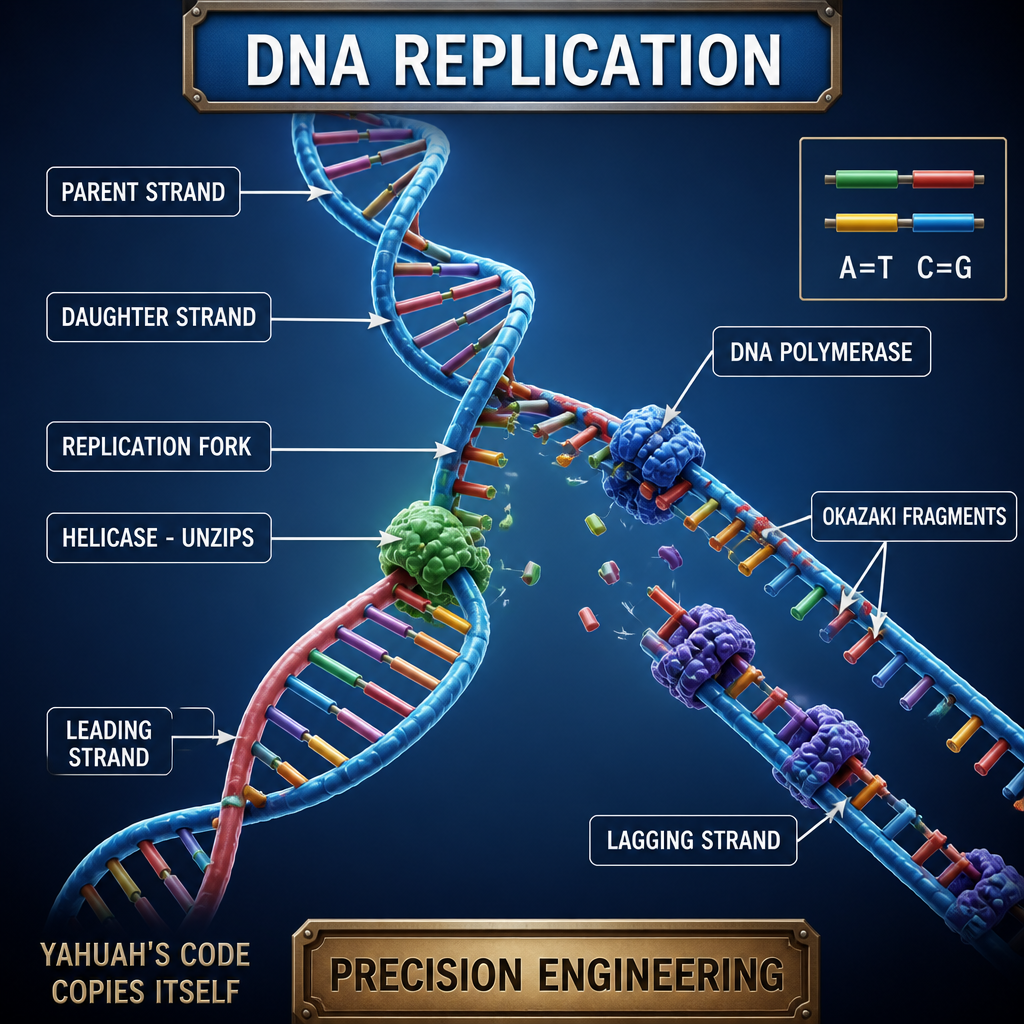
Steps of DNA Replication

  1. Helicase unzips the double helix (breaks hydrogen bonds)
  2. Primase adds RNA primer to start replication
  3. DNA Polymerase adds new nucleotides (5' to 3' direction)
  4. Ligase joins fragments together

Result: Two identical DNA molecules (semiconservative)

Key Enzymes

EnzymeFunction
HelicaseUnwinds and separates DNA strands
PrimaseCreates RNA primer
DNA PolymeraseAdds nucleotides, proofreads
LigaseJoins DNA fragments

EVIDENCE OF DESIGN: Error Correction

DNA polymerase has a built-in "proofreading" function:

This is like a spell-checker built into a copying machine - evidence of intelligent engineering!

REFLECT - Questions

1. What enzyme "unzips" the DNA?

2. What enzyme adds new nucleotides?

11Protein Synthesis

RECEIVE - From Gene to Protein

The Central Dogma

DNA → RNA → Protein

Two Steps

1. Transcription (in nucleus)

2. Translation (at ribosome)

The Genetic Code

61 codons code for 20 amino acids + 3 stop codons

Start codon: AUG (also codes for methionine)

Stop codons: UAA, UAG, UGA

EVIDENCE OF DESIGN: The Genetic Code

The genetic code is:

Key point: A code requires both an encoder and a decoder. DNA is meaningless without the translation machinery. Both had to exist together from the beginning!

REFLECT - Questions

1. Where does transcription occur?

2. What is a codon?

12The Information Problem

RECEIVE - The Ultimate Challenge to Evolution

"In the beginning was the Word, and the Word was with Elohim, and the Word was Elohim." - John 1:1
Information (the Word) comes from Yahuah - the ultimate Intelligence!

THE CENTRAL PROBLEM FOR EVOLUTION

Where does the information in DNA come from?

Mutations: Can They Create New Information?

What mutations do:

What mutations DON'T do:

CONCLUSION: DNA Points to a Creator

The complexity and information content of DNA is powerful evidence for intelligent design:

  1. Code requires intelligence: No code has ever arisen by chance
  2. Irreducible complexity: DNA needs proteins to replicate, proteins need DNA to be made
  3. Specified complexity: Not just complex, but specifically arranged for function
  4. Universal code: One Designer using one system across all life

"For since the creation of the world His invisible attributes are clearly seen, being understood by the things that are made" - Romans 1:20

RESPOND - Final Reflection

1. Why can't mutations create new genetic information?

2. How does the study of cell biology strengthen your faith in Yahuah as Creator?