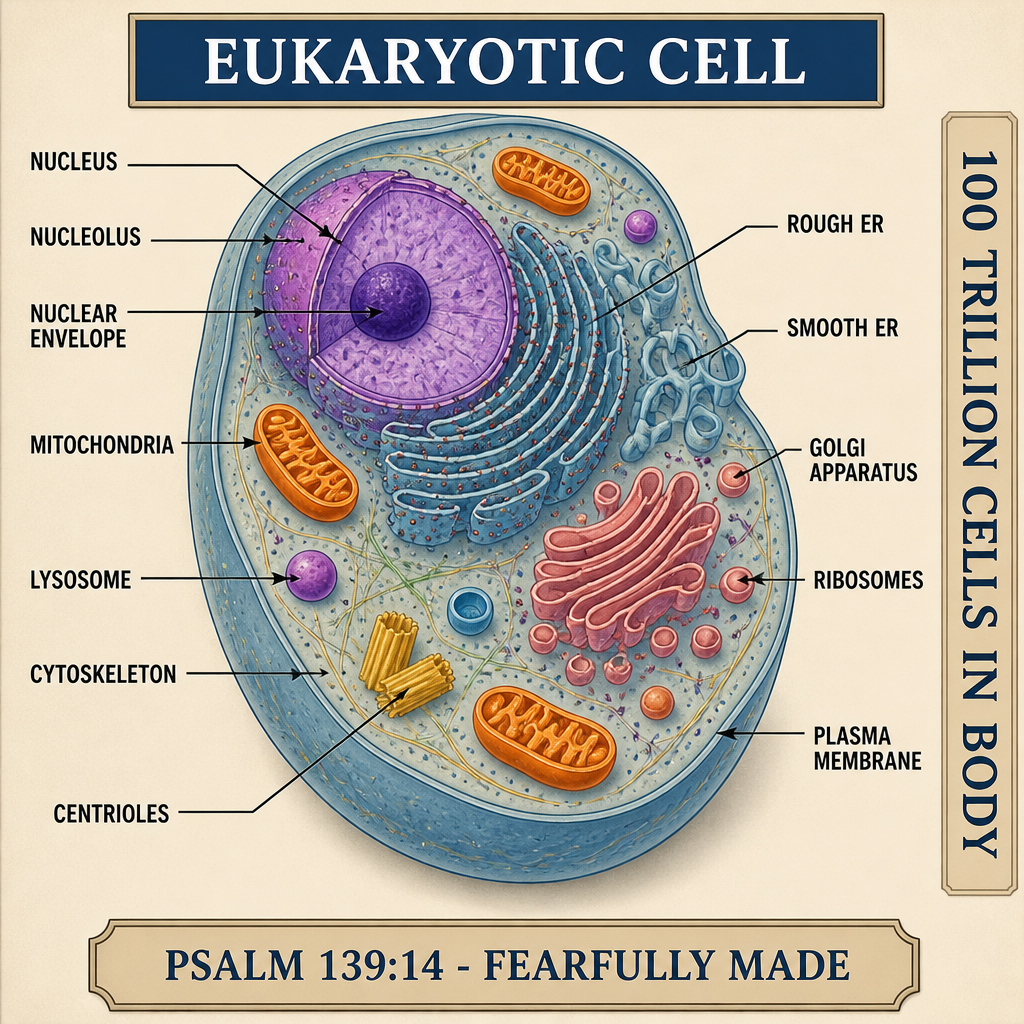
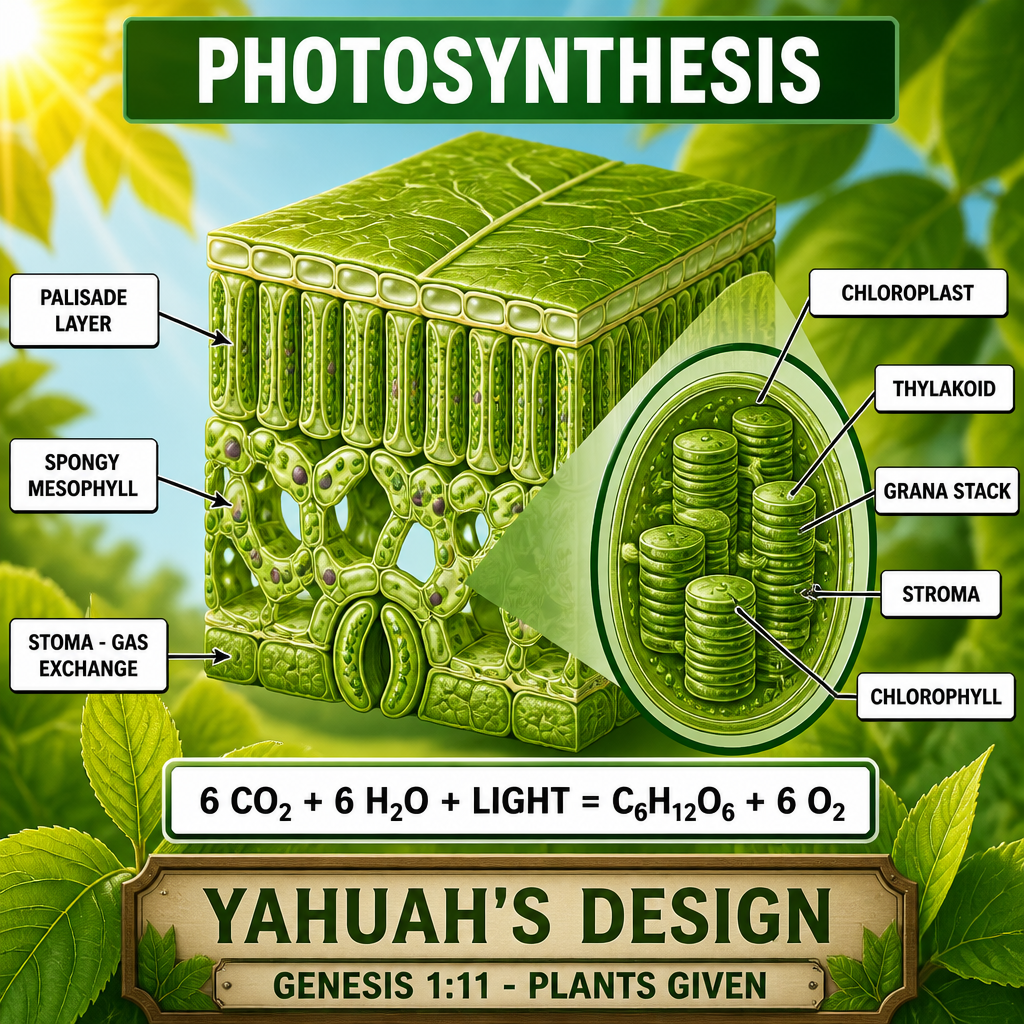
Dual View: Common Descent vs. Created Kinds
Genetics is the study of heredity and variation. Genes evolved over billions of years through random mutations, and all life shares common ancestry. Genetic similarities between species prove common descent.
Genetics is the study of Yahuah's designed inheritance system. He created distinct "kinds" with genetic information to produce variation within those kinds, while maintaining boundaries between kinds.
1. What is the difference between genotype and phenotype?
2. If B is dominant for brown eyes and b is recessive for blue, what phenotype would Bb have?
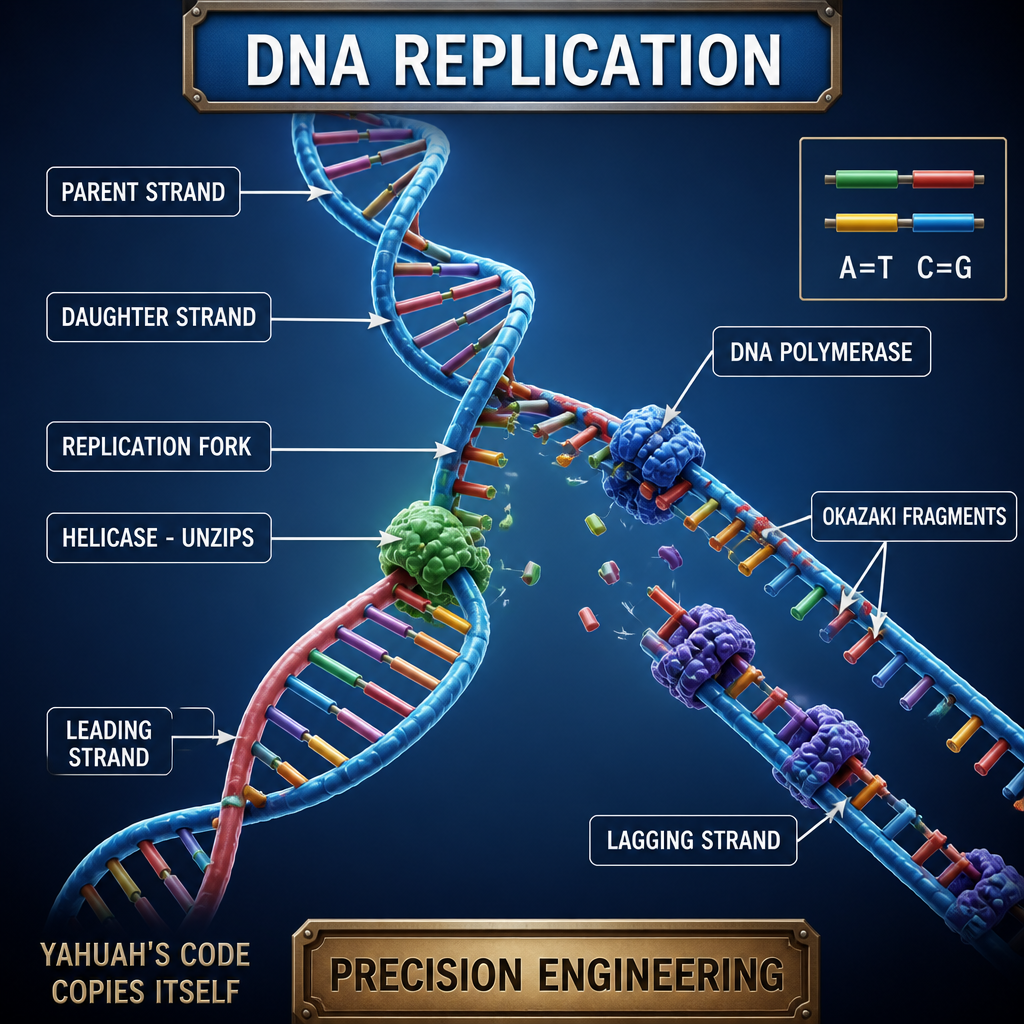
Meiosis produces sex cells (gametes) with half the chromosomes (haploid).
| Stage | What Happens |
|---|---|
| Meiosis I | Homologous pairs separate; crossing over occurs |
| Meiosis II | Sister chromatids separate (like mitosis) |
Result: 4 unique haploid cells (n = 23 in humans)
During meiosis, chromosomes exchange segments (crossing over), creating unique combinations. This built-in "shuffling" mechanism produces incredible variation within kinds - allowing adaptation without adding new genetic information!
1. How many chromosomes are in a human gamete (sperm or egg)?
2. What is the purpose of meiosis?
An Augustinian friar who discovered the basic laws of inheritance through pea plant experiments.
Note: Mendel was a creationist who believed his work revealed Yahuah's order!
1. Law of Dominance: One allele may mask (dominate) another
2. Law of Segregation: Allele pairs separate during gamete formation
3. Law of Independent Assortment: Genes for different traits are inherited independently
Mendel studied 7 traits including:
1. What does the Law of Segregation state?
| B | b | |
| B | BB | Bb |
| b | Bb | bb |
Genotype ratio: 1 BB : 2 Bb : 1 bb
Phenotype ratio: 3 dominant : 1 recessive
1. Cross two heterozygous tall plants (Tt × Tt). What percentage will be short (tt)?
Answer: %
2. Cross a homozygous dominant (BB) with a homozygous recessive (bb). What are all offspring genotypes?
All offspring:
| Pattern | Description | Example |
|---|---|---|
| Incomplete Dominance | Blend of traits | Red + White = Pink flowers |
| Codominance | Both traits fully expressed | Blood type AB |
| Multiple Alleles | More than 2 alleles exist | Blood type (A, B, O) |
| Polygenic | Multiple genes affect trait | Height, skin color |
| Sex-Linked | Gene on X chromosome | Color blindness |
| Genotype | Blood Type |
|---|---|
| IᴬIᴬ or Iᴬi | Type A |
| IᴮIᴮ or Iᴮi | Type B |
| IᴬIᴮ | Type AB |
| ii | Type O |
1. A mother has type A blood (Iᴬi) and father has type B (Iᴮi). What blood types could their children have?
Possible types:
Mutations are random changes in DNA that provide raw material for evolution. Beneficial mutations are selected, adding new genetic information over millions of years.
Mutations are copying errors in Yahuah's original perfect design. They represent a degradation of information, not an increase. The creation is "groaning" under the curse (Romans 8:22).
| Type | What Happens | Example |
|---|---|---|
| Point Mutation | Single base change | Sickle cell anemia |
| Insertion | Extra base added | Frameshift |
| Deletion | Base removed | Frameshift |
| Inversion | Segment reversed | Chromosome disorder |
| Duplication | Segment copied | Extra copies |
1. What type of mutation causes sickle cell anemia?
2. Why can't mutations be the mechanism for evolution?
| Disorder | Inheritance | Cause |
|---|---|---|
| Cystic Fibrosis | Autosomal recessive | CFTR gene mutation |
| Sickle Cell | Autosomal recessive | Hemoglobin mutation |
| Huntington's | Autosomal dominant | HTT gene expansion |
| Color Blindness | X-linked recessive | Photoreceptor genes |
| Hemophilia | X-linked recessive | Clotting factor genes |
| Down Syndrome | Chromosomal | Trisomy 21 |
A pedigree is a family tree showing inheritance patterns.
1. Why are X-linked recessive disorders more common in males?
Variation is evidence of evolution. Dog breeds, for example, show how natural selection can create entirely new species given enough time.
Variation within kinds was built into the original design. Dogs producing different dog breeds is not evolution - it's expression of pre-existing genetic information. A dog has never produced a non-dog.
Key insight: These mechanisms rearrange existing information - they don't create new genes!
Example: Dog Breeds
This is exactly what we'd expect from a Designer who front-loaded variety into the original kinds!
1. What's the difference between variation within a kind and evolution?
Textbooks often show examples of natural selection (finch beaks, peppered moths, bacteria resistance) and then claim this proves molecules-to-man evolution. This is a logical error!
Bottom line: Natural selection + time ≠ new body plans, organs, or genetic information
1. Explain why natural selection is not the same as evolution:
Humans share 98% DNA with chimps, proving common ancestry. "Junk DNA" is leftover from evolution.
Humans are uniquely created in Yahuah's image (Genesis 1:27). Similarities reflect common Designer, not common descent. "Junk DNA" is actually functional!
The ENCODE project discovered that at least 80% of "junk DNA" is functional:
"Junk DNA" was an evolutionary assumption - proven wrong by science!
1. Why doesn't genetic similarity between humans and chimps prove common ancestry?
| Technology | Description | Example |
|---|---|---|
| GMOs | Genes inserted into organisms | Bt corn |
| Cloning | Creating genetic copy | Dolly the sheep |
| Gene Therapy | Fixing defective genes | Treating genetic diseases |
| CRISPR | Precise gene editing | Editing human embryos |
| DNA Fingerprinting | Identifying individuals | Crime investigations |
1. What biblical principles should guide our use of genetic technology?
Baramin = Hebrew "bara" (created) + "min" (kind)
Estimates: ~1,000-2,000 animal kinds (not millions of species!)
After the Flood, kinds diversified rapidly into today's varieties through:
This explains the diversity we see today - without molecules-to-man evolution!
| Observation | Evolution Says | Creation Says |
|---|---|---|
| Similarities between organisms | Common ancestor | Common Designer |
| Variation within species | Evolution in progress | Built-in diversity |
| Distinct body plans | Transitional forms existed | Created kinds |
| Genetic information | Random mutations add it | Designed, degrading |
| Fossils | Slow gradual change | Rapid burial in Flood |
1. How does the concept of "created kinds" explain both similarity and diversity in the living world?
2. How has studying genetics strengthened your faith in Yahuah as Creator?