Chemistry: Atomic Structure, Bonding & Reactions

Exploring Yahuah's Building Blocks of Creation

Grades 10-11 | Truth Carriers Academy

Table of Contents

1Introduction to Chemistry

RECEIVE - What is Chemistry?
"Through faith we understand that the worlds were framed by the word of Elohim, so that things which are seen were not made of things which do appear." - Hebrews 11:3
Yahuah created visible matter from invisible atoms!

Chemistry Defined

Chemistry is the study of matter, its properties, composition, and how it changes.

Matter Classification

TypeDescriptionExample
ElementPure substance, one type of atomGold (Au), Oxygen (O)
CompoundTwo+ elements chemically combinedWater (H₂O), Salt (NaCl)
MixturePhysically combined, not bondedAir, salad, salt water

Physical vs. Chemical Properties

REFLECT - Questions

1. Is water an element, compound, or mixture?

2. Is melting point a physical or chemical property?
2Atomic Structure

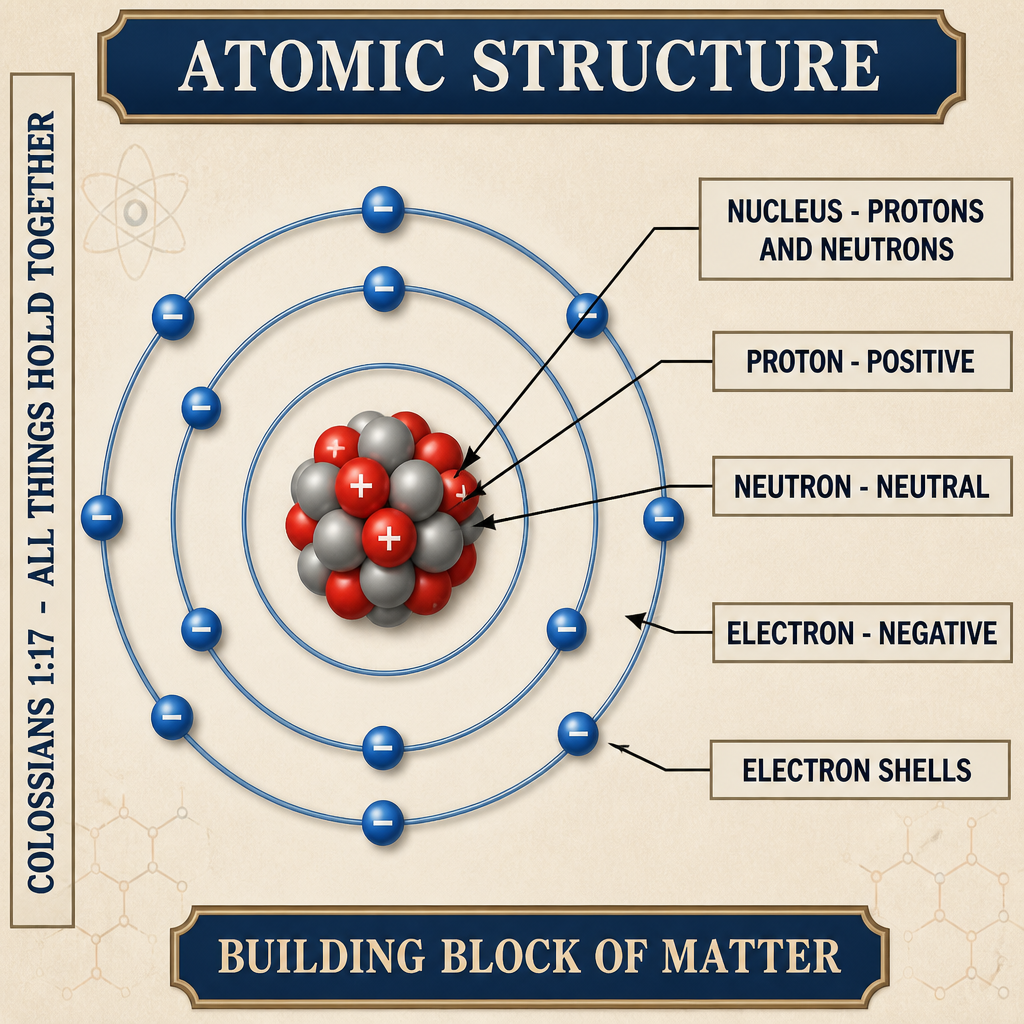
RECEIVE - Inside the Atom

Subatomic Particles

ParticleLocationChargeMass
ProtonNucleus+11 amu
NeutronNucleus01 amu
ElectronElectron cloud-1~0 amu

Key Numbers

Atomic Number (Z) = Number of protons (defines the element)

Mass Number (A) = Protons + Neutrons

Neutrons = Mass Number - Atomic Number

Isotopes

Isotopes are atoms of the same element with different numbers of neutrons.

Example: Carbon-12 (6 neutrons) vs. Carbon-14 (8 neutrons)

EVIDENCE OF DESIGN: The Atom

The atom is a marvel of design:

Slight changes to atomic forces would make chemistry - and life - impossible!

REFLECT - Questions

1. An atom has 17 protons and 18 neutrons. What is its mass number?

Mass number =

2. What particle determines the element's identity?

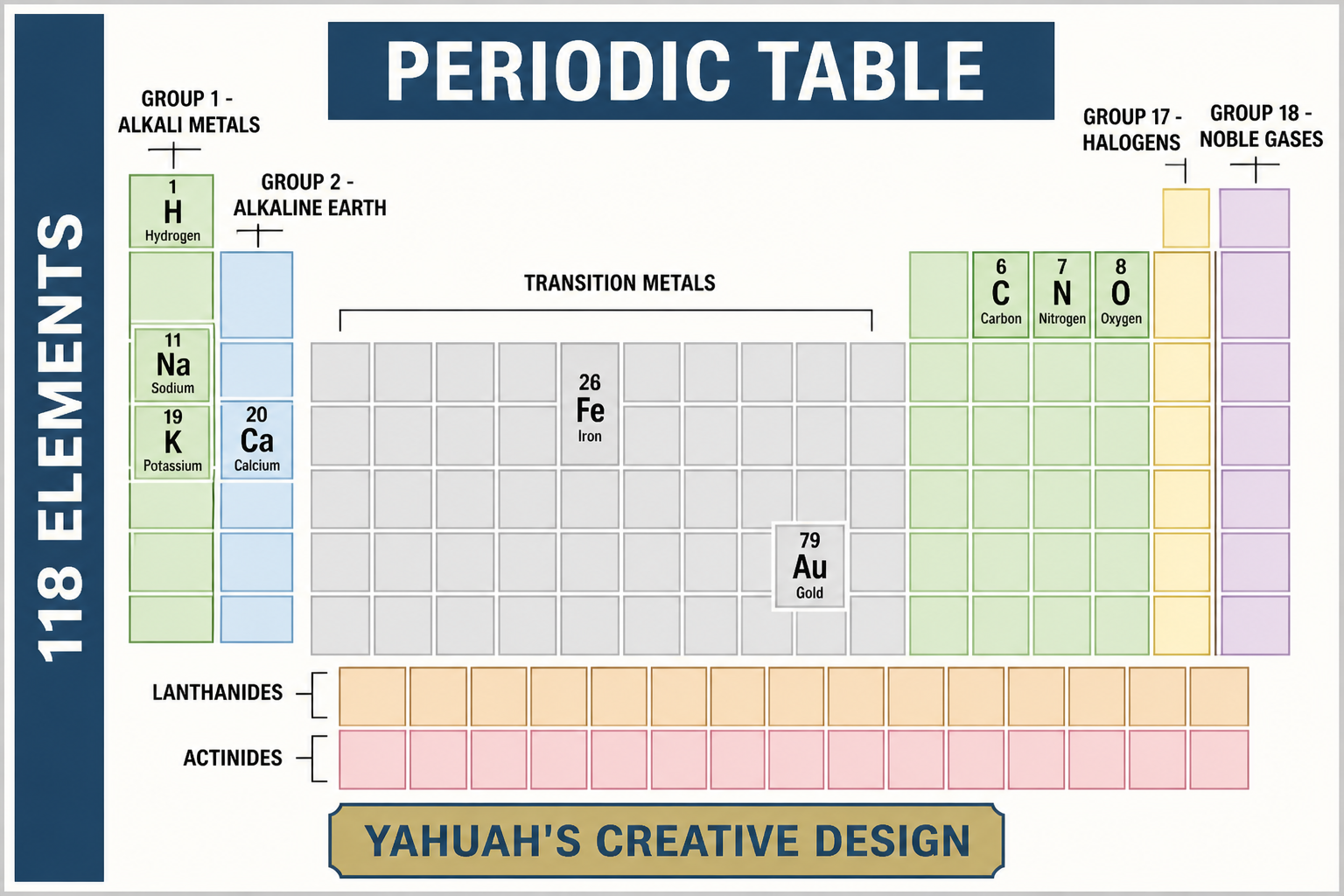
3The Periodic Table

RECEIVE - Organizing the Elements

Periodic Table Organization

Important Groups

GroupNameProperties
1Alkali MetalsVery reactive, +1 ion
2Alkaline Earth MetalsReactive, +2 ion
17HalogensVery reactive nonmetals, -1 ion
18Noble GasesStable, unreactive (full outer shell)

Metals, Nonmetals, Metalloids

TypePropertiesLocation
MetalsShiny, conduct, malleable, lose e⁻Left side
NonmetalsDull, poor conductors, gain e⁻Right side
MetalloidsProperties of bothStaircase line

REFLECT - Questions

1. What group contains the most unreactive elements?

2. Elements in the same group have similar

4Electron Configuration

RECEIVE - Where Electrons Live

Energy Levels & Orbitals

Electron Configuration Order

1s² → 2s² → 2p⁶ → 3s² → 3p⁶ → 4s² → 3d¹⁰ → 4p⁶ → 5s²...

Example: Oxygen (8 electrons)

1s² (2 electrons) - 6 remaining
2s² (2 electrons) - 4 remaining
2p⁴ (4 electrons) - done!

Configuration: 1s² 2s² 2p⁴

Valence Electrons

Valence electrons are electrons in the outermost energy level.

REFLECT - Questions

1. Write the electron configuration for Na (11 electrons):

2. How many valence electrons does Chlorine (Group 17) have?

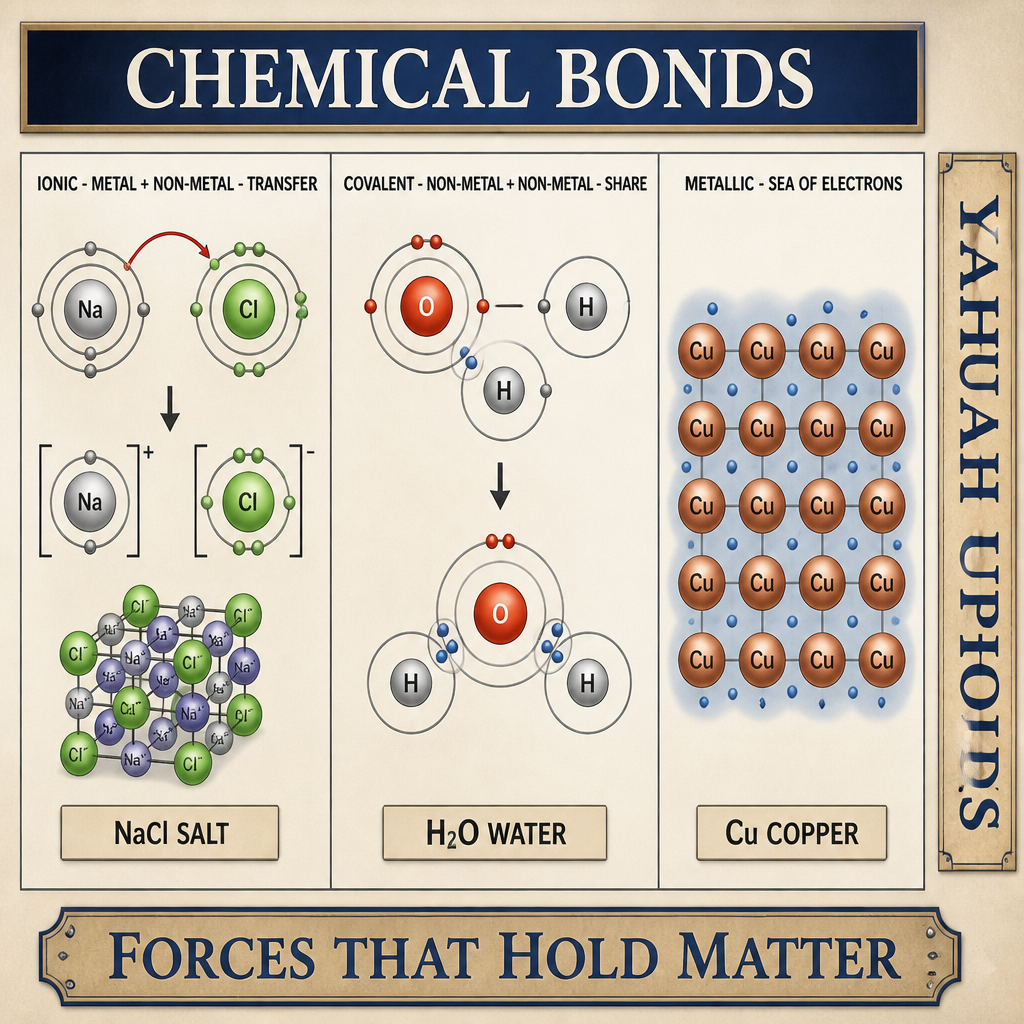
5Ionic Bonding

RECEIVE - Transfer of Electrons

Ionic Bond Formation

  1. Metal loses electrons → becomes positive ion (cation)
  2. Nonmetal gains electrons → becomes negative ion (anion)
  3. Opposite charges attract → ionic bond

Example: Sodium Chloride (NaCl)

Na (11 electrons) loses 1 → Na⁺ (10 electrons)
Cl (17 electrons) gains 1 → Cl⁻ (18 electrons)
Na⁺ and Cl⁻ attract → NaCl (table salt)

Ionic Compound Properties

REFLECT - Questions

1. In ionic bonding, which type of element loses electrons?

2. What charge would Calcium (Group 2) form?

6Covalent Bonding

RECEIVE - Sharing Electrons

Covalent Bond Formation

Nonmetal atoms share electrons to achieve a full outer shell.

Example: Water (H₂O)

Oxygen needs 2 electrons to complete its octet
Each Hydrogen needs 1 electron
O shares 1 electron with each H (2 single bonds)

Lewis Structure: H-O-H

Covalent Compound Properties

Polar vs. Nonpolar Covalent

TypeElectron SharingExample
NonpolarEqual sharingO₂, N₂, CH₄
PolarUnequal sharingH₂O, HCl

REFLECT - Questions

1. How many electrons are shared in a double bond?

2. Is water (H₂O) polar or nonpolar?

7Chemical Formulas & Naming

RECEIVE - The Language of Chemistry

Naming Ionic Compounds

  1. Write cation (metal) name first
  2. Write anion (nonmetal) name, change ending to -ide

Examples: NaCl = Sodium chloride, MgO = Magnesium oxide

Naming Covalent Compounds

  1. Use prefixes for both elements (mono-, di-, tri-, tetra-, penta-...)
  2. Change second element ending to -ide
  3. (Drop "mono-" on first element)

Examples: CO₂ = Carbon dioxide, N₂O₅ = Dinitrogen pentoxide

Common Polyatomic Ions

IonFormulaIonFormula
HydroxideOH⁻SulfateSO₄²⁻
NitrateNO₃⁻CarbonateCO₃²⁻
PhosphatePO₄³⁻AmmoniumNH₄⁺

REFLECT - Questions

1. Name CaCl₂:

2. Name P₂O₅:

3. Write the formula for Potassium nitrate:

8Chemical Reactions

RECEIVE - When Substances Change

Chemical Reaction Basics

ReactantsProducts

Evidence of Chemical Reaction

Law of Conservation of Mass

Matter cannot be created or destroyed in a chemical reaction.

Atoms are rearranged, not created or destroyed.

Total mass of reactants = Total mass of products

"While the earth remains, seedtime and harvest, and cold and heat, and summer and winter, and day and night shall not cease." - Genesis 8:22
Yahuah established natural laws that govern all chemical processes!

REFLECT - Questions

1. In the reaction A + B → C, what are A and B called?

2. What law states that mass is conserved in reactions?

9Balancing Equations

RECEIVE - Making Atoms Balance

Why Balance?

Balanced equations show the same number of each type of atom on both sides (conservation of mass).

Steps to Balance

  1. Write the unbalanced equation
  2. Count atoms of each element on both sides
  3. Add coefficients to balance (start with most complex molecule)
  4. Check that all atoms are balanced
  5. Make sure coefficients are in lowest whole-number ratio

Example: Hydrogen + Oxygen → Water

Unbalanced: H₂ + O₂ → H₂O
Count: Left: 2H, 2O | Right: 2H, 1O (unbalanced!)
Balance O by putting 2 in front of H₂O: H₂ + O₂ → 2H₂O
Now: Left: 2H, 2O | Right: 4H, 2O (H unbalanced!)
Balance H by putting 2 in front of H₂: 2H₂ + O₂ → 2H₂O
Check: Left: 4H, 2O | Right: 4H, 2O ✓

Balanced: 2H₂ + O₂ → 2H₂O

REFLECT - Practice

1. Balance: ___ Na + ___ Cl₂ → ___ NaCl

Coefficients: Na + Cl₂ → NaCl

2. Balance: ___ Fe + ___ O₂ → ___ Fe₂O₃

Coefficients: Fe + O₂ → Fe₂O₃

10Moles & Stoichiometry

RECEIVE - Counting Atoms by Weighing

The Mole

1 mole = 6.022 × 10²³ particles (Avogadro's number)

Like "dozen" = 12, "mole" = 6.022 × 10²³

Molar Mass

Molar mass = mass of 1 mole of substance (g/mol)

Equals atomic mass from periodic table in grams

Example: Carbon molar mass = 12.01 g/mol

Key Conversions

Moles = Mass / Molar Mass

n = m / M

Example: How many moles in 36 g of water?

Molar mass H₂O = 2(1) + 16 = 18 g/mol
n = m / M = 36 g / 18 g/mol
n = 2 moles of water

REFLECT - Practice

1. What is the molar mass of NaCl? (Na=23, Cl=35.5)

Molar mass = g/mol

2. How many moles in 88 g of CO₂? (Molar mass = 44 g/mol)

n = moles

11Types of Reactions

RECEIVE - Reaction Categories

Five Main Reaction Types

TypePatternExample
SynthesisA + B → AB2H₂ + O₂ → 2H₂O
DecompositionAB → A + B2H₂O → 2H₂ + O₂
Single ReplacementA + BC → AC + BZn + CuSO₄ → ZnSO₄ + Cu
Double ReplacementAB + CD → AD + CBNaCl + AgNO₃ → NaNO₃ + AgCl
CombustionFuel + O₂ → CO₂ + H₂OCH₄ + 2O₂ → CO₂ + 2H₂O

Energy in Reactions

REFLECT - Practice

1. Classify: 2KClO₃ → 2KCl + 3O₂

Type:

2. Classify: Mg + 2HCl → MgCl₂ + H₂

Type:

12Design in Chemistry

RECEIVE - The Creator's Chemistry

"For by Him all things were created that are in heaven and that are on earth, visible and invisible." - Colossians 1:16

Evidence of Design in Chemistry

FeatureDesign Evidence
CarbonUniquely versatile for life - 4 bonds, endless molecules
WaterAnomalous properties essential for life (expands when frozen, high specific heat)
Periodic LawOrderly pattern reflects intelligent organization
Chemical reactionsPrecise, predictable - laws require a Lawgiver
BiochemistryDNA, proteins - information systems require Designer

Water: The Perfect Solvent

Water's unique properties point to design:

No other molecule could sustain life like water - by design!

RESPOND - Final Reflection

1. How does the study of chemistry reveal Yahuah's design?

Answer Key

Unit 1: 1) Compound; 2) Physical

Unit 2: 1) 35; 2) Proton

Unit 3: 1) Noble gases (Group 18); 2) Properties

Unit 4: 1) 1s² 2s² 2p⁶ 3s¹; 2) 7

Unit 5: 1) Metal; 2) +2

Unit 6: 1) 4; 2) Polar

Unit 7: 1) Calcium chloride; 2) Diphosphorus pentoxide; 3) KNO₃

Unit 8: 1) Reactants; 2) Law of Conservation of Mass

Unit 9: 1) 2 Na + 1 Cl₂ → 2 NaCl; 2) 4 Fe + 3 O₂ → 2 Fe₂O₃

Unit 10: 1) 58.5 g/mol; 2) 2 moles

Unit 11: 1) Decomposition; 2) Single replacement