EXPOSED: Dating Methods Debunked
Why "Millions of Years" is a House Built on Sand
Truth Carriers EXPOSED Series
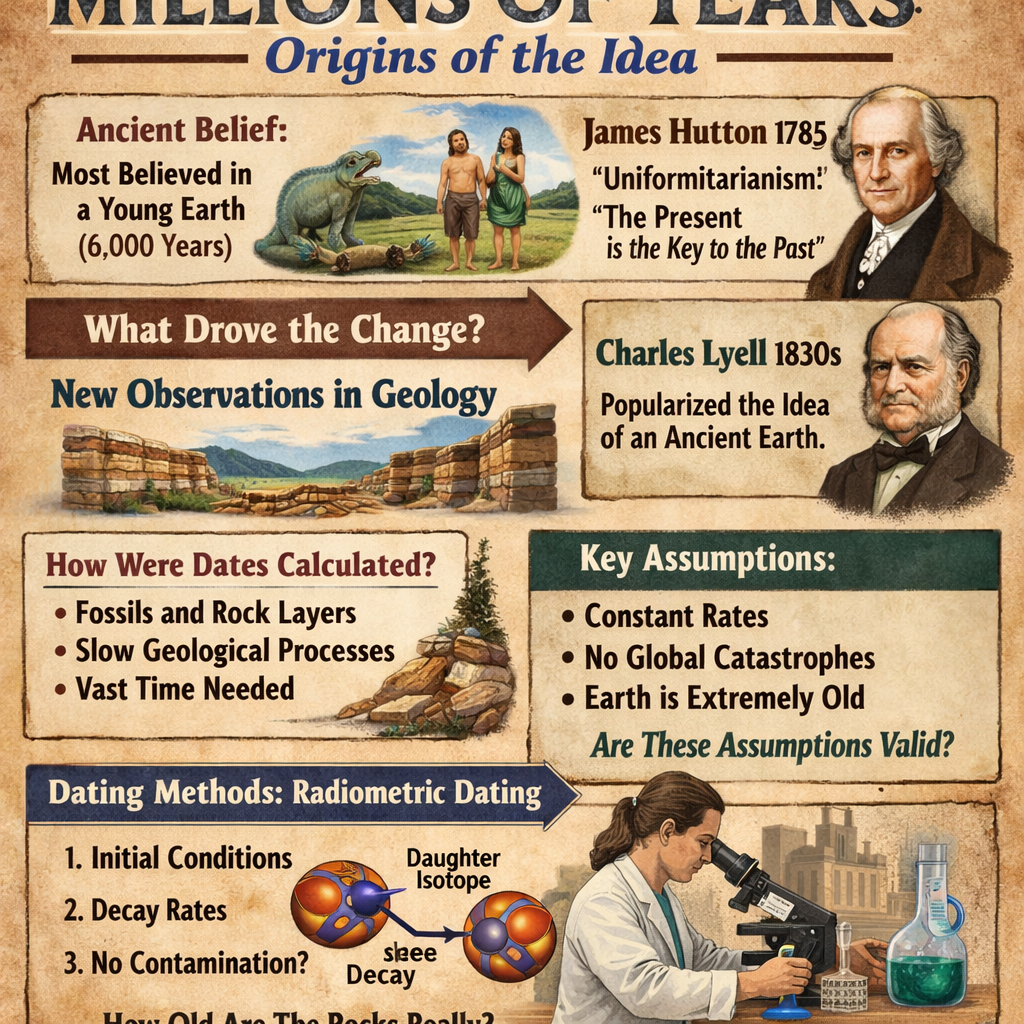
Examining the Assumptions Behind "Deep Time"
Why "Millions of Years" is a House Built on Sand
Examining the Assumptions Behind "Deep Time"
"The earth is 4.5 billion years old. This has been proven by radiometric dating methods. All scientists agree. The evidence is overwhelming."
Dating methods rest on unprovable assumptions. When tested on rocks of known age, they often give wildly wrong results. Evidence for a young earth is suppressed or ignored. The "billions of years" narrative is required for evolution - without it, evolution is impossible.
1. Why do evolutionists need millions of years?
All radiometric dating methods require these assumptions:
| Assumption | Problem |
|---|---|
| Initial conditions | Lava already contains "daughter" products |
| Closed system | Water, heat, pressure can add/remove isotopes |
| Constant decay | Evidence suggests accelerated decay in past |
Dating a rock is like finding an hourglass:
Without knowing these, you can't determine how long it's been running!
1. What three assumptions do all radiometric methods require?
Example: Uranium-238 → Lead-206 (half-life: 4.5 billion years)
| Method | Parent → Daughter | Half-Life | Used For |
|---|---|---|---|
| Carbon-14 | C-14 → N-14 | 5,730 years | Organic material |
| Potassium-Argon | K-40 → Ar-40 | 1.3 billion years | Volcanic rock |
| Uranium-Lead | U-238 → Pb-206 | 4.5 billion years | Igneous rock |
| Rubidium-Strontium | Rb-87 → Sr-87 | 48.8 billion years | Old rocks |
Age = ln(1 + D/P) × t½ / ln(2)
This formula assumes:
1. What is a "half-life"?
| Rock / Event | Known Age | Radiometric "Age" |
|---|---|---|
| Mt. St. Helens lava (1980) | ~10 years | 350,000 - 2.8 million years |
| Mt. Ngauruhoe, NZ (1954) | ~50 years | Up to 3.5 million years |
| Sunset Crater lava (1064 AD) | ~900 years | 270,000 years |
| Hualalai basalt (1800-1801) | ~200 years | 1.6 million - 2.96 billion years |
If the methods fail on rocks of known age, why trust them for unknown ages?
When multiple methods are used on the same rock, they often give wildly different ages:
1. What happened when Mt. St. Helens rocks (10 years old) were dated?
Living organisms absorb C-14 from atmosphere. When they die, C-14 decays. Compare C-14/C-12 ratio to estimate age.
Maximum range: ~50,000 years (after that, too little C-14 remains)
If materials are millions of years old, they should have NO detectable C-14. But C-14 is found in:
This indicates these materials are young - thousands, not millions of years!
1. Why is finding C-14 in coal and diamonds significant?
Potassium-40 (K-40) decays to Argon-40 (Ar-40). Measure ratio to estimate age.
Assumption: All Ar-40 comes from K-40 decay after rock formed.
Rocks can trap argon from the environment ("excess argon"), giving falsely old ages:
| Sample | True Age | K-Ar "Age" |
|---|---|---|
| Mt. St. Helens dacite (1986) | 10 years | 350,000 - 2.8 million years |
| Kilauea basalt (1959) | 0 years | 8.5 million years |
| Mt. Etna basalt (1972) | 0 years | 210,000 - 490,000 years |
1. What is "excess argon" and why is it a problem?
Radioisotopes and the Age of The Earth
An 8-year research project (1997-2005) by credentialed scientists investigating radioactive dating.
Evidence suggests accelerated decay occurred in the past. If decay rates were faster during Creation week and/or the Flood, this would explain:
1. What did the RATE project find regarding helium in zircons?
How do they date fossils?
"By the rocks they're found in."
How do they date the rocks?
"By the fossils in them."
This is circular reasoning!
Certain fossils are used to "date" rock layers:
Problem: These ages were assigned based on evolutionary assumptions BEFORE radiometric dating existed!
1. Explain the circular reasoning in fossil dating:
| Evidence | Maximum Age | Expected if Old |
|---|---|---|
| Salt in oceans | ~62 million years | Much higher concentration |
| Sediment in oceans | ~12 million years | Oceans filled with sediment |
| Erosion of continents | ~10 million years | Continents eroded flat |
| Earth's magnetic field | ~20,000 years | No magnetic field left |
| Moon recession | ~1.5 billion years | Moon touching Earth in past |
| Helium in atmosphere | ~2 million years | Much more helium |
| C-14 in coal/diamonds | ~50,000 years | No C-14 remaining |
1. List three evidences for a young earth:
In 2005, Dr. Mary Schweitzer discovered soft tissue inside a T. rex femur:
This should be impossible if the bones are 65+ million years old!
Proteins and soft tissue cannot last millions of years:
Yet soft tissue has been found in over 100 dinosaur specimens!
1. Why is soft tissue in dinosaur bones evidence for a young earth?
Written human history goes back ~5,000 years. Before that, no records exist.
Question: If humans have been around for 200,000+ years (as claimed), where are the records, cities, and artifacts?
Current world population: ~8 billion
Starting with 8 people (Noah's family) and a very conservative growth rate of 0.5% per year:
Human population data fits biblical timeline, not evolutionary one!
1. How does human population growth support a young earth?
| Event | Years Before Present |
|---|---|
| Creation | ~6,000 years |
| The Flood | ~4,500 years |
| Tower of Babel | ~4,200 years |
| Abraham | ~4,000 years |
| Exodus | ~3,500 years |
Calculated from genealogies in Genesis 5 & 11, plus historical anchors.
1. What will you say when someone claims "science has proven the earth is billions of years old"?