"The voice of Yahuah is upon the waters... Yahuah is upon many waters." - Psalm 29:3
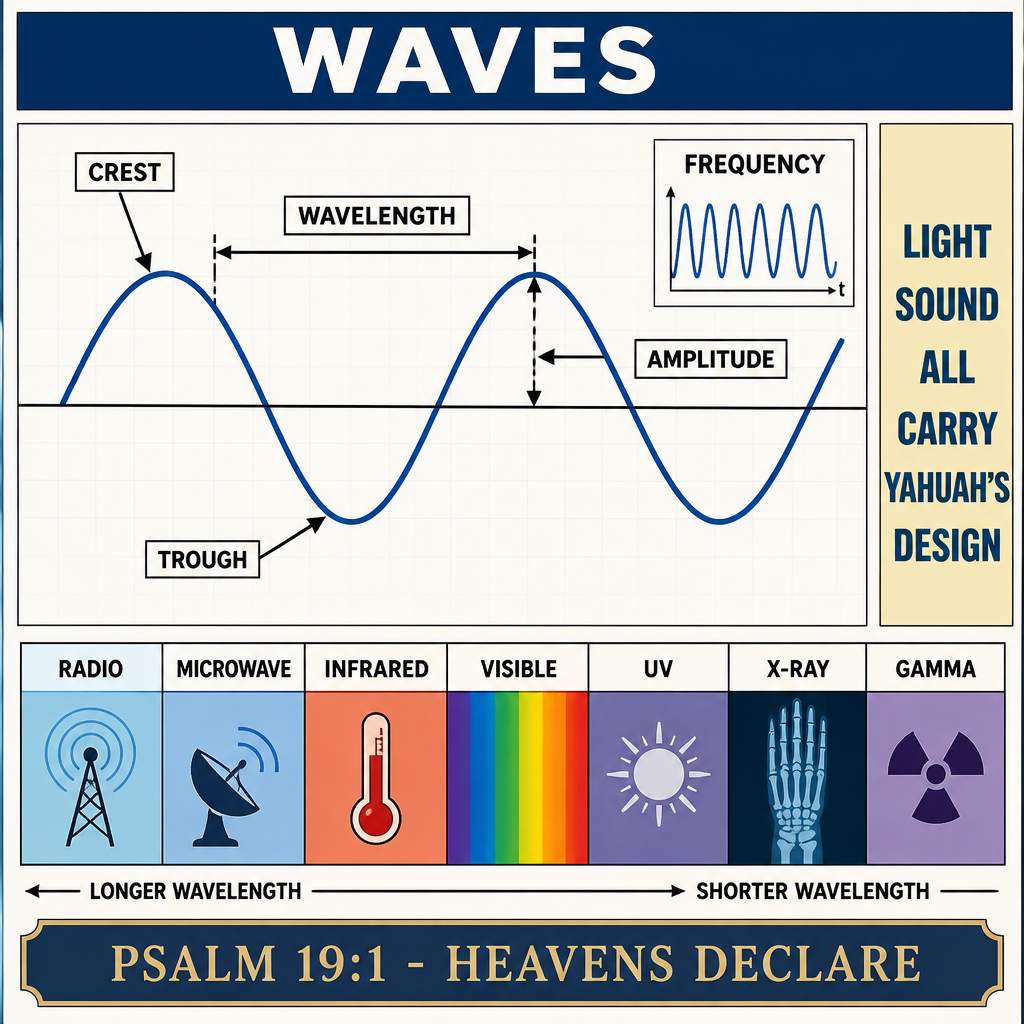
Waves carry energy and information - like Yahuah's voice traveling through creation!
Wave Definition
A wave is a disturbance that transfers energy from one place to another without transferring matter.
Two Types of Waves
Type
Motion
Examples
Transverse
Perpendicular to wave direction
Light, water surface, guitar string
Longitudinal
Parallel to wave direction
Sound, slinky compression
Wave Anatomy
Crest: Highest point
Trough: Lowest point
Amplitude (A): Height from rest to crest
Wavelength (λ): Distance crest to crest
Frequency (f): Waves per second (Hertz, Hz)
Period (T): Time for one wave (T = 1/f)
REFLECT - Questions
1. What do waves transfer?
2. Is sound a transverse or longitudinal wave?
2Wave Properties
RECEIVE - Wave Speed Equation
ADULT Sci Phys Energy
Wave Speed Formula
v = f × λ
Speed = Frequency × Wavelength
Units: m/s = Hz × m
Example Problem
A wave has frequency 500 Hz and wavelength 0.68 m. What is its speed?
v = f × λ
v = 500 Hz × 0.68 m
v = 340 m/s
(This is the speed of sound in air!)
Wave Behaviors
Behavior
Description
Reflection
Wave bounces off surface
Refraction
Wave bends when changing medium
Diffraction
Wave bends around obstacles
Interference
Waves combine (constructive/destructive)
REFLECT - Practice
1. A wave has f = 200 Hz and λ = 1.5 m. Find v.
v = m/s
2. Light travels at 3×10⁸ m/s. If λ = 600 nm (6×10⁻⁷ m), find f.
f = Hz
3Sound Waves
RECEIVE - The Physics of Sound
ADULT Sci Phys Waves
Sound Facts
Sound is a longitudinal mechanical wave
Requires a medium (cannot travel in vacuum)
Speed in air ≈ 343 m/s (at 20°C)
Faster in solids > liquids > gases
Sound Properties
Property
Depends On
Perception
Pitch
Frequency
High/Low
Loudness
Amplitude
Loud/Soft
Quality/Timbre
Wave shape
Different instruments
Doppler Effect
Change in frequency due to relative motion between source and observer.
Approaching: Higher pitch (waves compressed)
Receding: Lower pitch (waves stretched)
Example: Ambulance siren sounds higher when approaching, lower when passing.
"So then faith comes by hearing, and hearing by the word of Elohim." - Romans 10:17
Yahuah designed our ears to receive sound waves - and spiritual truth!
REFLECT - Questions
1. Why can't sound travel in space?
2. What determines the pitch of a sound?
4Light & the Electromagnetic Spectrum
RECEIVE - Electromagnetic Waves
"And Elohim said, Let there be light: and there was light." - Genesis 1:3
Light was the first thing Yahuah spoke into existence!
Properties of Light
Light is a transverse electromagnetic wave
Does NOT require a medium (travels through vacuum)
Speed of light: c = 3 × 10⁸ m/s
Exhibits wave AND particle properties (photons)
Electromagnetic Spectrum
Type
Wavelength
Use
Radio waves
Longest
Broadcasting, communication
Microwaves
↓
Cooking, radar
Infrared
↓
Heat, remote controls
Visible light
400-700 nm
Seeing! (ROYGBIV)
Ultraviolet
↓
Sterilization, tanning
X-rays
↓
Medical imaging
Gamma rays
Shortest
Cancer treatment
All EM waves travel at the speed of light!
REFLECT - Questions
1. What is the speed of light? m/s
2. Which EM waves have the longest wavelength?
5Reflection & Refraction
RECEIVE - How Light Behaves
Law of Reflection
Angle of incidence = Angle of reflection
θᵢ = θᵣ (measured from the normal)
Types of Reflection
Specular: Smooth surface, clear image (mirror)
Diffuse: Rough surface, scattered light (paper)
Snell's Law (Refraction)
n₁ sin θ₁ = n₂ sin θ₂
n = index of refraction (speed of light in vacuum / speed in material)
Index of Refraction Examples
Material
n
Vacuum
1.00
Air
1.0003
Water
1.33
Glass
1.5
Diamond
2.42
REFLECT - Questions
1. If light hits a mirror at 30° from the normal, at what angle does it reflect?
°
6Electric Charge & Force
RECEIVE - Fundamentals of Electricity
Electric Charge
Two types: Positive (+) and Negative (−)
Like charges repel; opposite charges attract
Charge is measured in Coulombs (C)
Electron charge: e = 1.6 × 10⁻¹⁹ C
Charge is conserved (can't be created or destroyed)
Coulomb's Law
F = k(q₁q₂)/r²
k = 9 × 10⁹ N·m²/C²
q₁, q₂ = charges; r = distance between them
Charging Methods
Method
Description
Friction
Rubbing transfers electrons
Conduction
Direct contact transfers charge
Induction
Charge separation without contact
REFLECT - Questions
1. What happens when two positive charges are brought near each other?
2. What is the unit of electric charge?
7Electric Current & Circuits
RECEIVE - Flowing Charge
Electric Current
I = Q/t
Current (Amperes) = Charge (Coulombs) / Time (seconds)
Current Types
Direct Current (DC): Flows in one direction (batteries)
Alternating Current (AC): Changes direction periodically (wall outlets)
Basic Circuit Components
Component
Function
Power source
Provides voltage (battery, outlet)
Conductor
Allows current to flow (wire)
Load/Resistor
Uses electrical energy (bulb, motor)
Switch
Opens/closes circuit
Voltage (Potential Difference)
Voltage (V) is the "push" that moves electrons through a circuit.
Measured in Volts (V)
Like water pressure in a pipe - higher voltage = more push!
REFLECT - Questions
1. If 10 coulombs of charge pass a point in 2 seconds, what is the current?
I = A
8Ohm's Law & Resistance
RECEIVE - The Fundamental Circuit Equation
Ohm's Law
V = I × R
Voltage (V) = Current (A) × Resistance (Ω)
Resistance
Resistance (R) opposes current flow, measured in Ohms (Ω).
Factors affecting resistance:
Material: Conductors (low R) vs. insulators (high R)
Length: Longer = more resistance
Cross-section: Thicker = less resistance
Temperature: Usually increases resistance
Example Problem
A 12V battery powers a circuit with 4Ω resistance. What is the current?
V = IR → I = V/R
I = 12V / 4Ω
I = 3 A
Electric Power
P = IV = I²R = V²/R
Power (Watts) = Voltage × Current
REFLECT - Practice
1. A circuit has V = 9V and R = 3Ω. Find I.
I = A
2. A device uses 2A of current at 120V. What is the power?
P = W
9Series & Parallel Circuits
RECEIVE - Circuit Configurations
Series Circuits
Components connected in a single path
Current: Same through all components (I = I₁ = I₂)
Voltage: Divided among components (V = V₁ + V₂)
Resistance: R_total = R₁ + R₂ + R₃...
If one component fails, circuit breaks
Parallel Circuits
Components connected in separate branches
Voltage: Same across all branches (V = V₁ = V₂)
Current: Divided among branches (I = I₁ + I₂)
Resistance: 1/R_total = 1/R₁ + 1/R₂ + 1/R₃...
If one component fails, others still work
Example: Series Circuit
Three resistors (2Ω, 3Ω, 5Ω) in series with 20V battery.
R_total = 2 + 3 + 5 = 10Ω
I = V/R = 20V/10Ω = 2A
REFLECT - Practice
1. Two resistors (6Ω and 12Ω) are in series. Find total resistance.
R_total = Ω
2. In a parallel circuit, voltage across each branch is (same/different)?
10Magnetism
RECEIVE - Magnetic Forces
Magnetic Properties
Magnets have two poles: North (N) and South (S)
Like poles repel; opposite poles attract
Cannot isolate a single pole (break magnet → two smaller magnets)
Magnetic field lines flow from N to S outside magnet
Types of Magnetic Materials
Type
Description
Example
Ferromagnetic
Strongly attracted
Iron, nickel, cobalt
Paramagnetic
Weakly attracted
Aluminum, platinum
Diamagnetic
Weakly repelled
Copper, water
Earth's Magnetic Field
Earth acts like a giant magnet with a magnetic field that:
Allows compass navigation
Protects from solar radiation
Magnetic North ≠ Geographic North
"He stretches out the north over the empty place, and hangs the earth upon nothing." - Job 26:7
Yahuah designed Earth's magnetic field to protect and guide us!
REFLECT - Questions
1. What happens when you bring two north poles together?
11Electromagnetism
RECEIVE - Electricity and Magnetism United
The Connection
Moving charges create magnetic fields (current → magnetism)
Changing magnetic fields create electric current (magnetism → current)
Discovered by Faraday, Oersted, and others
Electromagnet
A coil of wire with current flowing through it creates a magnetic field.
Strength increases with more coils
Strength increases with more current
Iron core increases strength dramatically
Can be turned on/off (unlike permanent magnets)
Applications
Device
Principle
Electric motor
Current in magnetic field → rotation
Generator
Rotation in magnetic field → current
Transformer
Changes voltage using magnetic coupling
Speaker
Electromagnet moves cone
REFLECT - Questions
1. What creates a magnetic field around a wire?
2. How does a generator work?
12Design in Physics
RECEIVE - The Lawgiver Behind the Laws
"The heavens declare the glory of El; and the firmament shows His handiwork." - Psalm 19:1
Evidence of Design in Physics
Phenomenon
Design Evidence
Physical Constants
Precisely tuned for life (fine-tuning)
Mathematical Order
Laws are elegant, consistent, universal
EM Spectrum
Our eyes tuned to sun's peak output
Earth's Magnetism
Shields life from harmful radiation
Wave Properties
Enable communication, vision, hearing
The Fine-Tuning Argument
Physical constants are precisely balanced for life:
Change gravity slightly → stars won't form or burn too fast
Change electromagnetic force → atoms won't bond properly
Change strong nuclear force → no stable elements
Conclusion: Laws require a Lawgiver. Physics points to Yahuah!
RESPOND - Final Reflection
1. How does the study of physics strengthen your faith in Yahuah as Creator?
Answer Key
Unit 1: 1) Energy; 2) Longitudinal
Unit 2: 1) 300 m/s; 2) 5×10¹⁴ Hz
Unit 3: 1) No medium/vacuum; 2) Frequency
Unit 4: 1) 3×10⁸ m/s; 2) Radio waves
Unit 5: 1) 30°
Unit 6: 1) Repel; 2) Coulomb
Unit 7: 1) 5 A
Unit 8: 1) 3 A; 2) 240 W
Unit 9: 1) 18 Ω; 2) Same
Unit 10: 1) Repel
Unit 11: 1) Electric current; 2) Rotation in magnetic field creates current