Companion Resource for Truth Carriers Academy Workbooks
For Instructors, Parents & Study Leaders
Teaching method
Introduction: How to Use This Guide
This Teacher's Guide is designed to help instructors, parents, and study group leaders maximize the effectiveness of the Truth Carriers Academy workbook curriculum. Whether you're teaching a home school class, leading a congregation study, or facilitating a small group, this guide provides:
Discussion Prompts - Open-ended questions to spark deeper conversations
Teaching Tips - Strategies for presenting sensitive or complex material
Group Activities - Hands-on learning experiences for all ages
Additional Resources - Books, documentaries, and websites for further study
Assessment Ideas - Ways to measure understanding beyond fill-in-the-blank
Common Questions - Anticipated student questions with suggested responses
Teaching Tip: The 6Rs method (Receive, Reflect, Recall, Recite, Review, Respond) is built into each workbook. As a teacher, your role is to facilitate the "Recite" and "Respond" stages through discussion and practical application.
Workbooks: Sabbath Deep Dive, Sacred Names, Clean Foods, Biblical Feasts
Sabbath Deep Dive
Discussion Prompts
"If the Sabbath was created at Creation (Genesis 2:2-3), why do most churches worship on Sunday?"
"What does it mean that the Sabbath is a 'sign' between Yahuah and His people? What other 'signs' identify believers?"
"How did Yahusha (Jesus) keep the Sabbath? Did He break it or did He break man-made traditions ABOUT it?"
"Constantine changed the day of worship in 321 AD. What authority did he have to do this?"
"Isaiah 66:23 says we'll keep Sabbath in the New Earth. Why would we keep something 'done away with' for eternity?"
Group Activities
Sabbath Experience: Have the group actually keep a Sabbath together - from Friday sunset to Saturday sunset. Prepare food ahead, avoid work, study Scripture, and fellowship.
Calendar Research: Show students how calendars work - that the 7-day week has never changed, only dates were skipped in 1582.
Timeline Creation: Create a visual timeline from Creation → Sinai → Yahusha → Constantine → Today showing Sabbath observance.
Additional Resources
Book: "The Sabbath" by Abraham Joshua Heschel
Documentary: "The Seventh Day" (search online)
Website: 119Ministries.com - Sabbath teaching series
Primary Source: Constantine's Sunday Law of 321 AD (easily found online)
Sacred Names
Discussion Prompts
"Why does the third commandment say 'do not take His name in VAIN' - and what does 'in vain' really mean?"
"The Hebrew text has YHWH (יהוה) over 6,800 times. Why did translators replace it with 'LORD'?"
"If you had a friend named 'John' but everyone called him 'Bob,' would that change who he is? Is it the same with Yahuah's name?"
"What is the difference between a TITLE (Lord, God) and a NAME (Yahuah, Yahusha)?"
Teaching Tip: This topic can be sensitive for those raised with traditional names. Emphasize that we're not judging anyone's salvation - we're pursuing truth and honoring the Father's actual name as Scripture commands.
Group Activities
Hebrew Letters: Learn to write יהוה (YHWH) in Hebrew. Discuss why vowels weren't originally written.
Bible Comparison: Compare the same verse in KJV, Hebrew Roots Bible, and The Scriptures to see the name differences.
Etymology Study: Research where the word "God" comes from (Germanic "Gott" - used for pagan deities).
Clean & Unclean Foods
Discussion Prompts
"Noah knew clean from unclean animals BEFORE the Law was given at Sinai (Genesis 7:2). What does this tell us?"
"In Acts 10, Peter's vision was about PEOPLE, not food. Why is it commonly taught as permission to eat pork?"
"If Yahuah designed pigs as 'garbage disposals' for the earth, why would He want us to eat them?"
"Modern science confirms shellfish accumulate toxins. Did Yahuah know something scientists only recently discovered?"
Sensitive Topic Alert
Food can be deeply tied to family traditions and culture. Approach with grace. Emphasize that this is about honoring Yahuah's design for our bodies, not earning salvation. Some students may have family members who disagree - equip them to respond respectfully.
Group Activities
Clean Food Feast: Prepare a meal together using ONLY Leviticus 11-approved ingredients.
Label Reading: Go through common grocery items and identify hidden unclean ingredients (gelatin, lard, etc.).
Scientific Research: Research pig parasites (trichinosis) and shellfish toxin accumulation.
Biblical Feasts (Moedim)
Discussion Prompts
"Leviticus 23:2 calls them 'MY feasts' (Yahuah's), not 'Jewish feasts.' What's the significance?"
"Yahusha fulfilled Passover, Unleavened Bread, Firstfruits, and Pentecost on the EXACT days. Coincidence?"
"If the fall feasts picture the Second Coming, shouldn't believers know WHEN they occur?"
"Christmas and Easter are not in Scripture. The Feasts ARE. Why do most churches observe the former but not the latter?"
Prophetic Chart: Create a visual showing how each feast pictures something Yahusha did/will do.
Origin Research: Research the pagan origins of Christmas (Saturnalia) and Easter (Ishtar/Ostara).
BIBLICAL COSMOLOGY
Workbooks: Firmament Deep Dive, Fixed Earth, Flood & Cosmology, Sun/Moon/Stars
Teaching Tip: This is perhaps the most controversial topic area. Students will face significant pushback. Equip them to handle it gracefully. Emphasize: "We believe what Scripture SAYS, not what modern science TELLS us Scripture must mean."
The Firmament
Discussion Prompts
"Genesis 1:6-8 describes a 'firmament' (raqia) - something SOLID separating waters. What did Moses understand this to mean?"
"If the firmament is just 'atmosphere,' why does it have 'windows' that can open (Genesis 7:11)?"
"Job 37:18 says the sky is 'strong as a molten looking glass.' Is atmosphere strong? Is it like a mirror?"
"Yahuah's throne is ABOVE the firmament (Ezekiel 1:26). Where exactly is His throne in the modern model?"
Group Activities
Hebrew Word Study: Look up "raqia" in Strong's Concordance. Discuss its root meaning (to hammer out, spread thin - like metal).
Model Building: Create a physical model of the biblical cosmos - dome firmament, waters above, pillared earth.
Ancient Sources: Research what ancient Hebrews, Egyptians, and Babylonians believed about the sky structure.
Fixed Earth (Geocentrism)
Discussion Prompts
"1 Chronicles 16:30 says the earth 'cannot be moved.' Psalm 93:1 says it's 'established, it cannot be moved.' Is Scripture wrong, or is our model wrong?"
"Joshua commanded the SUN to stand still (Joshua 10:12-13), not the earth to stop spinning. Was Joshua scientifically ignorant?"
"The Michelson-Morley experiment (1887) failed to detect earth's motion. Why is this rarely taught?"
"If we're spinning at 1,000 mph and orbiting at 67,000 mph and spiraling through the galaxy at 500,000 mph, why can't we feel or measure any of it?"
Handling Pushback
Students WILL face ridicule. Prepare them with:
"I believe what Scripture says over what man says."
"The same scientific establishment also teaches evolution. Why trust them on this but not that?"
"I'm not asking you to agree - just to consider why Scripture consistently describes a stationary earth."
Additional Resources
Documentary: "The Principle" (2014) - discusses geocentrism from scientific perspective
Workbooks: Evolution Destroyed, Space Program Anomalies, Flood Geology
Evolution Destroyed
Discussion Prompts
"Evolution requires BILLIONS of years. If the earth is young (6,000-10,000 years), is evolution even possible?"
"The second law of thermodynamics says everything tends toward disorder. How does evolution claim order increases?"
"No transitional fossils have ever been conclusively found. Why is evolution taught as fact?"
"If we evolved from apes, why are there still apes? And why no creatures 'currently evolving' between species?"
"Charles Darwin was not a scientist but a theologian who lost his faith. Does that matter?"
Group Activities
Probability Math: Calculate the probability of a single protein forming by chance. (Answer: Mathematically impossible)
Fossil Study: Research the "Cambrian Explosion" - sudden appearance of complex life with no ancestors.
Debate Practice: Have students practice responding to common evolutionist arguments.
Additional Resources
Documentary: "Evolution's Achilles' Heels"
Website: Creation.com, ICR.org (Institute for Creation Research)
Book: "Darwin's Black Box" by Michael Behe
Space Program Anomalies
Discussion Prompts
"Why has no country returned to the moon in 50+ years despite vastly better technology?"
"Why do ISS videos sometimes show anomalies (bubbles, harnesses, green screen glitches)?"
"Why does NASA's budget continue growing if they already 'proved' their claims decades ago?"
"Operation Paperclip brought Nazi scientists to run NASA. Does that affect credibility?"
Teaching Tip: Focus on ASKING QUESTIONS rather than making definitive claims. The goal is critical thinking, not absolute conclusions about complex topics.
TRUE HISTORY
Workbooks: Federal Reserve, Secret Societies, Christian Foundations of America, Hidden History
Federal Reserve & Banking
Discussion Prompts
"The Federal Reserve is not federal and has no reserves. Why is it called that?"
"Proverbs 22:7 says 'the borrower is servant to the lender.' How does the national debt make America a servant?"
"Money is created as DEBT. If all debt were paid, there would be no money. Is this system biblical?"
"Why did the Constitution say only gold and silver should be money (Article 1, Section 10)?"
"Deuteronomy 25:15 commands 'honest weights and measures.' How does inflation violate this?"
Group Activities
Debt Calculator: Visit USDebtClock.org and calculate each family's "share" of the national debt.
Inflation Exercise: Compare what $100 bought in 1913 vs today using an inflation calculator.
Fractional Reserve Demo: Use play money to demonstrate how $100 becomes $1,000 through lending.
Additional Resources
Book: "The Creature from Jekyll Island" by G. Edward Griffin
Primary Source: Jekyll Island meeting documentation
Secret Societies
Discussion Prompts
"Why do secret societies exist if their purposes are good? Yahusha said 'I spoke openly to the world' (John 18:20)."
"Many Founding Fathers were Freemasons. Does that change how we view America's founding?"
"Ephesians 5:11 says 'have no fellowship with the unfruitful works of darkness.' Can a believer be in a secret society?"
"Why do Masonic symbols appear on money, buildings, and corporate logos?"
Sensitive Topic Alert
Some students may have family members who are Freemasons or in other societies. Approach with facts, not attacks. Focus on what these organizations TEACH rather than attacking individuals who may be unaware of deeper meanings.
SUPERNATURAL & END TIMES
Workbooks: Giants/Nephilim, Great Deception, Mark of the Beast, Rise of Antichrist
Giants & Nephilim
Discussion Prompts
"Genesis 6:4 says giants existed. Numbers 13:33 says the spies saw them. Was Scripture lying?"
"If the Nephilim were just 'tall humans,' why were they completely destroyed by the flood and later by Israel?"
"The Book of Enoch isn't canon, but Jude quotes it. How should we approach non-canonical ancient texts?"
"Why did Yahuah command the complete destruction of certain Canaanite cities - men, women, and children?"
Key Passages: Genesis 6:1-4, Numbers 13:33, Deuteronomy 3:11 (Og's bed), 1 Samuel 17 (Goliath), 2 Samuel 21:15-22 (Goliath's relatives)
Group Activities
Height Comparison: Use tape to mark 9+ feet on a wall (Goliath's height). Have students stand next to it.
Bed Size: Measure out Og's bed dimensions (13 feet × 6 feet) on the floor.
Scripture Survey: Find every mention of giants in the Bible and map their locations.
Mark of the Beast Technology
Discussion Prompts
"Revelation 13:16-17 describes a mark needed to buy or sell. What technology could make this possible?"
"Microchip implants, digital IDs, and CBDCs (Central Bank Digital Currencies) are becoming reality. Coincidence?"
"The mark is received by choice. What deceptions might lead people to accept it willingly?"
"If you couldn't buy food without the mark, what would you do? How can we prepare?"
Teaching Tip: Balance urgency with hope. The goal is preparation and discernment, not fear. Emphasize that those who trust in Yahuah will be protected (Psalm 91).
The Great Deception
Discussion Prompts
"2 Thessalonians 2:11 says Yahuah will send 'strong delusion.' What might this deception look like?"
"If 'aliens' appeared tomorrow and claimed to have seeded life on earth, how would the world respond?"
"Fallen angels (demons) can appear as 'angels of light' (2 Corinthians 11:14). Could they pose as extraterrestrials?"
"Hollywood has been preparing the public for alien contact for decades. Why?"
HEALTH & PLANT MEDICINE
Workbooks: Plant Medicine Foundations, Pharmakeia Exposed, Medical Freedom
Plant Medicine & Biblical Healing
Discussion Prompts
"Genesis 1:29 says plants were given for food. Ezekiel 47:12 says leaves are for healing. Why don't doctors prescribe plants?"
"The word 'pharmacy' comes from the Greek 'pharmakeia' - translated 'sorcery' or 'witchcraft' in Scripture. Why?"
"Revelation 18:23 says Babylon deceives nations by 'sorcery' (pharmakeia). What is this warning about?"
"Why is the medical industry the 3rd leading cause of death in America (iatrogenic deaths)?"
Group Activities
Herb Garden: Plant a small medicinal herb garden (lavender, peppermint, chamomile, echinacea).
Tea Making: Learn to make medicinal teas for common ailments.
Research Project: Study what herbs were used in biblical times and their properties.
Important Disclaimer
This curriculum is for educational purposes. Always consult qualified healthcare providers for medical decisions. The goal is INFORMED CONSENT and understanding options, not replacing all modern medicine.
Additional Resources
Book: "Prescription for Nutritional Healing" by Phyllis Balch
Book: "The Green Pharmacy" by James A. Duke
Reference: "Healing Herbs of the Bible" by various authors
PRACTICAL SKILLS
Workbooks: Biblical Financial Freedom, Christian Homesteading
Biblical Financial Freedom
Discussion Prompts
"Romans 13:8 says 'Owe no man anything.' Is ALL debt sin, or just unmanageable debt?"
"Why does Scripture speak so often about money (more than 2,000 verses)?"
"The Jubilee Year cancelled all debts every 50 years. What would happen if we did this today?"
"Matthew 6:24 says you cannot serve Yahuah and mammon. What does 'serving money' look like?"
Group Activities
Budget Workshop: Create a biblical budget using the 10-10-80 principle (10% tithe, 10% savings, 80% living).
Debt Snowball: Learn and practice the debt payoff method.
Needs vs Wants: Sort common purchases into "needs" and "wants" categories.
Christian Homesteading
Discussion Prompts
"Why did Yahuah give Adam a garden to tend? What is the spiritual significance of working the land?"
"Proverbs 31 describes a woman who plants vineyards and provides food. How does modern life compare?"
"If the supply chain failed, could your family survive? What skills have we lost?"
"What does 'Come out of Babylon' (Revelation 18:4) look like practically?"
Group Activities
Gardening: Start a community garden project.
Preservation: Learn canning, dehydrating, or fermenting.
Skills Inventory: Have each family list skills they could teach/share with others.
WEEKLY SCHEDULE TEMPLATES
Plug-and-play schedules that layer the 6Rs (Receive, Reflect, Recall, Recite, Review, Respond) across a term. Map each row to your specific workbook lessons.
10-Week Track (1 lesson per week)
Good for congregations or small groups meeting once weekly. Use the at-home column for family follow-up.
Week
In-Session Focus
At-Home Reinforcement
1
Orientation + Lesson 1 (Receive + Reflect MC/T-F)
Read again with family; start Respond action; short prayer using sacred names
2
Lesson 2 (Receive) + small-group Reflect; begin Recall sketch/outline
Complete Recall; parent/peer Recite (teach-back)
3
Lesson 3 (Receive/Reflect) + quick Review of Week 1 memory
Family discussion using Reflect questions; simple project step
5
Lesson 5 + Review (Weeks 1–3) spaced check
Recall drawing/summary; prepare one objection/answer
6
Lesson 6 + skill/activity block
Respond action; memorize 2nd verse; practice Recite
7
Lesson 7 + case study discussion
Family role-play; short written reflection
8
Lesson 8 + Review (Weeks 4–6)
Recall chart/graphic; prepare final project idea
9
Lesson 9 + project work time + Recite check-ins
Finish project; parent sign-off on Respond task
10
Lesson 10 + capstone Recite + celebration
Final Review; testimonies; plan next steps/obedience
12-Week Track (two short sessions per week)
Split each lesson into two touchpoints: Session A (Receive/Reflect) and Session B (Recall/Respond/Review).
Week
Session A (45–60 min)
Session B (30–45 min)
1
Orientation + Lesson 1 Receive; Reflect MC/T-F
Recall draw/outline; Respond action step; pray together
2
Lesson 2 Receive + Reflect
Recite (pair teach-back); Review key verses 1–2
3
Lesson 3 Receive + Reflect
Recall; Respond; spaced Review (Lesson 1)
4
Lesson 4 Receive + discussion
Recite; Respond; Review (Lessons 1–2)
5
Lesson 5 Receive + activity
Recall; Respond; Review (Lesson 3)
6
Lesson 6 Receive + Reflect
Recite; Review (Lessons 1–4)
7
Lesson 7 Receive + case study
Recall; Respond; Review (Lesson 5)
8
Lesson 8 Receive + Reflect
Recite; Review (Lessons 6–7)
9
Lesson 9 Receive + discussion
Recall; Respond; Review (Lessons 1–8)
10
Lesson 10 Receive + project planning
Recite; project work time; Review (Lessons 3–9)
11
Project work / Q&A
Recite rehearsal; Review (all)
12
Capstone presentations
Celebration; testimonies; next-step commitments
Single-Week Lesson Flow (daily prompts)
Use this for home-school rhythm or to guide parents between meetings.
Day
Focus
Notes
Day 1
Receive: read lesson + key Scriptures aloud
Highlight sacred names; preview Reflect questions
Day 2
Reflect: MC + T/F; discuss 1 open-ended question
Record one “aha” moment
Day 3
Recall: close-book summary or drawing
Encourage independent effort first
Day 4
Recite: teach-back to parent/peer
2–3 minutes; gentle feedback
Day 5
Respond: do the action step + short prayer
Log completion; share gratitude
Day 6
Review: revisit key verse + 3 quick questions
Spaced repetition; prep for next lesson
Day 7
Rest/Reflect: family conversation or nature walk
Celebrate obedience; preview next topic
Prep Checklist (each week)
Skim upcoming lesson; flag any sensitive points and Scriptures to anchor the discussion.
Prepare one activity (hands-on or visual) and one question for Recite practice.
Set a Review plan: 3 quick questions + 1 memory verse check.
Plan a simple Respond action that is safe, doable, and measurable.
Children's Tier (4Rs) Weekly Schedule
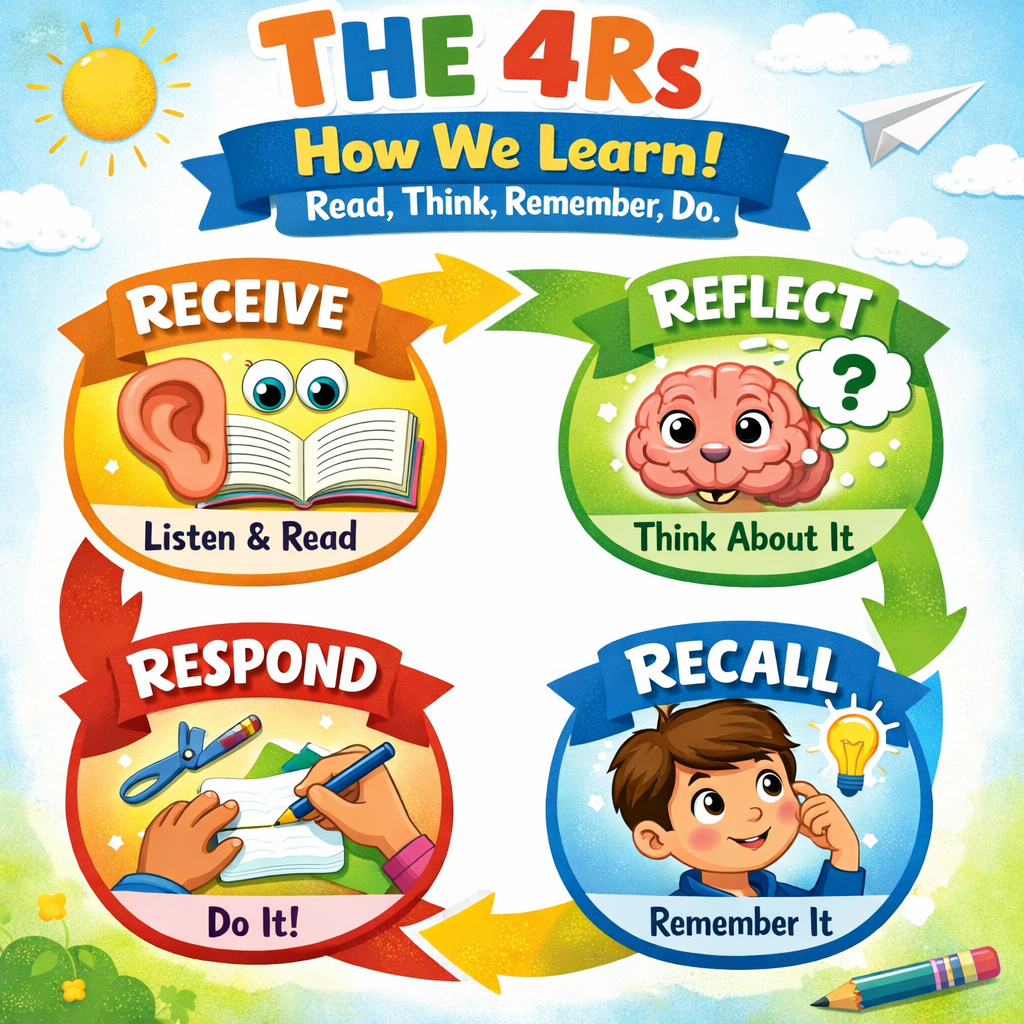
Simplified schedule for ages 5-10 using the 4Rs method: Receive, Reflect, Recall, Respond.
Week
Session Focus (30-45 min)
Home Activity
1
Lesson 1: Receive story + Reflect (2 MC, 2 T/F)
Color picture; tell story to family member
2
Lesson 2: Receive + simple matching game
Draw what you learned; sing memory verse
3
Lesson 3: Receive + Recall (draw the story)
Respond action with parent help
4
Lesson 4: Receive + group activity
Review Lessons 1-3 with picture cards
5
Lesson 5: Receive + Reflect questions
Simple craft project related to lesson
6
Lesson 6: Receive + song or rhyme
Teach song to sibling or parent
7
Lesson 7: Receive + role play
Act out story with family
8
Lesson 8: Receive + Review game (Lessons 1-7)
Draw favorite lesson; explain why
9
Lesson 9: Receive + simple project
Complete project with parent
10
Lesson 10: Celebrate! Review + share drawings
Receive certificate; share with family
Teaching Tip: Young children learn through repetition, songs, movement, and hands-on activities. Keep sessions short (30-45 min max), use lots of visuals, and celebrate every success!
Full Semester Planning Grid
Use this template to plan an entire semester covering multiple workbooks. Fill in workbook names and start dates.
Month
Workbook / Topic
Lessons
Special Events
Month 1
________________________
1-4
Orientation; Parent Night
Month 2
________________________
5-10
Mid-topic assessment
Month 3
________________________
1-5
Field trip / Guest speaker
Month 4
________________________
6-10
Project presentations
Month 5
________________________
1-5
Review week
Month 6
________________________
6-10
Semester celebration
Suggested Yearly Flow
Fall Semester: Torah Foundations (Sabbath, Feasts, Sacred Names) - aligns with Fall Feasts
Winter: True History or Biblical Cosmology - indoor study topics
Spring Semester: Plant Medicine, Homesteading - garden season preparation
Summer: Practical Skills intensive or lighter review
Sample Filled Lesson Plan: Sabbath Deep Dive Week 1
Example of how to use the weekly schedule with a specific workbook.
LESSON PLAN: Sabbath Deep Dive - Lesson 1
Topic:
The Sabbath at Creation (Genesis 2:1-3)
Duration:
60 minutes in-session + home assignments
Materials:
Workbooks, Bibles, calendar visual, whiteboard
Memory Verse:
"And Elohim blessed the seventh day, and set it apart, because on it He rested..." - Genesis 2:3
Time
Activity
Notes
0-5 min
Opening Prayer using sacred names
Set reverent tone; use Yahuah
5-20 min
RECEIVE: Read Lesson 1 aloud together
Pause for questions; highlight key points
20-35 min
REFLECT: Complete MC, T/F, Fill-in-blank
Work individually then discuss answers
35-45 min
Discussion: "Why did Yahuah rest if He doesn't get tired?"
Use discussion prompts from this guide
45-55 min
Activity: Create 7-day creation timeline
Visual showing Sabbath as the crown
55-60 min
Closing: Preview home assignment; closing prayer
Assign memory verse and Respond action
Home Assignment (Week 1)
RECALL: Draw the 7 days of creation with Sabbath highlighted
RECITE: Explain to a family member why Day 7 is special
RESPOND: Plan how your family will honor the NEXT Sabbath differently
Memory: Memorize Genesis 2:3
PROGRESS TRACKING SHEETS
Use these templates to monitor student growth across the 6Rs (or 4Rs for children).
Individual Student Progress Tracker
Print one per student per workbook. Mark completion dates and quality ratings.
Track when each lesson was reviewed to ensure long-term retention.
Lesson
Completed
Day 1 Review
Day 3 Review
Day 7 Review
Day 21 Review
Day 60 Review
1
____/____
□
□
□
□
□
2
____/____
□
□
□
□
□
3
____/____
□
□
□
□
□
4
____/____
□
□
□
□
□
5
____/____
□
□
□
□
□
6
____/____
□
□
□
□
□
7
____/____
□
□
□
□
□
8
____/____
□
□
□
□
□
9
____/____
□
□
□
□
□
10
____/____
□
□
□
□
□
Scripture Memory Log
Track key verses memorized across all workbooks.
Workbook
Verse Reference
Date Memorized
Last Reviewed
Respond Action Tracker
Monitor practical application and lifestyle changes.
Lesson/Topic
Action Committed
Status
Parent Sign-off
□ Started □ Ongoing □ Complete
□ Started □ Ongoing □ Complete
□ Started □ Ongoing □ Complete
□ Started □ Ongoing □ Complete
□ Started □ Ongoing □ Complete
□ Started □ Ongoing □ Complete
Teaching Tip: The Respond tracker is the most important! Transformation happens when truth moves from head to heart to hands. Celebrate every action step taken, no matter how small.
ASSESSMENT STRATEGIES
Beyond the workbook exercises, use these methods to gauge true understanding:
Teaching Tip: True assessment is TRANSFORMATION, not information. Is the student's LIFE changing? Are they keeping Sabbath? Using sacred names? Making better choices? These matter more than test scores.
HANDLING SENSITIVE TOPICS
General Principles
Lead with Scripture - Let the Word speak first, then support with evidence.
Show Grace - Students may have family who believe differently. Don't attack people, address ideas.
Acknowledge Uncertainty - On some topics (cosmology, end times details), we can say "Scripture seems to indicate..." rather than absolute claims.
Prepare for Pushback - Students will face opposition. Equip them with responses, not just information.
Focus on Application - Why does this matter for daily life? Keep it practical.
When Students Face Opposition
Response Training
Teach students these frameworks:
"I believe what Scripture says" - Simple, non-argumentative
"I'd rather be wrong with Scripture than right with the world" - Shows priorities
"What if we're both wrong? Let's study together" - Opens dialogue
"That's a good question - let me research and get back to you" - Honest humility
When You Don't Know the Answer
It's okay to say:
"I don't know, but let's find out together."
"That's beyond the scope of this lesson, but here's a resource to explore."
"Scripture doesn't give us a clear answer on that specific question."
Final Encouragement
"And the things that you have heard from me among many witnesses, commit these to faithful men who will be able to teach others also."
— 2 Timothy 2:2
You are part of a chain of truth-passing that goes back to the apostles themselves. The enemy has worked hard to obscure these truths for centuries. By teaching them faithfully, you are participating in the restoration of all things that Scripture promises (Acts 3:21).
May Yahuah bless your teaching, give you wisdom beyond your own, and bring forth much fruit through your faithfulness.
"The fear of Yahuah is the beginning of wisdom, and the knowledge of the Holy One is understanding."
— Proverbs 9:10