Biblical Clean & Unclean Food Laws
Torah Foundations Series | Truth Carriers Academy
Student Name:
Date Started:
HOW TO USE THIS WORKBOOK
The Truth Carriers Learning Method (6 Rs)
RECEIVE (read), REFLECT (answer questions), RECALL (close book, write from memory), RECITE (teach someone), REVIEW (spaced repetition), RESPOND (apply practically).
"Whether therefore ye eat, or drink, or whatsoever ye do, do all to the glory of Elohim." — 1 Corinthians 10:31
ABOUT THIS WORKBOOK
Introduction: This workbook examines one of the most controversial topics in modern Christianity: biblical dietary laws. For 1,500+ years, most Christians dismissed Leviticus 11 and Deuteronomy 14 as "abolished" or "fulfilled" by Yahusha's death and resurrection. But what if the entire church has misunderstood key passages like Mark 7, Acts 10, and Romans 14? What if the apostles NEVER stopped observing food laws—and the shift happened later due to political pressure, not biblical teaching? This workbook will challenge everything you've been taught about "all things made clean."
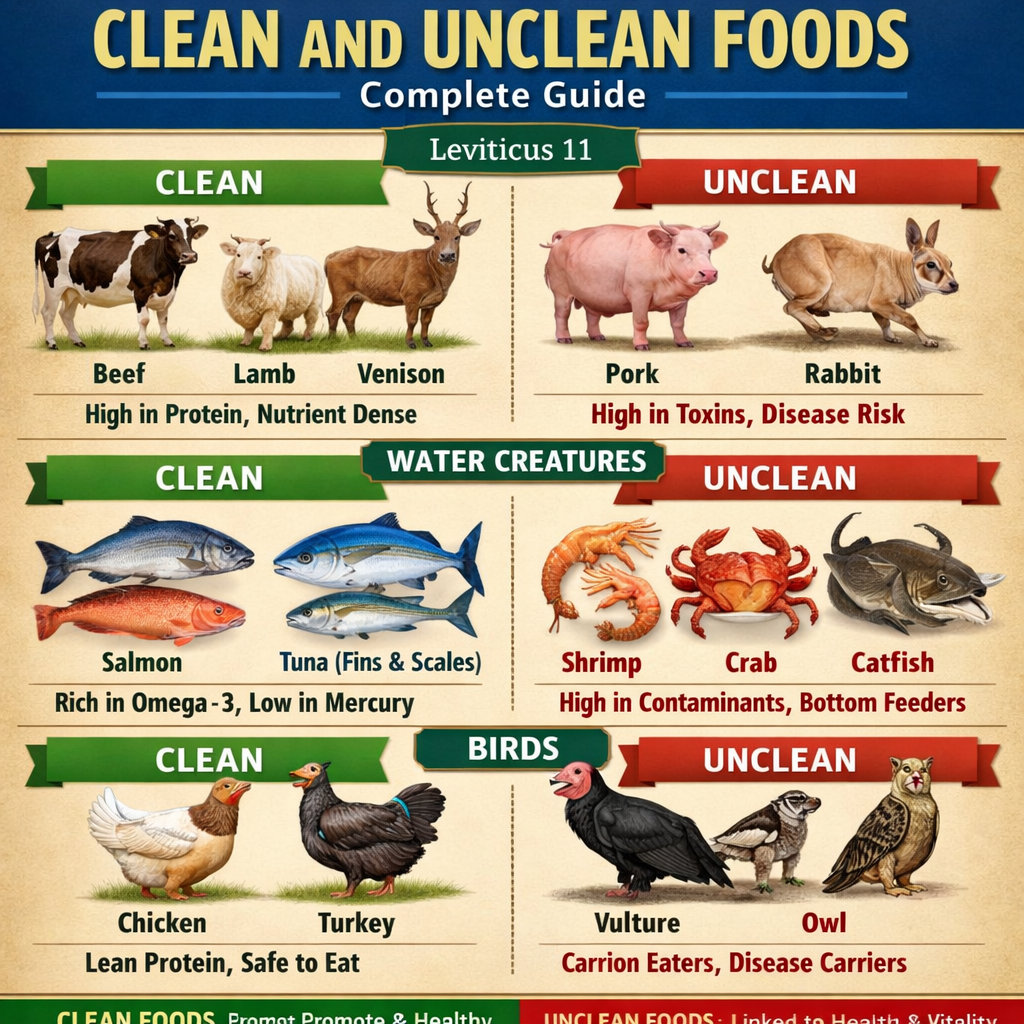
Complete Guide to Clean and Unclean Foods According to Leviticus 11
What You Will Learn:
- Leviticus 11 Classification System: Land animals must have BOTH split hoof AND chew cud (pig fails); water creatures need fins AND scales (all shellfish unclean = "sheqets"/abomination); 20 unclean birds (all predators/scavengers); 4 permitted insects (locust, katydid, cricket, grasshopper)
- Deuteronomy 14 Identity Context: Food laws follow identity declaration ("am qadosh" = holy people, "segullah" = treasured possession); we don't EARN holiness through diet—we MAINTAIN our already-given holy status through obedience
- Scientific Validation - Pork: Trichinella spiralis (10,000 cases annually); Taenia solium tapeworm causes neurocysticercosis (30-70% of epilepsy cases in endemic areas); Hepatitis E virus (73% of Spanish pigs); Yersinia enterocolitica (117,000 U.S. illnesses/year)
- Scientific Validation - Shellfish: Vibrio vulnificus (95% of seafood deaths, 50%+ mortality rate); Paralytic Shellfish Poisoning (1,000x more toxic than cyanide, NO antidote, cooking does NOT destroy); heavy metal bioaccumulation; Norovirus (76% of UK oysters)
- Mark 7 Examined: Dispute was about eating BREAD with unwashed hands (Pharisee tradition, NOT Torah command); NO unclean animal mentioned; Matthew 15:20 parallel explicitly states issue was "unwashed hands"
- Acts 10 Examined: Peter NEVER ate the vision animals; Peter stated "never eaten anything unclean" 10+ years AFTER resurrection; Peter himself interpreted vision as about GENTILES ("any person"), not food
- Greek Grammar Analysis: Mark 7:19 "katharizon" = participle meaning "cleansing" (NOT "declared clean"); phrase "thus He declared" does NOT appear in Greek text—translator addition; "bromata" (foods) only referred to Biblically-permitted foods in Jewish context
- Historical Church Testimony: Nazarenes (Jewish believers) kept Torah diet into 4th century; Ethiopian Orthodox still maintain no pork/shellfish; Seventh-Day Adventists follow Leviticus 11 (Adventist Health Study: 12% lower all-cause mortality); shift occurred around Bar Kokhba revolt (132-135 AD) to distance from Jews
- Practical Living: Identifying clean vs. unclean at grocery stores; hidden unclean ingredients (gelatin, lard, L-cysteine, carmine/cochineal); restaurant navigation; clean alternatives (turkey bacon, beef pepperoni); teaching children; handling social situations
- Final Truth: Yahuah's dietary instructions are permanent, not abolished; health benefits confirm wisdom; identity as "holy people" demands obedience
Key Scripture Themes:
- Leviticus 11:44-45: "For I am Yahuah your Elohim... you shall be holy; for I am holy"—Dietary laws are directly connected to holiness and identity
- Deuteronomy 14:1-2: "You are a holy people... a special treasure"—Identity PRECEDES instruction; we obey because of who we are, not to earn status
- Leviticus 11:9-12: Shellfish called "sheqets" (abomination)—stronger language than "tame" (unclean), indicating visceral rejection
- Acts 10:14: Peter's "never eaten anything unclean" 10+ years after resurrection—proves apostles still observed dietary laws
- Acts 21:20: Jerusalem believers "zealous for the Torah"—early church continued full Torah observance
- Matthew 15:20: "To eat with unwashed hands does not defile"—parallel to Mark 7, explicitly names handwashing as the issue
Sacred Names Used: Yahuah (not LORD), Yahusha (not Jesus), Elohim (God). These are the restored Hebrew names for the Creator and Messiah used throughout this curriculum.
Target Audience: Adults and families transitioning to Torah-observant lifestyle
Study Time: 8–10 hours for complete workbook with practical application
Note on Controversy: This workbook contradicts mainstream Christian teaching on dietary laws. You will encounter arguments most pastors reject. Study Scripture carefully, examine the Hebrew and Greek text, research peer-reviewed health studies, and test whether the traditional interpretation of Mark 7 and Acts 10 truly fits the context. "Prove all things; hold fast that which is good" (1 Thessalonians 5:21).
"For I am Yahuah your Elohim. You shall therefore consecrate yourselves, and you shall be holy; for I am holy... For I am Yahuah who brings you up out of the land of Egypt, to be your Elohim. You shall therefore be holy, for I am holy."
Table of Contents
- Leviticus 11 - Complete Classification System
- Deuteronomy 14 - The "Holy People" Context
- Scientific Validation - Pork Dangers
- Scientific Validation - Shellfish Dangers
- New Testament Passages Examined
- "All Things Made Clean" - Greek Grammar Analysis
- Historical Church Testimony
- Practical Application - Living Clean
Lesson Images
Clean Foods Health Science
Clean Unclean Foods Detailed
Lesson 1: Leviticus 11 - Complete Classification System
"Speak to the children of Israel, saying, 'These are the animals which you may eat among all the animals that are on the earth: Whatever divides the hoof, having cloven hooves and chewing the cud—among the animals, that you may eat.'"
Land Animals: Two Requirements
Yahuah established clear criteria for clean land animals. They must have BOTH:
- A completely divided (split) hoof
- Chew the cud (ruminate)
Either characteristic alone disqualifies an animal.
Clean Land Animals (Meeting Both Criteria)
Cattle/ox, sheep, goat, deer, gazelle, roebuck, wild goat, ibex, antelope, mountain sheep
Unclean Examples with Specific Disqualifications
| Animal | Hebrew | Why Unclean |
|---|---|---|
| Camel | גָּמָל (gamal) | Chews cud but lacks divided hoof |
| Hyrax/Rock Badger | שָׁפָן (shaphan) | Chews cud but lacks divided hoof |
| Rabbit/Hare | אַרְנֶבֶת (arnevet) | Chews cud but lacks divided hoof |
| Pig/Swine | חֲזִיר (chazir) | Has divided hoof but does NOT chew cud |
Water Creatures: Fins AND Scales
"These you may eat of all that are in the water: whatever in the water has fins and scales... But all in the seas or in the rivers that do not have fins and scales... they are an abomination (שֶׁקֶץ/sheqets) to you."
Sheqets = Abomination, detestable thing
Stronger than simply "unclean" (tame) - indicates visceral rejection
Clean: Salmon, tuna, cod, bass, trout, herring, sardines, tilapia - all fish with fins AND removable scales
Unclean (Sheqets): Shrimp, lobster, crab, clams, oysters, mussels, scallops, catfish, eels, sharks, squid, octopus
Unclean Birds: 20 Listed
Leviticus 11:13-19 lists twenty unclean birds: eagle, vulture, black vulture, kite, falcon, raven (all kinds), ostrich, nighthawk, sea gull, hawk (all kinds), little owl, cormorant, great owl, white owl, desert owl, osprey, stork, heron (all kinds), hoopoe, and bat.
Flying Insects: Four Permitted
"Yet these you may eat of every flying insect... those which have jointed legs above their feet with which to leap on the earth. These you may eat: the locust, the katydid, the cricket, and the grasshopper after its kind."
John the Baptist ate locusts and wild honey (Matthew 3:4; Mark 1:6)—clean food according to Torah!
All Crawling Creatures Forbidden
"Whatever crawls on its belly, whatever goes on all fours, or whatever has many feet... these you shall not eat, for they are an abomination" (Lev 11:41-42). This prohibits snakes, lizards, rodents, and multi-legged crawling creatures.
Fill-in-the-Blank Questions
1. Clean land animals must have a divided AND chew the .
2. The Hebrew word for "abomination" regarding unclean water creatures is .
3. Water creatures must have both and to be clean.
4. The pig has a divided hoof but does NOT .
5. The four permitted insects are locust, katydid, cricket, and .
True or False
Discussion Question
Why do you think Yahuah made the pig appear clean externally (split hoof) but fail internally (doesn't chew cud)? What spiritual lesson might this teach?
RECALL EXERCISE
Close this workbook. Write: The 2 requirements for clean land animals, the requirement for clean fish, and 3 examples of unclean animals.
TEACH-BACK CHALLENGE
Explain the Leviticus 11 clean/unclean laws to someone.
Person: Date:
Question:
Answer:
SCRIPTURE MEMORY: Leviticus 11:44
"For I am Yahuah your Elohim: ye shall therefore sanctify yourselves, and ye shall be holy; for I am holy..."
Write:
APPLICATION STEP
What I did:
Result:
Lesson 2: Deuteronomy 14 - The "Holy People" Context
"You are the sons of Yahuah your Elohim... For you are a holy people (עַם קָדוֹשׁ) to Yahuah your Elohim, and Yahuah has chosen you to be a people for Himself, a special treasure (סְגֻלָּה) above all the peoples who are on the face of the earth."
Am Qadosh = Holy People / Set-Apart Nation
סְגֻלָּה
Segullah = Treasured Possession / Special Property
Identity Precedes Instruction
Dietary laws immediately follow this identity declaration. This teaches an important sequence:
- Yahuah declares WHO we are (His holy people, His treasure)
- Yahuah then instructs HOW to live out that identity
- We don't earn holiness through diet—we maintain our already-given holy status through obedience
The Ten Clean Animals Named Explicitly
While Leviticus 11 provides criteria, Deuteronomy 14:4-5 names ten clean animals:
| Animal | Hebrew | Category |
|---|---|---|
| Ox | שׁוֹר | Domestic (suitable for sacrifice) |
| Sheep | שֶׂה כְשָׂבִים | Domestic (suitable for sacrifice) |
| Goat | שֶׂה עִזִּים | Domestic (suitable for sacrifice) |
| Deer | אַיָּל | Wild (clean for food) |
| Gazelle | צְבִי | Wild (clean for food) |
| Roebuck | יַחְמוּר | Wild (clean for food) |
| Wild Goat | אַקּוֹ | Wild (clean for food) |
| Ibex | דִּישֹׁן | Wild (clean for food) |
| Antelope | תְּאוֹ | Wild (clean for food) |
| Mountain Sheep | זֶמֶר | Wild (clean for food) |
Kid in Mother's Milk Prohibition
"You shall not boil a young goat in its mother's milk."
This command appears THREE times in Torah (Exodus 23:19; 34:26; Deuteronomy 14:21), emphasizing its importance. It connects compassion for animals with holiness distinctions and likely prohibited a known Canaanite cultic practice.
Fill-in-the-Blank Questions
1. The Hebrew phrase "am qadosh" means people.
2. "Segullah" means possession or special treasure.
3. The first three clean animals (ox, sheep, goat) were suitable for .
4. The remaining seven clean animals are animals, clean for food but not sacrifice.
5. The prohibition against boiling a kid in its mother's milk appears times in Torah.
True or False
Short Answer
Why is it significant that Yahuah declares Israel's identity BEFORE giving dietary instructions? What does this teach about grace and law?
RECALL EXERCISE
Close this workbook. Write: Why does Deuteronomy start with "you are holy"? Name 3 of the 10 clean animals listed.
TEACH-BACK CHALLENGE
Explain the "holy people" context of food laws.
Person: Date:
Question/Answer:
SCRIPTURE MEMORY: Deuteronomy 14:2
"For thou art an holy people unto Yahuah thy Elohim, and Yahuah hath chosen thee to be a peculiar people unto himself..."
Write:
APPLICATION STEP
What I did:
Result:
Lesson 3: Scientific Validation - Pork Dangers
Modern science has increasingly validated the wisdom embedded in Leviticus 11. Peer-reviewed research documents significant disease risks associated with animals Yahuah classified as unclean.
Trichinella spiralis (Trichinosis)
Symptoms: Larvae encyst in skeletal muscle causing muscle pain, fever, facial swelling
Severe cases: Myocarditis (heart inflammation), encephalitis, death
Statistics: Approximately 10,000 cases worldwide annually [CDC, Trichinellosis Fact Sheet]
Taenia solium (Pork Tapeworm)
The danger: When eggs are ingested, they cause neurocysticercosis—cysts in the brain causing seizures
Statistics:
- Causes 30% of epilepsy cases in endemic areas
- Up to 70% in high-risk communities
- Approximately 2.7 million people worldwide have cysticercosis
Hepatitis E Virus (HEV)
Findings:
- HEV found in 73% of Spanish pigs
- HEV RNA detected in 11% of U.S. grocery store pig livers
Yersinia enterocolitica
Findings: 83% of pig tongues positive for the pathogen
U.S. Statistics:
- 117,000 illnesses annually
- 640 hospitalizations
- 35 deaths
Fill-in-the-Blank Questions
1. Trichinosis causes approximately cases worldwide annually.
2. The pork tapeworm causes - cysts in the brain.
3. Pork tapeworm is responsible for % of epilepsy cases in endemic regions.
4. HEV was found in % of U.S. grocery store pig livers.
5. Yersinia enterocolitica causes approximately illnesses annually in the U.S.
True or False
Discussion Question
Does scientific evidence for health risks "prove" that food laws should be followed? Or do we follow them for different reasons? Explain your reasoning.
RECALL EXERCISE
Close this workbook. Write: 3 diseases from pork, 2 parasites in pork, and why cooking doesn't solve all problems.
Items I missed:
TEACH-BACK CHALLENGE
Explain the scientific dangers of pork to someone who says "pork is fine if cooked properly."
Person: Date:
Question:
Answer:
SCRIPTURE MEMORY: Isaiah 65:4
"Who sit among the graves, and spend the night in tombs, eating pig's flesh and broth of unclean meat in their vessels."
Write:
APPLICATION STEP
What I did:
Result:
Lesson 4: Scientific Validation - Shellfish Dangers
Shellfish process large volumes of water through filter-feeding, concentrating microorganisms up to 100 times from their environment. This bioaccumulation makes them "natural concentrators of pollutants."
Vibrio vulnificus
Mortality: Case-fatality rate for septicemia exceeds 50% even with aggressive treatment
Speed: Death can occur 24-72 hours after eating a single contaminated oyster
Risk factors: People with liver disease face 80 times greater risk of illness and 200 times greater risk of death [NIH, Vibrio vulnificus Research]
Paralytic Shellfish Poisoning (PSP)
- Caused by saxitoxins from dinoflagellates
- 50 times more potent than curare
- 1,000 times more toxic than cyanide
- COOKING DOES NOT DESTROY THESE TOXINS
- Contaminated shellfish appear, smell, and taste normal
- NO ANTIDOTE EXISTS
Heavy Metal Bioaccumulation
Norovirus
- Causes 58% of foodborne illness in the U.S.
- Norovirus found at low levels in 76% of oysters tested from UK growing beds
- Steaming does not reliably kill the virus
Fill-in-the-Blank Questions
1. Vibrio vulnificus causes % of all seafood-related deaths in the U.S.
2. The case-fatality rate for Vibrio septicemia exceeds %.
3. Paralytic shellfish poisoning is caused by toxins that are times more toxic than cyanide.
4. Cooking shellfish does destroy the saxitoxins that cause PSP.
5. Norovirus was found in % of oysters tested from UK growing beds.
True or False
Short Answer
Why do you think Yahuah called shellfish "sheqets" (abomination) rather than simply "tame" (unclean)? What might this stronger language indicate?
RECALL EXERCISE
Close this workbook. Write: How shellfish concentrate toxins, 3 specific health risks, and why "cooking thoroughly" doesn't solve all problems.
Items I missed:
TEACH-BACK CHALLENGE
Explain to someone why shellfish are called "abomination" (sheqets) and the scientific evidence supporting this classification.
Person: Date:
Question:
Answer:
SCRIPTURE MEMORY: Leviticus 11:10-11
"They shall be an abomination to you; you shall not eat their flesh, and their carcasses you shall regard as an abomination."
Write:
APPLICATION STEP
What I did:
Result:
Lesson 5: New Testament Passages Examined
Several New Testament passages are commonly cited as abolishing food laws. Careful examination of context reveals they address entirely different issues.
Mark 7 - Handwashing Traditions (NOT Food Laws)
Pharisees criticized Yahusha's disciples for eating bread with unwashed hands—violating "the tradition of the elders" (a rabbinic extension, NOT a Torah command).
Acts 10 - Peter's Vision (About GENTILES, Not Food)
Acts 10:28 — Peter's interpretation: "Yahuah has shown me that I should not call any PERSON common or unclean."
- Peter never ate the unclean animals in the vision
- Peter stated he had "never" eaten anything unclean—years after the resurrection
- Peter himself interpreted the vision as being about people, not food
- The entire chapter concerns Gentile inclusion—food is never mentioned again
Romans 14 - Idol Meat Controversy
Critical word: Romans 14:14 uses κοινὸν (koinon—"common"), NOT ἀκάθαρτον (akatharton—"biblically unclean"). Paul addresses ceremonial concerns about idol contamination, not Torah's clean/unclean categories.
1 Timothy 4 - Gnostic Asceticism Condemned
False teachers "forbid marriage and command to abstain from foods."
Colossians 2 - Pagan Asceticism
The context addresses "philosophy and empty deceit" (2:8), "worship of angels" (2:18), and "neglect of the body" (2:23). Paul warned against ascetic heresy judging Torah-keepers, not Torah itself.
New Testament Passages Summary Table
| Passage | Common Claim | Actual Context |
|---|---|---|
| Mark 7 | "All foods clean" | Handwashing traditions (bread, not pork) |
| Acts 10 | Peter ate unclean | About Gentiles; Peter NEVER ate the animals |
| Romans 14 | Eat anything | Idol-meat controversy; uses "common" not "unclean" |
| 1 Timothy 4 | Food laws abolished | Gnostic asceticism forbidding marriage |
| Colossians 2 | Don't judge by diet | Pagan philosophy judging Torah-keepers |
Fill-in-the-Blank Questions
1. In Mark 7, the dispute was about eating bread with unwashed .
2. Peter interpreted his vision as being about , not food.
3. Romans 14:14 uses the Greek word "koinon" meaning , not "akatharton" meaning biblically unclean.
4. 1 Timothy 4 describes false teachers who forbid - something Torah never prohibits.
5. Years after the resurrection, Peter said he had eaten anything unclean.
True or False
Discussion Question
If Yahusha truly abolished food laws in Mark 7, why was Peter still keeping them years later in Acts 10? What does this tell us about the early believers' understanding?
RECALL EXERCISE
Close this workbook. Write: What Mark 7 actually addresses, what "koinos" means, why Peter still kept food laws in Acts 10, and what Acts 10 was really about.
Items I missed:
TEACH-BACK CHALLENGE
Explain to someone what Mark 7 and Acts 10 actually teach vs. what they're commonly misinterpreted to mean.
Person: Date:
Question:
Answer:
SCRIPTURE MEMORY: Acts 10:28
"Elohim has shown me that I should not call any MAN common or unclean."
Write:
APPLICATION STEP
What I did:
Result:
Lesson 6: "All Things Made Clean" - Greek Grammar Analysis
Mark 7:19 - The Controversial Translation
Greek text: καθαρίζων πάντα τὰ βρώματα
(katharizon panta ta bromata)
Katharizon = "cleansing" (present participle)
NOT "declared clean" - that's translator interpretation
The Grammar Debate
Mainstream interpretation: The phrase is Mark's editorial comment, meaning Yahusha "declared all foods clean."
Torah-observant interpretation: The masculine nominative participle katharizon grammatically connects to the digestive process—the body's elimination "purges all foods." The KJV translates: "...goeth out into the draught, purging all meats?"
- The phrase "thus He declared" does NOT appear in the Greek—it's a translator addition
- The NASB places this in parentheses, acknowledging it as editorial comment
- Matthew's parallel (15:20) concludes: "but to eat with unwashed hands does not defile a man"—making no statement about all foods
- The word bromata means foods already considered food; pigs were never broma in Jewish context
What Was Yahusha's Actual Point?
Yahusha's argument was: Ceremonial handwashing traditions do not spiritually defile. What comes from the heart (evil thoughts, murder, adultery) defiles—not eating bread with ritually unwashed hands.
He was NOT teaching: "Go ahead and eat pork and shellfish."
"These are the things which defile a man, but to eat with unwashed hands does not defile a man."
The Definition of "Broma" (Food)
Fill-in-the-Blank Questions
1. The Greek word katharizon is a participle meaning "."
2. The phrase "thus He declared" does NOT appear in the text.
3. Matthew's parallel passage specifically mentions eating with unwashed .
4. The Greek word bromata means .
5. In Jewish context, pigs were never considered (broma) to begin with.
True or False
Short Answer
Why is it important to understand the Greek grammar and context of Mark 7:19 rather than just accepting a translation? What lessons does this teach about Bible study?
RECALL EXERCISE
Close this workbook. Write: The Greek phrase in Mark 7:19 and its grammatical analysis, what "katharizon" modifies, and 3 reasons the phrase was likely added.
Items I missed:
TEACH-BACK CHALLENGE
Explain to someone the Greek grammar issues with Mark 7:19 and why context matters for interpretation.
Person: Date:
Question:
Answer:
SCRIPTURE MEMORY: Mark 7:6-7
"This people honors Me with their lips, but their heart is far from Me. And in vain they worship Me, teaching as doctrines the commandments of men."
Write:
APPLICATION STEP
What I did:
Result:
Lesson 7: Historical Church Testimony
Early Believers (1st-3rd Centuries)
Peter's Testimony - Years After Resurrection
"Not so, Master! For I have never eaten anything common or unclean."
This statement—approximately 10+ years after the resurrection—proves the apostles did NOT understand Yahusha as having abolished food laws.
The Jerusalem Council (Acts 15)
The Council established requirements for Gentile believers:
- Abstain from food polluted by idols
- Abstain from sexual immorality
- Abstain from strangled animals
- Abstain from blood
These connect to Leviticus 17-18—laws for "strangers dwelling among Israel."
The Shift: Constantine Era (4th Century)
Scholars note: "The rejection of the dietary laws among many Gentile Christians seems to have been motivated not by Yahusha's teaching but by a desire to disassociate from the Jews."
Groups Maintaining Food Laws Throughout History
| Group | Time Period | Practice |
|---|---|---|
| Nazarenes | 1st-4th century | Full Torah observance including diet |
| Ethiopian Orthodox | 4th century-present | No pork/shellfish, blood drained |
| Seventh-Day Adventists | 19th century-present | Leviticus 11 distinctions maintained |
| Messianic/Hebrew Roots | 20th century-present | Full Torah dietary observance |
The Adventist Health Studies
- 12% lower all-cause mortality among those avoiding unclean meats
- Pesco-vegetarians (clean fish): 19% lower mortality
- Significant reductions in cardiovascular, renal, and endocrine mortality
Fill-in-the-Blank Questions
1. The Jerusalem assembly under James remained "zealous for the " (Acts 21:20).
2. The (Jewish believers) maintained Torah observance into the 4th century.
3. The church condemned all interest as sin for years before changing its position.
4. The Orthodox Church still maintains dietary laws similar to Leviticus 11.
5. The Adventist Health Study showed % lower all-cause mortality among those following biblical diet patterns.
True or False
Discussion Question
Why do you think the shift away from food laws occurred around the time of the Bar Kokhba revolt? What does this suggest about the motivations for the change?
RECALL EXERCISE
Close this workbook. Write: 3 early church fathers who upheld food laws, when the shift began, and the connection to anti-Jewish sentiment.
Items I missed:
TEACH-BACK CHALLENGE
Explain to someone the historical church testimony regarding food laws and why the change occurred.
Person: Date:
Question:
Answer:
SCRIPTURE MEMORY: Acts 24:14
"But this I confess to you, that according to the Way which they call a sect, so I worship the Elohim of my fathers, believing all things which are written in the Torah and in the Prophets."
Write:
APPLICATION STEP
What I did:
Result:
Lesson 8: Practical Application - Living Clean
Identifying Clean Foods at the Grocery Store
| Category | Clean Examples | Unclean to Avoid |
|---|---|---|
| Meat | Beef, lamb, goat, venison, bison | Pork (ham, bacon, sausage, pepperoni) |
| Poultry | Chicken, turkey, duck, goose, quail | Game birds without clear ID |
| Fish | Salmon, tuna, cod, tilapia, bass, trout | Catfish, shark, eel, all shellfish |
Hidden Unclean Ingredients to Watch For
| Ingredient | What It Is | Found In |
|---|---|---|
| Gelatin | Usually from pig skin/bones | Jell-O, marshmallows, gummy candies, yogurt |
| Lard | Pig fat | Baked goods, refried beans, pie crusts |
| Pepsin | Often from pig stomach | Cheese, supplements |
| Carmine/Cochineal | Crushed insects (red dye) | Red-colored yogurt, candy, drinks |
| L-cysteine | Often from pig hair | Commercial bread, bagels |
| Natural Flavors | May contain pork derivatives | Ramen, soups, chips |
Restaurant Navigation
- Ask about cooking oils (some restaurants use lard)
- Inquire whether beans/rice are cooked with pork products
- Confirm fish is actually scaled fish (catfish is common in fried fish)
- Request no bacon on salads, burgers, or sandwiches
- Be aware of cross-contamination on shared cooking surfaces
Clean Alternatives to Common Foods
| Unclean Food | Clean Alternative |
|---|---|
| Bacon | Turkey bacon, beef bacon |
| Pepperoni | Beef pepperoni |
| Ham | Smoked turkey, roast beef |
| Shrimp | Clean fish prepared similarly |
| Pork sausage | Chicken, turkey, or beef sausage |
Teaching Children
- "I don't eat pork or shellfish because of our family's beliefs."
- "Thank you for offering, but may I have [alternative] instead?"
- Focus on what you CAN eat rather than restrictions
- Make clean eating an adventure, not a burden
Handling Social Situations
- Communicate dietary needs to hosts in advance
- Offer to bring a dish everyone can enjoy
- Focus on fellowship, not food
- Be gracious, not judgmental toward those who eat differently
Fill-in-the-Blank Questions
1. is usually made from pig skin and bones.
2. is pig fat often found in baked goods and refried beans.
3. Carmine (red dye) is made from crushed .
4. A clean alternative to bacon is bacon or beef bacon.
5. When at restaurants, always ask about cooking as some use lard.
True or False
Personal Commitment
Write a personal commitment for how you will apply what you've learned about clean eating:
Final Discussion
How has this study changed your understanding of food laws? What is the most important truth you've learned?
RECALL EXERCISE
Close this workbook. Write: 5 hidden unclean ingredients, 3 clean alternatives, and 3 strategies for social situations.
Items I missed:
TEACH-BACK CHALLENGE
Explain to someone how to practically apply clean eating in daily life, including reading labels and navigating social situations.
Person: Date:
Question:
Answer:
SCRIPTURE MEMORY: 1 Corinthians 10:31
"Therefore, whether you eat or drink, or whatever you do, do all to the glory of Elohim."
Write:
APPLICATION STEP
What I did:
Result:
SPACED REVIEW TRACKER
Review each lesson at these intervals:
| Lesson | Done | D1 | D3 | D7 | D21 | D60 |
|---|---|---|---|---|---|---|
| 1. Clean/Unclean Animals | ||||||
| 2. Why These Laws? | ||||||
| 3. Before Sinai | ||||||
| 4. Yahusha and Food | ||||||
| 5. Acts 10 Vision | ||||||
| 6. Health Benefits | ||||||
| 7. Common Objections | ||||||
| 8. Practical Application |
Answer Key
Lesson 1
Fill-in-the-Blank: 1. hoof, cud 2. sheqets 3. fins, scales 4. chew the cud 5. grasshopper
True/False: 1. False 2. True 3. False
Lesson 2
Fill-in-the-Blank: 1. holy/set-apart 2. treasured 3. sacrifice 4. wild 5. three
True/False: 1. False 2. True
Lesson 3
Fill-in-the-Blank: 1. 10,000 2. neurocysticercosis 3. 30 (or 30-70) 4. 11 5. 117,000
True/False: 1. False 2. True
Lesson 4
Fill-in-the-Blank: 1. 95 2. 50 3. 1,000 4. NOT 5. 76
True/False: 1. False 2. False
Lesson 5
Fill-in-the-Blank: 1. hands 2. people/Gentiles 3. common 4. marriage 5. never
True/False: 1. False 2. False
Lesson 6
Fill-in-the-Blank: 1. cleansing 2. Greek 3. hands 4. foods 5. food
True/False: 1. False 2. True
Lesson 7
Fill-in-the-Blank: 1. Torah/law 2. Nazarenes 3. 1,500 4. Ethiopian 5. 12
True/False: 1. False 2. True
Lesson 8
Fill-in-the-Blank: 1. Gelatin 2. Lard 3. insects 4. turkey 5. oils
True/False: 1. False 2. True