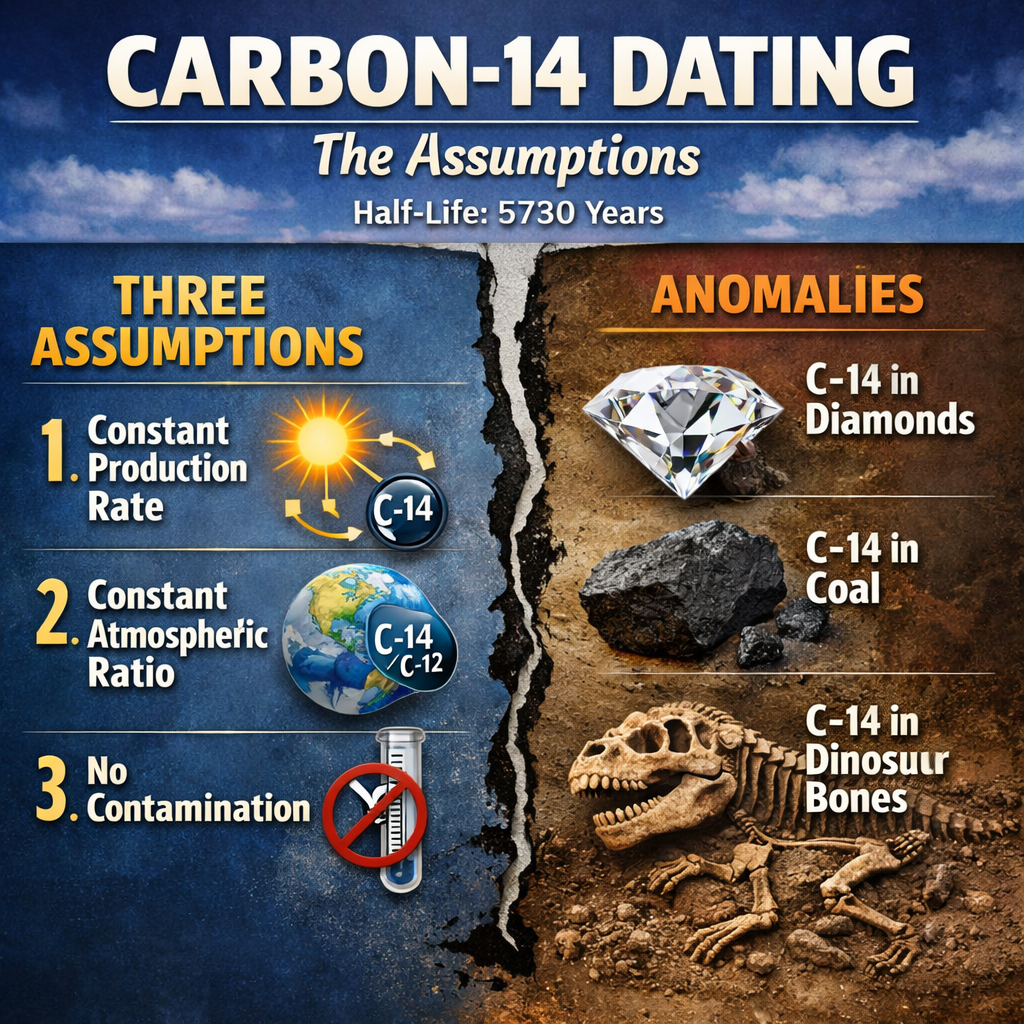
Understanding the Assumptions Behind Radiocarbon Dating
TRUTH CARRIERS EDUCATION SYSTEM True Science Series - Adult Level (6Rs)
Exodus 20:11
"For in six days Yahuah made heaven and earth, the sea, and all that in them is, and rested the seventh day: wherefore Yahuah blessed the sabbath day, and hallowed it."
The Three Assumptions Behind Carbon-14 Dating
INTRODUCTION
Radiocarbon dating is often presented as infallible proof of millions of years. But is it?
Every dating method rests on assumptions that cannot be proven.
This workbook will equip you to understand what radiocarbon dating actually measures, the assumptions it relies upon, its known limitations, and how evidence aligns with Scripture's timeline.
We honor Yahuah's truth by examining evidence carefully and thinking critically.
ABOUT THIS WORKBOOK
What You Will Learn:
How radiocarbon dating works and what it actually measures
The three core assumptions underlying all C14 dates
Known problems: contamination, reservoir effects, calibration issues
Evidence that challenges long-age interpretations
How the Genesis Flood affects carbon dating results
How to think biblically about dating claims
Audience: Adult / Teen (Ages 16+)
Study Time: 10-15 hours (10 lessons)
HOW TO USE THIS WORKBOOK
The Truth Carriers Learning Method - 6 Rs
This workbook uses the 6 Rs Learning Method for deep understanding and long-term retention:
1. RECEIVE Read the teaching content. Study the scientific evidence and assumptions.
2. REFLECT Complete fill-in-blanks, multiple choice, and discussion questions.
3. RECALL Close the book and write the key concepts and problems from memory.
4. RECITE Teach these scientific facts to someone else.
5. REVIEW Use the spaced review tracker. Review at Day 1, 3, 7, 21, 60.
6. RESPOND Apply this knowledge when evaluating dating claims. Hold Scripture as your plumb line.
TABLE OF CONTENTS
Lesson 1: What is Radiocarbon?
Lesson 2: The Three Core Assumptions
Lesson 3: Calibration Curves and Changing Atmosphere
Lesson 4: Contamination and Sample Handling
Lesson 5: Reservoir Effects (Old Carbon In)
Lesson 6: Detection Limits and Statistical Noise
Lesson 7: C14 in "Old" Materials
Lesson 8: Famous Anomalies and Cross-Checks
Lesson 9: Flood Impact on Carbon Inventory
Lesson 10: Thinking Biblically about Dating Claims
KEY TERMS
Term
Definition
Isotope
Atoms of the same element with different numbers of neutrons (e.g., C12, C13, C14)
Half-life
Time for half of a radioactive substance to decay (C14 = 5,730 years)
Calibration Curve
Chart used to convert raw C14 measurements to calendar years
Reservoir Effect
When organisms absorb "old" carbon, making them appear older than they are
Contamination
Introduction of foreign carbon that skews results
Background
Minimum detectable signal; sets practical age limit
Closed System
Assumption that no carbon entered or left the sample after death
Suess Effect
Dilution of atmospheric C14 by burning fossil fuels (since Industrial Revolution)
Bomb Pulse
Spike in atmospheric C14 from nuclear testing (1950s-1960s)
Detection Limit
Maximum age that can be measured (~50,000-60,000 years for C14)
Error Margin
Range of uncertainty in a measurement (reported as +/- years)
Old Carbon
Carbon depleted in C14, often from geological sources
LESSON 1: WHAT IS RADIOCARBON?
THE BASICS
Carbon-14 (C14) is a radioactive isotope of carbon. It forms in the upper atmosphere and is absorbed by all living things.
How Carbon-14 Forms
Cosmic rays from space strike nitrogen atoms (N14) in the upper atmosphere, converting them to .
This radioactive carbon combines with oxygen to form CO2, which is absorbed by through photosynthesis.
Animals eat plants, and all living things maintain a ratio of C14 to C12 that matches the .
What Happens at Death
When an organism dies, it stops taking in new carbon.
The C14 in its body begins to back into nitrogen.
The half-life of C14 is approximately years.
KEY LIMITATION
Radiocarbon dating works only on organic materials (things that were once alive).
It does NOT work on rocks, metals, or minerals!
The Dating Calculation
Scientists measure the ratio of C14 to C12 remaining in a sample.
They compare this ratio to what is assumed for the living organism.
Using the half-life, they calculate how long ago the organism .
Psalm 119:160
"The sum of Your word is truth, and every one of Your righteous judgments endures forever."
Multiple Choice
1. Carbon-14 is formed when cosmic rays strike:
○ A) Carbon atoms ○ B) Nitrogen atoms ○ C) Oxygen atoms ○ D) Hydrogen atoms
2. The half-life of Carbon-14 is approximately:
○ A) 57 years ○ B) 573 years ○ C) 5,730 years ○ D) 57,300 years
3. Carbon-14 dating can be used on:
○ A) Rocks and minerals ○ B) Organic materials only ○ C) Metals ○ D) Any material
True or False
1. Carbon-14 dating works on volcanic rocks. ○ True ○ False - Correction:
2. Living organisms maintain a C14/C12 ratio matching the atmosphere. ○ True ○ False - Correction:
3. C14 decays into oxygen after death. ○ True ○ False - Correction:
RECALL EXERCISE
Close this workbook. Write from memory:
How C14 forms in the atmosphere
The half-life of C14
What types of materials C14 dating works on
TEACH-BACK CHALLENGE
Explain to someone how radiocarbon dating works in simple terms.
Person taught: Date:
SCRIPTURE MEMORY: Exodus 20:11
"For in six days Yahuah made heaven and earth, the sea, and all that in them is..."
APPLICATION STEP
LESSON 2: THE THREE CORE ASSUMPTIONS
CRITICAL UNDERSTANDING
Every radiocarbon date depends on three unprovable assumptions. If any assumption is wrong, the date is wrong.
Assumption #1: Known Initial Ratio
Scientists assume they know how much C14 was in the organism when it .
This assumes the atmospheric C14/C12 ratio has always been the as today.
The Problem:
We cannot travel back in time to measure past atmospheric ratios. This is an , not a measurement.
Assumption #2: Constant Decay Rate
Scientists assume C14 has always decayed at exactly the same .
While decay rates appear constant today, we cannot prove they were identical throughout history.
Assumption #3: Closed System
Scientists assume no C14 has been or removed from the sample since death.
This is called the "closed system" assumption.
THE CRITICAL QUESTION
When presented with a radiocarbon date, always ask:
What was measured? (the actual data)
What was assumed? (the interpretations)
What is the margin of error? (the uncertainty)
Assumptions vs. Measurements
What is MEASURED
What is ASSUMED
Current C14/C12 ratio in sample
Initial C14/C12 ratio when alive
Number of C14 atoms detected
Decay rate has never changed
Sample composition today
No contamination occurred
Multiple Choice
1. The "closed system" assumption means:
○ A) The lab doors were closed during testing ○ B) No carbon was added or removed after death ○ C) The atmosphere was closed off ○ D) Only scientists can access the data
2. If the initial C14 ratio was different than assumed, the calculated age would be:
○ A) Exactly correct ○ B) Wrong ○ C) Unaffected ○ D) More accurate
True or False
1. Scientists can directly measure the initial C14 ratio of ancient samples. ○ True ○ False - Correction:
2. All three assumptions must be true for C14 dates to be accurate. ○ True ○ False - Correction:
RECALL EXERCISE
Close this workbook. Write the three core assumptions from memory:
TEACH-BACK CHALLENGE
Explain the three assumptions to someone and why they matter.
Person taught: Date:
APPLICATION STEP
LESSON 3: CALIBRATION CURVES AND CHANGING ATMOSPHERE
THE PROBLEM
Raw radiocarbon measurements must be "calibrated" because the atmospheric C14 level has NOT been constant.
Why Calibration is Needed
Scientists discovered that raw C14 ages don't match known historical dates.
The atmospheric C14/C12 ratio has significantly over time.
Therefore, scientists created calibration curves to adjust raw dates.
Factors That Change Atmospheric C14
1. Solar Activity
The sun's magnetic field affects how many cosmic rays reach Earth.
More solar activity = fewer cosmic rays = C14 produced.
2. Earth's Magnetic Field
A stronger magnetic field shields Earth from cosmic rays.
Evidence suggests Earth's magnetic field was much in the past.
3. The Suess Effect
Since the Industrial Revolution, burning fossil fuels has released massive amounts of "old" carbon (C12) into the atmosphere.
This the atmospheric C14 ratio.
4. The Bomb Pulse
Nuclear testing in the 1950s-1960s nearly atmospheric C14.
This spike is still being absorbed into the biosphere.
Calibration Methods
Scientists use several methods to build calibration curves:
Tree rings (dendrochronology) - Overlapping patterns from old trees
Varves - Annual lake sediment layers
Coral - Annual growth bands
Cave deposits - Speleothems with uranium-series dating
CRITICAL OBSERVATION
Each calibration method has its own assumptions!
We are using one set of assumptions to "correct" another set of assumptions.
Multiple Choice
1. The Suess Effect refers to:
○ A) Nuclear testing increasing C14 ○ B) Fossil fuels diluting atmospheric C14 ○ C) Solar flares creating more C14 ○ D) Tree ring calibration
2. A stronger Earth magnetic field in the past would mean:
○ A) More C14 production ○ B) Less C14 production ○ C) No effect on C14 ○ D) Faster decay rates
True or False
1. Atmospheric C14 levels have remained perfectly constant throughout history. ○ True ○ False - Correction:
2. Calibration curves are themselves based on assumptions. ○ True ○ False - Correction:
RECALL EXERCISE
List four factors that change atmospheric C14 levels:
APPLICATION STEP
LESSON 4: CONTAMINATION AND SAMPLE HANDLING
THE CHALLENGE
Even tiny amounts of contamination can dramatically alter a radiocarbon date.
Types of Contamination
1. Modern Carbon Contamination
Introduction of modern carbon (high in C14) makes samples appear .
Organic acids from decaying plant matter in soil can penetrate samples.
These acids can add or replace in the sample.
4. Conservation Chemicals
Museum specimens are often treated with preservatives.
Many preservatives contain carbon that contaminates the .
Contamination Effects
True Age
1% Modern Contamination
Reported Age
20,000 years
1% modern carbon added
~18,000 years
40,000 years
1% modern carbon added
~33,000 years
Infinite (no C14)
1% modern carbon added
~37,000 years
CRITICAL INSIGHT
For very old samples, even 1% contamination with modern carbon can make an "infinitely old" sample appear to be only 37,000 years old!
Laboratory Protocols
Labs use various cleaning protocols to remove contamination:
Acid washes to remove carbonates
Alkali washes to remove humic acids
"Lab blanks" to measure background contamination
Background subtraction in calculations
However, no cleaning protocol can guarantee complete removal of all .
Multiple Choice
1. Modern carbon contamination makes samples appear:
○ A) Older ○ B) Younger ○ C) The same age ○ D) More accurate
2. For very old samples, 1% modern contamination can:
○ A) Have no effect ○ B) Make infinite-age samples appear ~37,000 years old ○ C) Make samples appear older ○ D) Improve accuracy
True or False
1. Laboratory cleaning protocols can guarantee complete removal of contamination. ○ True ○ False - Correction:
2. Museum preservation chemicals can contaminate samples. ○ True ○ False - Correction:
RECALL EXERCISE
List three types of contamination and their effects on apparent age:
APPLICATION STEP
LESSON 5: RESERVOIR EFFECTS (OLD CARBON IN)
THE PROBLEM
Some living organisms absorb "old carbon" from their environment, making them appear thousands of years old while still alive!
What is a Reservoir Effect?
A "reservoir" is any source of carbon that has a different C14/C12 ratio than the .
Organisms that absorb carbon from these reservoirs will have misleading C14 .
Marine Reservoir Effect
The ocean acts as a massive carbon reservoir.
Deep ocean water can be to thousands of years "old" in C14 terms.
Marine organisms (fish, shells, seaweed) absorb this old carbon.
Result:
Living marine organisms can appear to be 400-1,000+ years old by C14 dating!
Hard-Water Effect
Freshwater lakes and rivers can also contain old carbon.
Limestone and volcanic rocks release CO2 with little or no .
Aquatic organisms absorb this carbon and appear much older than they are.
Famous Case: Living Mollusks
DOCUMENTED EXAMPLE
Living freshwater mollusks from flowing springs have been dated at over 2,000 years old.
They were alive when tested!
This demonstrates the hard-water effect in action.
Volcanic CO2 Effect
Plants growing near volcanic vents absorb CO2 from volcanic .
This volcanic CO2 contains virtually no C14 (it comes from ancient rocks).
Plants and animals in these areas can appear thousands of years old while .
Multiple Choice
1. The marine reservoir effect occurs because:
○ A) Ocean water is contaminated ○ B) Deep ocean water has "old" carbon ○ C) Fish don't absorb C14 ○ D) The ocean is too salty
2. Living freshwater mollusks have been dated at:
○ A) 0 years (accurate) ○ B) Over 2,000 years ○ C) Millions of years ○ D) Negative ages
True or False
1. All organisms absorb carbon with the same C14 ratio as the atmosphere. ○ True ○ False - Correction:
2. Volcanic CO2 typically has normal C14 levels. ○ True ○ False - Correction:
RECALL EXERCISE
Explain the marine reservoir effect and the hard-water effect in your own words:
SCRIPTURE MEMORY: 2 Peter 3:5-6
"For this they willingly are ignorant of, that by the word of Elohim the heavens were of old, and the earth standing out of the water and in the water: Whereby the world that then was, being overflowed with water, perished."
APPLICATION STEP
LESSON 6: DETECTION LIMITS AND STATISTICAL NOISE
THE LIMIT
Radiocarbon dating has a practical maximum age limit of approximately 50,000-60,000 years.
Why There is a Limit
After approximately 10 half-lives (~57,300 years), so little C14 remains that it becomes indistinguishable from noise.
The count rate of C14 atoms approaches the natural background radiation in the .
Half-Life Progression
Half-Lives
Years Elapsed
C14 Remaining
1
5,730
50%
2
11,460
25%
5
28,650
3.125%
10
57,300
0.098%
15
85,950
0.003%
Error Bars and Uncertainty
All radiocarbon dates are reported with error margins (e.g., 5,000 +/- 200 years).
As samples get older, the error bars dramatically.
Reported ages are probability ranges, not exact numbers.
The Significance of "Background"
IMPORTANT
Even the most sophisticated equipment cannot distinguish between:
A sample with a tiny amount of original C14
A sample with NO original C14 but some contamination
Background radiation in the detector itself
Beyond ~50,000 years, any C14 signal detected could be entirely from or background noise.
Multiple Choice
1. The practical age limit of C14 dating is approximately:
○ A) 5,000 years ○ B) 50,000-60,000 years ○ C) 1 million years ○ D) No limit
2. After 10 half-lives, approximately how much C14 remains?
○ A) 10% ○ B) 1% ○ C) Less than 0.1% ○ D) 50%
True or False
1. Radiocarbon dates are exact numbers with no uncertainty. ○ True ○ False - Correction:
2. As samples get older, the error margins decrease. ○ True ○ False - Correction:
RECALL EXERCISE
Explain why radiocarbon dating has an upper age limit:
APPLICATION STEP
LESSON 7: C14 IN "OLD" MATERIALS
THE MYSTERY
Detectable C14 has been found in materials claimed to be millions of years old. How is this possible?
The Problem
If coal, oil, and fossils are really millions of years old, they should contain detectable C14.
After 1 million years (~175 half-lives), not a single atom of the original C14 should remain.
Yet, C14 is consistently detected in these materials!
C14 in Coal
Coal is claimed to be 50-300 million years old.
Multiple studies have found measurable C14 in coal samples from around the world.
The C14 ages typically range from to 50,000 years.
C14 in Diamonds
Diamonds are claimed to be 1-3 years old.
Diamonds are the hardest natural substance, making contamination extremely difficult.
Yet, multiple studies have detected significant C14 in diamonds!
RATE Study (2005):
Analyzed 10 diamond samples from various locations. All contained measurable C14 corresponding to ages of 55,000-70,000 years - far younger than the claimed billion-year ages.
C14 in Fossils
Dinosaur fossils are claimed to be 65+ million years old.
Multiple studies have found detectable C14 in dinosaur .
One study found C14 ages ranging from 22,000-39,000 years.
Two Interpretations
Mainstream Interpretation
Young-Age Interpretation
C14 from contamination or in-situ production
These materials are actually young (thousands, not millions of years)
Lab error or background noise
The C14 is original to the samples
Nuclear reactions within the sample
Deep-time ages are incorrect
CRITICAL THINKING
The presence of C14 in materials claimed to be millions of years old is a significant anomaly that demands explanation.
Whatever the explanation, it demonstrates that the dating systems have .
Multiple Choice
1. If coal is really millions of years old, it should contain:
○ A) Abundant C14 ○ B) Some C14 ○ C) Zero detectable C14 ○ D) More C14 than modern plants
2. C14 has been detected in:
○ A) Coal only ○ B) Diamonds only ○ C) Coal, diamonds, and fossils ○ D) Nothing older than 50,000 years
True or False
1. After 1 million years, significant original C14 should remain. ○ True ○ False - Correction:
2. Diamonds are easily contaminated with modern carbon. ○ True ○ False - Correction:
RECALL EXERCISE
Explain the C14 anomaly in "old" materials and why it matters:
APPLICATION STEP
LESSON 8: FAMOUS ANOMALIES AND CROSS-CHECKS
DOCUMENTED FAILURES
When radiocarbon dates can be checked against known-age samples or other dating methods, significant discrepancies often appear.
Anomaly #1: Living Snails
Living snails from artesian springs in Nevada were C14 dated.
Result: They appeared to be years old!
Cause: Hard-water effect from dissolved limestone in the .
Anomaly #2: Freshly Killed Seals
Freshly killed seals from McMurdo Sound, Antarctica were dated.
Result: Ages ranged from 615 to years old.
Cause: Marine reservoir effect from eating marine organisms.
Anomaly #3: Wood in Basalt
Wood found encased in basalt lava was dated by both C14 and potassium-argon (K-Ar) methods.
Method
Result
C14 (wood)
~45,000 years
K-Ar (basalt)
~45 million years
The wood appears to be 1,000 times than the rock encasing it!
Anomaly #4: Multiple Dates, Same Sample
The same sample sent to different labs (or the same lab multiple times) often yields significantly dates.
This demonstrates that C14 dating is less precise than often claimed.
The Importance of Cross-Checks
PRINCIPLE
Good science requires multiple independent lines of evidence before drawing conclusions.
When methods disagree, it indicates problems with one or more .
Deuteronomy 19:15
"One witness shall not rise up against a man for any iniquity, or for any sin... at the mouth of two witnesses, or at the mouth of three witnesses, shall the matter be established."
Multiple Choice
1. Living snails from Nevada springs were dated at:
○ A) 0 years ○ B) 270 years ○ C) 27,000 years ○ D) 27 million years
2. When C14 and K-Ar gave different dates for the same formation, the difference was:
○ A) A few years ○ B) A few hundred years ○ C) About 1,000 times different ○ D) Exactly the same
True or False
1. Radiocarbon dates always agree with other dating methods. ○ True ○ False - Correction:
2. The same sample always gives the same C14 date at different labs. ○ True ○ False - Correction:
RECALL EXERCISE
Describe two documented C14 anomalies and their causes:
TEACH-BACK CHALLENGE
Explain to someone why cross-checking dating methods is important.
Person taught: Date:
APPLICATION STEP
LESSON 9: FLOOD IMPACT ON CARBON INVENTORY
THE BIBLICAL PERSPECTIVE
If the Genesis Flood was a real global event, it would have dramatically altered the Earth's carbon inventory.
Pre-Flood Conditions (Biblical Model)
The pre-Flood world may have had:
Far more living (vegetation, animals)
A stronger magnetic field (shielding from cosmic rays)
Different atmospheric composition
Lower atmospheric C14/C12 ratio
The Flood's Effects
1. Massive Burial of Carbon
The Flood rapidly buried enormous quantities of vegetation and animals.
This became the fossil fuels (coal, oil, natural gas) we find today.
This removed a huge amount of C12 from the .
2. Release of Old Carbon
Volcanic activity during and after the Flood released massive amounts of CO2.
This volcanic carbon had virtually no .
3. Post-Flood Rebalancing
After the Flood, the C14/C12 ratio had to gradually build up to current levels.
This process would take hundreds to thousands of .
Implications for Dating
THE EFFECT
If the pre-Flood atmosphere had less C14, then:
Pre-Flood organisms started with less C14
C14 dating would interpret this as being much than actual
A 4,500-year-old sample might be dated as 20,000-50,000 years old
Reconciling Biblical Timeline and C14
C14 Conventional Age
Possible Actual Age (Biblical)
50,000 years
~4,500 years (early post-Flood)
20,000 years
~4,000 years (mid post-Flood)
5,000 years
~4,000-5,000 years (ratio stabilizing)
3,000 years
~3,000 years (current ratio established)
Genesis 7:11-12
"In the six hundredth year of Noah's life... the same day were all the fountains of the great deep broken up, and the windows of heaven were opened. And the rain was upon the earth forty days and forty nights."
Multiple Choice
1. If the pre-Flood atmosphere had less C14, organisms from that time would appear:
○ A) Younger than actual ○ B) Older than actual ○ C) The same age ○ D) Impossible to date
2. The Flood would have affected the carbon cycle by:
○ A) Burying massive amounts of carbon ○ B) Releasing volcanic carbon ○ C) Changing the C14/C12 ratio ○ D) All of the above
True or False
1. The pre-Flood world likely had the same C14 levels as today. ○ True ○ False - Correction:
2. A global flood would have no effect on the Earth's carbon inventory. ○ True ○ False - Correction:
RECALL EXERCISE
Explain how the Genesis Flood could affect radiocarbon dating:
SCRIPTURE MEMORY: 2 Peter 3:5-6
"For this they willingly are ignorant of, that by the word of Elohim the heavens were of old, and the earth standing out of the water and in the water: Whereby the world that then was, being overflowed with water, perished."
APPLICATION STEP
LESSON 10: THINKING BIBLICALLY ABOUT DATING CLAIMS
THE GOAL
To be equipped to evaluate dating claims critically while holding Scripture as our ultimate standard of truth.
Key Questions to Ask
When presented with any radiocarbon date, ask:
What was actually measured? (the raw data)
What assumptions were made? (interpretations)
What is the margin of error? (uncertainty)
Has it been cross-checked? (confirmation)
What are alternative interpretations? (multiple possibilities)
Measurement vs. Interpretation
Measurement (Observable)
Interpretation (Assumed)
Current C14/C12 ratio
Initial ratio was the same as today
Counts per minute detected
Decay rate has always been constant
Sample composition now
No contamination occurred
Calibration curve adjustment
Calibration methods are accurate
Scripture as the Plumb Line
Psalm 119:160
"The sum of Your word is truth, and every one of Your righteous judgments endures forever."
We do not reject good science. We distinguish between:
Historical science - Interpretations of the unobserved past (based on assumptions)
Having Courage
It takes courage to question the mainstream narrative.
But Yahuah calls us to "prove all things" and "hold fast that which is " (1 Thessalonians 5:21).
REMEMBER
Dating methods are tools, not infallible oracles.
Every method has assumptions, limitations, and potential errors.
When data conflicts with Scripture, examine the behind the data.
Yahuah's Word is our foundation of truth.
Summary: What We've Learned
C14 dating measures carbon ratios in materials only
Every C14 date depends on three unprovable
Calibration curves are themselves based on assumptions
Contamination can dramatically alter results
Reservoir effects cause living organisms to appear thousands of years old
The practical limit is ~50,000-60,000 years
C14 in "old" materials challenges deep-time
Many documented anomalies show C14 dating is not infallible
The Genesis Flood would dramatically affect carbon dating
Scripture is our ultimate standard of
Multiple Choice
1. When evaluating a dating claim, you should FIRST ask:
○ A) Is it published in a journal? ○ B) What was actually measured vs. assumed? ○ C) How old is it? ○ D) Who did the study?
2. Historical science differs from operational science because it:
○ A) Uses different equipment ○ B) Interprets the unobserved past based on assumptions ○ C) Is always correct ○ D) Doesn't use math
True or False
1. Dating methods are infallible and never have errors. ○ True ○ False - Correction:
2. Scripture should be our ultimate standard of truth. ○ True ○ False - Correction:
FINAL RECALL EXERCISE
List the five key questions to ask when evaluating any dating claim:
TEACH-BACK CHALLENGE
Teach someone the key problems with radiocarbon dating and how to think critically about dating claims.
Person taught: Date:
SCRIPTURE MEMORY: Revelation 14:7
"Fear Elohim, and give glory to Him; for the hour of His judgment is come: and worship Him that made heaven, and earth, and the sea, and the fountains of waters."
APPLICATION STEPS
SPACED REVIEW TRACKER
Review at increasing intervals to move knowledge to long-term memory.
Lesson
Day 1
Day 3
Day 7
Day 21
Day 60
1. What is Radiocarbon?
2. Three Core Assumptions
3. Calibration Curves
4. Contamination
5. Reservoir Effects
6. Detection Limits
7. C14 in Old Materials
8. Famous Anomalies
9. Flood Impact
10. Thinking Biblically
ANSWER KEY
LESSON 1: What is Radiocarbon?
Fill-in-the-Blank:
C14
plants
atmosphere
decay
5,730
died
Multiple Choice:
B) Nitrogen atoms
C) 5,730 years
B) Organic materials only
True or False:
False - C14 dating only works on organic (once-living) materials, not rocks
True
False - C14 decays into nitrogen (N14), not oxygen
LESSON 2: The Three Core Assumptions
Fill-in-the-Blank:
died
same
assumption
rate
added
Multiple Choice:
B) No carbon was added or removed after death
B) Wrong
True or False:
False - The initial ratio is assumed, not directly measured
True
LESSON 3: Calibration Curves and Changing Atmosphere
Fill-in-the-Blank:
varied
less
stronger
dilutes
doubled
Multiple Choice:
B) Fossil fuels diluting atmospheric C14
B) Less C14 production
True or False:
False - Atmospheric C14 levels have varied significantly
True
LESSON 4: Contamination and Sample Handling
Fill-in-the-Blank:
younger
older
carbon
sample
contamination
Multiple Choice:
B) Younger
B) Make infinite-age samples appear ~37,000 years old
True or False:
False - No protocol can guarantee complete removal
True
LESSON 5: Reservoir Effects
Fill-in-the-Blank:
atmosphere
dates
hundreds
C14
emissions
living
Multiple Choice:
B) Deep ocean water has "old" carbon
B) Over 2,000 years
True or False:
False - Some organisms absorb "old" carbon from reservoirs
False - Volcanic CO2 has virtually no C14
LESSON 6: Detection Limits and Statistical Noise
Fill-in-the-Blank:
background
detector
increase
contamination
Multiple Choice:
B) 50,000-60,000 years
C) Less than 0.1%
True or False:
False - All C14 dates have uncertainty (error margins)
False - Error margins increase with age
LESSON 7: C14 in "Old" Materials
Fill-in-the-Blank:
zero
20,000
billion
bones
problems
Multiple Choice:
C) Zero detectable C14
C) Coal, diamonds, and fossils
True or False:
False - After 1 million years, no original C14 should remain
False - Diamonds are extremely hard to contaminate
LESSON 8: Famous Anomalies and Cross-Checks
Fill-in-the-Blank:
27,000
springs
1,300
younger
different
methods
Multiple Choice:
C) 27,000 years
C) About 1,000 times different
True or False:
False - C14 dates often disagree with other methods
False - The same sample can give different dates
LESSON 9: Flood Impact on Carbon Inventory
Fill-in-the-Blank:
biomass
biosphere
C14
years
older
Multiple Choice:
B) Older than actual
D) All of the above
True or False:
False - Pre-Flood conditions were likely different
False - A global flood would dramatically affect carbon inventory
LESSON 10: Thinking Biblically about Dating Claims
Fill-in-the-Blank:
good
assumptions
organic
assumptions
claims
truth
Multiple Choice:
B) What was actually measured vs. assumed?
B) Interprets the unobserved past based on assumptions
True or False:
False - All dating methods have limitations and potential errors
True
TRUTH CARRIERS EDUCATION SYSTEM
True Science Series - Carbon Dating Exposed
Teaching the next generation to think critically and hold Scripture as truth.
"Prove all things; hold fast that which is good." - 1 Thessalonians 5:21