Kanaph (כָּנָף)
Hebrew H3671: "wing, extremity, corner, edge" - Earth has four corners
Raqia (רָקִיעַ)
Hebrew H7549: "firmament, expanse" - From raqa, to beat/spread out
Geocentrism
Earth-centered model: Earth is fixed at center; sun, moon, stars move
Heliocentrism
Sun-centered model: Sun is fixed; Earth spins and orbits around it
Cosmology
Study of the structure and nature of the universe
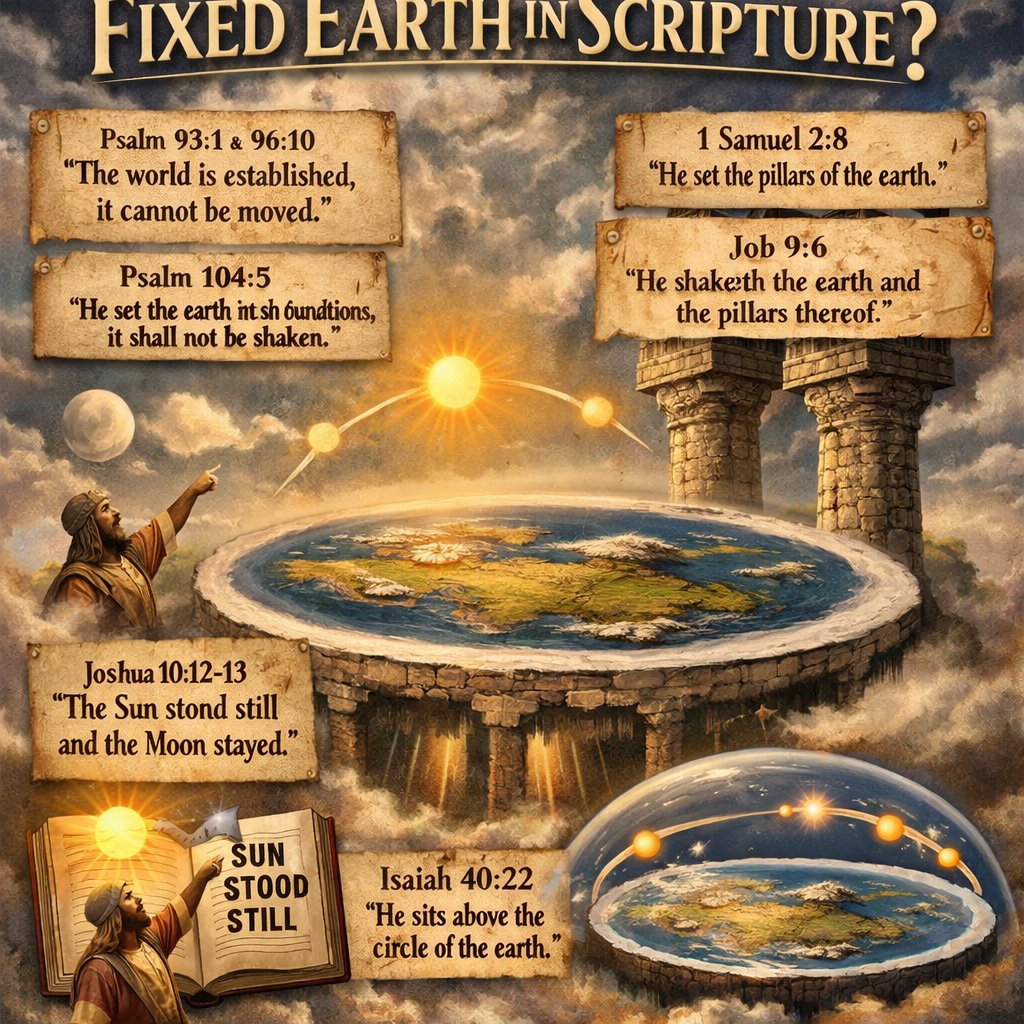
Fixed Earth 02
Key Hebrew Word Studies
Chug (חוּג) vs. Dur (דּוּר) - Circle vs. Ball
Isaiah 40:22 uses chug (circle) - "He that sitteth upon the circle of the earth"
Isaiah 22:18 uses dur (ball) - "toss thee like a ball"
Conclusion: Isaiah knew both words. He chose "circle" (flat) not "ball" (sphere) in 40:22. If he meant sphere, he would have used "dur."
Mot (מוֹט) - "Moved/Shaken"
Strong's H4131: to waver, slip, shake, totter, be moved
Scripture repeatedly says the earth "shall NOT be moved" (lo mot). This is a definitive statement that the earth does not shake, waver, spin, or travel through space.
Complete Scripture Reference List
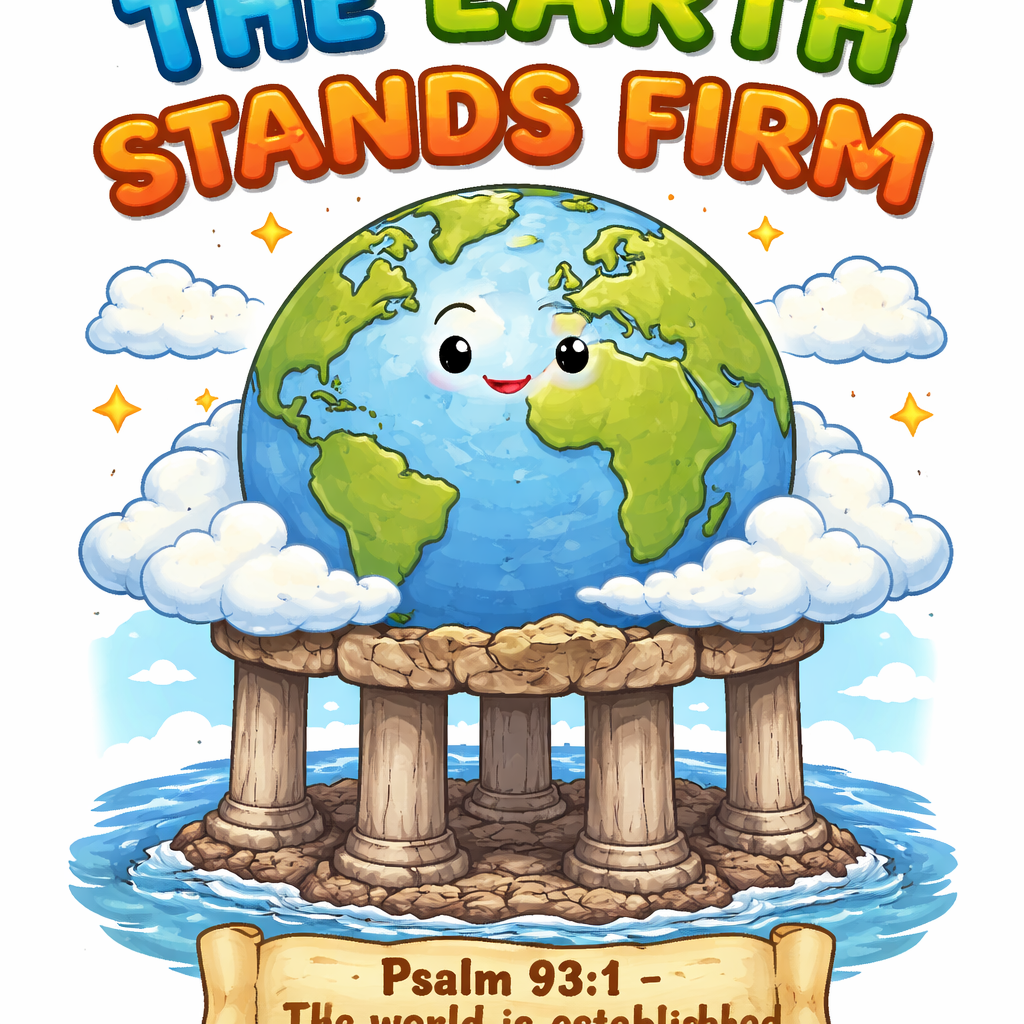
Earth Cannot Be Moved (4 Passages)
Psalm 93:1 - "The world also is stablished, that it cannot be moved."
Psalm 96:10 - "The world also shall be established that it shall not be moved."
1 Chronicles 16:30 - "The world also shall be stable, that it be not moved."
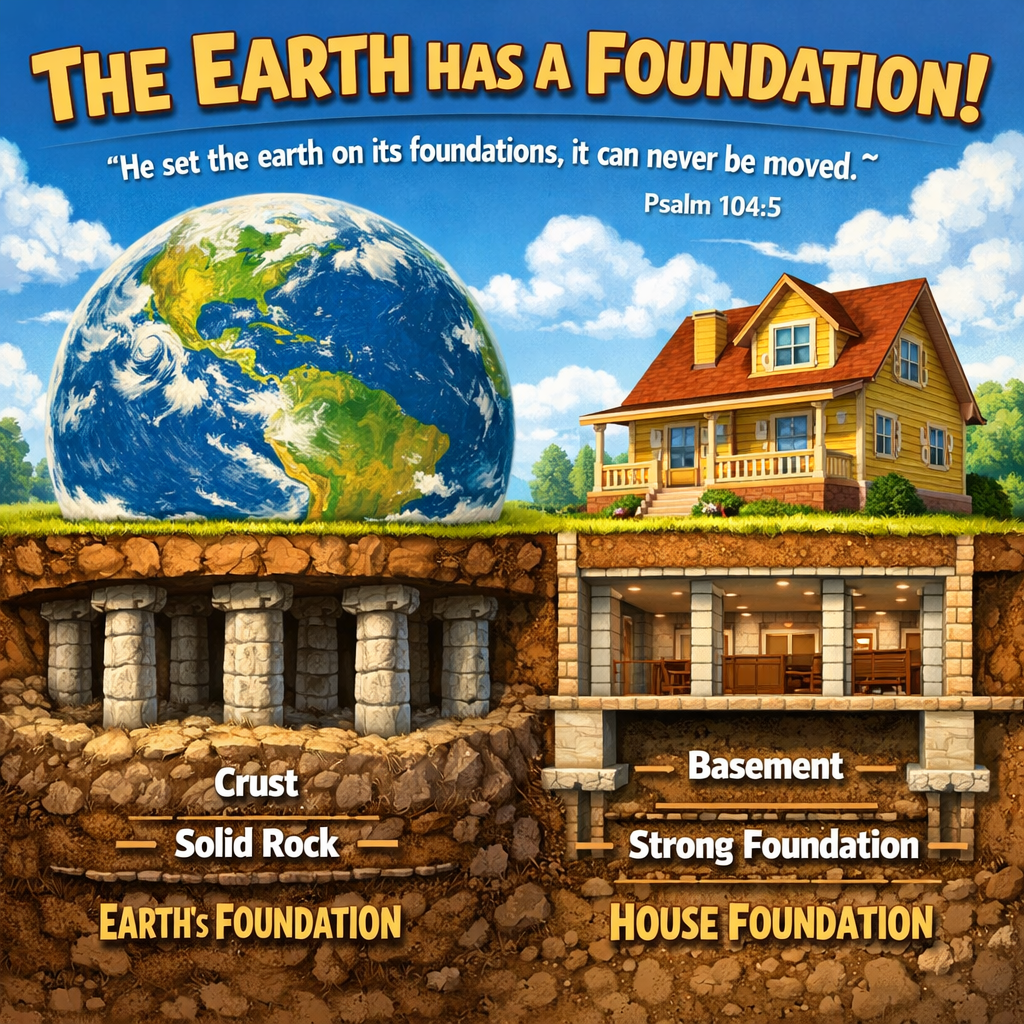
Psalm 104:5 - "Who laid the foundations of the earth, that it should not be removed for ever."
Earth Has Foundations
Job 38:4-6 - "Where wast thou when I laid the foundations of the earth?... Whereupon are the foundations thereof fastened? or who laid the corner stone thereof?"
Isaiah 48:13 - "Mine hand also hath laid the foundation of the earth."
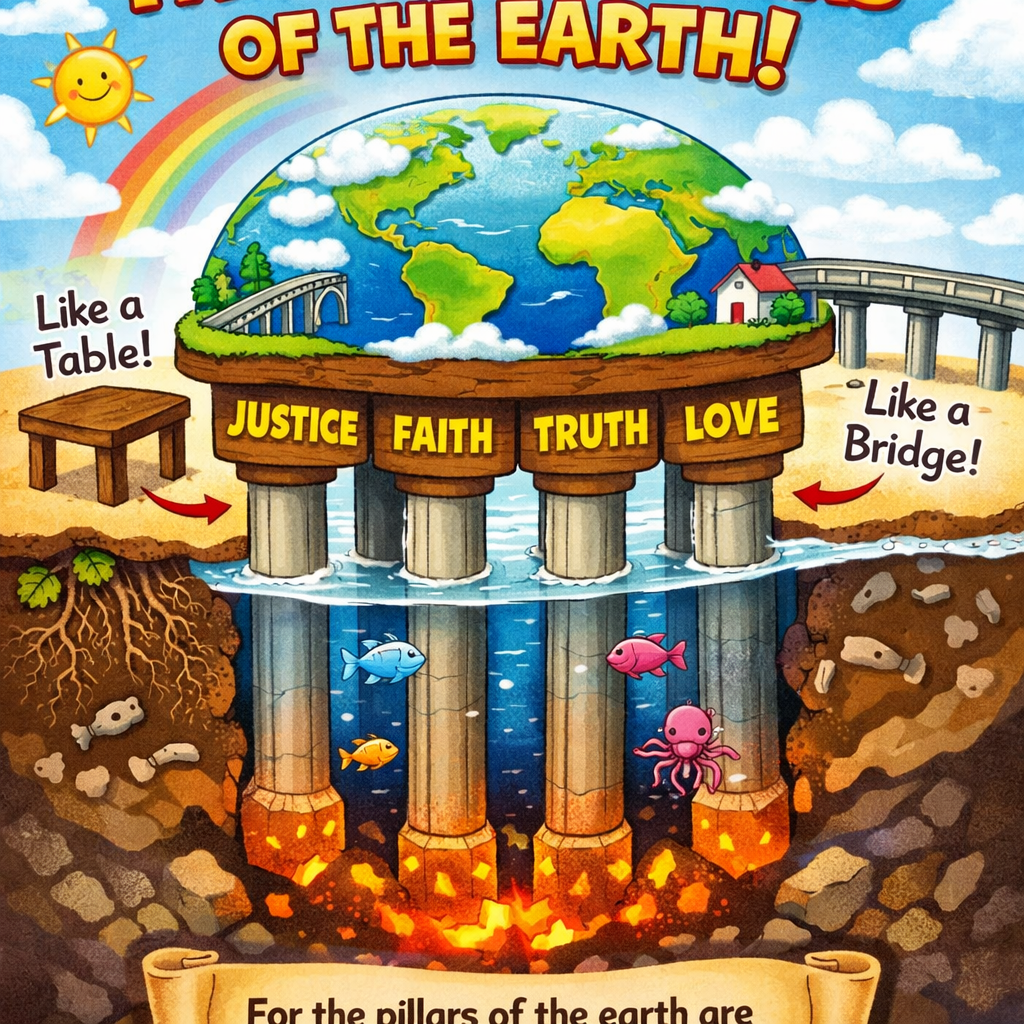
Earth Has Pillars
1 Samuel 2:8 - "For the pillars of the earth are Yahuah's, and he hath set the world upon them."
Job 9:6 - "Which shaketh the earth out of her place, and the pillars thereof tremble."
Sun Moves (Not Earth)
Joshua 10:12-13 - "Sun, stand thou still... And the sun stood still in the midst of heaven, and hasted not to go down about a whole day."
Ecclesiastes 1:5 - "The sun also ariseth, and the sun goeth down, and hasteth to his place where he arose."
Psalm 19:4-6 - "In them hath he set a tabernacle for the sun... His going forth is from the end of the heaven, and his circuit unto the ends of it."
Scripture vs. Modern Science Comparison
Topic
Scripture Says
Modern Science Claims
Earth's motion
Cannot be moved (4 passages)
Spins 1,000 mph, orbits 67,000 mph
Earth's structure
Has foundations, pillars, cornerstone
Floats in space, no support
Earth's shape
Circle (chug), has ends and corners
Sphere/ball
Sun's motion
Rises, sets, has circuit, can stand still
Stationary; earth rotates
What moves
Sun moves, earth is fixed
Earth moves, sun appears fixed
Earth's surface
Spread out, stretched forth
Curved ball surface
Common Objections - Quick Answers
Objection: "Those are just figures of speech"
Response:
Which ones - all 67+ verses? If Yahuah wanted to describe a spinning ball, He could have. Why use ONLY language contradicting the globe model? The firmament alone is mentioned 17 times with physical descriptions.
Objection: "Circle (chug) can mean sphere"
Response:
No. Hebrew has a word for ball: "dur" (Isaiah 22:18). Isaiah knew both words and chose "circle" (chug) in 40:22. A compass draws a circle, not a sphere. He meant what he wrote.
Objection: "We have photos from space"
Response:
NASA admits all "photos" are composites—CGI and artist renderings pieced together. Different "photos" show vastly different Earth sizes and continent shapes. No continuous video of a rotating Earth exists.
Lesson 1: The Earth Cannot Be Moved
Introduction
This study examines what Scripture actually says about the earth's nature and motion. We begin with the most foundational claim: FOUR separate passages declare that the earth is fixed and cannot be moved. These are not poetry or metaphor—they are declarative statements about Yahuah's creation.
Four Witnesses: The Earth Cannot Be Moved
Psalm 93:1 - "Yahuah reigneth, he is clothed with majesty; Yahuah is clothed with strength, wherewith he hath girded himself: the world also is stablished, that it cannot be moved."
Psalm 96:10 - "Say among the heathen that Yahuah reigneth: the world also shall be established that it shall not be moved: he shall judge the people righteously."
1 Chronicles 16:30 - "Fear before him, all the earth: the world also shall be stable, that it be not moved."
Psalm 104:5 - "Who laid the foundations of the earth, that it should not be removed for ever."
Hebrew Word Analysis
"Moved" - Hebrew: מוֹט (mot) - Strong's H4131
Meaning: to waver, slip, shake, totter, be moved, fall
Meaning: to be firm, stable, established, fixed, prepared, secure
Usage: Describes things that are permanent, immovable, anchored
Scripture's claim: The earth IS firm, stable, fixed
The Physics Problem
Modern science claims the earth:
Spins at approximately 1,000 mph at the equator
Orbits the sun at approximately 67,000 mph
Travels through the galaxy at approximately 500,000 mph
Critical Question
Can something moving at 1,000 + 67,000 + 500,000 mph accurately be described as "stable," "established," and unable to be "moved"? Would Yahuah use such definitive, immovable language for something in constant violent motion?
Fixed Earth 01
Context: Yahuah's Reign and Creation
Notice the context of these passages:
Psalm 93:1 - "Yahuah REIGNETH" - context of His sovereign rule
Psalm 96:10 - "Yahuah REIGNETH... he shall judge" - context of sovereignty and judgment
1 Chronicles 16:30 - "Fear before him" - context of worship
Psalm 104:5 - "Who LAID the foundations" - context of creation
These are not casual poetic expressions. They are factual claims about Yahuah's creation made in the context of His power, reign, and creative acts.
Lesson 1 Exercises
1. Multiple Choice: How many Scripture passages explicitly state that the earth cannot be moved?
2. Multiple Choice: The Hebrew word "mot" (moved) means:
3. Multiple Choice: The Hebrew word "kun" (established/stablished) means:
4. True or False: The context of these "cannot be moved" passages is casual poetry with no factual claims.
5. Critical Thinking: If the earth spins at 1,000 mph, orbits at 67,000 mph, and travels through the galaxy at 500,000 mph, can it accurately be called "stable" and "established" and something that "cannot be moved"? Explain your reasoning.
6. Scripture Study: Read all four passages listed above. What common theme do you observe? Why would Yahuah repeat this teaching in multiple books of Scripture?
Lesson 2: The Foundations, Pillars, and Cornerstone of the Earth
Introduction
Scripture uses specific CONSTRUCTION terminology to describe the earth: foundations, measures, line, pillars, and cornerstone. These are terms for a fixed structure, not a spinning ball floating in space.
Foundations of the Earth
Job 38:4-6 - "Where wast thou when I laid the foundations of the earth? declare, if thou hast understanding. Who hath laid the measures thereof, if thou knowest? or who hath stretched the line upon it? Whereupon are the foundations thereof fastened? or who laid the corner stone thereof?"
Construction Terminology in Job 38:
"Laid the foundations" - like laying a building's foundation
"Laid the measures" - measured specific dimensions
"Stretched the line" - surveyor's line for straight construction
"Corner stone" - foundational stone that anchors a structure
Isaiah 48:13 - "Mine hand also hath laid the foundation of the earth, and my right hand hath spanned the heavens."
Zechariah 12:1 - "Yahuah, which stretcheth forth the heavens, and layeth the foundation of the earth, and formeth the spirit of man within him."
Pillars of the Earth
1 Samuel 2:8 - "For the pillars of the earth are Yahuah's, and he hath set the world upon them."
Job 9:6 - "Which shaketh the earth out of her place, and the pillars thereof tremble."
Psalm 75:3 - "The earth and all the inhabitants thereof are dissolved: I bear up the pillars of it. Selah."
Key Questions
What do pillars DO? (Answer: Support/hold up a structure)
What is the earth SET UPON? (Answer: Pillars - 1 Samuel 2:8)
Why would a ball floating in space need pillars?
Can you describe a spinning ball using "foundations, measures, line, cornerstone, pillars"?
The Hebrew Word "Yacad"
Yacad (יָסַד) - Strong's H3245
Meaning: to found, fix, establish, lay foundation
Usage: Used for building foundations, establishing structures
This is CONSTRUCTION terminology. You don't describe a spinning ball with construction terms. You describe a fixed, founded structure.
Lesson 2 Exercises
1. Matching: Match each construction term from Job 38 with its meaning:
Term
A. Foundations
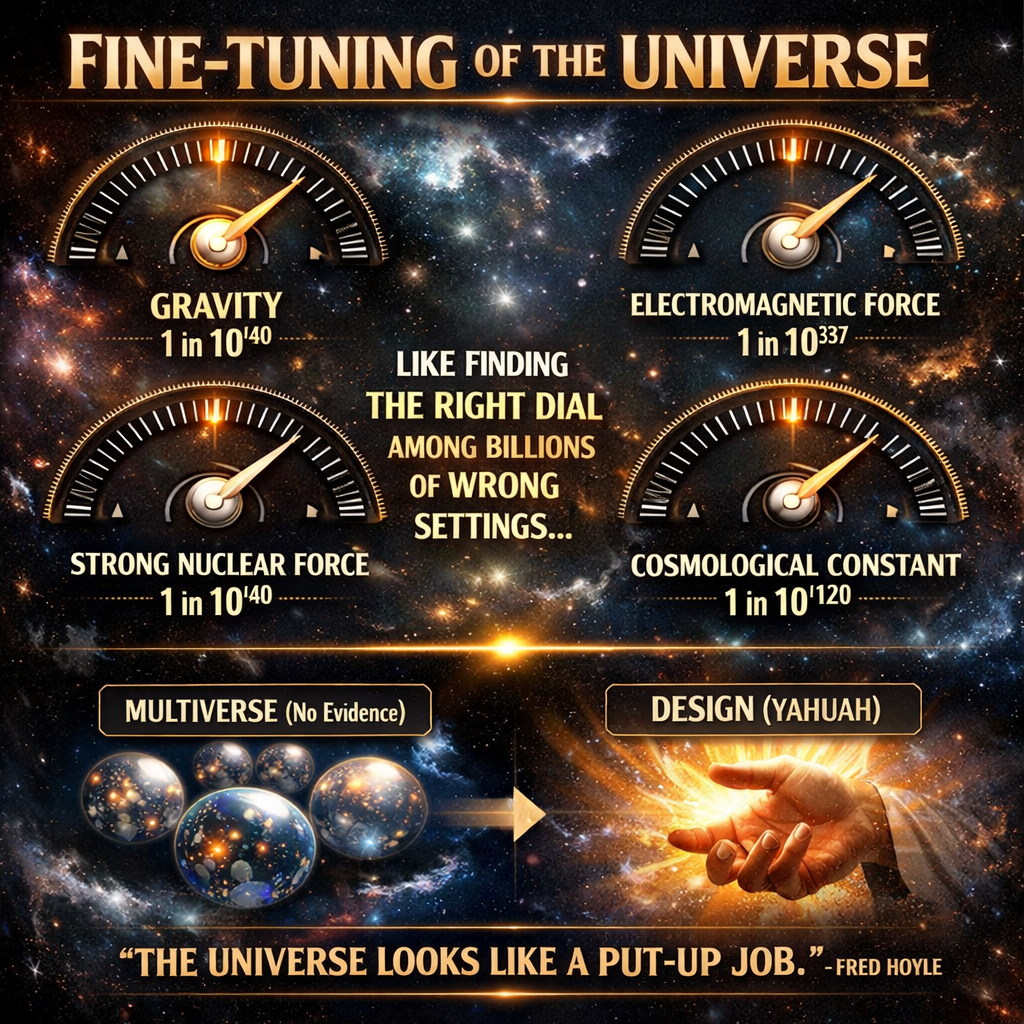
Physics Fine Tuning
B. Measures
C. Line
D. Corner stone
E. Fastened
Meaning
1. Anchors a structure
2. Anchored, secured
3. Base support
4. Surveyor's tool
5. Dimensions
Write your answers: A=___ B=___ C=___ D=___ E=___
2. Multiple Choice: According to 1 Samuel 2:8, what is the world SET UPON?
3. Multiple Choice: Job 38 asks "Whereupon are the foundations thereof ___?"
4. True or False: You can accurately describe a spinning ball using the words "foundations, measures, line, cornerstone, pillars."
5. Analysis: Why would Yahuah use such specific construction terminology if the earth is actually a ball floating in space? What kind of structure has "foundations that are fastened" and "pillars"?
6. Scripture Study: Read Job 26:7-11. Verse 7 says earth "hangeth upon nothing," but verse 11 says "the pillars of heaven tremble." How do these verses work together to describe creation?
Lesson 3: Circle vs. Ball - What Isaiah Actually Wrote
Introduction
Many claim Isaiah 40:22 proves the earth is a sphere because it says "circle." But Hebrew has distinct words for "circle" (chug) and "ball" (dur). Understanding this distinction is crucial.
The Key Passage
Isaiah 40:22 - "It is he that sitteth upon the circle of the earth, and the inhabitants thereof are as grasshoppers; that stretcheth out the heavens as a curtain, and spreadeth them out as a tent to dwell in."
Hebrew Word Study: Chug vs. Dur
"Circle" - Hebrew: חוּג (chug) - Strong's H2329
Meaning: circle, circuit, compass
Usage: A flat, round shape; a circular boundary or path
NOT: a sphere, ball, or three-dimensional object
"Ball" - Hebrew: דּוּר (dur) - Strong's H1754
Meaning: ball, circle (as round)
Usage: A sphere, a ball that can be thrown
Proof: Isaiah Knew Both Words
Isaiah 22:18 - "He will surely violently turn and toss thee like a ball [dur] into a large country."
Critical Evidence
In Isaiah 22:18, Isaiah used "dur" (ball) to describe something round that could be tossed. In Isaiah 40:22, he used "chug" (circle). He knew both words. He chose CIRCLE, not ball. If he meant sphere, he would have written "dur."
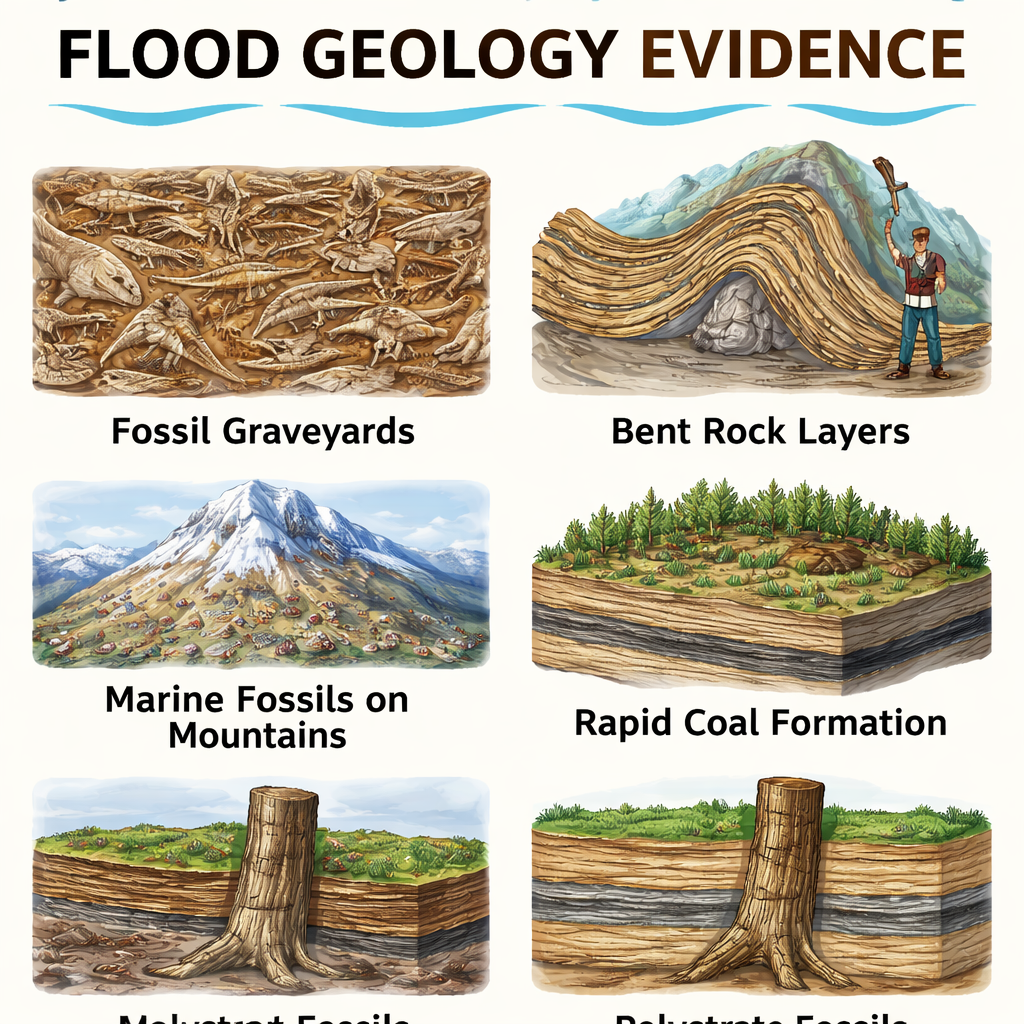
Flood Geology Evidence
Other Uses of "Chug" in Scripture
Job 22:14 - "Thick clouds are a covering to him, that he seeth not; and he walketh in the circuit [chug] of heaven."
The "circuit" of heaven - a circular PATH, not a sphere.
Proverbs 8:27 - "When he prepared the heavens, I was there: when he set a compass [chug] upon the face of the depth."
A "compass" (circle) set upon the waters - a circular boundary, like a compass drawing a circle.
Context of Isaiah 40:22
Look at what else Isaiah 40:22 says:
Yahuah sits UPON the circle - looking down from above
Inhabitants appear as grasshoppers - viewed from above
Heavens stretched as a CURTAIN - a covering
Heavens spread as a TENT to dwell in - a dome structure
The Complete Picture
Isaiah describes: A circular earth, viewed from above (inhabitants like grasshoppers), with a tent/curtain (dome) stretched over it. This is a flat circle with a dome covering—exactly what biblical cosmology describes.
Lesson 3 Exercises
1. Multiple Choice: The Hebrew word used in Isaiah 40:22 for "circle" is:
2. Multiple Choice: In which verse does Isaiah use the word "dur" (ball)?
3. Multiple Choice: According to Isaiah 40:22, the heavens are spread out like:
4. True or False: The Hebrew words "chug" (circle) and "dur" (ball) mean the same thing.
5. Analysis: Isaiah used "dur" (ball) in 22:18 and "chug" (circle) in 40:22. What does this prove about his word choice and meaning?
6. Critical Thinking: Isaiah 40:22 describes Yahuah sitting UPON the circle, looking down at inhabitants who appear as grasshoppers, with a tent/curtain stretched over it. Does this sound like a ball in space or a flat circle with a dome? Explain.
Lesson 4: The Sun Moves, Not the Earth
Introduction
Modern science claims the earth rotates and the sun only APPEARS to move. But Scripture consistently describes the sun as actually moving while the earth remains fixed. This lesson examines multiple passages that demonstrate the sun's motion.
Joshua's Long Day
Joshua 10:12-13 - "Then spake Joshua to Yahuah in the day when Yahuah delivered up the Amorites before the children of Israel, and he said in the sight of Israel, Sun, stand thou still upon Gibeon; and thou, Moon, in the valley of Ajalon. And the sun stood still, and the moon stayed, until the people had avenged themselves upon their enemies. Is not this written in the book of Jasher? So the sun stood still in the midst of heaven, and hasted not to go down about a whole day."
Key Observations:
Joshua commanded the SUN to stand still—not the earth to stop rotating
The sun stood still "in the midst of heaven"
The sun "hasted not to go down" - it normally hastens (moves)
The moon also STAYED (stopped moving)
This lasted "about a whole day"
The Physics Problem
If Earth's Rotation Stopped...
If it was earth's rotation that stopped (not the sun's movement):
Earth supposedly spins at ~1,000 mph at equator
Sudden stop = everything not bolted down flies off at 1,000 mph
Oceans would wash over continents
Atmosphere would keep moving, creating supersonic winds
Total planetary destruction
But Joshua's account shows an ordinary day extended—no catastrophe, no destruction.
Fixed Earth Scriptures
The Sun Has a Circuit
Psalm 19:4-6 - "In them hath he set a tabernacle for the sun, Which is as a bridegroom coming out of his chamber, and rejoiceth as a strong man to run a race. His going forth is from the end of the heaven, and his circuit unto the ends of it: and there is nothing hid from the heat thereof."
What This Passage Reveals:
The sun has a TABERNACLE (dwelling/tent)
The sun comes out "as a bridegroom from his chamber"
The sun "rejoices as a strong man to run a race" - it moves
The sun has a "going forth" - it departs
The sun has a CIRCUIT - a path it travels
The Sun Hastens to Its Place
Ecclesiastes 1:5 - "The sun also ariseth, and the sun goeth down, and hasteth to his place where he arose."
The sun:
ARISES - it comes up
GOES DOWN - it descends
HASTENS - it hurries, moves quickly
Returns to "his place" - it has a location it returns to
The Sun Returned Ten Degrees
Isaiah 38:8 - "Behold, I will bring again the shadow of the degrees, which is gone down in the sun dial of Ahaz, ten degrees backward. So the sun returned ten degrees, by which degrees it was gone down."
The SUN RETURNED ten degrees—it moved backward. The shadow moved because the SUN moved.
Lesson 4 Exercises
1. Multiple Choice: What did Joshua command to stand still?
2. Multiple Choice: According to Psalm 19, the sun has:
3. Multiple Choice: In Ecclesiastes 1:5, the sun "hasteth" means it:
4. True or False: If earth's rotation (at ~1,000 mph) suddenly stopped, life would continue normally as described in Joshua's account.
5. Analysis: Isaiah 38:8 says "the sun returned ten degrees." If the sun is stationary and only appears to move due to earth's rotation, how would you explain this verse?
6. Critical Thinking: Why does Scripture consistently describe the SUN as moving (arising, going down, hastening, having a circuit, standing still, returning) if it's actually stationary? Could Yahuah have written "Earth, stop rotating" if that's what happened?
Lesson 5: The Ends and Corners of the Earth
Introduction
Scripture repeatedly speaks of the "ends" and "corners" of the earth. A sphere has neither ends nor corners. This lesson examines these significant terms.
The Ends of the Earth
Isaiah 40:28 - "Hast thou not known? hast thou not heard, that the everlasting Elohim, Yahuah, the Creator of the ends of the earth, fainteth not, neither is weary?"
Isaiah 45:22 - "Look unto me, and be ye saved, all the ends of the earth: for I am El, and there is none else."
Job 28:24 - "For he looketh to the ends of the earth, and seeth under the whole heaven."
Job 38:13 - "That it might take hold of the ends of the earth, that the wicked might be shaken out of it?"
"Ends" - Hebrew: קָצֶה (qatseh) - Strong's H7097
Meaning: end, extremity, edge, border, outmost part
Key insight: A sphere has NO ends—you can travel forever and never reach an end. A flat surface with edges HAS ends.
Clean Foods Health Science
The Four Corners of the Earth
Isaiah 11:12 - "And he shall set up an ensign for the nations, and shall assemble the outcasts of Israel, and gather together the dispersed of Judah from the four corners of the earth."
Revelation 7:1 - "And after these things I saw four angels standing on the four corners of the earth, holding the four winds of the earth, that the wind should not blow on the earth, nor on the sea, nor on any tree."
Revelation 20:8 - "And shall go out to deceive the nations which are in the four quarters of the earth, Gog and Magog."
Key insight: A sphere has ZERO corners. You cannot stand "on the four corners" of a ball.
A Tree Visible to the End of the Earth
Daniel 4:11 - "The tree grew, and was strong, and the height thereof reached unto heaven, and the sight thereof to the end of all the earth."
Critical Question
How could a tree be visible "to the end of all the earth" on a ball? On a sphere, you cannot see beyond the horizon (approximately 3 miles at sea level). But on a flat, extended surface, a tall enough structure COULD be visible from great distances.
Summary of Evidence
Scripture Says
Ball/Sphere Has
Ends (30+ times)
No ends
Four corners
Zero corners
Edges/extremities
No edges
Things visible to "the end"
Horizon blocks view (3 mi)
Lesson 5 Exercises
1. Multiple Choice: The Hebrew word "qatseh" (ends) means:
2. Multiple Choice: According to Revelation 7:1, four angels stand on:
3. Multiple Choice: How many corners does a sphere have?
4. True or False: On a sphere, you can reach an "end" by traveling in any direction.
5. Analysis: Daniel 4:11 describes a tree visible "to the end of all the earth." Is this possible on a sphere where the horizon blocks view beyond ~3 miles? What kind of surface would allow this?
6. Critical Thinking: Scripture uses "ends of the earth" over 30 times. If these are just "figures of speech," why would Yahuah ONLY use language that contradicts a spherical earth? Why never use language that describes a ball?
Lesson 6: Earth Spread Out and Stretched Forth
Introduction
Scripture describes the earth as "spread forth" and "stretched out"—language that implies a flat expanse, not a curved ball surface.
The Earth Spread Forth
Isaiah 42:5 - "Thus saith El Yahuah, he that created the heavens, and stretched them out; he that spread forth the earth, and that which cometh out of it."
Isaiah 44:24 - "Thus saith Yahuah, thy redeemer... I am Yahuah that maketh all things; that stretcheth forth the heavens alone; that spreadeth abroad the earth by myself."
Psalm 136:6 - "To him that stretched out the earth above the waters: for his mercy endureth for ever."
Same root as: "Raqia" (firmament) - beaten/spread out expanse
Key insight: You cannot "spread out" a ball. Spreading produces a flat surface.
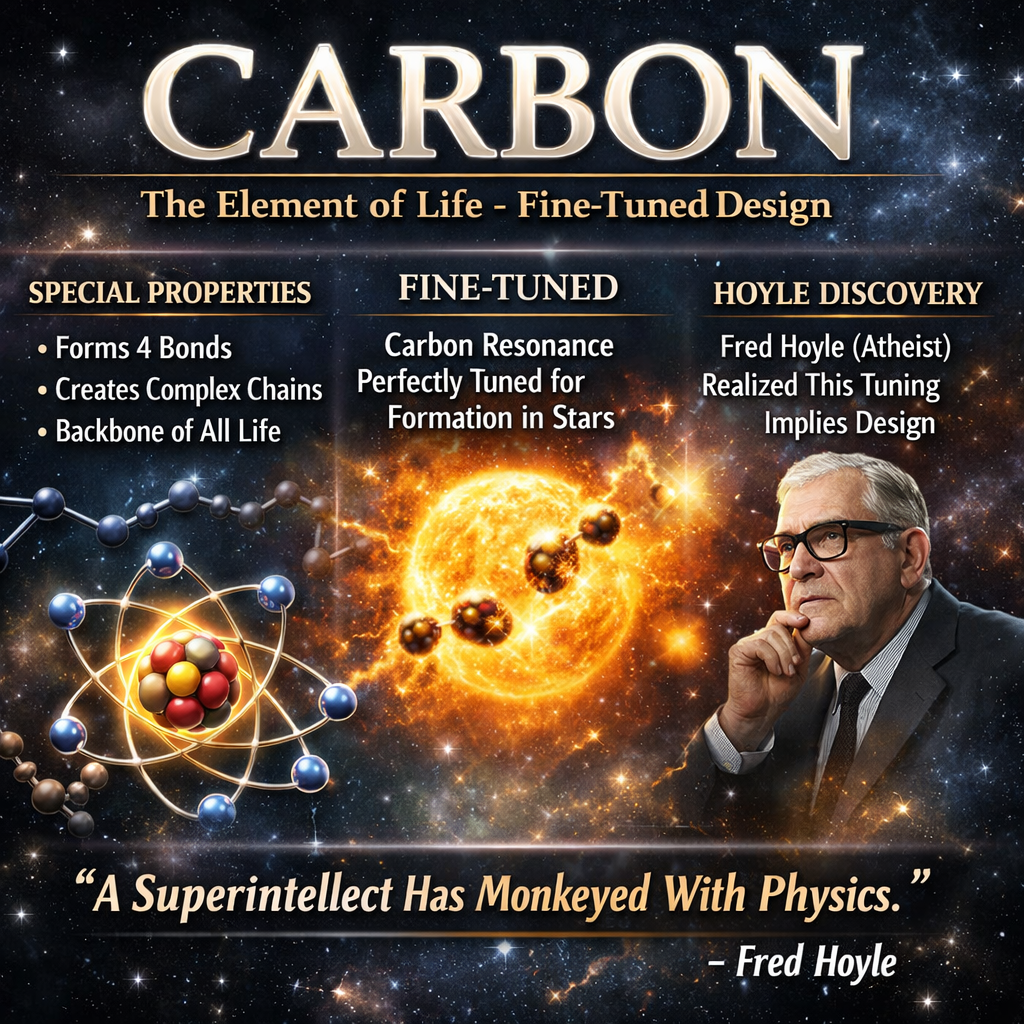
Chemistry Carbon Uniqueness
The Earth Has Breadth
Job 38:18 - "Hast thou perceived the breadth of the earth? declare if thou knowest it all."
"Breadth" (Hebrew: rachab) means width—a flat measurement across a surface.
Understanding the Language
Consider what these terms actually describe:
"Spread forth" - like spreading a blanket
"Stretched out" - like stretching canvas
"Spreadeth abroad" - extends in all directions
"Above the waters" - over the deep/ocean
"Breadth" - width, measurement across
Critical Questions
Can you "spread out" a ball?
What shape do you get when you spread something out?
Why is the same Hebrew root (raqa) used for the firmament AND spreading out the earth?
Lesson 6 Exercises
1. Multiple Choice: The Hebrew word "raqa" (spread forth) is the same root as:
2. Multiple Choice: According to Psalm 136:6, the earth was stretched out:
3. True or False: You can "spread out" a sphere to make it bigger.
4. Analysis: Job 38:18 asks if you've perceived the "breadth" (width) of the earth. Is "breadth" typically used to measure spheres or flat surfaces?
5. Critical Thinking: Why would Yahuah use the same Hebrew root (raqa) for both the firmament (raqia) AND spreading out the earth? What does this suggest about their nature?
Lesson 7: Answering Common Objections
Introduction
This lesson equips you to respond to common objections raised against the biblical cosmology we've been studying.
Objection 1: "Those are just figures of speech/poetry"
Biblical Response:
Which ones? All 67+ verses describing this cosmology?
The firmament alone is mentioned 17 times with physical descriptions
Foundations, pillars, cornerstone—all "figures of speech"?
Why would Yahuah use ONLY language that contradicts reality?
If He wanted to describe a ball, He could have used "dur"
Scripture claims to be truth—not systematic deception
Objection 2: "The Bible isn't a science book"
Biblical Response:
No, but when it describes creation, it's accurate
Either Yahuah told the truth about what He made, or He didn't
2 Timothy 3:16 - ALL Scripture is inspired by Elohim
Can we trust Yahuah's word or not?
The issue isn't "science" - it's whether Scripture is true
Objection 3: "Circle (chug) can mean sphere"
Biblical Response:
No, "chug" means circle/circuit—a flat round shape
Hebrew HAS a word for ball: "dur" (Isaiah 22:18)
Isaiah knew both words and chose "circle" in 40:22
A compass draws a circle, not a sphere
If he meant sphere, he would have used "dur"
Objection 4: "Job 26:7 says earth hangs on nothing - proving a ball in space"
Biblical Response:
"Hangs upon nothing" = no visible support underneath
Same chapter (v.11) mentions "pillars of heaven tremble"
The earth is supported by Yahuah's power, not visible props
This doesn't prove a spinning ball in space
Read the full context (Job 26:5-14) - pillars, bounds, etc.
Objection 5: "Scientists have proven the earth is a globe"
Biblical Response:
Have they proved it, or claimed it?
What observable, testable, repeatable proof exists?
CGI images are not proof
Mathematical models are not proof
We should test claims against Scripture AND observation
Romans 3:4 - "Let Elohim be true, but every man a liar"
Objection 6: "We have photos from space"
Biblical Response:
NASA admits all "photos" are composites—CGI pieced together
Different "photos" show vastly different Earth sizes
Continent shapes change between images
No continuous video of a rotating earth exists
Compare different NASA images—they don't match
Romans 3:4 - "Yea, let Elohim be true, but every man a liar."
Proverbs 30:5-6 - "Every word of Eloah is pure: he is a shield unto them that put their trust in him. Add thou not unto his words, lest he reprove thee, and thou be found a liar."
Lesson 7 Exercises
1. Scenario: Someone tells you "The Bible isn't a science book." How would you respond?
2. Scenario: Someone claims Isaiah 40:22's "circle" proves the earth is a sphere. What evidence proves otherwise?
3. Scenario: Someone says "We have photos of earth from space." What problems exist with this claim?
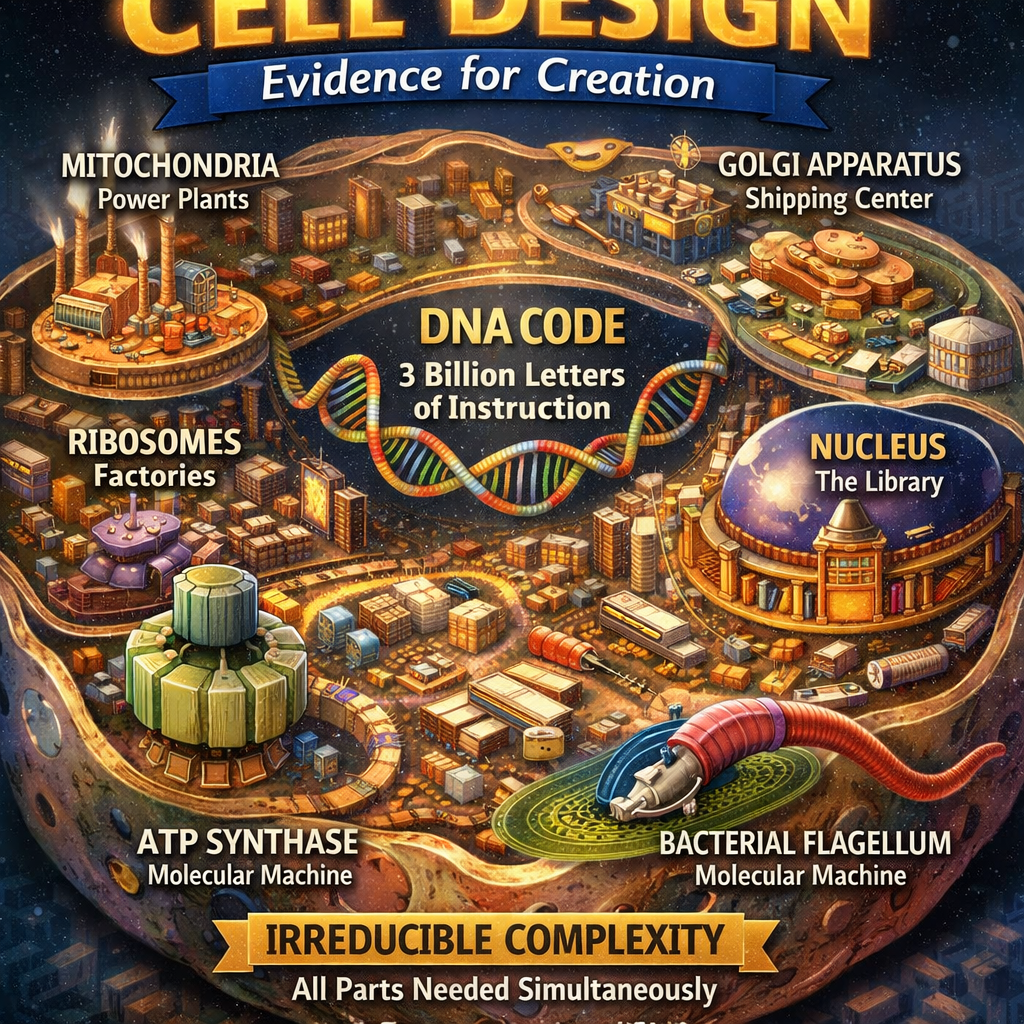
Biology Cell Design
4. Analysis: How does Job 26:7 ("hangs upon nothing") fit with Job 26:11 ("pillars of heaven")? Are these contradictory or complementary?
5. Application: According to Romans 3:4 and Proverbs 30:5-6, whose word should we trust when there's a conflict between Scripture and human claims?
Lesson 8: Review and Personal Commitment
Summary of Evidence
Throughout this study, we have examined what Scripture actually says about the earth:
Scripture Teaching
Key Verses
Earth cannot be moved
Psalm 93:1, 96:10, 104:5; 1 Chronicles 16:30
Earth has foundations
Job 38:4-6; Isaiah 48:13; Zechariah 12:1
Earth has pillars
1 Samuel 2:8; Job 9:6; Psalm 75:3
Earth is a circle (not ball)
Isaiah 40:22 (chug, not dur)
Sun moves (not earth)
Joshua 10:12-13; Psalm 19:4-6; Ecclesiastes 1:5
Earth has ends
Isaiah 40:28, 45:22; Job 28:24, 38:13
Earth has four corners
Isaiah 11:12; Revelation 7:1, 20:8
Earth spread/stretched out
Isaiah 42:5, 44:24; Psalm 136:6
The Core Question
Who Will You Believe?
Every single description in Scripture contradicts the modern globe model. This is not one verse—it's CONSISTENT throughout Scripture. Either Scripture is wrong about creation, or modern "science" is wrong. Both cannot be true.
Romans 3:4 - "Yea, let Elohim be true, but every man a liar."
What This Means
If Scripture's cosmology is accurate:
We live in a designed creation, not random chance
Earth is special and central, not an insignificant speck
There is a Creator above watching over us
The heavens declare His glory (Psalm 19:1)
Modern "science" has deceived the nations
Scripture can be trusted literally
Personal Commitment
Having studied the Scriptures about the earth, I affirm:
The earth is fixed and cannot be moved (Psalm 93:1, 96:10, 104:5; 1 Chronicles 16:30)
The earth has foundations, pillars, and a cornerstone (Job 38:4-6; 1 Samuel 2:8)
The sun moves, not the earth (Joshua 10:12-13; Ecclesiastes 1:5; Psalm 19:4-6)
The earth is a circle (chug), not a ball (dur) (Isaiah 40:22 vs. 22:18)
The earth has ends and corners, which a sphere does not have
I will trust Scripture over the claims of men (Romans 3:4)
I will study further and share this truth with others
Name:
Date:
Lesson 8 Exercises
1. Reflection: What did you believe about the earth's shape and motion before this study?
2. Reflection: Which Scripture or teaching impacted you most during this study? Why?
3. Personal: Is it difficult to believe Scripture when it contradicts what you were taught in school? How do you resolve this conflict?
4. Implications: If Scripture is literally accurate about the earth's structure, what does this mean about creation, Yahuah's design, and our place in the universe?
5. Application: How will you apply what you've learned? Will you study further? Share with others?
6. Final Summary: In your own words, summarize the main evidence that Scripture describes a fixed, unmoved earth rather than a spinning ball in space.
Complete Answer Key
For Instructor Use
Lesson 1: The Earth Cannot Be Moved
1. C) Four
2. C) To waver, slip, shake, totter
3. C) Firm, stable, fixed, secure
4. False - The context is Yahuah's reign, sovereignty, creation, and judgment. These are factual statements made in connection with His power and creative acts, not casual poetry.
5. Sample answer: No. Something moving at over 500,000 mph combined cannot accurately be described as "stable," "established," or something that "cannot be moved." The Hebrew words mean firm, fixed, and not wavering—the opposite of constant violent motion.
6. Sample answer: The common theme is that earth is fixed, stable, and immovable. The repetition in multiple books (Psalms, Chronicles) emphasizes this is important truth, not poetry. Yahuah wanted this fact clearly established.
Lesson 2: Foundations, Pillars, and Cornerstone
1. A=3, B=5, C=4, D=1, E=2
2. B) The pillars of the earth
3. C) Fastened
4. False - These are construction terms for fixed structures (buildings, foundations). You cannot describe a spinning ball with terms like "foundations that are fastened," "measures," "survey line," "cornerstone," and "pillars."
5. Sample answer: Yahuah uses construction terminology because the earth IS a constructed, founded structure—not a ball floating in space. Buildings have foundations, pillars, and cornerstones. Balls do not.
6. Sample answer: "Hangs on nothing" means no visible support underneath (Yahuah's power holds it). "Pillars of heaven" shows creation has structural elements. These complement each other: creation has structure, but it's held by Yahuah's power, not visible ropes.
Lesson 3: Circle vs. Ball
1. B) Chug (circle)
2. B) Isaiah 22:18
3. B) A tent and curtain
4. False - Chug means circle (flat, round shape). Dur means ball (sphere). Isaiah knew both words and used them correctly in their respective contexts.
5. Sample answer: This proves Isaiah knew the difference between circle and ball. When he meant ball (22:18), he used "dur." When describing earth (40:22), he chose "chug" (circle). If he meant sphere, he would have used "dur."
6. Sample answer: This sounds like a flat circle with a dome (tent) covering. Looking down from above (grasshoppers view), with a curtain/tent stretched over it—this is biblical cosmology: flat circle, dome firmament.
Lesson 4: The Sun Moves
1. B) The sun and moon
2. B) A tabernacle and a circuit
3. C) Hurries/moves quickly
4. False - If earth's rotation (1,000 mph) suddenly stopped, everything would fly off, oceans would flood continents, supersonic winds would destroy everything. Joshua's account shows an ordinary day extended—no catastrophe.
5. Sample answer: The verse clearly says "the sun returned"—actual movement of the sun. If the sun is stationary, this verse makes no sense. But if the sun actually moves, the verse is straightforward.
6. Sample answer: Scripture consistently describes the SUN as moving because that's what actually happens. Yahuah could have written "Earth, stop rotating" if that's what occurred. He consistently wrote about sun movement because the sun actually moves.
Lesson 5: Ends and Corners
1. B) End, extremity, edge, border
2. C) The four corners of the earth
3. D) Zero
4. False - On a sphere, you travel forever without reaching an end. On a flat surface with edges, you can reach ends/borders.
5. Sample answer: On a sphere with ~3-mile horizon, a tree couldn't be visible to "the end of all the earth." This would only work on a flat, extended surface where distant sight is possible.
6. Sample answer: If these were just figures of speech, we'd expect SOME language describing a ball. But Scripture ONLY uses flat-earth language: ends, corners, spread out, foundations, pillars. This consistency shows intentional accurate description.
Lesson 6: Spread Out and Stretched
1. B) Raqia (firmament)
2. B) Above the waters
3. False - Spreading something out produces a flat surface. You cannot spread out a ball.
4. Sample answer: "Breadth" (width) is a flat measurement—used for flat surfaces, not spheres. Spheres have circumference and radius, not "breadth."
5. Sample answer: The same root (raqa = beat/spread out) used for both suggests they're similar: both spread out, beaten flat, extended. The firmament and earth surface are both spread-out expanses.
Lesson 7: Answering Objections
1-5. Personal responses—assess for understanding of key arguments: Hebrew word distinctions, contextual evidence, Scripture authority, photo/image issues.
Lesson 8: Review and Commitment
1-6. Personal reflections—assess for genuine engagement, accurate summary of evidence, and thoughtful application.