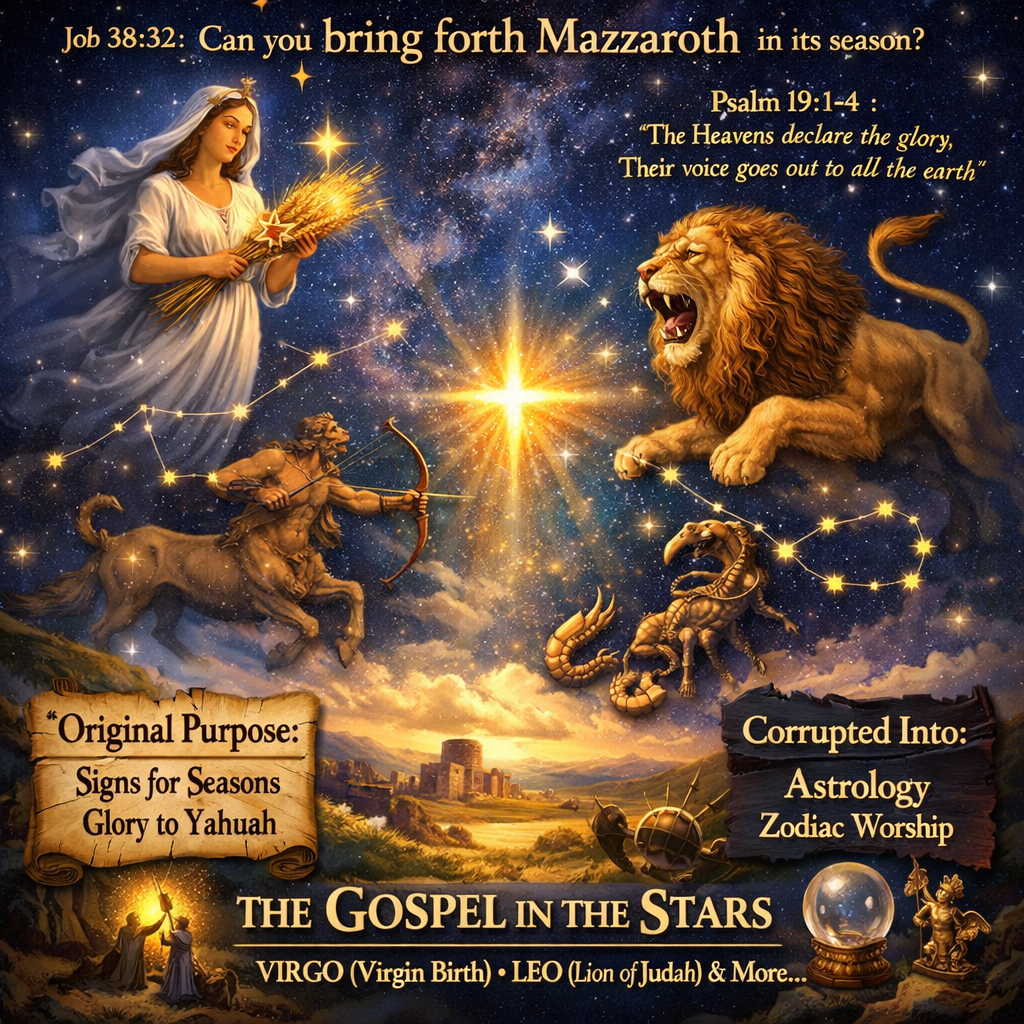
The Mazzaroth - Yahuah's Witness in the Heavens
How to Use This Workbook (6Rs)
Each lesson follows: Receive (read/learn), Reflect (questions), Recall (close-book memory), Recite (teach-back), Review (spaced repetition), Respond (apply).
Lessons
1Purpose of the Luminaries
RECEIVE
"Let them be for signs and for moedim and for days and years." – Genesis 1:14
The sun, moon, and stars were created to mark time and testify of Yahuah's order. The Hebrew terms otot (signs) and moedim (appointed times) connect astronomy directly to worship and calendar keeping.
REFLECT
Multiple Choice
- 1) "Moedim" means: a) Harvests b) Appointed times c) Stars d) Months
- 2) Which day were luminaries made? a) Day 1 b) Day 2 c) Day 4 d) Day 6
- 3) "Otot" refers to: a) Judgments b) Signs c) Seasons d) Weeks
Fill in the blank
- They were created for _______ and for moedim.
- The word "moedim" comes from the root meaning "to ______."
- Day 4 purpose: mark ______ and years.
- Psalm 19 says the heavens declare ______.
- Signs in the heavens are described as divine ______.
True / False
T / F The luminaries are primarily decorative.
T / F Genesis 1 connects lights to moedim.
T / F Appointed times are random.
Discussion: How does viewing the sky as a calendar change how you see worship?
RECALL
Without looking, list the four purposes of the luminaries.
RECITE
Explain Genesis 1:14 to a friend in two minutes using the terms signs and moedim.
REVIEW
Mark your review checks below: Day 1 □ Day 3 □ Day 7 □ Day 21 □ Day 60 □
RESPOND
Plan to observe one sunset this week and note how it marks the day's end in Yahuah's calendar.
2Signs and Moedim
RECEIVE
Moedim are divine appointments (Leviticus 23). The luminaries announce Sabbaths and feast days, showing Yahuah's schedule in the sky.
REFLECT
- MC: The weekly moed tied to creation is: a) Passover b) Sabbath c) Trumpets d) Firstfruits
- MC: Which light best marks months? a) Sun b) Moon c) Stars
- MC: Feasts are rehearsals pointing to: a) Sports b) Prophecy c) Weather
- Fill: "Moed" means appointed ______.
- Fill: The moon marks the ______ in Scripture.
- Fill: Sabbath is the ____ day of the week.
- Fill: Leviticus ___ lists the moedim.
- Fill: Appointments are Yahuah's ______.
- TF: Moedim are only for ancient Israel. (T/F)
- TF: The sky proclaims appointed times. (T/F)
- TF: Feasts have no prophetic meaning. (T/F)
- Discussion: Why call feasts "rehearsals"?
RECALL
Name three spring moedim and one fall moedim from memory.
RECITE
Teach back how the moon signals moedim in one minute.
REVIEW
Review checks: 1 □ 3 □ 7 □ 21 □ 60 □
RESPOND
Choose one upcoming feast and note the moon phase that will accompany it.
3The Heavens Declare
RECEIVE
"The heavens declare the glory of El; the sky shows His handiwork." – Psalm 19
Psalm 19 presents two witnesses: the silent sky and the written Torah. Both reveal Yahuah's glory and instruction.
REFLECT
- MC: Psalm 19 pairs heavens with: a) Kings b) Torah c) Priests
- MC: The sky's speech is described as: a) Loud b) Silent yet universal c) Local
- MC: Bullinger saw the sky as: a) Random b) Prophetic narrative c) Myth
- Fill: Psalm 19 moves from sky to ______.
- Fill: Torah is called ______ and ______ (Ps 19:7).
- Fill: The sky has no ______ yet is heard.
- Fill: Stars are said to be counted and ______ by Yahuah.
- Fill: Psalm 104:19 says the moon marks ______.
- TF: Psalm 19 says the heavens are silent. (T/F)
- TF: The passage denies Torah. (T/F)
- TF: Both creation and Scripture witness together. (T/F)
- Discussion: How do sky and Scripture reinforce each other?
RECALL
Quote the first line of Psalm 19 and summarize its shift at verse 7.
RECITE
Explain to a peer how Psalm 19 supports biblical astronomy.
REVIEW
Review checks: 1 □ 3 □ 7 □ 21 □ 60 □
RESPOND
Write a short prayer thanking Yahuah for revelation in the sky and in Torah.
4Moon and Biblical Calendar
RECEIVE
Psalm 104:19: "He appointed the moon for moedim." The moon governs months (chodesh) and anchors feast timing. Lunar observation keeps the calendar tied to creation rather than civil systems.
REFLECT
- MC: The Hebrew for month is: a) Moed b) Chodesh c) Shanah
- MC: First visible crescent is used by: a) Solar only calendars b) Biblical observers c) Clocks
- MC: Which feast is on 1st day of 7th month? a) Passover b) Trumpets c) Shavuot
- Fill: Moon marks the ______ times.
- Fill: New moon signals start of a ______.
- Fill: Trumpets is day ___ of month seven.
- Fill: Equinox relates to length of ______.
- Fill: Genesis 1:14 ties lights to ______.
- TF: Moon phases are irrelevant to feasts. (T/F)
- TF: Yahusha rose on Firstfruits. (T/F)
- TF: Lunar cycle is ~29.5 days. (T/F)
- Discussion: Why might Yahuah link worship to the moon cycle?
RECALL
List the four primary moon phases in order.
RECITE
Teach someone how the moon marks the start of a biblical month.
REVIEW
Review checks: 1 □ 3 □ 7 □ 21 □ 60 □
RESPOND
Observe the next new moon and record the sighting date.
5Ordinances of Heaven (Job 38)
RECEIVE
Job 38:31-33 references Pleiades, Orion, and Mazzaroth. Yahuah asks if humans can "bind" or "loose" these constellations, highlighting His control and the ordered statutes of the heavens.
REFLECT
- MC: Mazzaroth likely refers to: a) Planets b) Zodiac band c) Comets
- MC: Orion in Hebrew is: a) Kesil b) Kimah c) Ash
- MC: Pleiades means: a) Archer b) Cluster c) Lion
- Fill: "Can you bind the chains of ______?"
- Fill: Yahuah calls stars by their ______.
- Fill: Ordinances of heaven = fixed ______.
- Fill: Job 38 contrasts divine power with human ______.
- Fill: Mazzaroth is mentioned in Job ___.
- TF: Humans control star movements. (T/F)
- TF: The passage shows random chaos. (T/F)
- TF: Names of constellations are known in Scripture. (T/F)
- Discussion: How do these verses inspire humility when studying the sky?
RECALL
Without notes, name the three constellations cited in Job 38.
RECITE
Explain "ordinances of heaven" in your own words.
REVIEW
Review checks: 1 □ 3 □ 7 □ 21 □ 60 □
RESPOND
Look up the night sky map and locate Orion or Pleiades this week.
6Named Stars in Scripture
RECEIVE
Scripture references Pleiades (Kimah), Orion (Kesil), Arcturus/Bear (Ash), and the "chambers of the south." These names show awareness of specific star groups and their roles.
REFLECT
- MC: Ash/Ayish is often linked to: a) Virgo b) Great Bear c) Draco
- MC: Polaris is near the: a) Celestial equator b) North celestial pole c) South pole
- MC: Pleiades nickname: a) Daughters of Zion b) Seven Sisters c) Mighty Men
- Fill: Kimah refers to ______.
- Fill: Kesil is translated as ______ in many versions.
- Fill: Arcturus may also be the ______ Bear.
- Fill: Chambers of the south point to ______ constellations.
- Fill: Yahusha is called the bright and morning ______.
- TF: Ancient Hebrews had zero knowledge of constellations. (T/F)
- TF: Scripture says Yahuah names stars. (T/F)
- TF: Polaris exactly aligns with the pole forever. (T/F)
- Discussion: Why might Scripture mention specific star groups?
RECALL
List three star/constellation names found in Scripture.
RECITE
Share the meaning of "Kimah" and "Kesil" with a peer.
REVIEW
Review checks: 1 □ 3 □ 7 □ 21 □ 60 □
RESPOND
Sketch a simple map of Pleiades or Orion and label its key stars.
7Practical Observation Basics
RECEIVE
Dark adaptation takes ~30 minutes; red light protects night vision. Know the Bortle scale for sky quality and avoid bright screens to see more stars.
REFLECT
- MC: Color least harmful to night vision: a) Blue b) White c) Red
- MC: Full dark adaptation time: a) 5 min b) 30+ min c) 2 min
- MC: Bortle scale class 1 is: a) City b) Suburban c) Excellent dark-sky
- Fill: Rod cells are bleached by ______ light.
- Fill: A dim ______ flashlight is best at night.
- Fill: Bortle ___ is inner city sky.
- Fill: Avoid ______ screens while observing.
- Fill: Planispheres must match your ______.
- TF: Looking at a phone improves adaptation. (T/F)
- TF: Dark adaptation increases sensitivity. (T/F)
- TF: Bortle 9 is the darkest sky. (T/F)
- Discussion: What simple habits improve your viewing session?
RECALL
List two things that destroy dark adaptation and two that protect it.
RECITE
Explain the Bortle scale to someone new to observing.
REVIEW
Review checks: 1 □ 3 □ 7 □ 21 □ 60 □
RESPOND
Plan one 30-minute dark adaptation session this week and record what you see at the start vs. after 30 minutes.
8Finding Your Way in the Sky
RECEIVE
Use Big Dipper pointer stars to find Polaris; use Cassiopeia as a backup. Learn seasonal anchors (Summer Triangle, Winter Hexagon) to navigate.
REFLECT
- MC: Big Dipper stars used as pointers: a) Bowl outer edge b) Handle c) Both
- MC: Polaris is part of: a) Ursa Minor b) Orion c) Lyra
- MC: Summer Triangle includes: a) Vega, Deneb, Altair b) Vega, Betelgeuse, Rigel c) Antares, Spica, Regulus
- Fill: Extend line from Merak through ______ to find Polaris.
- Fill: Polaris altitude ≈ your ______.
- Fill: Cassiopeia looks like a ______.
- Fill: Winter Hexagon includes Sirius and ______.
- Fill: The ecliptic traces the path of the ______.
- TF: The Summer Triangle is visible all winter. (T/F)
- TF: Polaris is fixed forever. (T/F)
- TF: Knowing one asterism helps find many. (T/F)
- Discussion: Which anchor pattern will you learn first and why?
RECALL
Without notes, describe how to locate Polaris using the Big Dipper.
RECITE
Teach a friend the Summer Triangle stars.
REVIEW
Review checks: 1 □ 3 □ 7 □ 21 □ 60 □
RESPOND
Go outside and find one anchor pattern tonight; sketch its position relative to the horizon.
9Seasons, Years, and Appointed Times
RECEIVE
The sun marks days/years; the moon marks months; together they frame the biblical calendar. Solstices and equinoxes mark extremes and balance points; feasts align with harvest seasons.
REFLECT
- MC: Equinox means: a) Longest day b) Equal day/night c) Hottest day
- MC: Sun's noon altitude at equinox: 90° minus ______.
- MC: First month of Scripture begins in: a) Fall b) Spring c) Winter
- Fill: Summer solstice has the ______ day length.
- Fill: Winter solstice has the ______ day length.
- Fill: Equinox sunrise is due ______.
- Fill: Moedim connect to barley and ______ harvests.
- Fill: Genesis 8:22 promises seasons will not ______.
- TF: Biblical year ignores the sun. (T/F)
- TF: Agriculture and feasts are linked. (T/F)
- TF: The moon alone sets years. (T/F)
- Discussion: How does the sky keep you grounded in agricultural reality?
RECALL
State the formula for sun altitude at noon on equinox.
RECITE
Explain how sun and moon together frame the moedim.
REVIEW
Review checks: 1 □ 3 □ 7 □ 21 □ 60 □
RESPOND
Record next sunrise/sunset azimuths on an equinox or solstice and note the change.
10Discernment: Astronomy vs Astrology
RECEIVE
Scripture forbids worship of the host of heaven (Deuteronomy 4:19) yet encourages observing Yahuah's signs. Biblical astronomy studies His order; astrology assigns fates and worship to creation.
REFLECT
- MC: Deut 4:19 warns against: a) Planting b) Worshiping stars c) Farming
- MC: Astrology treats stars as: a) Clocks b) Random c) Gods/fate
- MC: Proper response to heavens: a) Fear b) Worship creation c) Honor Creator
- Fill: Biblical astronomy = study of Yahuah's ______.
- Fill: Astrology assigns personal ______ by stars.
- Fill: Romans 1 warns against worshiping the ______.
- Fill: Psalm 147:4 says Yahuah ______ the stars.
- Fill: Signs point to the ______, not themselves.
- TF: Reading horoscopes aligns with Torah. (T/F)
- TF: Creation points to the Creator. (T/F)
- TF: Studying sky order is idolatry. (T/F)
- Discussion: How can believers keep curiosity without crossing into forbidden practices?
RECALL
List two verses that warn against star worship.
RECITE
Give a 60-second distinction between astronomy and astrology.
REVIEW
Review checks: 1 □ 3 □ 7 □ 21 □ 60 □
RESPOND
Write a personal boundary statement on how you will engage the topic biblically.
Answer Key (Quick Reference)
Lesson 1 MC: 1-b, 2-c, 3-b. T/F: F, T, F.
Lesson 2 MC: 1-b, 2-b, 3-b. T/F: F, T, F.
Lesson 3 MC: 1-b, 2-b, 3-b. T/F: F, F, T.
Lesson 4 MC: 1-b, 2-b, 3-b. T/F: F, T, T.
Lesson 5 MC: 1-b, 2-a, 3-b. T/F: F, F, T.
Lesson 6 MC: 1-b, 2-b, 3-b. T/F: F, T, F.
Lesson 7 MC: 1-c, 2-b, 3-c. T/F: F, T, F.
Lesson 8 MC: 1-a, 2-a, 3-a. T/F: F, F, T.
Lesson 9 MC: 1-b, 2-latitude, 3-b. T/F: F, T, F.
Lesson 10 MC: 1-b, 2-c, 3-c. T/F: F, T, F.
Spaced Review Tracker
Check off each review session after you revisit the lesson content on the suggested days.
| Lesson | Day 1 | Day 3 | Day 7 | Day 21 | Day 60 |
|---|
| 1 | □ | □ | □ | □ | □ |
| 2 | □ | □ | □ | □ | □ |
| 3 | □ | □ | □ | □ | □ |
| 4 | □ | □ | □ | □ | □ |
| 5 | □ | □ | □ | □ | □ |
| 6 | □ | □ | □ | □ | □ |
| 7 | □ | □ | □ | □ | □ |
| 8 | □ | □ | □ | □ | □ |
| 9 | □ | □ | □ | □ | □ |
| 10 | □ | □ | □ | □ | □ |