Intelligent Design in Cellular Systems
TRUTH CARRIERS EDUCATION SYSTEM
True Science Series - Adult/Teen Level
Modern biology reveals something extraordinary: living cells are not simple "blobs of protoplasm" as once believed.
They are molecular factories of astounding complexity.
This workbook examines the molecular machines, genetic code, and irreducible systems that point unmistakably to intelligent design—using evidence from secular scientists themselves.
"The entire cell can be viewed as a factory that contains an elaborate network of interlocking assembly lines, each of which is composed of a set of large protein machines." — Bruce Alberts, former President of the National Academy of Sciences
This workbook uses the 6 Rs Learning Method for deep understanding and long-term retention:
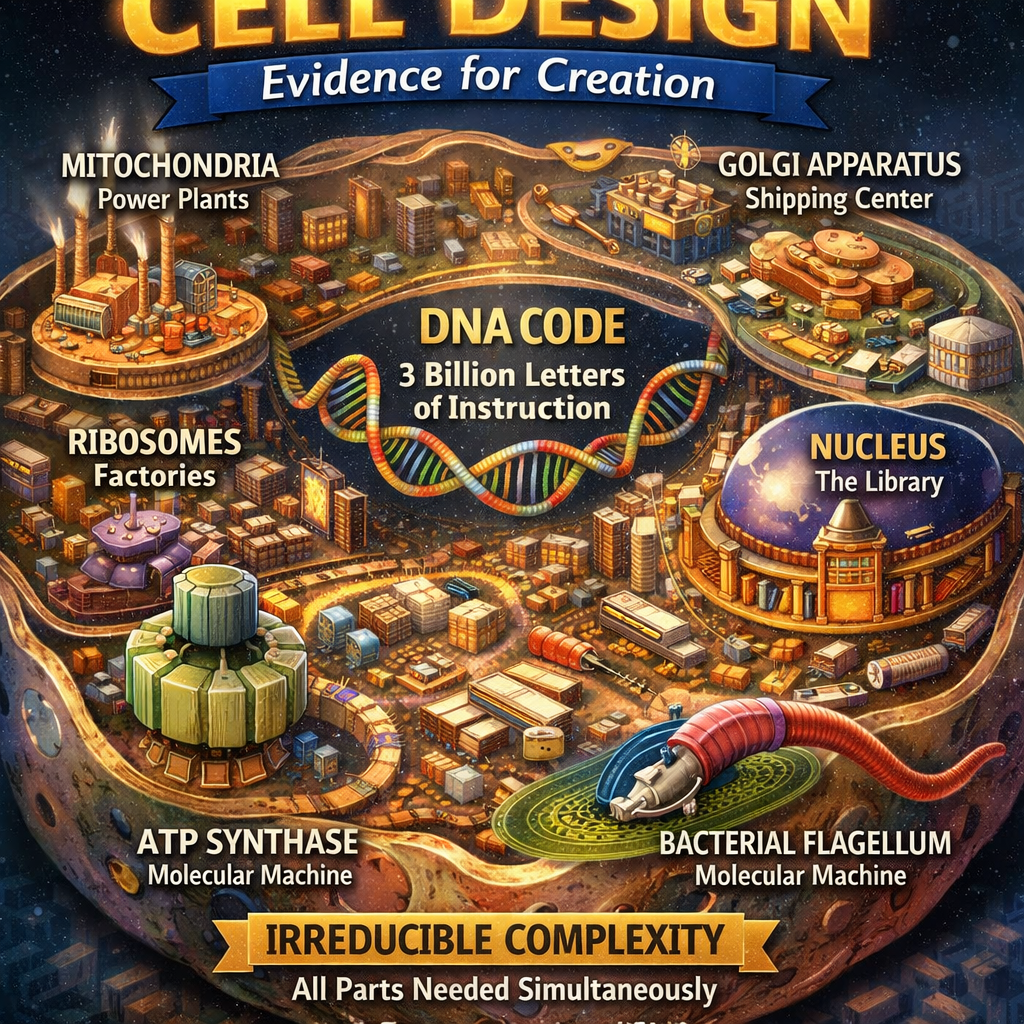
The Cell: A Molecular Factory of Irreducible Complexity
There exists a minimum level of complexity below which independent life is impossible. Even the simplest cells are far more complex than any machine humans have ever built.
The smallest known self-replicating organism is Mycoplasma genitalium, a parasitic bacterium.
Scientists at the J. Craig Venter Institute built a "minimal" bacterial cell with genes (473).
Remarkably, they discovered that of these genes (149) had completely unknown functions—we still don't fully understand even the simplest cell.
Every cell requires a plasma membrane (lipid bilayer) that:
Without a membrane, molecules would simply away (diffuse).
1. The minimum number of essential genes for the simplest cell is approximately:
○ A) 50 genes
○ B) 150 genes
○ C) 380 genes
○ D) 1,000 genes
2. In the 2016 synthetic minimal cell, how many genes had unknown functions?
○ A) 0 - all functions were known
○ B) 149 genes
○ C) 10 genes
○ D) 473 genes
1. Early scientists believed cells were simple "blobs of protoplasm."
○ True ○ False — Correction:
2. A cell can function without a membrane.
○ True ○ False — Correction:
Close this workbook. Write from memory: The minimum gene requirement. Why the 2016 experiment was significant. Four functions of the cell membrane.
Explain to someone why "simple cells" don't exist.
Person: Date:
"I will praise thee; for I am fearfully and wonderfully made."
ATP synthase is a nanoscale rotary turbine that manufactures ATP—the universal energy currency of all living cells.
This molecular machine is embedded in cell membranes and consists of:
By comparison, the most efficient human-made motors achieve only 40-60% efficiency.
ATP synthase operates like a turbine with:
1. ATP synthase is best described as:
○ A) A simple chemical reaction
○ B) A rotary molecular motor
○ C) A random arrangement of proteins
○ D) A temporary structure
2. The efficiency of ATP synthase is:
○ A) About 10%
○ B) About 50%
○ C) Nearly 100%
○ D) Unknown
Draw and label ATP synthase from memory. Include: rotor, stator, proton flow direction, ATP production.
The bacterial flagellum is a rotary propulsion system with remarkable similarity to human-designed outboard motors.
The flagellum consists of 20-30 different proteins arranged as:
Approximately genes are required to build and operate the flagellum (40).
If any critical part is removed—the hook, rotor rings, or stators—the flagellum to function (fails/ceases).
A partial flagellum provides no advantage for (motility/swimming).
1. How many different proteins make up the bacterial flagellum?
○ A) 2-3
○ B) 5-10
○ C) 20-30
○ D) 100+
2. If the hook protein is removed from a flagellum:
○ A) It works slightly less efficiently
○ B) It completely fails to function
○ C) Another protein takes over
○ D) It works better
List the 6 main components of the flagellum from memory. Explain why removal of any part causes failure.
Explain the bacterial flagellum to someone using the outboard motor analogy.
Person: Date:
The ribosome reads genetic instructions and assembles proteins—like an automated factory assembly line.
Structure:
Function:
DNA helicase unwinds the DNA double helix so it can be copied—rotating at speeds comparable to a jet turbine.
Function: Unwinds DNA at the replication fork
Speed: Approximately base pairs per second in E. coli (1,000)
Comparison: The rotational speed has been compared to a turbine (jet)
1. The ribosome is a simple structure with only 2-3 parts.
○ True ○ False — Correction:
2. DNA helicase unwinds DNA at extremely high speeds.
○ True ○ False — Correction:
Compare the ribosome to a factory. List 3 functions of the ribosome. Describe what DNA helicase does.
DNA is not merely a chemical—it is a language, a code, a set of instructions written in molecular form.
DNA (Deoxyribonucleic Acid) is the molecular carrier of genetic information:
DNA uses triplets called (codons) to specify amino acids:
1. The human genome contains approximately:
○ A) 1 million base pairs
○ B) 3.2 billion base pairs
○ C) 100 base pairs
○ D) 50 billion base pairs
2. The genetic code uses codons that are:
○ A) 2 letters long
○ B) 3 letters long
○ C) 4 letters long
○ D) Variable length
Write from memory: The 4 DNA bases. The number of possible codons. Bill Gates' quote about DNA.
Explain to someone how DNA is like computer code.
Person: Date:
Can random, undirected processes create coded information? Information theory says no.
In our uniform experience, meaningful and languages always come from (codes; intelligence).
We never see complex, specified information arising from random processes.
DNA includes sophisticated error correction:
Result: Mutation rate of only 1 mistake per bases (10⁹ or 1 billion)
You need repair enzymes to maintain accurate DNA. But you need accurate DNA to encode repair enzymes. Which came first?
1. Random mutations can create new specified information.
○ True ○ False — Correction:
2. All codes whose origin we know came from an intelligent source.
○ True ○ False — Correction:
Explain: The two properties of functional information. Werner Gitt's quote. The bootstrapping paradox.
Even leading secular scientists acknowledge the extraordinary difficulty of explaining the origin of the genetic code through natural processes.
Francis Crick, co-discoverer of DNA's structure, made this remarkable statement:
This fundamental paradox has no naturalistic solution:
This paradox was so perplexing that Crick even entertained " panspermia" (directed)—the idea that life was sent here by an advanced civilization.
Why would he warn against this? Because biological structures look so much like designed machines that scientists need constant reminders to assume otherwise.
1. According to Francis Crick, the origin of life appears to be:
○ A) Simple and well-understood
○ B) Almost a miracle
○ C) Completely solved
○ D) Not worth studying
2. The chicken-and-egg problem refers to:
○ A) Poultry farming
○ B) DNA needing proteins and proteins needing DNA
○ C) Evolution of birds
○ D) Breakfast foods
Write Francis Crick's 1981 admission from memory. Explain the chicken-and-egg problem.
Explain why even secular scientists admit the origin of life is a "miracle."
Person: Date:
Irreducible Complexity (Michael Behe, 1996): "A single system composed of several well-matched, interacting parts that contribute to the basic function, wherein the removal of any one of the parts causes the system to effectively cease functioning."
A standard mousetrap has five essential parts:
Remove piece and the trap fails completely (any/one).
There is no functional intermediate—no "half-mousetrap" that catches half a mouse.
Darwin wrote that his theory would "absolutely break down" if any complex organ could be shown that could not have been formed by , successive, modifications (numerous; slight).
Irreducibly complex systems cannot be built this way because stages would be non-functional (intermediate).
As we learned, the flagellum requires 40+ protein parts:
1. A mousetrap with only 3 of 5 parts still works partially.
○ True ○ False — Correction:
2. Irreducibly complex systems can be built by small, gradual steps.
○ True ○ False — Correction:
Define irreducible complexity in your own words. Give the mousetrap example. Explain how this challenges evolution.
Blood clotting requires 12+ protein factors interacting in precise sequence.
Components include:
Evidence of Irreducibility:
People missing just one component suffer life-threatening bleeding:
Remove one part and the system fails (catastrophically).
The immune system requires multiple interdependent components working together.
Requirements:
Key Point: If any crucial part is missing, the organism cannot mount specific responses (immune).
1. Hemophilia results from:
○ A) Having too many clotting factors
○ B) Missing one clotting factor
○ C) Having thick blood
○ D) Exercise deficiency
2. The complement system involves approximately how many proteins?
○ A) 2
○ B) 5
○ C) 20
○ D) 100
Explain why hemophilia demonstrates irreducible complexity. List 4 components required for adaptive immunity.
You don't have to take our word for it. Secular scientists themselves acknowledge the design-like nature of living systems.
Write three scientist quotes from memory. Explain why each is significant.
Share these quotes with someone and discuss what they mean.
Person: Date:
Review the key evidence for intelligent design:
Without looking back, list all 6 categories of evidence for design we covered.
Give a 5-minute summary of this workbook to someone.
Person: Date:
Mark each box when you complete a review session:
| Lesson | Day 1 | Day 3 | Day 7 | Day 21 | Day 60 |
|---|---|---|---|---|---|
| 1. Minimum Requirements | |||||
| 2. ATP Synthase | |||||
| 3. Bacterial Flagellum | |||||
| 4. Ribosome & Helicase | |||||
| 5. DNA Language | |||||
| 6. Information Theory | |||||
| 7. Origin of Code | |||||
| 8. Irreducible Complexity | |||||
| 9. More IC Systems | |||||
| 10. Scientist Quotes | |||||
| 11. Application |
Psalm 139:14 - "I am fearfully and wonderfully made"
Romans 1:20 - "His invisible attributes... clearly perceived in the things made"
Colossians 1:16-17 - "By Him all things were created... in Him all things hold together"
Job 38-41 - Yahuah's questions about creation's complexity
Hebrews 3:4 - "Every house is builded by some man; but he that built all things is Elohim"
Isaiah 46:10 - "Declaring the end from the beginning"
Genesis 1:21 - "Elohim created... every living creature... after their kind"
Truth Carriers Education System
Biology by Design: Intelligent Design in Cellular Systems
Adult/Teen Level Workbook