True Science Series - Adult Edition (6Rs)
Testing assumptions, limits, and evidence in radiocarbon dating
Truth Carriers Education System
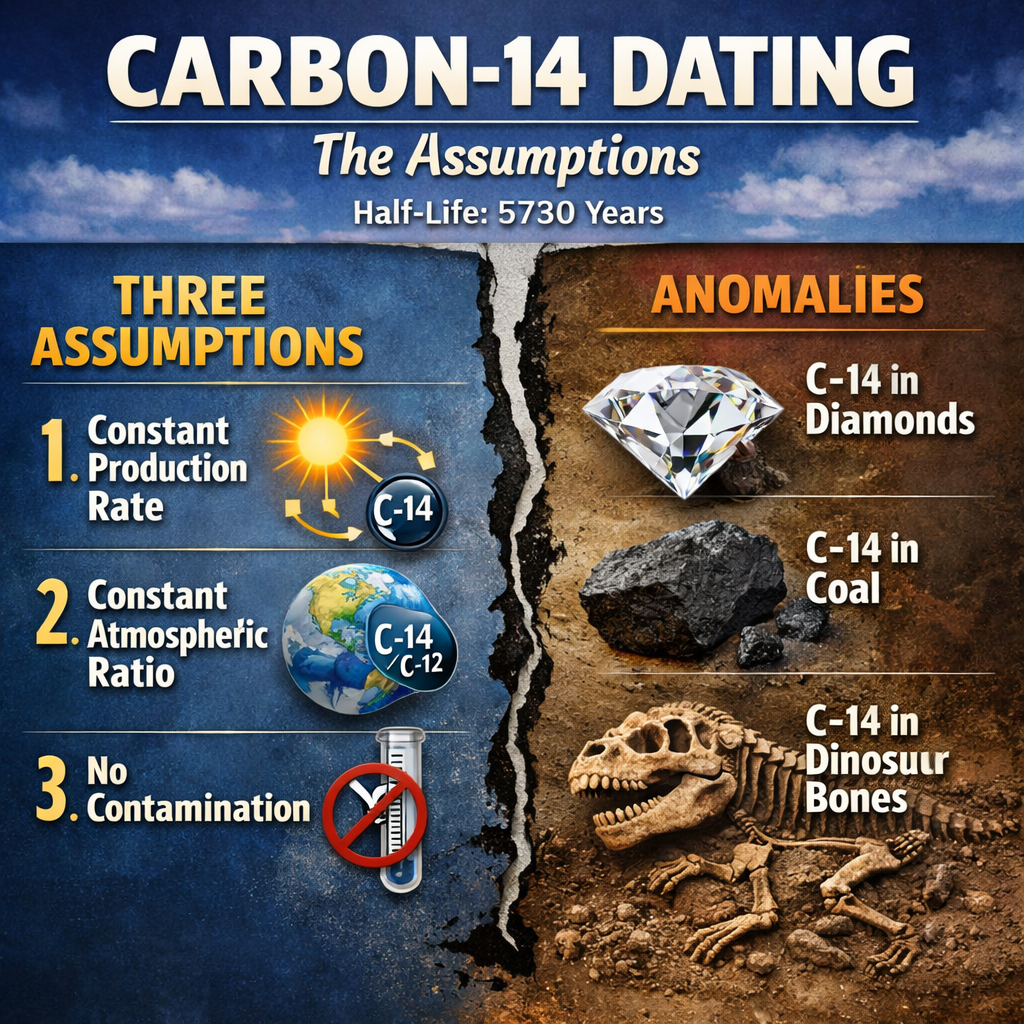
The Three Core Assumptions Behind Carbon-14 Dating
Radiocarbon dating is presented as a settled scientific clock, yet it rests on assumptions, calibrations, and limits. This workbook equips you to separate measurements from interpretations, recognize common error sources, and view the data through a Scriptural lens.
Key Scriptures:
Radiocarbon (C14) is a short-lived isotope formed in the upper atmosphere. Living things exchange carbon with the atmosphere; after death, C14 decays with a half-life of about 5,730 years. The method compares the remaining C14/C12 ratio to an assumed starting ratio.
1. Radiocarbon measures the ratio of ______ to C12 in once-living samples.
2. The half-life of C14 is about ______ years.
3. Radiocarbon does not work on ______ or metals.
Why does radiocarbon provide a range (with error bars) instead of a single exact age?
Without looking, summarize how C14 is produced and why it decays.
Explain to someone why radiocarbon applies only to organics.
Who did you teach? Date:
Every radiocarbon age rests on three unmeasured assumptions: (1) the initial C14/C12 ratio is known, (2) the system stayed closed (no C addition/removal), (3) decay rate is constant. Each assumption can be challenged by history, environment, or handling.
Which is NOT a core assumption?
How could a global Flood disrupt any of the three assumptions?
List the three assumptions without looking.
Teach someone why assumptions matter as much as the measurement.
Calibration curves adjust raw C14 ages using tree rings and other records. But C14 production changes with solar activity, geomagnetic strength, and human impacts (Suess effect, nuclear tests). This means “calibrated” ages still sit on assumptions.
1. Calibration curves often rely on _____________ (tree rings).
2. Solar and _____________ changes alter C14 production.
3. The “bomb pulse” from _____________ tests raised atmospheric C14.
Why does a changing atmosphere make “one-size” initial C14 ratios unlikely?
List two human impacts and two natural factors that change C14 production.
Explain to someone how calibration curves are intended to “fix” changing C14.
Modern carbon makes samples appear younger. Common contamination sources: humic acids in soil, conservation chemicals, microbial growth, and handling. Labs use pretreatment and blanks, but no process is perfect.
How could conservation glues on artifacts alter a reported age?
List three contamination sources and how each skews results.
Teach someone why contamination risk grows as samples approach the 50–60k-year limit.
Some environments dilute C14 with “old” carbon (little or no C14), making samples appear older. Examples: marine shells (deep water), hard-water effect from limestone, volcanic CO2 vents.
1. Marine shells can date older because of the ____________ effect.
2. Volcanic CO2 has little ________, which dilutes atmospheric ratios.
3. Fresh mollusk shells have been dated at ____________ of years.
Why must reservoir corrections be location-specific?
List two settings where reservoir effects are significant.
Explain the hard-water effect to a friend using one example.
Radiocarbon ages beyond ~50–60k years approach instrument background. Tiny contamination or counting noise can swing results by thousands of years. Reported ages are statistical ranges with confidence levels.
Why do small lab errors matter more near the dating limit?
State the common practical limit and one reason for it.
Teach someone why a “measurable” date near 60k years may be mostly noise.
Detectable C14 has been reported in coal, oil, fossils, and even diamonds labeled “millions of years” old. Mainstream explanations point to contamination; young-age models say the presence itself is evidence of youth.
Finding C14 in diamonds suggests:
How should a believer present this data fairly without overstating certainty?
Name two materials older than 1 million years (by conventional dating) that still show measurable C14.
Explain both mainstream and young-age interpretations of C14 in coal.
Examples: living snails dated thousands of years (reservoir effect); wood in lava dated older than encasing rock; mixed dates within one site. Multiple, independent lines of evidence are needed.
1. Living snails dating at thousands of years illustrate the ____________ effect.
2. Multiple independent ____________ help confirm or challenge a reported age.
3. When results disagree, investigators should check ____________ and context.
Why is context (stratigraphy, contamination risk, reservoir) essential when an anomaly appears?
List two anomalies and the likely reasons behind them.
Describe to someone how to “test all things” with dating claims.
The Flood would have buried immense biomass, lowering post-Flood atmospheric C14 relative to C12. Early post-Flood organisms would start with less C14, appearing “older” on today’s scale. Rebalancing over centuries affects calibration.
If pre-Flood C14 was lower, then:
How does a global Flood provide a mechanism for “old” radiocarbon ages within a young-earth view?
State one reason the Flood could change atmospheric C14/C12 ratios.
Teach someone the difference between measurement and interpretation regarding the Flood.
Radiocarbon gives measurements that are interpreted through assumptions. Scripture gives the non-negotiable frame: Yahuah created, the Flood happened, and Yahusha upholds all things. Engage data with humility, clarity, and courage.
List three respectful questions to ask when someone cites a C14 age that conflicts with Scripture.
Close this book. Summarize the biggest limitation of radiocarbon dating.
Share with someone how to “test all things” (1 Thessalonians 5:21) when hearing any scientific claim.
Check off after each review to cement long-term retention.
| Lesson | Day 1 | Day 3 | Day 7 | Day 21 | Day 60 |
|---|---|---|---|---|---|
| 1 | ☐ | ☐ | ☐ | ☐ | ☐ |
| 2 | ☐ | ☐ | ☐ | ☐ | ☐ |
| 3 | ☐ | ☐ | ☐ | ☐ | ☐ |
| 4 | ☐ | ☐ | ☐ | ☐ | ☐ |
| 5 | ☐ | ☐ | ☐ | ☐ | ☐ |
| 6 | ☐ | ☐ | ☐ | ☐ | ☐ |
| 7 | ☐ | ☐ | ☐ | ☐ | ☐ |
| 8 | ☐ | ☐ | ☐ | ☐ | ☐ |
| 9 | ☐ | ☐ | ☐ | ☐ | ☐ |
| 10 | ☐ | ☐ | ☐ | ☐ | ☐ |