TRUTH CARRIERS EDUCATION SYSTEM Homeschool Foundation Series - Adult/Teen Level
Deuteronomy 6:6-7
"And these words, which I command you this day, shall be in your heart: And you shall teach them diligently unto your children, and shall talk of them when you sit in your house, and when you walk by the way, and when you lie down, and when you rise up."
INTRODUCTION
Modern compulsory education is less than 200 years old. For most of human history, parents were responsible for educating their own children—as Scripture commands.
This workbook examines:
The origins and stated purposes of compulsory schooling
The Prussian model and its influence
Key figures who shaped public education
Research comparing homeschool vs. public school outcomes
Legal rights of parents
The biblical mandate for parent-led education
Purpose: To understand WHY we homeschool and the foundations of our educational calling.
HOW TO USE THIS WORKBOOK
The Truth Carriers Learning Method - 6 Rs
1. RECEIVE Read the history and research on education.
2. REFLECT Complete exercises and consider implications.
3. RECALL Write key facts and dates from memory.
4. RECITE Teach others why you chose homeschooling.
5. REVIEW Review at Day 1, 3, 7, 21, 60.
6. RESPOND Apply this knowledge to your homeschool vision.
LESSON 1: THE FIRST COMPULSORY EDUCATION LAW
Historical Fact
The first compulsory education law in America was passed in in .
Stated Rationale
Instill "good " in children
Americanize the influx of immigrants (particularly Irish Catholics)
Create a unified citizenry with standardized
Before Compulsory Education
Prior to 1852:
Parents educated their own children
Churches ran schools
Literacy rates were already (over 90%)
Education was localized and diverse
KEY INSIGHT
Compulsory schooling was NOT created because people were uneducated. It was created to standardize what children were taught and to reduce parental/church influence.
Timeline
1852: Massachusetts passes first compulsory law
1918: All states have compulsory laws
1979: U.S. Department of Education created
Multiple Choice
1. The first U.S. compulsory education law was in:
○ A) Virginia, 1776 ○ B) Massachusetts, 1852 ○ C) New York, 1900 ○ D) California, 1920
2. Before compulsory schooling, literacy rates were:
○ A) Very low (under 30%) ○ B) Moderate (50%) ○ C) Already high (over 90%) ○ D) Unknown
RECALL
Write: When/where first compulsory law passed. Three stated rationales. Pre-compulsory literacy rates.
SCRIPTURE MEMORY: Deuteronomy 6:7
"And you shall teach them diligently unto your children..."
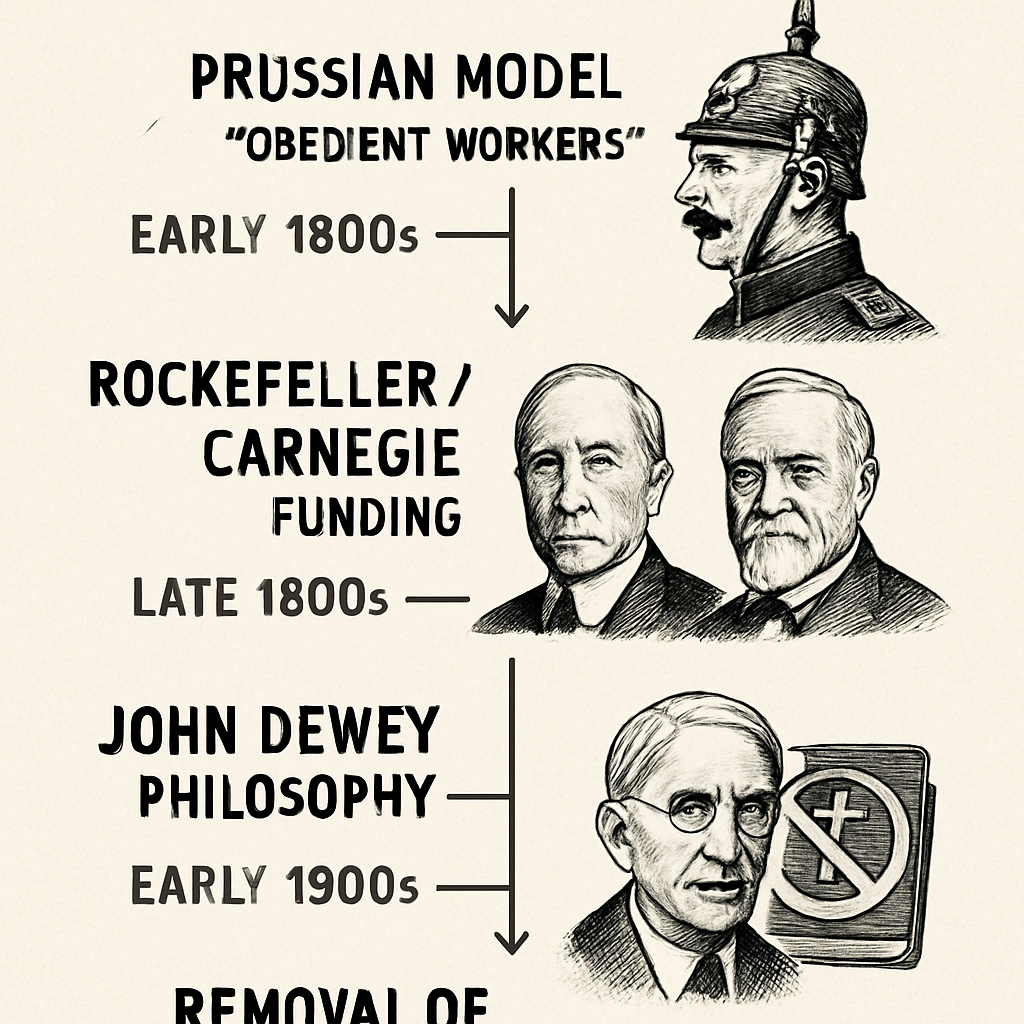
LESSON 2: THE PRUSSIAN MODEL
What Is It?
A system of standardized, state-controlled education developed in (Germany) designed to create obedient citizens and soldiers.
Key Features
Age-graded classrooms (children sorted by age, not ability)
Standardized curriculum (same content for all)
State-trained teachers with approved methods
Bells signaling transitions (factory-style)
Emphasis on to authority
Horace Mann's Role
Horace Mann visited Prussia in and returned to lobby for importing this model to Massachusetts—and eventually all of America.
The Prussian Goal:
Create citizens who would be obedient to the state, work reliably in factories, and not question authority. Critical thinking was NOT a priority.
What Was Replaced
Localized, community-based schools
Multi-age classrooms (older helping younger)
Parent and church involvement
Classical education (logic, rhetoric, history)
Multiple Choice
1. The Prussian model was designed to create:
○ A) Independent thinkers ○ B) Obedient citizens ○ C) Religious leaders ○ D) Scientists
2. Horace Mann visited Prussia in:
○ A) 1776 ○ B) 1837 ○ C) 1900 ○ D) 1950
RECALL
Write: Five features of the Prussian model. Who imported it to America and when.
TEACH-BACK
Explain to someone where the modern school system came from and what it was designed to produce.
Person taught: Date:
LESSON 3: JOHN DEWEY AND PROGRESSIVE EDUCATION
Who Was John Dewey?
John Dewey (1859-1952) was a philosopher known as the "father of Education."
His Influence
Dewey shifted education's focus from:
Classical Education
Progressive Education
Memorization, logic
Experience-based learning
Great books, history
Social relevance
Absolute truth
(truth is relative)
Individual excellence
Democratic cooperation
Key Quote
John Dewey, The School and Society (1899):
Schools should be instruments of social rather than just academic instruction.
Impact
Schools became tools for shaping society
Moral relativism entered curriculum
"Socialization" became a primary goal
Traditional academic rigor decreased
Multiple Choice
1. John Dewey is known as the father of:
○ A) Classical education ○ B) Progressive education ○ C) Homeschooling ○ D) University education
2. Dewey believed schools should be instruments of:
○ A) Religious instruction ○ B) Social change ○ C) Military training ○ D) Parental values
RECALL
Write: Who John Dewey was. How he shifted education's focus. Impact of progressive education.
LESSON 4: DEPARTMENT OF EDUCATION - SPENDING VS. OUTCOMES
Creation
The U.S. Department of Education was created in under President Jimmy Carter.
The Data
Metric
1970
2018
Change
Per-pupil spending (inflation-adjusted)
~$5,000
~$13,000
+156%
NAEP Reading scores (17-year-olds)
285
287
+0.7%
NAEP Math scores (17-year-olds)
304
306
+0.7%
THE DISCONNECT
Spending increased 156%. Test scores remained essentially flat.
Literacy Data
1940: U.S. literacy rate was %
1979: Literacy rate was 99%
2019: ~21% of adults have "low literacy skills" (PIAAC assessment)
Question: Has increased federal involvement in education improved outcomes?
Multiple Choice
1. The U.S. Department of Education was created in:
○ A) 1852 ○ B) 1900 ○ C) 1979 ○ D) 2000
2. Since 1970, per-pupil spending has:
○ A) Decreased 50% ○ B) Stayed flat ○ C) Increased 156% ○ D) Tripled
3. Since 1970, test scores have:
○ A) Increased dramatically ○ B) Remained essentially flat ○ C) Decreased 50% ○ D) Tripled
RECALL
Write: When Dept of Education created. Spending change vs. score change. Literacy trend.
LESSON 5: HOMESCHOOL ACADEMIC RESEARCH
Academic Achievement
Peer-reviewed research consistently shows homeschoolers score to percentile points higher than public school students.
Standardized Test Performance
Test
Homeschool Average
Public School Average
SAT
1190
1060
ACT
26.5
21
Achievement Tests
65th-80th percentile
50th percentile
College Outcomes
Graduation rate: Homeschoolers ~66.7%, Public school ~57.5%
Freshman GPA: Homeschoolers 3.41, Public school 3.12
College acceptance rate: Homeschoolers 87%, Public school 68%
Research Sources
National Home Education Research Institute (NHERI) analyzed 14 peer-reviewed studies; % showed statistically significant positive outcomes for homeschoolers.
Multiple Choice
1. Homeschoolers typically score how much higher on standardized tests?
○ A) 5-10 percentile points ○ B) 15-30 percentile points ○ C) 50+ percentile points ○ D) The same
2. The average homeschool SAT score is approximately:
○ A) 900 ○ B) 1060 ○ C) 1190 ○ D) 1400
RECALL
Write: Three statistics showing homeschool academic advantage.
LESSON 6: THE SOCIALIZATION MYTH
The Common Question
"But what about ?" - The most frequent objection to homeschooling.
Research Findings
A review of peer-reviewed literature found that % of studies showed homeschooled students performed significantly better on measures of social, emotional, and psychological development.
Key Studies
Homeschooled children show equal or better social skills
Better self-concept and self-esteem
Higher leadership ability
Fewer behavioral problems
2025 Study (International Journal of Indian Psychology):
Homeschooled children are "equally capable in terms of " and often exhibit fewer behavioral problems.
Real Socialization
Homeschoolers socialize through:
Community involvement
Sports teams and co-ops
Church activities
Multi-age interactions (more like real life)
Family relationships
BIBLICAL PERSPECTIVE
Scripture never commands children to be "socialized" with age-segregated peers. It commands parents to train children in Yahuah's ways.
Multiple Choice
1. Research shows homeschoolers have:
○ A) Poor social skills ○ B) Equal or better social skills ○ C) No social skills ○ D) Unknown social skills
2. What percentage of studies showed homeschoolers performed better socially?
○ A) 10% ○ B) 30% ○ C) 64% ○ D) 90%
RECALL
Write: Research findings on homeschool socialization. Five ways homeschoolers socialize.
TEACH-BACK
Practice responding to "What about socialization?" using research data.
Person practiced with: Date:
LESSON 7: PARENTAL RIGHTS - SUPREME COURT RULINGS
Pierce v. Society of Sisters (1925)
Supreme Court Ruling:
"The child is not the mere creature of the ."
This ruling affirmed that parents, not the state, have primary authority over children's education.
Wisconsin v. Yoder (1972)
The key homeschool legal victory. The Court ruled that compulsory attendance laws could not override the right of parents to direct religious and educational upbringing.
Troxel v. Granville (2000)
Supreme Court:
Affirmed the " right of parents to make decisions concerning the care, custody, and control of their children."
Meyer v. Nebraska (1923)
Overturned a ban on teaching foreign languages, affirming parental rights in education.
LEGAL FOUNDATION
Parental rights in education are recognized as fundamental rights under the 14th Amendment.
Multiple Choice
1. Pierce v. Society of Sisters established that:
○ A) The state owns children ○ B) Children are not mere creatures of the state ○ C) Parents have no rights ○ D) Public school is mandatory
2. The key homeschool legal case was:
○ A) Roe v. Wade ○ B) Wisconsin v. Yoder ○ C) Brown v. Board ○ D) Marbury v. Madison
RECALL
Write: Three Supreme Court cases supporting parental rights. Key quote from each.
LESSON 8: HOMESCHOOL METHODS COMPARISON
Structured vs. Unstructured
Research (Martin-Chang, 2011) found that homeschooling produces higher academic scores than unstructured (unschooling) methods.
Common Methods
Method
Description
Strengths
Classical
Trivium: Grammar, Logic, Rhetoric
Critical thinking, great books
Charlotte Mason
Living books, nature study, narration
Love of learning, gentle approach
Traditional
Textbooks, workbooks, structure
Clear progression, measurable
Unit Studies
Theme-based, integrating subjects
Engagement, connections
Eclectic
Mix of methods
Flexibility, customization
The 6Rs Method (Truth Carriers)
Receive: Take in the teaching
Reflect: Process through exercises
Recall: Retrieve from memory
Recite: Teach to others
Review: Spaced repetition
Respond: Apply in life
Multiple Choice
1. Research shows which method produces higher scores?
○ A) Unschooling ○ B) Structured homeschooling ○ C) No difference ○ D) Public school style
2. The Classical method is based on:
○ A) Textbooks only ○ B) The Trivium ○ C) Nature study ○ D) Unit themes
RECALL
Write: Five homeschool methods and their strengths. The 6Rs of Truth Carriers method.
LESSON 9: THE BIBLICAL MANDATE
Scripture Commands
Deuteronomy 6:6-7
"And these words, which I command you this day, shall be in your heart: And you shall them diligently unto your children..."
Proverbs 22:6
"Train up a child in the way he should go: and when he is old, he will not from it."
Ephesians 6:4
"And, ye fathers, provoke not your children to wrath: but bring them up in the and admonition of Yahuah."
○ A) Send children to school ○ B) Teach children diligently ○ C) Let children teach themselves ○ D) Hire tutors
2. Ephesians 6:4 specifically addresses:
○ A) Mothers ○ B) Fathers ○ C) Teachers ○ D) Priests
RECALL
Write: Three Scripture passages commanding parent-led education. What should be taught.
SCRIPTURE MEMORY: Proverbs 22:6
"Train up a child in the way he should go: and when he is old, he will not depart from it."
LESSON 10: DANGERS OF PUBLIC SCHOOLING
Concerning Trends
Moral relativism: No absolute truth taught
Evolution: Taught as fact, creation excluded
Secular worldview: Yahuah removed from curriculum
Peer influence: Negative social pressure
Ideology: Political agendas in curriculum
Time Investment
A child in public school from K-12 spends approximately hours in school—more time than any other influence except sleep.
1 Corinthians 15:33
"Be not deceived: evil communications corrupt good ."
The Question
Should we turn our children over to an institution that:
Was designed to create obedient workers?
Removes Yahuah from all instruction?
Teaches evolution as fact?
Promotes moral relativism?
Exposes children to negative peer influence?
Multiple Choice
1. Approximately how many hours does a child spend in K-12 public school?
○ A) 5,000 hours ○ B) 8,000 hours ○ C) 14,000+ hours ○ D) 20,000 hours
2. 1 Corinthians 15:33 warns that bad company corrupts:
○ A) Intelligence ○ B) Good character/manners ○ C) Wealth ○ D) Health
RECALL
Write: Five concerning trends in public education. Scripture warning about influences.
LESSON 11: PRACTICAL HOMESCHOOL VISION
Developing Your Philosophy
Consider and write answers to these questions:
Why are we homeschooling?
What do we want our children to know and become?
What methods align with our family's values?
How will we integrate Scripture into all subjects?
Key Components of Success
Prayer: Foundation of all education
Scripture: Central to all learning
Consistency: Regular schedule and routine
Flexibility: Adapt to your child's needs
Community: Connect with other homeschoolers
Review: Spaced repetition for retention
Your Homeschool Vision Statement
Write a statement of why you homeschool and what you hope to accomplish:
APPLICATION
LESSON 12: SUMMARY - THE CALLING OF PARENT EDUCATORS
What We've Learned
Topic
Key Takeaway
History
Compulsory schooling is recent (1852) and designed for standardization
Prussian Model
Designed for obedience, not critical thinking
John Dewey
Shifted focus from academics to social engineering
Spending vs. Outcomes
156% more spending, flat results
Homeschool Research
15-30 percentile points higher
Socialization
Homeschoolers equal or better
Legal Rights
Parents have fundamental constitutional rights
Biblical Mandate
Parents commanded to teach children
The Call
Psalm 78:4-7
"We will not hide them from their children, showing to the generation to come the praises of Yahuah, and his strength, and his wonderful works that he has done... That the generation to come might know them... and not forget the works of El..."
YOUR CALLING
You are not just "doing school at home." You are fulfilling the biblical mandate to raise the next generation in the fear and admonition of Yahuah. This is a sacred calling—embrace it!
FINAL RECALL
Write: Eight key takeaways from this workbook. Your personal commitment as a parent-educator.
FINAL TEACH-BACK
Share with another family why homeschooling matters and what the research shows.
Family shared with: Date:
SPACED REVIEW TRACKER
Lesson
Done
Day 1
Day 3
Day 7
Day 21
Day 60
1. First Compulsory Law
___
☐
☐
☐
☐
☐
2. Prussian Model
___
☐
☐
☐
☐
☐
3. John Dewey
___
☐
☐
☐
☐
☐
4. Spending vs. Outcomes
___
☐
☐
☐
☐
☐
5. Homeschool Research
___
☐
☐
☐
☐
☐
6. Socialization Myth
___
☐
☐
☐
☐
☐
7. Parental Rights
___
☐
☐
☐
☐
☐
8. Homeschool Methods
___
☐
☐
☐
☐
☐
9. Biblical Mandate
___
☐
☐
☐
☐
☐
10. Dangers
___
☐
☐
☐
☐
☐
11. Practical Vision
___
☐
☐
☐
☐
☐
12. Summary/Calling
___
☐
☐
☐
☐
☐
ANSWER KEY
Lesson 1
Fill-ins: Massachusetts, 1852, order, values, high