True History Series - Adult Edition
Reformation History, Church Authority, and the Battle for Truth
Truth Carriers Education System
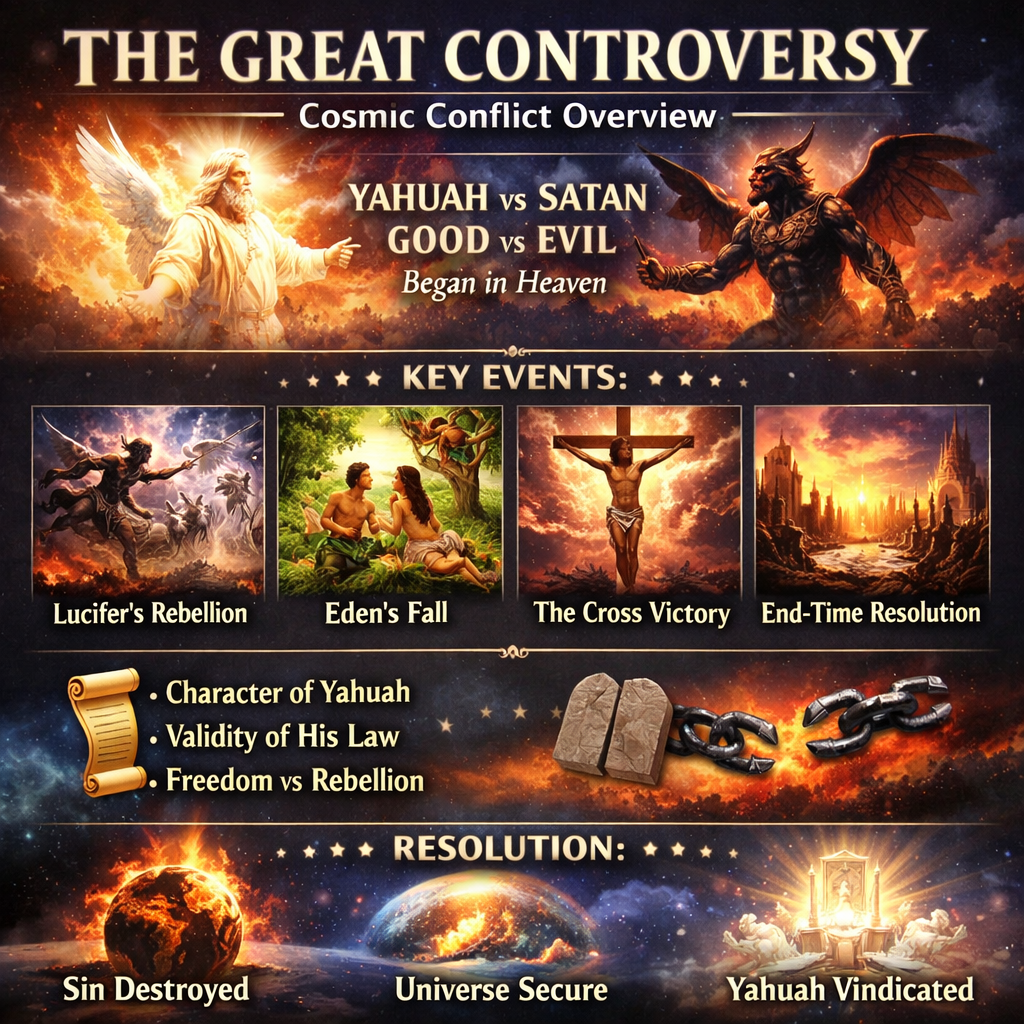
The Great Controversy: From Heaven's Rebellion to Final Victory
This workbook uses the 6 Rs Learning Method designed for deep understanding and long-term retention:
This workbook examines one of the most critical periods in Christian history: the great controversy between truth and apostasy, between Scripture and tradition, between liberty and control.
What You Will Learn:
Key Scriptures:
The Great Controversy: The Cosmic Battle Between Truth and Error
Before Martin Luther nailed his 95 Theses to the Wittenberg door, brave men had already challenged Rome's corruption at the cost of their lives. These were the "proto-reformers" - the morning stars who heralded the coming dawn of Reformation.
Key Contributions:
Historical Context: Wycliffe wrote during the Western Schism (1378-1417), when rival popes in Rome and Avignon excommunicated each other - proving the papacy was not an infallible institution.
Key Work: De Ecclesia (The Church) - argued that the true Church consists of the elect with Christ as the only Head, not a visible hierarchy ruled by the Pope.
The Council of Constance (1414-1418):
1. John Wycliffe is called the "________________ of the Reformation."
2. Wycliffe was the first to translate the Bible into ________________.
3. Jan Hus was rector at the University of ________________.
4. The Council of ________________ condemned Hus to death in 1415.
5. The Council ruled that "________________ need not be kept with heretics."
Why was translating the Bible into common languages considered so dangerous by the Roman Church? What does this tell us about the source of true spiritual authority?
Without looking, write down:
Explain to a family member or friend who John Wycliffe and Jan Hus were, and why their courage matters today.
Who did you teach? Date:
"We ought to obey God rather than men."
The Reformation exploded across Europe in the 16th century. These men - Luther, Tyndale, Calvin, Knox - shared one unifying conviction: Scripture alone (Sola Scriptura) is the final authority, and the papal system had become the prophesied Antichrist.
October 31, 1517: Posted 95 Theses challenging indulgences on Wittenberg church door.
Diet of Worms (1521): When commanded to recant his writings, Luther declared:
Luther on Antichrist (The Smalcald Articles, 1537):
Mission: Translate the Bible into English so common people could read it.
Famous Declaration: "If God spare my life, ere many years I will cause a boy that driveth the plough to know more of the Scripture than thou dost."
Martyrdom: Strangled and burned at the stake in 1536. His dying words: "Lord, open the King of England's eyes."
Key Work: Institutes of the Christian Religion
On Antichrist: Calvin argued that Antichrist must be an ecclesiastical power within the visible church (sitting in "Temple of God"), not an external heathen king or Turkish sultan.
Suffering: Served as a galley slave on a French ship for his faith.
Achievement: Scottish Parliament of 1560 outlawed the Mass and rejected papal jurisdiction.
On Antichrist: The Pope should be recognized as "the very antichrist, and son of perdition, of whom Paul speaks."
| Reformer | Country | Key Statement |
|---|---|---|
| Martin Luther | Germany | "The Pope is the very Antichrist" |
| John Calvin | France/Switzerland | "Paul's words apply to the Papacy" |
| William Tyndale | England | "Cannot preach Christ except against antichrist" |
| John Knox | Scotland | "The very antichrist and son of perdition" |
1. Luther posted his 95 Theses on October 31, ________________.
2. At the Diet of ________________, Luther declared "Here I stand."
3. Tyndale's dying prayer was "Lord, open the King of ________________'s eyes."
4. Calvin's key work was called ________________ of the Christian Religion.
5. The Scottish Parliament of ________________ rejected papal authority.
1. What did ALL the major Reformers agree on regarding prophecy?
2. What principle united the Protestant Reformers?
Why is it significant that Reformers from different countries (Germany, England, France, Scotland) independently arrived at the same interpretation of prophecy?
List the four Reformers from this lesson and one key fact or quote from each:
Explain to someone why the Reformers identified the papacy as Antichrist and what unified them in this belief.
Who did you teach? Date:
"That day shall not come, except there come a falling away first, and that man of sin be revealed... who opposeth and exalteth himself above all that is called God."
Long before Luther, a group of believers preserved biblical truth in the Alpine valleys of Europe. Known as the Waldenses (or Vaudois), they represent what Revelation calls the "woman fled into the wilderness" - the true church preserving apostolic faith during the darkest centuries.
| Catholic/Modern View | Protestant/Traditional View |
|---|---|
| Founded by Peter Waldo, a merchant of Lyon, around 1173 AD | Ancestors retreated to the Alps during the Constantine era (4th century), refusing Rome's syncretism |
| A medieval reform movement | "Church in the Wilderness" of Revelation 12 |
Medieval records refer to the Waldenses as Insabbatati (or Sabbatati, Xabatati). What does this mean?
| "Shoe" Theory | "Sabbath" Theory |
|---|---|
| From wooden sandals (sabots) worn to signify poverty | Related to Sabbath (Sabbatum) observance |
One of the most horrific persecutions of true believers in history:
January 1655: Duke of Savoy issues the Guestaldo Order - Waldenses must convert to Catholicism or face exile.
April 24, 1655: Catholic forces attack the valleys. Thousands massacred in brutal fashion.
Response: Sir Samuel Morland, English ambassador sent by Oliver Cromwell, documented the atrocities in The History of the Evangelical Churches of the Valleys of Piemont (1658).
1. The Waldenses are also called the ________________ (French name).
2. Medieval records called them "________________" which may refer to Sabbath.
3. The Piedmont Massacre occurred in ________________ (year).
4. John ________________ wrote a famous poem about the massacre.
5. Revelation 12 describes the woman (true church) fleeing into the ________________.
Why is it significant that groups like the Waldenses preserved biblical truth throughout the medieval period? How does this challenge the claim that Rome was the "only church" during these centuries?
Write down what you remember about:
Tell someone about the Waldenses and why they matter to church history.
Who did you teach? Date:
"And the woman fled into the wilderness, where she hath a place prepared of God."
How did Christianity shift from seventh-day Sabbath to Sunday observance? The answer lies in the 4th century, when Emperor Constantine legalized Christianity - and began reshaping it.
Four years BEFORE the Council of Nicaea, Constantine issued the first civil law mandating Sunday rest:
| Actually Decided at Nicaea | Common Myths (NOT decided) |
|---|---|
| Arian Controversy: Christ is homoousios (same substance) with the Father | The Bible canon (never discussed) |
| Easter date: Separated from Jewish calendar (Quartodeciman controversy) | Sabbath change to Sunday (not at this council) |
The clearest evidence that the Sabbath was STILL being observed by many Christians comes from this council:
| Date | Event | Significance |
|---|---|---|
| 321 AD | Constantine's Sunday Law | First civil legislation for Sunday rest |
| 325 AD | Council of Nicaea | Separated Easter from Passover calculation |
| 364 AD | Council of Laodicea | Anathematized Sabbath-keeping Christians |
| 538 AD | Siege of Rome broken | Papal temporal power begins (1260 year prophecy) |
1. Constantine's Sunday law was issued in the year ________________ AD.
2. Constantine called Sunday the "venerable day of the ________________."
3. The Council of ________________ threatened anathema against Sabbath-keepers.
4. Canon 29 forbade Christians from "________________" by resting on Sabbath.
5. Daniel 7:25 prophesied that "he" would think to change ________________ and laws.
1. What does Canon 29 of Laodicea prove?
2. What did Constantine's 321 AD law NOT mention?
Constantine's law used "Day of the Sun" language that appealed to both Christians and sun-worshippers. Why would he word it this way? What does this tell us about his motivations?
Describe the three main events in the Sabbath transition:
Explain to someone how and when the Sabbath-to-Sunday transition occurred.
Who did you teach? Date:
"And he shall... think to change times and laws."
The Sabbath transition was just one part of a larger pattern. As Christianity became the state religion, pagan practices were gradually absorbed and "Christianized." This process is called syncretism.
| Element | Origin |
|---|---|
| "Easter" (English name) | Traced by Venerable Bede (8th century) to Eostre/Ostara, Anglo-Saxon goddess |
| Easter eggs | Fertility symbols from spring rites |
| Easter rabbits | Ancient fertility symbols |
| Dawn services | Sun worship traditions |
The cult of martyrs grew rapidly in the 4th century after legalization:
1. December 25th coincides with Natalis Solis ________________.
2. Venerable Bede traced "Easter" to the goddess ________________.
3. The biblical name for the spring celebration is ________________.
4. ________________ is the mixing of different religious practices.
5. The cult of ________________ (departed believers) grew rapidly after 325 AD.
Why did the early church leadership choose to accommodate pagan practices rather than eliminate them? What were the short-term benefits and long-term consequences?
List three examples of syncretism discussed in this lesson and their pagan origins:
Explain what syncretism is and give at least two examples of how pagan practices entered Christianity.
Who did you teach? Date:
"Learn not the way of the heathen... For the customs of the people are vain."
The Reformers' unanimous identification of the papacy as Antichrist created a crisis for Rome. The Counter-Reformation developed theological weapons to deflect this charge - interpretations still dominant in many churches today.
Fourth Session (April 1546) - Tradition Elevated:
"The Council receives and venerates with an equal affection of piety and reverence, all the books both of the Old and of the New Testament... as also the said traditions..."
Result: By elevating Tradition to equality with Scripture, Trent insulated the Church from biblical critique.
Index of Forbidden Books: Institutionalized censorship of vernacular Bible translations.
To deflect the Reformers' identification of the papacy as Antichrist, Jesuit scholars developed two opposing views:
Implication: The papacy CANNOT be Antichrist because he hasn't come yet.
Implication: The papacy CANNOT be Antichrist because prophecies are already fulfilled.
| View | Origin | Antichrist Identity |
|---|---|---|
| Historicism | Protestant Reformers | Papal Rome (fulfilled throughout history) |
| Futurism | Jesuit Ribera (1590) | Future individual (not here yet) |
| Preterism | Jesuit Alcazar (1614) | Ancient Rome (already fulfilled) |
1. The Council of ________________ elevated Tradition to equality with Scripture.
2. ________________ was the Jesuit who developed Futurism in 1590.
3. ________________ developed Preterism in 1614.
4. The original Protestant view is called ________________.
5. Modern dispensationalism follows the ________________ school of interpretation.
1. Why did Rome develop TWO opposite eschatological views?
Why is it significant that modern evangelical churches have largely adopted a Jesuit counter-reformation interpretation of prophecy? What has been lost?
Describe the three major schools of prophetic interpretation and their origins:
Explain how the Jesuits developed counter-eschatology to defend Rome from the Reformers' charges.
Who did you teach? Date:
"Satan himself is transformed into an angel of light."
Perhaps the most powerful witnesses to the Sabbath truth are the Protestant churches themselves. Throughout history, scholars from every major denomination have admitted that Sunday observance has no biblical warrant.
| Denomination | Admission |
|---|---|
| Lutheran | Church "dispensed with" a commandment - no biblical warrant |
| Baptist | "Not in the New Testament" - branded with paganism |
| Catholic | "Not a single line" in Bible - Church changed it |
| Methodist | John Wesley admitted no explicit NT command |
| Presbyterian | Westminster divines acknowledged custom, not command |
1. The Augsburg Confession (1530) is a ________________ document.
2. Dr. Hiscox said Sunday comes "branded with the mark of ________________."
3. Cardinal Gibbons said "the Scriptures enforce the religious observance of ________________."
4. The Catholic Mirror called Sunday "the acknowledged offspring of the ________________ Church."
5. Sola Scriptura means "________________ alone."
If Protestant churches believe in "Scripture alone," but scholars from those same churches admit Sunday has no scriptural basis, how do you reconcile this contradiction?
List three denominational admissions about Sunday and what each one said:
Share these Protestant and Catholic admissions with someone and discuss their implications.
Who did you teach? Date:
"In vain do they worship me, teaching for doctrines the commandments of men."
Daniel and Revelation repeatedly use the numbers 1260 days, 42 months, and "time, times, and half a time." Using the day-for-year principle, the Reformers identified a 1260-year period of papal dominance.
| Expression | Calculation | References |
|---|---|---|
| Time, times, half a time | 3.5 prophetic years | Daniel 7:25; 12:7; Rev 12:14 |
| 42 months | 42 x 30 = 1260 days | Revelation 11:2; 13:5 |
| 1260 days | 1260 prophetic days = 1260 literal years | Revelation 11:3; 12:6 |
The Reformers applied this principle: 1260 prophetic days = 1260 literal years.
Event: The Siege of Rome is broken. Byzantine general Belisarius defeats the Ostrogoths, removing the last Arian obstacle to papal supremacy.
Significance: The Pope gains temporal (political) as well as spiritual authority.
Event: French General Berthier enters Rome by order of Napoleon. Pope Pius VI is taken captive.
Result: Pius VI dies in exile in 1799. Papal political power broken.
Math: 538 + 1260 = 1798
1. The 1260 days equals ________________ literal years using day-for-year.
2. Papal temporal power began around ________________ AD.
3. Pope Pius VI was taken captive in ________________.
4. 538 + 1260 = ________________.
5. Revelation 13:3 speaks of a "________________ wound" being healed.
1. What Scripture supports the day-for-year principle?
The prophecy indicates the "deadly wound" would be healed. What evidence do you see in our world today that papal influence is being restored?
Explain the 1260-year prophecy: the dates, the events, and the math:
Walk someone through the 538-1798 timeline and its prophetic significance.
Who did you teach? Date:
"And there was given unto him a mouth speaking great things... and power was given unto him to continue forty and two months."
The battle between truth and error has always had civil implications. Religious liberty - the separation of church and state - was won through immense sacrifice. Understanding its origins helps us guard it today.
| Founder | Religious Position | Key Quote/Action |
|---|---|---|
| George Washington | Freemason/Anglican (rarely took communion) | Used "Great Architect" rather than "Christ" |
| Thomas Jefferson | Deist, rejected Trinity | "Wall of separation between church and State" (1802) |
| Benjamin Franklin | Deist, supported all sects | "Most acceptable service of God was doing good to man" |
| John Adams | Unitarian | Despised "sacerdotal imposture" |
| James Madison | Religious liberty advocate | Wrote Memorial and Remonstrance (1785) |
1. Thomas Jefferson spoke of a "wall of ________________" between church and state.
2. The Treaty of ________________ (1797) stated America was not founded on Christianity.
3. James Madison wrote the Memorial and ________________.
4. Religious liberty protects ________________ from persecution by the majority.
5. The First Amendment protects free exercise of ________________.
Why should Bible-believing Christians support separation of church and state, even if they disagree with how secular culture uses that separation?
Describe the religious beliefs of three founders and why separation of church and state matters:
Explain to someone why religious liberty matters from both a historical and prophetic perspective.
Who did you teach? Date:
"Render unto Caesar the things which are Caesar's; and unto God the things that are God's."
We have traced the great controversy from Wycliffe to the American founding. But this is not merely history - it is preparation. The same issues are returning in our day. How shall we then live?
The same issues - worship, commandments, religious coercion - will return. Those who understand history will recognize the patterns.
| Area | Response |
|---|---|
| Personal Study | Know Scripture and prophecy for yourself |
| Sabbath Observance | Honor Yahuah's appointed times, not man's traditions |
| Discernment | Test all teachings by Scripture alone (Sola Scriptura) |
| Courage | Be willing to stand alone like Luther, Hus, and Tyndale |
| Witness | Share these truths with others |
1. Revelation 14:12 describes saints who keep the ________________ of Elohim.
2. The Reformers used the principle of ________________ Scriptura (Scripture alone).
3. Revelation 13 warns of religious ________________ in the last days.
4. Error uses both ________________ and deception to fight truth.
5. Yahuah has always preserved a ________________ who hold to His truth.
Having completed this study, what three specific actions will you take in response to what you've learned?
List the 10 lessons of this workbook and one key insight from each:
Share the overall message of this workbook with someone - the great controversy between truth and error throughout history.
Who did you teach? Date:
"Here is the patience of the saints: here are they that keep the commandments of God, and the faith of Yahusha."
Review each lesson at these intervals for long-term memory:
| Lesson | Completed | Day 1 | Day 3 | Day 7 | Day 21 | Day 60 |
|---|---|---|---|---|---|---|
| 1. Proto-Reformers | ||||||
| 2. Magisterial Reformers | ||||||
| 3. The Waldenses | ||||||
| 4. Sabbath Transition | ||||||
| 5. Syncretism | ||||||
| 6. Counter-Reformation | ||||||
| 7. Protestant Admissions | ||||||
| 8. 1260 Years | ||||||
| 9. Religious Liberty | ||||||
| 10. Lessons for Today |
Fill in the Blanks: 1. Morning Star 2. English 3. Prague 4. Constance 5. Faith
True/False: 1. FALSE (died naturally, bones later exhumed and burned) 2. TRUE 3. TRUE 4. FALSE (it undermined faith)
Fill in the Blanks: 1. 1517 2. Worms 3. England 4. Institutes 5. 1560
Multiple Choice: 1. b 2. c
Fill in the Blanks: 1. Vaudois 2. Insabbatati/Sabbatati 3. 1655 4. Milton 5. wilderness
True/False: 1. FALSE 2. TRUE 3. FALSE 4. TRUE
Fill in the Blanks: 1. 321 2. Sun 3. Laodicea 4. judaizing 5. times
Multiple Choice: 1. b 2. c
Fill in the Blanks: 1. Invicti 2. Eostre/Ostara 3. Passover 4. Syncretism 5. saints/martyrs
True/False: 1. FALSE 2. TRUE 3. FALSE 4. FALSE
Fill in the Blanks: 1. Trent 2. Ribera 3. Alcazar 4. Historicism 5. Futurist
Multiple Choice: 1. b
Fill in the Blanks: 1. Lutheran 2. paganism 3. Saturday 4. Catholic 5. Scripture
True/False: 1. FALSE 2. TRUE 3. FALSE 4. TRUE
Fill in the Blanks: 1. 1260 2. 538 3. 1798 4. 1798 5. deadly
Multiple Choice: 1. b
Fill in the Blanks: 1. separation 2. Tripoli 3. Remonstrance 4. minorities 5. religion
True/False: 1. FALSE 2. TRUE 3. TRUE 4. FALSE
Fill in the Blanks: 1. commandments 2. Sola 3. coercion 4. force 5. remnant