MATHEMATICS: TRADITIONAL METHODS
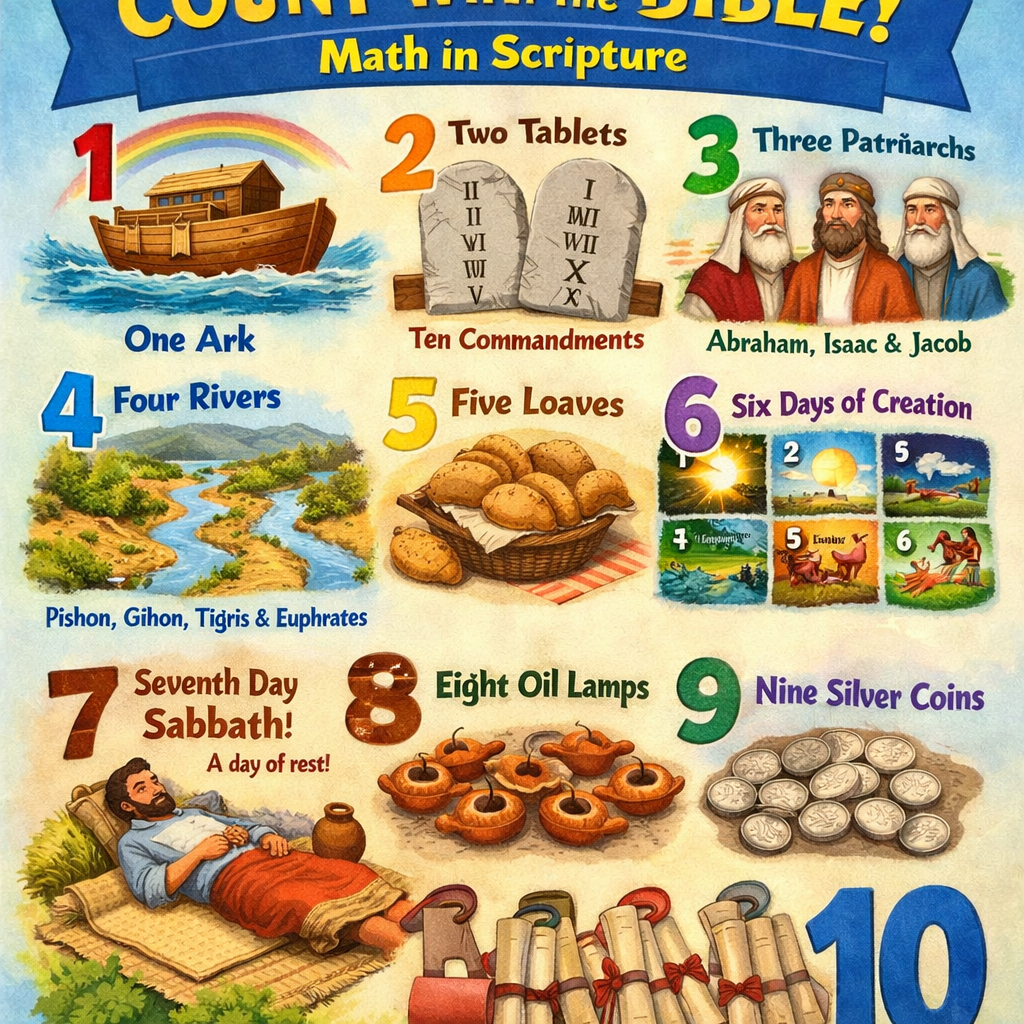
Learning to count with Yahuah!
Building Mathematical Excellence Through Time-Tested Principles
TRUTH CARRIERS EDUCATION SYSTEM Practical Skills Series - All Ages
WORKBOOK OVERVIEW
Purpose: Teach mathematics using classical methods that have proven successful for generations.
Philosophy:
Mastery before moving on - Fully understand each concept before advancingStandard algorithms - Teaching proven methods that actually workMemorization is valuable - Math facts should be automaticVertical progression - Build on solid foundations
THREE TIERS BY AGE
Tier Ages Focus TIER 1 6-9 Foundations: Numbers, Operations, Basic Geometry TIER 2 10-13 Intermediate: Fractions, Percentages, Pre-Algebra TIER 3 14-18 Advanced: Algebra, Geometry, Trigonometry, Calculus
HOW TO USE THIS WORKBOOK
The Truth Carriers Learning Method — 6 Rs
This workbook uses the 6 Rs Learning Method for deep understanding and long-term retention:
1. RECEIVE
2. REFLECT
3. RECALL
4. RECITE
5. REVIEW
6. RESPOND
TIER 1 - LESSON 1: PLACE VALUE (Ages 6-9)
Core Teaching
Understanding place value is the foundation of all mathematics.
Practice Problems
1. 347 = ____ hundreds + ____ tens + ____ ones
2. 5 hundreds + 8 tens + 2 ones = ____
3. What digit is in the tens place of 629? ____
Multiple Choice
1. In 783, which digit is in the hundreds place?
○ A) 3
2. What is 400 + 30 + 5?
○ A) 435
RECALL EXERCISE Close this workbook. Write what hundreds, tens, and ones mean. Write an example number broken into place values.
APPLICATION STEP
TIER 1 - LESSON 2: ADDITION WITH CARRYING (Ages 7-8)
Core Teaching: The Traditional Algorithm
47
+ 28
------
Step 1: Add ones: 7 + 8 = 15
Write 5, carry 1 to tens
Step 2: Add tens: 1 + 4 + 2 = 7
¹
47
+ 28
------
75
Practice Problems
35 58 67 89
+ 27 + 34 + 25 + 47
----- ----- ----- -----
Word Problems
1. A farmer has 48 chickens. He buys 37 more. Total: ____
2. 56 students in one class, 45 in another. Total: ____
Multiple Choice
1. 46 + 27 = ?
○ A) 63
2. When ones add to 10+, you must:
○ A) Stop
RECALL EXERCISE Write the steps for addition with carrying from memory.
APPLICATION
TIER 1 - LESSON 3: MULTIPLICATION TABLES (Ages 7-9)
The Times Tables to MEMORIZE
Multiplication facts should be automatic . Practice until instant recall!
Timed Drill - Solve in 2 minutes
3 × 4 = ____ 5 × 6 = ____ 2 × 9 = ____ 4 × 7 = ____ 6 × 8 = ____ 7 × 7 = ____ 8 × 9 = ____ 9 × 6 = ____ 12 × 5 = ____ 11 × 8 = ____ 7 × 8 = ____ 9 × 9 = ____
Multiple Choice
1. 7 × 8 = ?
○ A) 54
2. 9 × 6 = ?
○ A) 54
RECALL Write out the 7 times table from memory (7×1 through 7×12).
APPLICATION
TIER 2 - LESSON 4: FRACTIONS (Ages 10-11)
Core Teaching
Multiplying Fractions
2 3 2×3 6 1
- × - = ----- = -- = -
3 4 3×4 12 2
Multiply numerators, multiply denominators, simplify.
Dividing Fractions (Keep-Change-Flip)
2 1 2 2 4
- ÷ - = - × - = -
3 2 3 1 3
Keep first, Change ÷ to ×, Flip second.
Practice
1. ½ × ¾ = ____
2. ⅔ ÷ ¼ = ____
3. Convert 2⅓ to improper fraction: ____
Multiple Choice
1. ½ × ⅔ = ?
○ A) ⅓
2. To divide fractions, you:
○ A) Multiply straight across
RECALL Write the rules for multiplying and dividing fractions from memory.
APPLICATION
TIER 2 - LESSON 5: PERCENTAGES (Ages 11-12)
Core Teaching
Common Conversions
Fraction Decimal Percent ½ 0.5 50% ¼ 0.25 25% ⅓ 0.333... 33.3% ¾ 0.75 75%
Practice - Real World Problems
1. A shirt is $40, on sale for 25% off. Sale price: ____
2. Meal costs $35. 15% tip: ____ Total: ____
3. Sales tax is 8%. Item costs $50. Total with tax: ____
Multiple Choice
1. 20% of 60 = ?
○ A) 10
2. A $100 item with 30% off costs:
○ A) $30
RECALL Write how to calculate: discount, tip, and sales tax from memory.
APPLICATION
TIER 3 - LESSON 6: SOLVING EQUATIONS (Ages 14-15)
Core Teaching
x + 5 = 12 3x = 24
x + 5 - 5 = 12 - 5 3x ÷ 3 = 24 ÷ 3
x = 7 x = 8
Two-Step Equations
2x + 5 = 17
Step 1: Subtract 5: 2x = 12
Step 2: Divide by 2: x = 6
Check: 2(6) + 5 = 17 ✓
Practice
1. x + 9 = 15 → x = ____
2. 5x = 35 → x = ____
3. 3x + 7 = 22 → x = ____
4. 4x - 8 = 20 → x = ____
Multiple Choice
1. If 2x + 3 = 11, then x = ?
○ A) 4
2. To solve 5x = 45, you should:
○ A) Add 5
RECALL Write the steps to solve a two-step equation from memory.
APPLICATION
TIER 3 - LESSON 7: PYTHAGOREAN THEOREM (Ages 14-16)
Core Teaching
Find hypotenuse: legs = 3 and 4
a² + b² = c²
3² + 4² = c²
9 + 16 = c²
25 = c²
c = 5
Common Pythagorean Triples (memorize these!)
3, 4, 5
5, 12, 13
8, 15, 17
7, 24, 25
Practice
1. Legs = 6 and 8. Hypotenuse = ____
2. Legs = 5 and 12. Hypotenuse = ____
3. Leg = 9, Hypotenuse = 15. Other leg = ____
Multiple Choice
1. In a right triangle with legs 6 and 8, the hypotenuse is:
○ A) 14
2. The Pythagorean theorem only works for:
○ A) All triangles
RECALL Write the Pythagorean theorem and 3 Pythagorean triples from memory.
APPLICATION
BIBLICAL MATHEMATICS
Numbers in Scripture Reveal Divine Design
This section explores:
The symbolic meaning of key biblical numbers
Introduction to Hebrew gematria (letter-number values)
Mathematical patterns in Yahuah's creation
"The heavens declare the glory of Elohim; and the firmament shows His handiwork." — Psalm 19:1
LESSON 8: BIBLICAL NUMBER SYMBOLISM (All Ages)
Core Teaching: Numbers Have Meaning in Scripture
Throughout the Bible, certain numbers carry consistent symbolic meaning. Understanding these patterns enriches our study of Scripture.
Practice: Finding Number Patterns
1. Yahusha chose ____ disciples (represents authority/government)
2. Israel wandered ____ years in the wilderness (testing)
3. The week has ____ days, with the 7th being Sabbath (completion)
4. Yahusha fasted ____ days in the wilderness (testing)
5. There are ____ books of Moses (Torah = grace/teaching)
Multiple Choice
1. The number 7 in Scripture represents:
○ A) Man's effort
2. Why is 40 significant in the Bible?
○ A) It represents wealth
3. The number 12 appears with:
○ A) Tribes of Israel and Apostles
True or False
1. The number 6 represents human effort falling short. ___
2. There were 10 plagues upon Egypt. ___
3. The number 3 represents testing. ___
RECALL EXERCISE Close the book and write the meanings of: 1, 3, 7, 12, 40.
APPLICATION STEP
LESSON 9: INTRODUCTION TO HEBREW GEMATRIA (Ages 12+)
Core Teaching: Hebrew Letters Have Number Values
In Hebrew, each letter also represents a number. This system is called gematria . The same word can be read as letters OR as a number!
Example Calculations
The Hebrew word for "life" is חי (Chai)
ח (Chet) = 8
י (Yod) = 10
-----------
חי = 18
This is why 18 is considered a "lucky" number!
Gifts are often given in multiples of 18.
The Hebrew word אחד (Echad = "One")
א (Aleph) = 1
ח (Chet) = 8
ד (Dalet) = 4
-----------
אחד = 13
The word אהבה (Ahavah = "Love") also = 13!
This shows One Elohim = Love
Practice: Gematria Calculations
1. Aleph (1) + Bet (2) + Gimel (3) = ____
2. Yod (10) + Hey (5) + Vav (6) + Hey (5) = ____ (this spells YHVH!)
3. What is the value of חי (8 + 10)? ____
4. Shin (300) + Lamed (30) + Vav (6) + Mem (40) = ____ (Shalom = Peace)
Multiple Choice
1. Gematria is:
○ A) A Hebrew prayer
2. The Hebrew word חי (Chai = "life") equals:
○ A) 7
3. Which letter has the highest value?
○ A) Aleph (1)
True or False
1. In Hebrew, the same symbol can be both a letter and a number. ___
2. The value of Yod is 100. ___
3. "Echad" (One) and "Ahavah" (Love) have the same gematria value. ___
RECALL EXERCISE Write the values of Aleph, Yod, and Tav from memory. Calculate חי.
APPLICATION STEP
LESSON 10: MATHEMATICAL PATTERNS IN CREATION (Ages 12+)
Core Teaching: Yahuah's Creation Displays Mathematical Order
The natural world reveals precise mathematical patterns that point to intelligent design rather than random chance.
Fibonacci in Creation
Flower petals: Lilies have 3, buttercups have 5, delphiniums have 8, marigolds have 13Sunflower seeds: Spiral in patterns of 34 and 55Pinecones: Spirals follow Fibonacci numbersTree branches: Branch in Fibonacci patternsHuman body: 1 nose, 2 eyes, 5 fingers per hand
The Golden Ratio in Creation
Nautilus shell: Spirals follow the golden ratioGalaxies: Spiral arms follow golden ratio curvesHuman face: Proportions approximate the golden ratioDNA molecule: Width to length ratio approximates 1.618
Practice: Fibonacci Calculations
1. What is the next number: 1, 1, 2, 3, 5, 8, 13, ____?
2. What is 34 + 55 = ____? (Next Fibonacci number)
3. 21 ÷ 13 = ____ (approximately)
4. 55 ÷ 34 = ____ (approximately)
5. A lily has ____ petals, which is a Fibonacci number.
Multiple Choice
1. The Fibonacci sequence starts with:
○ A) 1, 2, 3, 4, 5
2. The Golden Ratio is approximately:
○ A) 3.14
3. Which is NOT a Fibonacci number?
○ A) 5
True or False
1. Sunflower seed spirals follow Fibonacci patterns. ___
2. The golden ratio appears in the structure of DNA. ___
3. The number 7 is in the Fibonacci sequence. ___
RECALL EXERCISE Write the first 10 Fibonacci numbers and explain how to calculate them.
APPLICATION STEP
📅 SPACED REVIEW TRACKER
Instructions: After completing each lesson, return to review at these intervals.
Lesson Completed Day 1 Day 3 Day 7 Day 21 Day 60 1. Place Value ___/___ ☐ ☐ ☐ ☐ ☐ 2. Addition/Carrying ___/___ ☐ ☐ ☐ ☐ ☐ 3. Multiplication Tables ___/___ ☐ ☐ ☐ ☐ ☐ 4. Fractions ___/___ ☐ ☐ ☐ ☐ ☐ 5. Percentages ___/___ ☐ ☐ ☐ ☐ ☐ 6. Solving Equations ___/___ ☐ ☐ ☐ ☐ ☐ 7. Pythagorean Theorem ___/___ ☐ ☐ ☐ ☐ ☐ BIBLICAL MATHEMATICS 8. Biblical Number Symbolism ___/___ ☐ ☐ ☐ ☐ ☐ 9. Hebrew Gematria ___/___ ☐ ☐ ☐ ☐ ☐ 10. Patterns in Creation ___/___ ☐ ☐ ☐ ☐ ☐
"Precept upon precept... line upon line..." — Isaiah 28:10
ANSWER KEY
Lesson 1: Place Value
1) 3, 4, 7; 2) 582; 3) 2
MC: 1-C, 2-A
Lesson 2: Addition
35+27=62, 58+34=92, 67+25=92, 89+47=136
Word: 1) 85, 2) 101
MC: 1-B, 2-B
Lesson 3: Multiplication
12, 30, 18, 28, 48, 49, 72, 54, 60, 88, 56, 81
MC: 1-B, 2-A
Lesson 4: Fractions
1) ⅜, 2) 2⅔, 3) 7/3
MC: 1-A, 2-B
Lesson 5: Percentages
1) $30, 2) $5.25, $40.25, 3) $54
MC: 1-B, 2-B
Lesson 6: Equations
1) 6, 2) 7, 3) 5, 4) 7
MC: 1-A, 2-D
Lesson 7: Pythagorean
1) 10, 2) 13, 3) 12
MC: 1-B, 2-B
BIBLICAL MATHEMATICS
Lesson 8: Biblical Number Symbolism
1) 12, 2) 40, 3) 7, 4) 40, 5) 5
MC: 1-B (Perfection and completion), 2-B (Testing/trial periods), 3-A (Tribes and Apostles)
T/F: 1-TRUE, 2-TRUE, 3-FALSE (3 represents divine completeness)
Lesson 9: Hebrew Gematria
1) 6, 2) 26 (YHVH), 3) 18, 4) 376 (Shalom)
MC: 1-B (Number system), 2-C (18), 3-D (Tav=400)
T/F: 1-TRUE, 2-FALSE (Yod=10), 3-TRUE (both=13)
Lesson 10: Patterns in Creation
1) 21, 2) 89, 3) 1.615 or 1.62, 4) 1.617 or 1.62, 5) 3
MC: 1-B (0,1,1,2,3,5), 2-B (1.618), 3-C (9 is not Fibonacci)
T/F: 1-TRUE, 2-TRUE, 3-FALSE (Fibonacci: 1,1,2,3,5,8,13... no 7)
🖨️ Print
🗑️ Clear
💾 Save