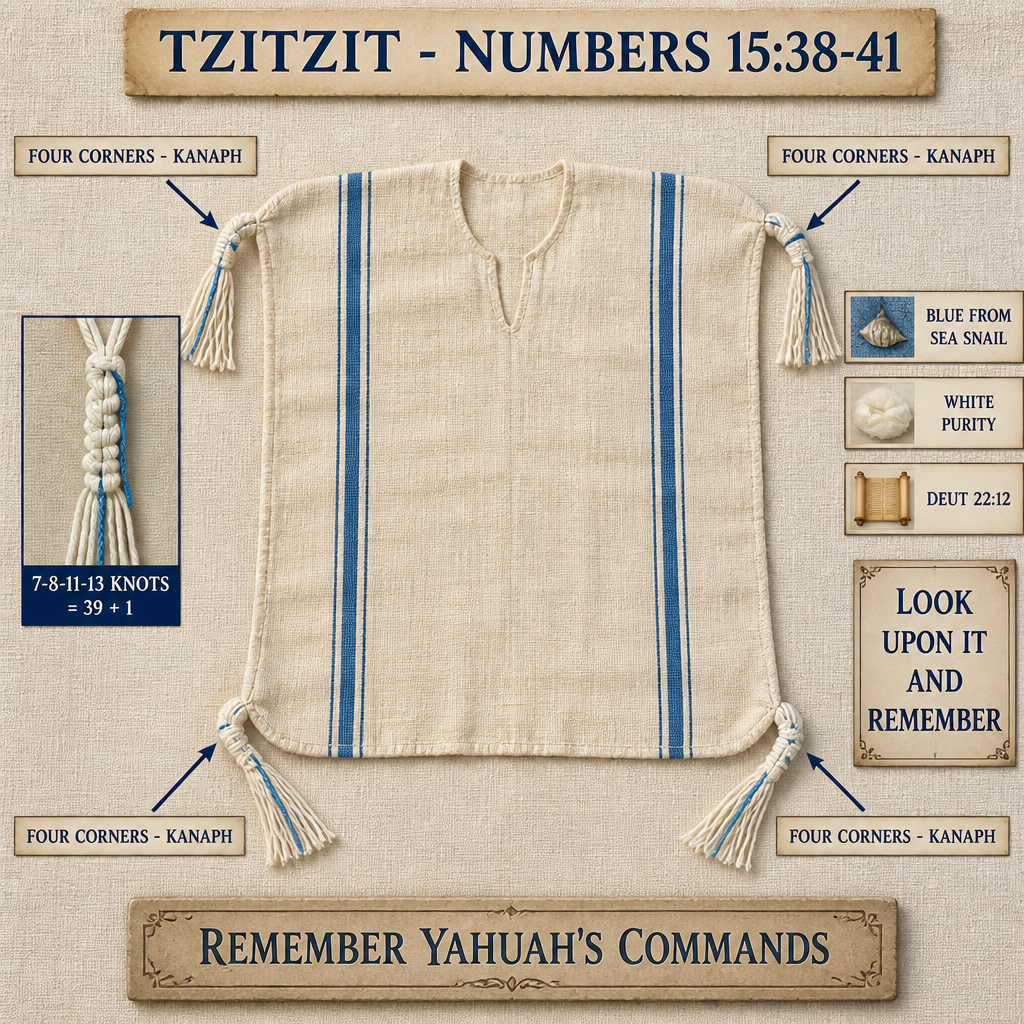
"Speak to the children of Israel: Tell them to make tassels on the corners of their garments throughout their generations, and to put a blue thread in the tassels of the corners."
— Numbers 15:38
Student Name: ________________________________
Date Started: ________________________________
Truth Carriers Ministry straightisthegate.com | messiah2027.com
HOW TO USE THIS WORKBOOK
The 6Rs Learning Method
This workbook uses the 6Rs Learning Method for deep understanding and long-term retention:
1. RECEIVE Read the teaching content carefully. Look up every Scripture reference.
2. REFLECT Answer questions: fill-in-blank, multiple choice, true/false, and discussion.
3. RECALL Close the book and write what you remember from memory.
4. RECITE Teach the lesson to someone else in your own words.
5. REVIEW Use the spaced review tracker: Day 1, 3, 7, 21, 60.
6. RESPOND Apply what you learned with practical action steps.
Sacred Names: This workbook uses the restored names: Yahuah (the Father), Yahusha (the Messiah), and Elohim (plural majesty). Pronunciation: yah-HOO-ah, yah-HOO-sha.
1The Command: Numbers 15:37-41
RECEIVE — Learn the Teaching
"And Yahuah spoke to Moses, saying, 'Speak to the children of Israel: Tell them to make tassels on the corners of their garments throughout their generations, and to put a blue thread in the tassels of the corners. And you shall have the tassel, that you may look upon it and remember all the commandments of Yahuah and do them, and that you may not follow the harlotry to which your own heart and your own eyes are inclined, and that you may remember and do all My commandments, and be set apart to your Elohim.'" — Numbers 15:38-40
צִיצִת
Tzitzit (tsee-TSEET) — "Tassel, fringe, lock of hair" Strong's H6734
Key Elements of the Command
WHO: "Children of Israel" — all covenant people
WHAT: Make tzitzit (tassels) on the corners of garments
WHEN: "Throughout their generations" — perpetual command
WHERE: On the "corners" (kanaf/wings) of garments
WHY: To remember and DO all Yahuah's commandments
The Blue Thread (Tekhelet)
The Hebrew word is פְּתִיל תְּכֵלֶת (petil tekhelet) — a cord/thread of blue.
Tekhelet was a specific shade of blue from a sea creature (likely the Murex trunculus snail)
The same blue used in the Tabernacle and High Priest's garments
Represents the sky/heavens — looking up to Yahuah
Lost for centuries but rediscovered in modern times
REFLECT — Answer Questions
Fill in the Blanks (from Numbers 15:38-40)
1. "Tell them to make _____________ on the corners of their garments."
2. "And to put a _____________ thread in the tassels of the corners."
3. "That you may look upon it and _____________ all the commandments of Yahuah."
4. "And that you may not follow the _____________ to which your own heart and eyes are inclined."
5. "And be _____________ to your Elohim."
Multiple Choice
1. The primary purpose of tzitzit is to:
□ A) Look more religious than others
□ B) Remember and do Yahuah's commandments
□ C) Show ethnic identity
□ D) Protect from evil spirits
2. The tzitzit are placed on the:
□ A) Sleeves of garments
□ B) Collar area
□ C) Corners (wings) of garments
□ D) Belt/waist area
3. The command applies:
□ A) Only to priests
□ B) Only in the wilderness period
□ C) Throughout all generations
□ D) Only during feast days
True or False
____ 1. The tzitzit are meant to be hidden under clothing.
____ 2. The blue thread (tekhelet) was the same blue used in the Tabernacle.
____ 3. Tzitzit help prevent following the desires of heart and eyes.
____ 4. The command was only for Moses' generation.
____ 5. Looking at tzitzit should prompt remembrance of all commandments.
Memory Verse — Numbers 15:39
"And you shall have the tassel, that you may look upon it and remember all the commandments of Yahuah and do them."
RECALL — Close Your Book
Without looking, write:
The three main purposes of tzitzit from Numbers 15
What "tekhelet" means
RECITE — Teach Someone
Explain Numbers 15:37-41 to a family member or friend. Cover: the command, the blue thread, and the purpose.
Person I taught: _________________ Date: _________
RESPOND — Apply This Week
2Deuteronomy 22:12 — The Four Corners
RECEIVE — Learn the Teaching
"You shall make yourself tassels on the four corners of the clothing with which you cover yourself." — Deuteronomy 22:12
Tekhelet appears 49 times in Scripture, always referring to a specific shade of blue used in sacred items:
The Tabernacle curtains (Exodus 26:1)
The veil before the Holy of Holies (Exodus 26:31)
The High Priest's ephod and robe (Exodus 28:6, 31)
Coverings for holy vessels when traveling (Numbers 4:6-12)
The cord to attach the High Priest's crown (Exodus 28:37)
The thread in tzitzit (Numbers 15:38)
The Source: The Chilazon
Ancient sources describe tekhelet coming from a sea creature called the chilazon:
Found in the Mediterranean Sea
Produced a permanent blue dye
Extremely expensive — worth its weight in gold
Knowledge of production was lost around 7th century CE
Modern rediscovery: In the 1990s, researchers identified the Murex trunculus snail as the likely source. The dye process has been recreated, making authentic tekhelet available today.
The Symbolism of Blue
The Talmud (Menachot 43b) explains: "Why is tekhelet different from all other colors? Because tekhelet resembles the sea, and the sea resembles the sky, and the sky resembles the Throne of Glory."
The blue thread connects us visually from earth to heaven — a reminder that our citizenship is above.
Historical Loss
After the destruction of the Temple and dispersions, the knowledge of making tekhelet was lost. For about 1,300 years, Jews wore tzitzit with all-white threads only. The rediscovery of tekhelet in modern times is seen by many as prophetically significant — preparation for restoration.
REFLECT — Answer Questions
Fill in the Blanks
1. Tekhelet appears _____________ times in Scripture.
2. The same blue was used in the Tabernacle and High Priest's _____________.
3. The sea creature source is called the _____________.
4. The color blue symbolically connects earth to _____________ to the Throne.
5. Knowledge of tekhelet production was lost around the _______ century CE.
Multiple Choice
1. The likely source of ancient tekhelet was:
□ A) A plant root
□ B) A mineral deposit
□ C) The Murex trunculus snail
□ D) An insect
2. The blue thread symbolically represents:
□ A) The tribe of Judah
□ B) A connection from earth to heaven
□ C) Water for cleansing
□ D) Royalty of kings
True or False
____ 1. Tekhelet was an inexpensive, common dye.
____ 2. The same blue was used for the veil before the Holy of Holies.
____ 3. Authentic tekhelet is unavailable today.
____ 4. The blue represents a visual connection to Yahuah's throne.
RECALL — Close Your Book
List five items in the Tabernacle/Temple that used tekhelet:
RECITE — Teach Someone
Explain the symbolism of the blue thread: sea → sky → throne of glory.
Person I taught: _________________ Date: _________
RESPOND — Apply This Week
4Yahusha and the Tzitzit
RECEIVE — Learn the Teaching
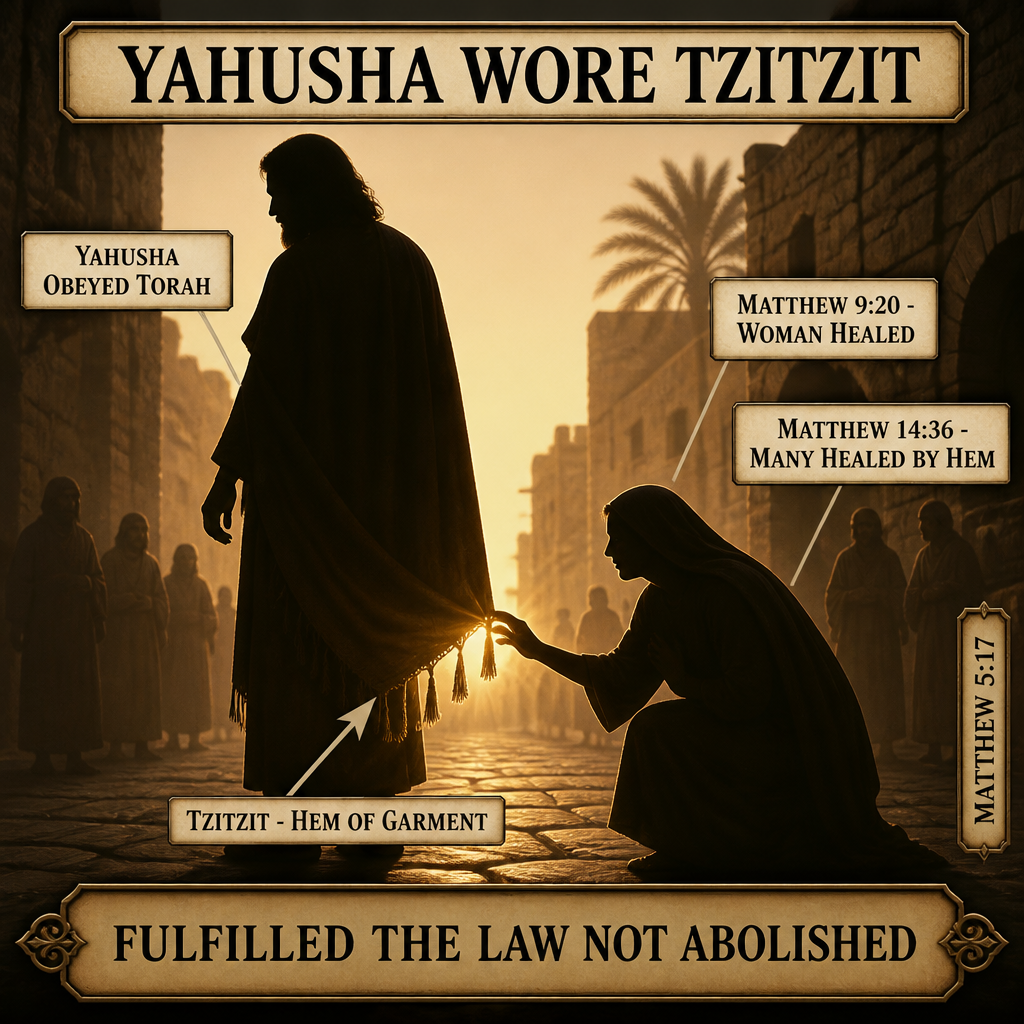
"And suddenly, a woman who had a flow of blood for twelve years came from behind and touched the hem of His garment. For she said to herself, 'If only I may touch His garment, I shall be made well.' But Yahusha turned around, and when He saw her He said, 'Be of good cheer, daughter; your faith has made you well.' And the woman was made well from that hour." — Matthew 9:20-22
The "Hem" = Tzitzit
The Greek word translated "hem" is κράσπεδον (kraspedon) — which specifically means "fringe, tassel, border." This is the same word the Septuagint uses to translate "tzitzit" in Numbers 15:38!
The woman touched Yahusha's tzitzit — the tassels of His garment!
"And begged Him that they might only touch the hem of His garment. And as many as touched it were made perfectly well." — Matthew 14:36
Malachi's Prophecy
"But to you who fear My name the Sun of Righteousness shall arise with healing in His wings." — Malachi 4:2
The Hebrew word for "wings" here is כָּנָף (kanaf) — the same word used for the "corners" of the garment where tzitzit hang! The Messiah would have "healing in His tzitzit" — and Yahusha literally fulfilled this when the sick were healed by touching His tassels!
Yahusha Wore Tzitzit
This proves that Yahusha, as a Torah-observant Jew, wore tzitzit. He kept every commandment, including Numbers 15:38. If the Son of Yahuah wore tzitzit, shouldn't His followers?
REFLECT — Answer Questions
Fill in the Blanks
1. The Greek word "kraspedon" means _____________ or tassel.
2. The woman with the blood flow touched Yahusha's _____________.
3. Malachi 4:2 prophesied "healing in His _____________."
4. The Hebrew word "kanaf" means both wings and _____________ of garment.
5. Yahusha's healing through His tzitzit _____________ Malachi's prophecy.
Multiple Choice
1. The "hem" of Yahusha's garment in Matthew 9:20 was:
□ A) The bottom edge of His robe
□ B) His belt
□ C) His tzitzit (tassels)
□ D) His head covering
2. "Kanaf" in Hebrew means:
□ A) Blue thread
□ B) Wings/corners
□ C) Healing power
□ D) Righteousness
True or False
____ 1. Yahusha did not wear tzitzit because He was above the Law.
____ 2. Multiple people were healed by touching Yahusha's tzitzit.
____ 3. Malachi 4:2 has nothing to do with tzitzit.
____ 4. The Septuagint uses "kraspedon" for tzitzit in Numbers 15:38.
Memory Verse — Malachi 4:2
"But to you who fear My name the Sun of Righteousness shall arise with healing in His wings."
RECALL — Close Your Book
Explain the connection between Malachi 4:2 and the woman touching Yahusha's garment:
RECITE — Teach Someone
Share the revelation: The "hem" in Matthew 9 was Yahusha's tzitzit, fulfilling Malachi 4:2!
Person I taught: _________________ Date: _________
RESPOND — Apply This Week
5Making Tzitzit: The Knots and Wraps
RECEIVE — Learn the Teaching
Traditional Structure
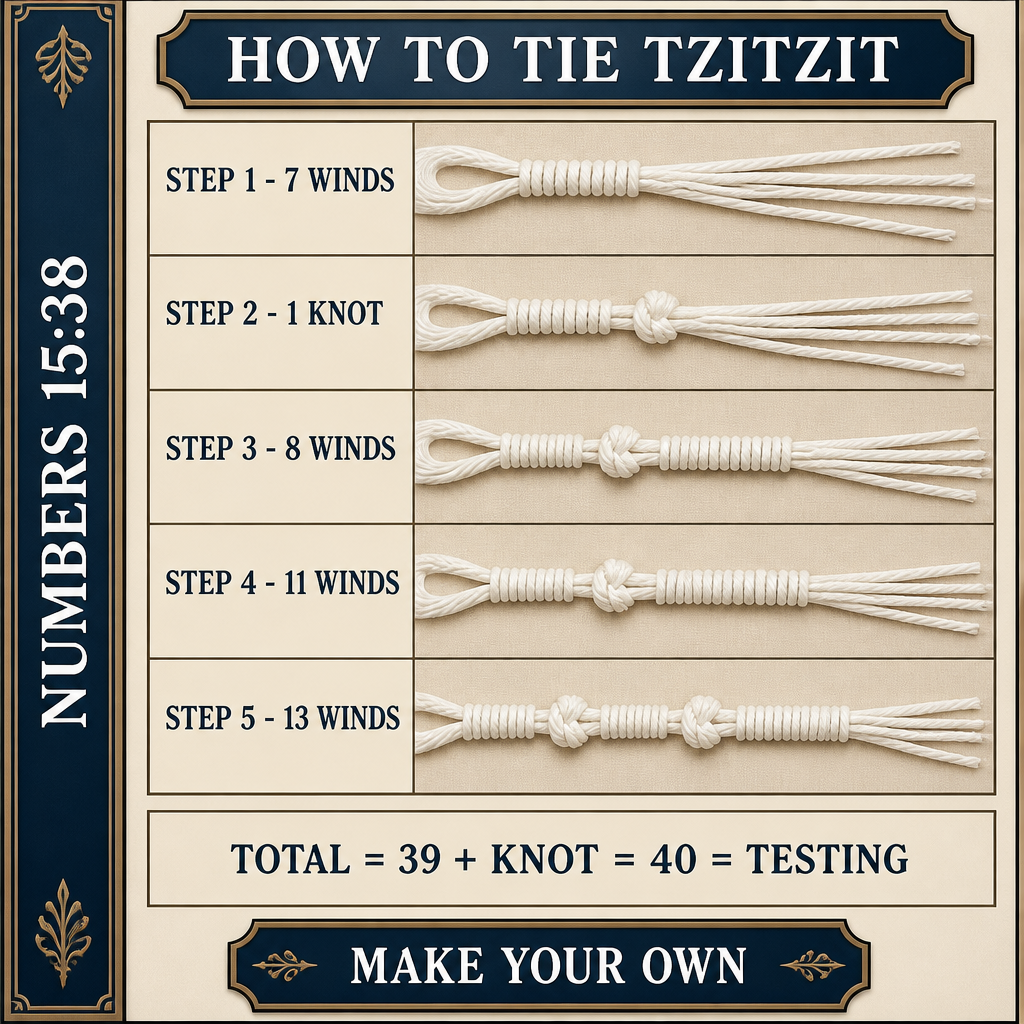
Each tzitzit consists of 8 threads (4 doubled over through a hole in the corner) with a series of knots and wraps. The most common pattern:
5 double knots spaced throughout
Wraps between knots: 7, 8, 11, 13 (one common tradition)
One thread (the shamash) is longer for wrapping
If using tekhelet, typically one of the 4 threads is blue
The Numerical Significance
Element
Number
Significance
Wraps: 7 + 8
15
= YH (יה) — first two letters of Yahuah's name
Wraps: 11
11
= VH (וה) — last two letters of Yahuah's name
Wraps: 13
13
= ECHAD (אחד) — "ONE" (Deut 6:4)
Total wraps
39
Traditional count of Sabbath labors
Knots
5
= Five books of Torah
Note: Different communities use different wrapping patterns. The key is the intention to remember Yahuah's commands.
Gematria: Tzitzit = 600
The Hebrew letters of צִיצִת add up to 600:
צ (Tsade) = 90
י (Yod) = 10
צ (Tsade) = 90
י (Yod) = 10
ת (Tav) = 400
Total = 600
600 + 8 threads + 5 knots = 613 — the traditional count of Torah commandments!
Materials Needed to Make Tzitzit
White wool or cotton thread (at least 24 inches per thread)
One blue thread if using tekhelet
A four-cornered garment with holes in the corners
Patience and prayer!
REFLECT — Answer Questions
Fill in the Blanks
1. Each tzitzit typically has _____________ threads (4 doubled).
2. The longer thread used for wrapping is called the _____________.
3. The gematria value of "tzitzit" is _____________.
4. 600 + 8 threads + 5 knots = _____________.
5. The wraps 7 + 8 = 15, which represents _____________ in Hebrew.
Multiple Choice
1. The common number of double knots in tzitzit is:
□ A) 3
□ B) 4
□ C) 5
□ D) 7
2. The wraps 7+8+11+13 spell out:
□ A) "Torah"
□ B) "Yahuah Echad" (Yahuah is One)
□ C) "Holy Holy Holy"
□ D) "Remember and obey"
True or False
____ 1. All Jewish communities use exactly the same wrapping pattern.
____ 2. The gematria of tzitzit (600) + threads (8) + knots (5) = 613.
____ 3. The shamash is the shorter thread.
____ 4. Tzitzit can be made from wool or cotton.
RECALL — Close Your Book
Write the numerical significance of the wraps (7, 8, 11, 13):
RESPOND — Apply This Week
6When and How to Wear Tzitzit
RECEIVE — Learn the Teaching
When to Wear
The command in Numbers 15:39 says "that you may look upon it" — implying daytime visibility. Traditional practice:
Daytime: Worn throughout the day for visible reminder
Night: Some remove at night (can't "see" in darkness)
Prayer: The tallit gadol is specifically worn during morning prayers
Daily: The tallit katan is worn all day under or over clothing
"And you shall have the tassel, that you may look upon it and remember all the commandments of Yahuah." — Numbers 15:39
"Blessed are You, Yahuah our Elohim, King of the universe, who has set us apart by His commandments and commanded us to wrap ourselves in the tzitzit."
REFLECT — Answer Questions
Fill in the Blanks
1. Numbers 15:39 says to "_____________ upon" the tzitzit.
2. The tallit gadol is typically worn during _____________ prayers.
3. The blessing thanks Yahuah for commanding us to _____________ in tzitzit.
4. Tzitzit serve as a visible _____________ of Yahuah's commands.
True or False
____ 1. Tzitzit must always be worn visibly outside clothing.
____ 2. The command implies daytime wear because it says "look upon."
____ 3. There is no blessing to recite when wearing tzitzit.
____ 4. The tallit katan can be worn under a regular shirt.
RECALL — Close Your Book
List the four wearing options from the table:
RESPOND — Apply This Week
7The Pharisees' Error: Matthew 23:5
RECEIVE — Learn the Teaching
"But all their works they do to be seen by men. They make their phylacteries broad and enlarge the borders of their garments." — Matthew 23:5
What Was Yahusha Criticizing?
Yahusha did NOT condemn wearing tzitzit — He wore them Himself! He criticized the motive:
"To be seen by men" — religious showmanship
"Enlarge the borders" — making tzitzit excessively large for attention
Pride and hypocrisy, not genuine obedience
The problem was pride, not the tzitzit themselves.
Avoiding the Same Error
When wearing tzitzit today, check your heart:
Am I wearing these to remember Yahuah's commands?
Or am I wearing them to look more righteous than others?
Do I feel spiritually superior because of them?
Would I still wear them if no one could see?
Right Motive vs. Wrong Motive
Right Motive
Wrong Motive
Remember Yahuah's commands
Impress others
Personal obedience
Public recognition
Humble reminder
Badge of superiority
Looking to heaven
Looking for applause
REFLECT — Answer Questions
Fill in the Blanks
1. The Pharisees did their works to be _____________ by men.
2. They "enlarged the _____________" of their garments.
3. Yahusha criticized their _____________, not the tzitzit themselves.
4. The right motive is to _____________ Yahuah's commands.
Multiple Choice
1. Yahusha's criticism in Matthew 23:5 was about:
□ A) Wearing tzitzit at all
□ B) Pride and showing off
□ C) Using the wrong color thread
□ D) Wearing them during Sabbath
True or False
____ 1. Matthew 23:5 proves we should not wear tzitzit today.
____ 2. Yahusha Himself wore tzitzit (as shown in Matthew 9).
____ 3. The Pharisees' sin was pride, not tzitzit-wearing.
____ 4. Making tzitzit larger to be noticed is acceptable.
RECALL — Close Your Book
Explain the difference between right and wrong motives for wearing tzitzit:
RESPOND — Apply This Week
8Who Should Wear Tzitzit?
RECEIVE — Learn the Teaching
The Scriptural Scope
Numbers 15:38 says: "Speak to the children of Israel." Who is included?
Biological Israelites — descendants of Jacob
Grafted-in believers — Romans 11 teaches Gentiles are grafted into Israel
Covenant members — all who enter covenant with Yahuah
"One Torah shall be for the native-born and for the stranger who dwells among you." — Exodus 12:49
Should Women Wear Tzitzit?
This is debated in the Torah-observant community:
View
Reasoning
Women should
"Children of Israel" includes women; same Torah for all
Women shouldn't
Time-bound positive command; traditionally male garment
Women may
Optional but permitted; personal conviction
Each family should study, pray, and decide based on conviction.
Should Children Wear Tzitzit?
Training children early creates habits of obedience:
Start when old enough to understand the purpose
Make it a positive experience, not a burden
Teach the meaning as they grow
Model consistent wear yourself
REFLECT — Answer Questions
Fill in the Blanks
1. Romans 11 teaches that Gentile believers are _____________ into Israel.
2. Exodus 12:49 says "One _____________ for the native and the stranger."
3. Whether women wear tzitzit is a matter of _____________ and conviction.
4. Children should be taught the _____________ of tzitzit as they grow.
True or False
____ 1. Only biological Jews should wear tzitzit.
____ 2. Grafted-in believers are part of the "children of Israel."
____ 3. All Torah communities agree on women wearing tzitzit.
____ 4. Training children in tzitzit from young age is beneficial.
RECALL — Close Your Book
List the three views on women wearing tzitzit:
RESPOND — Apply This Week
9Common Objections Answered
RECEIVE — Learn the Teaching
Objection 1: "That's just for Jews"
Answer: Believers grafted into Israel through Messiah share in Israel's covenants (Romans 11, Ephesians 2:12-13). "One Torah for the native and stranger" (Exodus 12:49). If we're Abraham's seed through faith, we're heirs of the promises — and responsibilities.
Objection 2: "We're not under the Law"
Answer: "Under the law" refers to the law's condemnation for sin, not freedom from obedience. Yahusha didn't abolish the Law but fulfilled it (Matthew 5:17-19). "Sin is lawlessness" (1 John 3:4) — rejecting Torah is sin.
Objection 3: "That's legalism"
Answer: Legalism is trying to earn salvation through works. Obedience from love is not legalism — it's what Yahusha commanded (John 14:15). We obey BECAUSE we're saved, not to GET saved.
Objection 4: "It's outdated/cultural"
Answer: Numbers 15:38 says "throughout your generations" — perpetual command. The purpose (remembering commands) is timeless. If cultural dress negates the command, would we discard other "cultural" commandments?
Objection 5: "I don't need physical reminders"
Answer: Yahuah knows us better than we know ourselves. He commanded physical reminders because we NEED them. Do you also reject wedding rings, communion, or baptism as unnecessary physical symbols?
REFLECT — Answer Questions
Fill in the Blanks
1. "Under the law" refers to the law's _____________ for sin.
2. Obedience from love is not _____________.
3. "Throughout your _____________" shows the command is perpetual.
4. We obey _____________ we're saved, not to get saved.
RECALL — Close Your Book
Write responses to two objections from memory:
RECITE — Teach Someone
Practice answering: "Why do you wear those strings on your clothes?"
Person I practiced with: _________________ Date: _________
RESPOND — Apply This Week
10Living the Reminder Daily
RECEIVE — Learn the Teaching
"And you shall have the tassel, that you may look upon it and remember all the commandments of Yahuah and do them." — Numbers 15:39
Three Actions in One Command
LOOK — Intentionally glance at your tzitzit throughout the day
REMEMBER — Let them trigger remembrance of Yahuah's instructions
DO — Put the commands into action
Tzitzit are not magic — they're a trigger for obedience.
Practical Daily Integration
Morning: Put on tallit katan with blessing, setting intention for the day
Throughout day: When you notice your tzitzit, pause and remember Yahuah
Temptation: When tempted, look at tzitzit — "Would this honor Yahuah?"
Conversation: Use as opportunity to share faith when asked
Evening: Reflect: Did I remember and obey today?
The Ripple Effect
Wearing tzitzit affects more than just you:
Your children see obedience modeled
Other believers may be encouraged to study
Unbelievers may ask questions (witnessing opportunity)
You are reminded constantly of your identity
Final Challenge
Yahuah gave this command because He loves us and knows we need reminders. Every commandment is for our good (Deuteronomy 10:13). Will you:
Begin wearing tzitzit if you don't already?
Wear them more consistently if you've been inconsistent?
Use them intentionally as the reminder they're meant to be?
REFLECT — Final Questions
Fill in the Blanks
1. The three actions in Numbers 15:39 are look, remember, and _____________.
2. Tzitzit are a _____________ for obedience, not magic.
3. When _____________, looking at tzitzit can help us choose obedience.
4. Wearing tzitzit can be a _____________ opportunity when asked about them.
True or False
____ 1. Tzitzit automatically make us more righteous.
____ 2. Looking at tzitzit should trigger remembrance of Yahuah.
____ 3. Every commandment is for our good.
____ 4. Wearing tzitzit only affects the individual wearer.
Final Memory Verse — Deuteronomy 10:13
"To keep the commandments of Yahuah and His statutes which I command you today for your good."
RECALL — Final Summary
Write a summary of the entire tzitzit command: what, why, how, and who:
RECITE — Final Teach-Back
Teach someone the full lesson of tzitzit: the command, the symbolism, Yahusha's connection, and practical application.
Person I taught: _________________ Date: _________
RESPOND — Commitment
My commitment regarding tzitzit:
Signature: _________________ Date: _________
ANSWER KEY
Lesson 1
ADULT Tzitzit Numbers15
Fill-in: 1) tassels 2) blue 3) remember 4) harlotry 5) set apart