Welcome, Young Artists!
"I will praise Thee; for I am fearfully and wonderfully made: marvellous are Thy works." - Psalm 139:14
Yahuah is the Master Artist who created everything we see - from towering mountains to tiny butterflies, from brilliant sunsets to the intricate patterns on a snowflake. When we create art, we reflect His creative nature in us!
What We Will Learn:
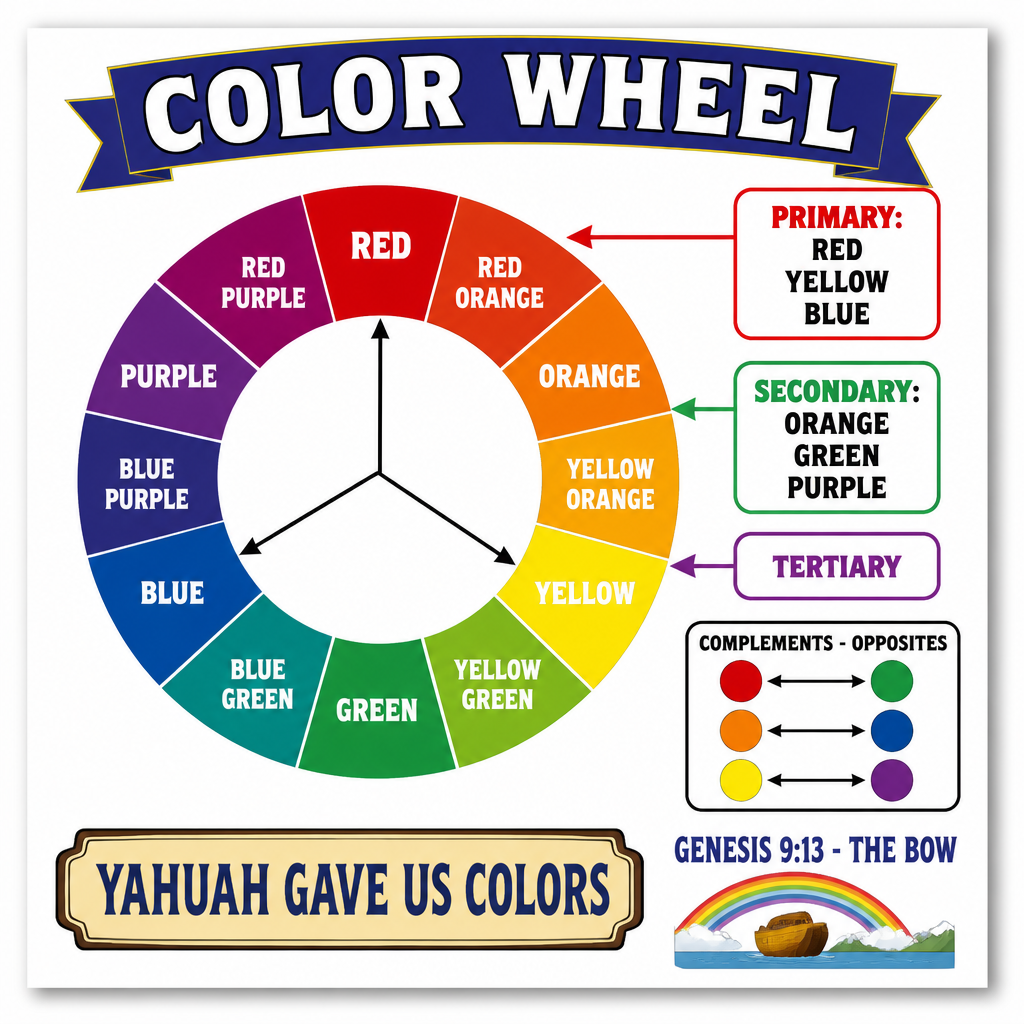
CHILD Art Color Wheel
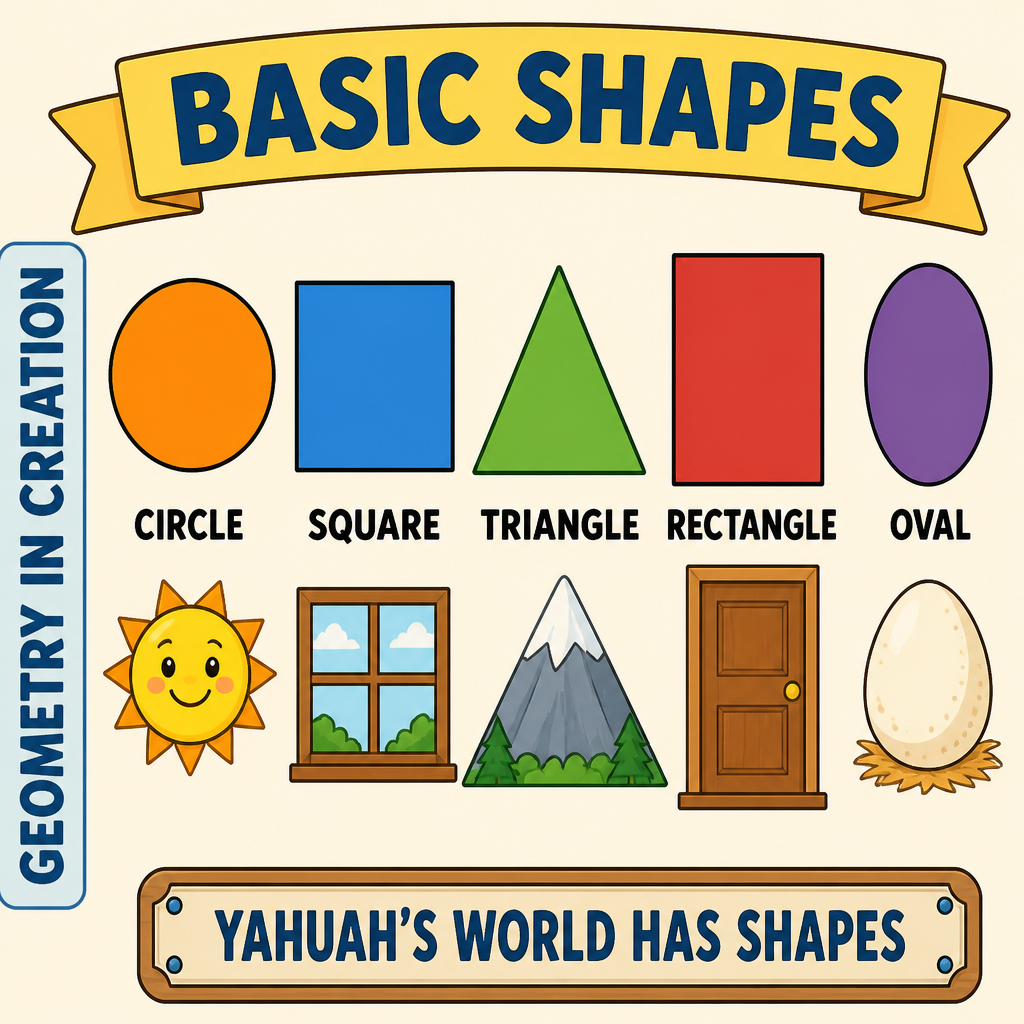
CHILD Art Shapes
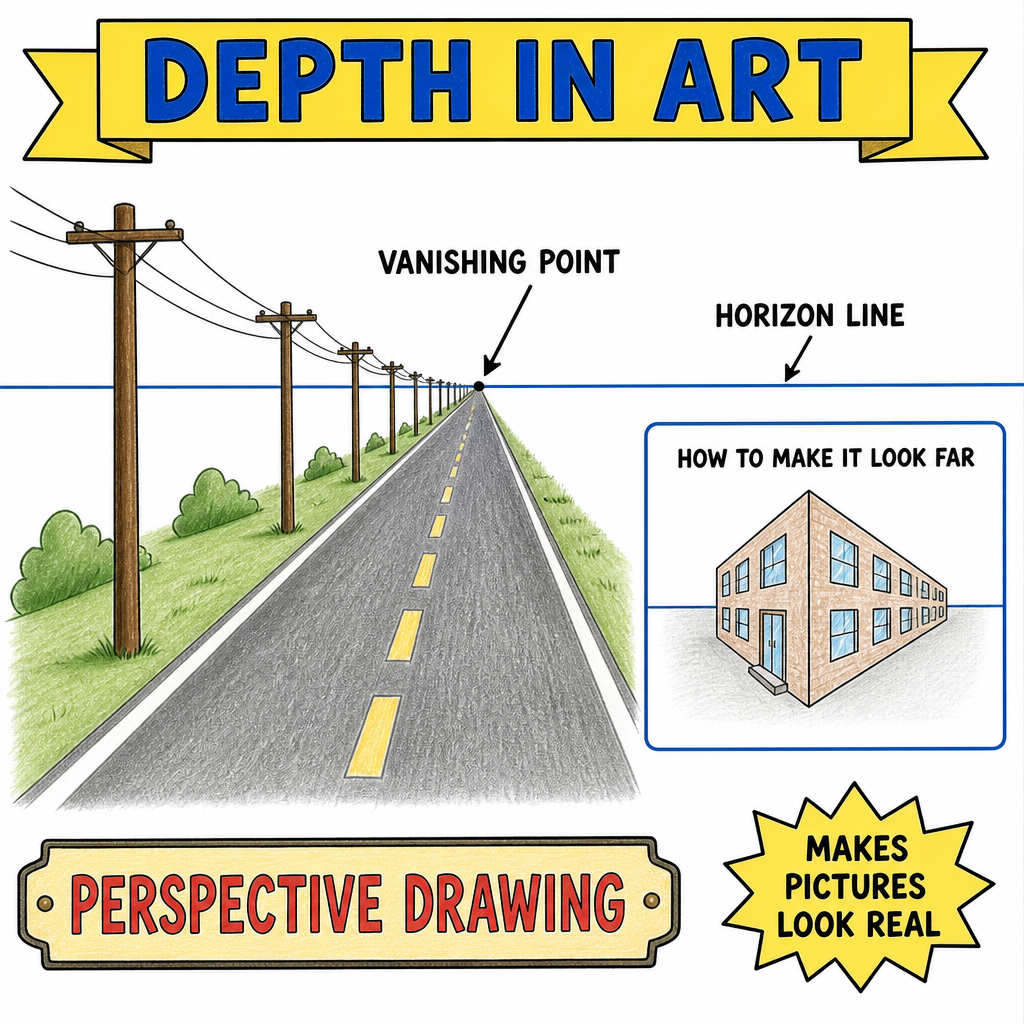
CHILD Art Perspective
- 🎨 Advanced color theory (color wheel, complementary colors, value)
- ✏️ Drawing techniques (shading, perspective, proportion)
- 🖌️ Painting basics (watercolor, acrylic techniques)
- 📐 Elements and principles of design
- 🖼️ Famous artists and art history
- ✂️ Mixed media and crafts
For Parents
This course develops observational skills, fine motor control, and creative thinking. Projects can be done with basic supplies: pencils, colored pencils, watercolors, construction paper, and scissors.
1The Color Wheel
The color wheel is an artist's tool for understanding how colors relate to each other!
Primary Colors
These cannot be made by mixing other colors:
Secondary Colors
Made by mixing two primary colors:
ORANGE
(R+Y)
GREEN
(Y+B)
PURPLE
(B+R)
Tertiary Colors
Made by mixing a primary and secondary color next to it:
Red-Orange
Yellow-Orange
Yellow-Green
Blue-Green
Blue-Purple
Red-Purple
Key Vocabulary
- Hue - Another word for color (red, blue, etc.)
- Tint - A color mixed with WHITE (lighter)
- Shade - A color mixed with BLACK (darker)
- Value - How light or dark a color is
Activity: Create Your Own Color Wheel
- Draw a large circle and divide it into 12 sections
- Paint or color the 3 PRIMARY colors in every 4th section
- Mix and add the 3 SECONDARY colors between them
- Mix and add the 6 TERTIARY colors in the remaining spaces
Color wheel here
2Color Relationships
"He hath made every thing beautiful in His time." - Ecclesiastes 3:11
Complementary Colors
Colors OPPOSITE each other on the color wheel. They make each other "pop" when placed side by side!
| Color | Complement | Example in Nature |
|---|
| Red | Green | Red cardinals in green trees |
| Yellow | Purple | Yellow flowers with purple centers |
| Blue | Orange | Orange sunset over blue ocean |
Analogous Colors
Colors NEXT TO each other on the color wheel. They create harmony and calm feelings.
Examples: Blue-Green-Yellow / Red-Orange-Yellow / Blue-Purple-Red
Activity: Complementary Color Artwork
Create a picture using only ONE pair of complementary colors:
- Choose: Red/Green, Yellow/Purple, OR Blue/Orange
- Use tints and shades of both colors
- Ideas: sunset scene, underwater scene, garden
Complementary color artwork
3Light, Shadow & Shading
Shading makes flat drawings look 3D! It shows where light hits an object and where shadows form.
The Value Scale
Practice drawing a row of boxes from WHITE to BLACK:
Shading Techniques
- Hatching - Parallel lines close together (closer = darker)
- Cross-Hatching - Criss-crossing lines
- Stippling - Dots (more dots = darker)
- Blending - Smooth transition with finger or blending tool
Parts of Shaded Objects
- Highlight - Brightest spot where light hits directly
- Mid-tone - Middle value areas
- Core Shadow - Darkest part of the object
- Cast Shadow - Shadow the object makes on another surface
- Reflected Light - Light that bounces back onto the dark side
Activity: Shade a Sphere
Draw a circle and add shading to make it look like a 3D ball:
- Draw a circle
- Decide where your light source is (top left?)
- Leave a highlight on that side
- Add mid-tones around the middle
- Make the opposite side darkest (core shadow)
- Add a cast shadow beneath
Practice shading spheres here
4Drawing What You See
"Lift up your eyes on high, and behold who hath created these things." - Isaiah 40:26
Good artists learn to really LOOK at what they're drawing. This is called observational drawing.
Tips for Drawing from Observation
- Look more, draw less - Spend more time looking at your subject than at your paper
- Break it into shapes - See the basic shapes in complex objects
- Compare sizes - "Is the top bigger than the bottom?"
- Notice negative space - The space AROUND objects is important too
- Squint your eyes - This helps you see values (light and dark) better
Activity: Still Life Drawing
Set up 3 objects (fruit, cup, book, etc.) and draw them:
- Lightly sketch the basic shapes first
- Refine the outlines
- Add details
- Add shading
Still life drawing
Activity: Draw Yahuah's Creation
Go outside or use a photo to draw something from nature:
- A leaf with all its veins
- A flower or plant
- A seashell or rock
- An animal or bird
Nature drawing
5Proportion in Drawing
Proportion means how big things are compared to each other. Getting proportions right makes drawings look realistic!
Human Face Proportions (General Guide)
- Eyes are about halfway down the head
- The space between eyes = about one eye width
- Ears line up with eyes and nose
- Mouth is about 1/3 of the way from nose to chin
Using a Pencil to Measure
- Hold your pencil at arm's length
- Use your thumb to mark a measurement on the pencil
- Compare that measurement to other parts of your subject
Activity: Draw a Face
Practice drawing a face using proportion guidelines:
- Draw an oval for the head
- Draw a horizontal line halfway down for eye placement
- Draw a line halfway between eyes and chin for the nose
- Draw a line 1/3 down from nose for the mouth
- Add the features following these guidelines
Face drawing practice
6Introduction to Perspective
Perspective is how we show depth and distance on a flat piece of paper!
Perspective Vocabulary
- Horizon Line - Where the sky meets the ground (at your eye level)
- Vanishing Point - A point on the horizon where lines seem to meet
- Overlapping - When objects in front block objects behind
- Size - Objects look smaller when far away
Easy Ways to Show Depth
- Overlap - Draw some objects in front of others
- Size - Make far things smaller, near things bigger
- Placement - Far things go higher on the page, near things lower
- Detail - Near things have more detail, far things are simpler
- Color - Far things are lighter/grayer, near things are brighter
Activity: One-Point Perspective Road
- Draw a horizontal line (horizon) across your paper
- Put a dot in the middle (vanishing point)
- Draw two diagonal lines from the bottom corners to the dot (road)
- Add fence posts along the road (smaller as they go back)
- Add trees or buildings (smaller in the distance)
Perspective drawing
7Watercolor Painting
"He sendeth the springs into the valleys, which run among the hills." - Psalm 104:10
Watercolor is a beautiful, flowing paint that uses water to create soft, transparent effects!
Watercolor Techniques
- Wet-on-Dry - Wet paint on dry paper (more control)
- Wet-on-Wet - Wet paint on wet paper (soft, blurry effects)
- Layering - Let paint dry, then add more on top
- Lifting - Remove wet paint with a dry brush or paper towel
- Salt Texture - Sprinkle salt on wet paint for cool effects
Watercolor Tips
- Work from LIGHT to DARK (save white areas!)
- Use plenty of water for light washes
- Let layers dry before adding more
- Keep a paper towel nearby for mistakes
- Tilt your paper to let colors flow into each other
Activity: Watercolor Sunset
- Wet your paper with clean water
- Add yellow at the horizon line
- Add orange above the yellow
- Add pink/red at the top
- Let colors blend naturally
- When dry, add silhouettes (trees, mountains) with dark paint
Practice on watercolor paper if available!
8Elements of Art
The Elements of Art are the building blocks artists use to create artwork!
The 7 Elements
| Element | What It Is | Example |
|---|
| Line | A mark connecting two points | Outline of a mountain |
| Shape | Flat, 2D areas (circle, square) | Moon, window |
| Form | 3D shapes (sphere, cube) | Ball, building |
| Color | Hue, value, intensity | Blue sky, red apple |
| Value | Lightness or darkness | Shadows on a face |
| Space | Area around/within objects | Distance in a landscape |
| Texture | How something looks like it feels | Rough bark, smooth glass |
Activity: Element Scavenger Hunt
Look at a famous painting or a scene outside. Find examples of each element:
- Line: _________________________________
- Shape: _________________________________
- Form: _________________________________
- Color: _________________________________
- Value: _________________________________
- Space: _________________________________
- Texture: _________________________________
9Art Inspired by Yahuah's Creation
"The heavens declare the glory of Elohim; and the firmament sheweth His handywork." - Psalm 19:1
Throughout history, artists have been inspired by Yahuah's beautiful creation. Let's create artwork that honors Him!
Project 1: Detailed Nature Study
Choose ONE item from nature and draw it in great detail:
- A feather (notice the patterns!)
- A pinecone (observe the spiral pattern)
- A butterfly wing (amazing symmetry)
- A flower (count the petals, see the patterns)
Take your time - this teaches patience and observation!
Detailed nature study
Project 2: Landscape Painting
Create a landscape showing Yahuah's beautiful earth:
- Include a sky with the firmament above
- Mountains, fields, or ocean
- Plants and/or animals
- Use perspective to show depth
Landscape painting/drawing
10Your Art Portfolio
"Whatsoever ye do, do it heartily, as to Yahuah, and not unto men." - Colossians 3:23
What We Learned:
- ✅ The color wheel and color relationships
- ✅ Shading and value to create 3D effects
- ✅ Drawing from observation
- ✅ Proportion in drawing
- ✅ Basic perspective
- ✅ Watercolor techniques
- ✅ The 7 Elements of Art
Final Project: Bible Scene Illustration
Choose a Bible story and create an artwork illustrating it. Use everything you've learned!
Ideas:
- Creation (Genesis 1) - Use all the colors!
- Noah's Ark - Animals, water, rainbow
- The Exodus - Crossing the Red Sea
- Daniel in the Lions' Den - Practice drawing animals
- Yahusha feeding the 5,000 - People, landscape, perspective
Requirements:
- Use at least 3 elements of art intentionally
- Include shading for 3D effect
- Show depth using perspective techniques
- Choose a color scheme (complementary or analogous)
Final Bible scene illustration
Artist's Statement
What story did you illustrate? ________________________________
What elements of art did you use? ________________________________
What was your color scheme? ________________________________
What do you want people to see in your artwork? ________________________________
________________________________
Certificate of Completion
________________________________
has successfully completed
Art Adventures - Grades 3-5
Date: ________________
"Creating art to glorify Yahuah!"