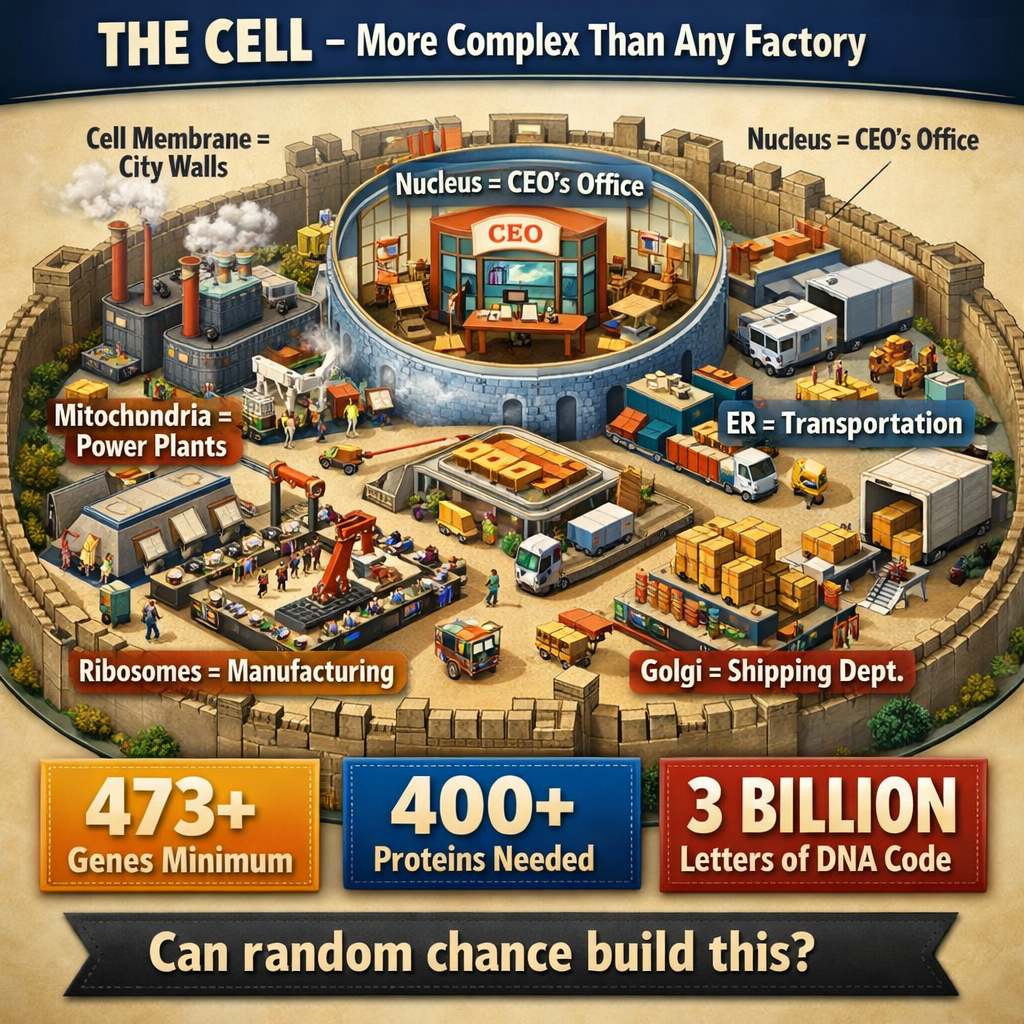
The incredible complexity of cells

DNA shows intelligent design
Sacred Names Pronunciation Guide
Yahuah (YAH-hoo-ah) - The Father's name
Yahusha (YAH-hoo-sha) - The Son's name
Elohim (El-oh-HEEM) - Hebrew for "God"
Ruach HaKodesh (ROO-akh ha-KO-desh) - The Holy Spirit
Note to Parents/Teachers: This workbook examines the Industrial Revolution from perspectives often omitted in standard textbooks. While acknowledging technological advances, we explore the human costs, the forces that drove industrialization, and the destruction of traditional ways of life. The goal is critical thinking, not rejection of all technology.
Lesson 1: Introduction - The Standard Narrative
Ecclesiastes 7:29 - "Elohim made mankind upright, but they have gone in search of many schemes."
What Textbooks Say
The Standard Story:
- The Industrial Revolution (1760-1840) was primarily a positive development
- New machines made life easier and more productive
- Factories provided jobs and increased wealth
- Technology lifted people out of poverty
- It was inevitable "progress"
Questions to Consider
Before accepting this narrative, we should ask:
- Who benefited most from industrialization?
- What was lost when rural life was destroyed?
- Were people actually happier or healthier?
- Was this transition truly voluntary?
- Who promoted and financed the changes?
Hidden Perspective:
Before factories, most families owned or rented their own land, grew their own food, made their own clothes, and controlled their own time. The Industrial Revolution transferred this independence to factory owners, landlords, and bankers.
Receive and Recall
1. The Industrial Revolution began around .
2. Before factories, most families owned or rented their own .
3. We should always ask who most from major changes.
Reflect and Respond
- Why is it important to question standard historical narratives?
- What might "progress" mean to different groups of people?
- How does Ecclesiastes 7:29 relate to human "schemes"?
Answer Key - Lesson 1
1. 1760
2. land
3. benefited
Lesson 2: Life Before the Factories
Proverbs 27:23-24 - "Be sure you know the condition of your flocks, give careful attention to your herds; for riches do not endure forever, and a crown is not secure for all generations."
The Agrarian Way of Life
Before industrialization, most people lived on the land:
| Agrarian Life |
Factory Life |
| Families worked together |
Family members separated |
| Flexible hours based on seasons |
Rigid factory schedules |
| Produced own food |
Dependent on wages for food |
| Owned tools and materials |
Factory owned everything |
| Multi-skilled (farming, crafts) |
Repetitive single tasks |
| Fresh air and sunshine |
Dark, polluted factories |
The Cottage Industry
Before factories, goods were often made at home:
- Spinning and weaving - Done by families in their cottages
- Blacksmithing - Local craftsmen served villages
- Woodworking - Furniture made by local artisans
- Brewing and baking - Home production for family and sale
"A man's home was his castle, and he worked at his own pace, taking breaks when he wished, celebrating traditional holidays, and enjoying the company of family while working."
— Historical description of pre-industrial life
Receive and Recall
1. Before factories, families often worked .
2. The cottage involved making goods at home.
3. Agrarian workers controlled their own schedules.
4. Factory workers became on wages for food.
Reflect and Respond
- What advantages did agrarian life have over factory life?
- Why does Proverbs emphasize knowing the condition of your flocks?
- What is lost when families no longer work together?
Answer Key - Lesson 2
1. together
2. industry
3. time/work
4. dependent
Lesson 3: The Enclosure Acts - Stealing the Commons
Isaiah 5:8 - "Woe to those who add house to house and join field to field, till there is no room and you must live alone in the land."
What Were the Commons?
For centuries, English villages had "common lands" that everyone could use:
- Pastures for grazing animals
- Forests for gathering wood and hunting
- Streams for fishing
- Fields for growing crops
Even the poorest families could survive by using the commons. They could raise a cow, gather firewood, hunt small game, and grow vegetables.
The Enclosure Acts (1750-1850)
The British Parliament passed over 4,000 Enclosure Acts that:
- Took common lands and gave them to wealthy landowners
- Built fences around what had been public land
- Made it illegal for common people to use the land
- Forced small farmers off their traditional lands
Who Made These Laws?
Parliament was controlled by wealthy landowners who passed laws benefiting themselves. The very people who stole the land were the ones writing the laws. Poor farmers had no representation and no voice.
"The law locks up the man or woman who steals the goose from off the common, but leaves the greater villain loose who steals the common from the goose."
— 17th century English folk poem
The Results
- Millions of rural people lost their means of survival
- Families who had lived on the land for generations became homeless
- People were forced to move to cities seeking work
- Factory owners gained a desperate workforce willing to work for low wages
Receive and Recall
1. lands were shared by everyone in a village.
2. Over Enclosure Acts were passed by Parliament.
3. The Enclosure Acts took land from the and gave it to the wealthy.
4. People forced off the land moved to seeking work.
Reflect and Respond
- How does Isaiah 5:8 apply to the Enclosure Acts?
- Is it legal theft if the government writes the law?
- Why would factory owners want a desperate workforce?
Answer Key - Lesson 3
1. Common
2. 4,000
3. poor/common people
4. cities
Lesson 4: Factory Conditions - The Human Cost
James 5:4 - "Look! The wages you failed to pay the workers who mowed your fields are crying out against you. The cries of the harvesters have reached the ears of Yahuah of hosts."
Working Conditions
Early factories were often brutal:
- Hours: 14-16 hour workdays, 6 days a week
- Environment: Dark, dangerous, poorly ventilated
- Discipline: Beatings, fines, and harsh punishments
- Wages: Barely enough to survive
- Safety: Frequent injuries and deaths
Child Labor
Children as young as 5 years old worked in factories:
- Paid even less than adults
- Small enough to crawl under machinery
- Often beaten to stay awake
- Many died from accidents or disease
- Never learned to read or received education
Primary Source
"I have seen them fall asleep, and they have been performing their work with their hands while they were asleep, after the strapping had taken place." — Factory worker testimony to Parliament, 1832
Living Conditions
Factory workers lived in crowded, filthy slums:
- Entire families in single rooms
- No running water or sanitation
- Disease spread rapidly (cholera, typhus)
- Life expectancy dropped dramatically
- London's average life expectancy: 25 years in industrial areas
Was This Progress?
Before industrialization, even poor rural families lived longer, healthier lives with access to fresh air, clean water, and their own food. The "progress" of factories meant shorter lives, broken families, and grinding poverty for millions.
Receive and Recall
1. Factory workers often worked to 16 hours a day.
2. Children as young as years old worked in factories.
3. In London's industrial areas, average life expectancy was only years.
4. James 5:4 speaks of crying out to Yahuah.
Reflect and Respond
- How does James 5:4 apply to factory owners who underpaid workers?
- Why would anyone accept such terrible conditions?
- How does this compare to the agrarian life they left behind?
Answer Key - Lesson 4
1. 14
2. 5
3. 25
4. wages/workers
Lesson 5: Who Financed Industrialization?
Proverbs 22:7 - "The rich rule over the poor, and the borrower is slave to the lender."
Following the Money
Building factories required enormous capital. Where did it come from?
Sources of Industrial Capital
- The Slave Trade: Profits from trafficking humans funded many early industries
- Colonial Exploitation: Wealth extracted from India, Africa, and the Americas
- Banking Houses: International banking families provided loans
- Land Enclosures: Wealth transferred from common people to landlords
The Banking Connection
Major banking families, including the Rothschilds and others, financed industrial development across Europe. They profited from loans to governments, corporations, and infrastructure projects. Industrialization created massive debt, which created massive profits for lenders.
The Factory Owners
Who were the new industrial elite?
- Often connected to banking and finance
- Had political connections to pass favorable laws
- Built monopolies to eliminate competition
- Used government force to suppress worker organizing
"Give me control of a nation's money and I care not who makes its laws."
— Attributed to Mayer Amschel Rothschild
Creating Dependency
The industrial system created new forms of dependency:
- Workers dependent on wages (couldn't grow their own food)
- Factories dependent on banks for capital
- Governments dependent on taxes from industry
- Everyone dependent on the money system
Receive and Recall
1. Profits from the trade helped finance early industries.
2. families provided loans for industrial development.
3. Proverbs says the borrower is to the lender.
4. The industrial system created new forms of .
Reflect and Respond
- How does control of money create control of people?
- Why is understanding who finances change important?
- How does Proverbs 22:7 describe the debt relationship?
Answer Key - Lesson 5
1. slave
2. Banking
3. slave/servant
4. dependency
Lesson 6: The Destruction of the Family
Psalm 127:3-5 - "Children are a heritage from Yahuah, offspring a reward from him. Like arrows in the hands of a warrior are children born in one's youth."
Family Life Before Factories
In agrarian societies, families worked together:
- Parents and children worked side by side
- Skills passed from generation to generation
- Grandparents remained integrated in family life
- Children learned by observing and helping
- The home was the center of production
Family Life After Factories
Industrialization separated families:
- Fathers worked in factories, away from home
- Mothers often worked in different factories
- Children worked separately or were left alone
- Families saw each other only at night (exhausted)
- The home became only a place to sleep
Designed Disruption?
Some historians argue this disruption wasn't accidental. A dependent workforce is easier to control. When families are separated and exhausted, they have less time for community, education, or resistance.
Long-Term Effects
- Weakened intergenerational bonds
- Loss of traditional knowledge and skills
- Children raised by strangers (later, schools)
- Elderly isolated from family support
- Community ties replaced by factory relationships
"The factory system, however much it may have increased the total national wealth, has done so only by destruction of the home."
— G.K. Chesterton
Receive and Recall
1. Before factories, families together.
2. Industrialization families from each other.
3. Skills were passed from to generation.
4. A dependent workforce is easier to .
Reflect and Respond
- How did factory work change family relationships?
- What knowledge is lost when generations are separated?
- How does Psalm 127 describe the value of children?
Answer Key - Lesson 6
1. worked
2. separated
3. generation
4. control
Lesson 7: The Rise of Public Schools
Deuteronomy 6:6-7 - "These commandments that I give you today are to be on your hearts. Impress them on your children. Talk about them when you sit at home and when you walk along the road..."
Before Public Schools
Education was traditionally a family responsibility:
- Parents taught children at home
- Apprenticeships taught trades
- Churches taught reading (for Bible study)
- Communities shared knowledge
- Literacy rates were actually quite high
The Purpose of Public Schools
Industrial schools were designed to produce factory workers:
"We want one class to have a liberal education. We want another class, a very much larger class of necessity, to forgo the privilege of a liberal education and fit themselves to perform specific difficult manual tasks."
— Woodrow Wilson, 1909
Features of Industrial Schools
- Bells: Train children to respond to factory bells
- Rows: Sit in orderly rows like factory stations
- Schedules: Rigid time blocks, no flexibility
- Obedience: Follow orders without question
- Standardization: Same lessons for everyone
The Prussian Model
American public schools were modeled on the Prussian (German) system, which was explicitly designed to create obedient soldiers and workers. Horace Mann and other reformers imported this model to America in the 1840s.
Removing Parental Influence
Compulsory schooling laws took children from their families for most of their waking hours. Parents lost the ability to transmit their values, religion, and worldview. The state became the primary influence on children's minds.
Receive and Recall
1. Before public schools, taught children at home.
2. Industrial schools were designed to produce factory .
3. American schools were modeled on the system.
4. Deuteronomy 6 says parents should commandments on their children.
Reflect and Respond
- How do schools resemble factories?
- What does Deuteronomy 6 say about who should educate children?
- Why might industrial leaders want state-controlled education?
Answer Key - Lesson 7
1. parents
2. workers
3. Prussian
4. impress
Lesson 8: Urbanization - From Villages to Slums
Micah 4:4 - "Everyone will sit under their own vine and under their own fig tree, and no one will make them afraid."
The Great Migration
Millions of people moved from countryside to cities:
1800 - Only 20% of British people lived in cities
1850 - Over 50% now lived in cities (first in history)
1900 - 75% of British people were urban
Why People Moved
Most didn't move voluntarily:
- Enclosure Acts took their land
- Cottage industries destroyed by factory competition
- No way to survive in rural areas
- Forced to seek factory work
Urban Conditions
City slums were nightmarish:
- Overcrowded tenements with no light or air
- Open sewers running through streets
- Polluted water causing cholera epidemics
- Smoke from factories blocking the sun
- Crime, alcoholism, and despair
Historical Description
"In one cellar room in Manchester, 18 people were found living. In Liverpool, one-third of the population lived in cellars. Many never saw daylight."
What Was Lost
- Connection to the land
- Fresh air and clean water
- Community and neighborly relationships
- Self-sufficiency and independence
- The biblical vision of "vine and fig tree"
Receive and Recall
1. By 1850, over % of British people lived in cities.
2. Most people moved to cities because they had no way to in rural areas.
3. epidemics were caused by polluted water.
4. Micah 4:4 describes everyone sitting under their own tree.
Reflect and Respond
- What is the biblical vision for how people should live?
- Why might those in power prefer people in cities rather than on farms?
- What have we lost by losing connection to the land?
Answer Key - Lesson 8
1. 50
2. survive
3. Cholera
4. fig
Lesson 9: Worker Resistance
Exodus 1:12 - "But the more they were oppressed, the more they multiplied and spread."
People Fought Back
Workers did not accept their conditions passively:
The Luddites (1811-1816)
- Skilled craftsmen who destroyed factory machinery
- Named after "Ned Ludd" (possibly mythical)
- Fought to preserve traditional ways of life
- The government sent more troops against Luddites than against Napoleon
- Leaders were executed or transported to Australia
Misrepresented in History
The Luddites are often portrayed as simple-minded opponents of progress. In reality, they were skilled workers defending their communities against forced impoverishment. They were not anti-technology but anti-exploitation.
Other Forms of Resistance
- Strikes: Workers refusing to work until conditions improved
- Unions: Workers organizing together (often illegal)
- Riots: Uprisings against bread prices and conditions
- Chartism: Movement for democratic rights
Government Response
The ruling class used force to suppress resistance:
- Laws making unions illegal (Combination Acts)
- Military force against protesters
- Death penalty for machine-breaking
- Transportation to penal colonies
- Spies infiltrating worker movements
"When the government fears the people, there is liberty. When the people fear the government, there is tyranny."
— Attributed to Thomas Jefferson
Receive and Recall
1. The were skilled craftsmen who destroyed factory machinery.
2. More troops were sent against the Luddites than against .
3. The Acts made unions illegal.
4. Machine-breaking could result in the penalty.
Reflect and Respond
- Were the Luddites simply "anti-progress" or defending their communities?
- Why did the government respond so harshly to worker resistance?
- What does Exodus 1:12 say about oppressed people?
Answer Key - Lesson 9
1. Luddites
2. Napoleon
3. Combination
4. death
Lesson 10: The American Experience
Deuteronomy 28:12 - "You will lend to many nations but will borrow from none."
America Before Industrialization
Early America was largely agrarian:
- 90% of people lived on farms in 1790
- Thomas Jefferson envisioned a nation of independent farmers
- The yeoman farmer was the ideal citizen
- Land was widely available
"Those who labor in the earth are the chosen people of God, if ever He had a chosen people."
— Thomas Jefferson, Notes on Virginia
Industrial Transformation
America industrialized rapidly after the Civil War:
- Railroads connected the continent
- Massive factories arose in cities
- Immigrants provided cheap labor
- Robber barons accumulated vast wealth
Who Drove American Industrialization?
- J.P. Morgan: Banking and finance
- John D. Rockefeller: Oil monopoly
- Andrew Carnegie: Steel industry
- Cornelius Vanderbilt: Railroads
The Federal Reserve Connection
Many of these same families and their descendants were involved in creating the Federal Reserve in 1913, establishing private control over America's money supply.
Receive and Recall
1. In 1790, % of Americans lived on farms.
2. Thomas envisioned a nation of independent farmers.
3. John D. Rockefeller controlled the industry.
4. The Reserve was created in 1913.
Reflect and Respond
- Why did Jefferson believe farmers were "chosen people"?
- How did America change from Jefferson's vision?
- What does Deuteronomy 28:12 say about borrowing vs. lending?
Answer Key - Lesson 10
1. 90
2. Jefferson
3. oil
4. Federal
Lesson 11: Loss of Skills and Self-Sufficiency
Proverbs 31:13-15 - "She selects wool and flax and works with eager hands. She is like the merchant ships, bringing her food from afar. She gets up while it is still night; she provides food for her family."
What People Used to Know
Before industrialization, most people had many skills:
- Growing and preserving food
- Raising and butchering animals
- Making and repairing clothing
- Building and repairing homes
- Making soap, candles, medicine
- Managing finances without banks
What Was Lost
Industrial specialization eliminated these skills:
- One task repeated endlessly (specialization)
- No knowledge of whole processes
- Dependency on buying everything
- Loss of traditional knowledge
- Helplessness without the system
Deliberate Deskilling
Factory owners deliberately broke production into simple, repetitive tasks so workers could be easily replaced. Skilled craftsmen who once controlled their work became interchangeable "hands" with no bargaining power.
The Proverbs 31 Woman
The biblical ideal woman was:
- Skilled in many crafts
- Productive and entrepreneurial
- Provider for her household
- Not dependent on the market for everything
"The more you can do for yourself, the less you are at the mercy of others."
— Traditional wisdom
Receive and Recall
1. Industrial meant workers repeated one task endlessly.
2. Factory owners broke production into simple tasks so workers could be easily .
3. Traditional was lost as skills weren't passed down.
4. The Proverbs 31 woman was and skilled in many crafts.
Reflect and Respond
- What skills do you wish you had that previous generations possessed?
- How does dependency make people easier to control?
- What can we learn from the Proverbs 31 woman?
Answer Key - Lesson 11
1. specialization
2. replaced
3. knowledge
4. productive
Lesson 12: Environmental Destruction
Revelation 11:18 - "The time has come for destroying those who destroy the earth."
The Price of "Progress"
Industrialization caused unprecedented environmental damage:
- Rivers turned into sewers
- Air pollution blackened buildings and lungs
- Forests cleared for fuel and factories
- Species driven to extinction
- Soil depleted and contaminated
Before and After
| Pre-Industrial |
Industrial |
| Clean rivers for drinking and fishing |
Rivers too polluted for life |
| Clear air and blue skies |
Smog blocking the sun |
| Sustainable farming practices |
Soil exhaustion and chemicals |
| Forests for fuel and materials |
Deforestation for industry |
Historical Example
The Thames River in London was so polluted by 1858 that it was called the "Great Stink." Parliament had to close because the smell was unbearable. The river was essentially dead, with no fish or life.
Biblical Stewardship
Scripture teaches we are caretakers, not exploiters:
- Genesis 2:15 - We are to "work and keep" the garden
- Leviticus 25 - The land needs Sabbath rest
- Deuteronomy 22:6 - Even animal welfare matters
- Revelation 11:18 - Judgment for destroying the earth
Receive and Recall
1. Rivers turned into open .
2. The Thames River event of 1858 was called the "Great ."
3. Genesis 2:15 says we are to work and the garden.
4. Revelation 11:18 speaks of judgment for those who the earth.
Reflect and Respond
- How does Scripture describe our responsibility to creation?
- Was environmental destruction necessary for economic growth?
- How can we practice biblical stewardship today?
Answer Key - Lesson 12
1. sewers
2. Stink
3. keep
4. destroy
Lesson 13: Lessons for Today
Ecclesiastes 1:9 - "What has been will be again, what has been done will be done again; there is nothing new under the sun."
Patterns That Continue
The Industrial Revolution established patterns we still see today:
1. Dependency Creation
- Self-sufficient people become dependent consumers
- Loss of skills means loss of options
- Control of money = control of people
2. Centralization
- Small producers eliminated by large corporations
- Local economies absorbed into global systems
- Decisions made far from those affected
3. Technology as Control
- New technologies used to monitor and control
- Automation eliminates human work
- Those who control technology control society
The Fourth Industrial Revolution
Today we are told we're entering a "Fourth Industrial Revolution" with AI, automation, and digital currencies. The same questions apply: Who benefits? Who decides? What is lost?
Biblical Wisdom for Our Time
- Pursue self-sufficiency where possible
- Build community relationships
- Learn traditional skills
- Question official narratives
- Keep families together and strong
- Trust in Yahuah, not systems of men
Receive and Recall
1. Self-sufficient people were made into dependent .
2. means decisions are made far from those affected.
3. Those who control control society.
4. We should pursue -sufficiency where possible.
Reflect and Respond
- How do patterns from the Industrial Revolution continue today?
- What practical steps can we take toward self-sufficiency?
- How should believers respond to the "Fourth Industrial Revolution"?
Answer Key - Lesson 13
1. consumers
2. Centralization
3. technology
4. self
Lesson 14: Course Review and Final Assessment
Hosea 4:6 - "My people are destroyed for lack of knowledge."
Key Concepts Review
What We Learned
- The standard narrative of "progress" hides real costs
- Enclosure Acts forced people off the land
- Factory conditions were brutal and deadly
- Banking interests financed and profited from industrialization
- Families were separated and weakened
- Public schools trained workers, not thinkers
- Urbanization destroyed communities
- Workers resisted but were suppressed
- Skills and self-sufficiency were deliberately destroyed
- Environmental destruction accompanied industrial growth
- These patterns continue today
Biblical Perspective
Scripture provides the framework for understanding:
- Families should work and stay together
- Parents should educate their own children
- People should have their own "vine and fig tree"
- The borrower is slave to the lender
- We are stewards, not exploiters, of creation
- Knowledge and discernment prevent destruction
Final Review
1. The Acts took common lands from the people.
2. Factory children as young as years old worked long hours.
3. The system was designed to produce obedient workers.
4. The were skilled workers who fought against the factories.
5. Thomas Jefferson envisioned a nation of independent .
6. Industrial specialization led to the loss of .
7. Micah 4:4 describes everyone under their own and fig tree.
8. The borrower is to the lender.
9. We are called to be of creation, not exploiters.
10. Hosea 4:6 says people are destroyed for lack of .
Final Reflection Questions
- How has this study changed your understanding of "progress"?
- What practical applications can you make in your own life?
- How can we prepare for the changes coming in our generation?
- What biblical principles should guide our response?
Answer Key - Lesson 14
1. Enclosure
2. five (5)
3. Prussian/school
4. Luddites
5. farmers
6. skills
7. vine
8. slave/servant
9. stewards
10. knowledge
Course Completion Notes for Parents/Teachers:
Students who complete this workbook should understand that:
- Historical "progress" narratives often hide real costs
- Economic changes are often driven by those who profit from them
- Loss of self-sufficiency creates dependency and control
- Scripture provides principles for evaluating social changes
- Critical thinking helps us recognize similar patterns today
Encourage students to apply these lessons by learning practical skills, building community, and trusting in Yahuah rather than systems of men.