Medieval times
The Reformation era
Knights, Castles & the Middle Ages
Grades 3-4 | Ages 8-10
Medieval times
The Reformation era
Explore the Middle Ages using the 4 Rs!
"In all your ways acknowledge Him, and He shall direct your paths." - Proverbs 3:6
After the Roman Empire collapsed in 476 AD, Europe entered a new period called the Middle Ages or Medieval Period. This time lasted about 1,000 years (from about 500 AD to 1500 AD)!
Historians call this the "Middle Ages" because it comes between ancient times (Greece and Rome) and modern times. The early part (500-1000 AD) is sometimes called the "Dark Ages" because:
Even during difficult times, Yahuah preserved His truth! Faithful believers kept copies of Scripture, and some monasteries became centers of learning. Many people truly loved Yahuah, even when the organized church had problems.
After Rome fell, new kingdoms formed across Europe:
These kingdoms were often at war with each other!
Textbooks often don't explain WHY Rome fell. Many believe Rome collapsed partly because of:
Nations rise and fall based on how they honor or dishonor Yahuah's ways!
1. When did the Roman Empire fall?
2. How long did the Middle Ages last?
3. The early part of the Middle Ages is sometimes called the "" Ages.
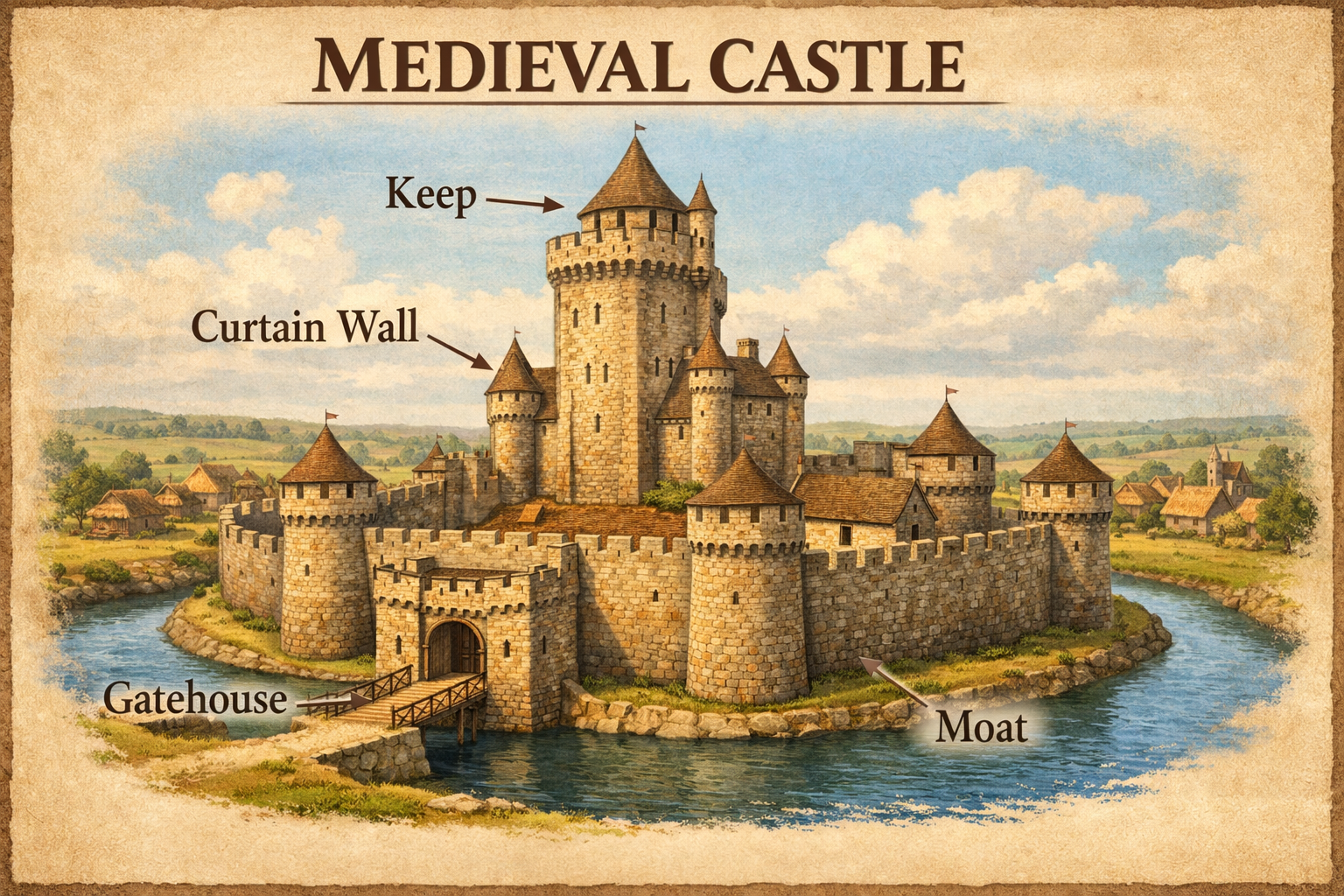
During the Middle Ages, powerful lords built castles to protect themselves and their people from enemies. Castles were like small fortified towns!
Castles were busy places! Many people lived and worked inside:
Castles weren't very comfortable - they were cold, dark, and drafty!
While castles provided physical protection, the Bible tells us that Yahuah is our TRUE fortress! Stone walls can crumble, but Yahuah never fails. David called Yahuah his fortress because he knew that real safety comes from trusting in the Creator, not in buildings made by man.
1. What was the main tower of a castle called?
2. What was a moat?
3. The was the large room for feasts and meetings.
Draw your own castle. Label these parts: Keep, Moat, Drawbridge, Curtain Wall
Knights were warriors who fought on horseback and served a lord. Becoming a knight was a long process that started in childhood!
Knights were supposed to follow a code of honor called chivalry:
While the code of chivalry sounds good, many knights didn't follow it. Some were cruel, greedy, or used their power to hurt others. The Crusades (we'll learn about these later) showed that even "Christian" knights sometimes did terrible things. Only Yahuah's true teachings lead to real honor!
The Apostle Paul tells us to put on the "armor of Elohim" - not metal armor, but spiritual protection! This includes the belt of truth, breastplate of righteousness, shield of faith, and sword of the Spirit (Yahuah's Word). This armor protects us from sin and spiritual enemies!
1. What was a boy called before he became a squire?
2. How much could a knight's armor weigh?
3. The knight's code of honor was called .
During the Middle Ages, society was organized in a system called feudalism. It was like a pyramid, with the king at the top and peasants at the bottom.
1. King - Owned all the land, gave land to nobles
2. Nobles/Lords - Received land from king, gave land to knights
3. Knights - Fought for the lords in exchange for land
4. Peasants/Serfs - Worked the land, couldn't leave without permission
Fief - A piece of land given to a knight or noble
Vassal - Someone who received land and promised loyalty in return
Serf - A peasant who was tied to the land and had few rights
Manor - The lord's estate, including the castle, village, and farmland
Most people in the Middle Ages (about 90%!) were peasants. Their life was very hard:
The feudal system kept most people poor and powerless while a few people had everything. This is NOT what Yahuah intended! The Bible teaches that:
Unlike feudalism, where some people were seen as more important than others, Yahuah values every person! Kings and peasants are equal in His eyes. The Bible teaches that leaders should SERVE others, not just use them for their own benefit.
1. Who was at the TOP of the feudal pyramid?
2. What percentage of people were peasants?
3. A piece of land given to a knight was called a .
During the Middle Ages, the Roman Catholic Church was the most powerful organization in Europe. The Pope in Rome was considered the head of all Christianity and was sometimes more powerful than kings!
Pope: The head of the Church in Rome
Cardinals: Helped the Pope and chose new Popes
Bishops: Ruled over large areas called dioceses
Priests: Led local churches in villages
Monks/Nuns: Lived in monasteries and convents, devoted to prayer
While there were many sincere believers, the powerful Church had serious problems:
Even in dark times, Yahuah preserved His truth! Groups like the Waldensians kept reading Scripture and following Yahusha's teachings. Many common people had real faith, even if the Church leadership was corrupt. Yahuah always has His faithful remnant!
The Waldensians were believers in the mountains of Italy and France who kept true faith alive! They:
1. Who was considered the head of the Church in Rome?
2. What was a major problem with the medieval Church?
3. The were faithful believers who kept Scripture alive.
Life in the Middle Ages was very different from today. There was no electricity, running water, or modern medicine. Most people never traveled more than a few miles from where they were born!
Peasants worked about 12-16 hours a day during busy seasons!
Peasants ate: Bread, porridge, vegetables, some eggs and cheese
Nobles ate: Meat (beef, pork, venison), fine breads, pastries, and lots of it!
No one had: Potatoes, tomatoes, corn, or chocolate - these came from America later!
Medieval medicine was often based on superstition rather than science:
Interestingly, if people had followed the health laws in the Bible, they would have been much healthier! The Torah taught:
Yahuah's instructions were thousands of years ahead of medieval medicine!
1. How many hours might peasants work during busy seasons?
2. Which of these foods did medieval people NOT have?
3. Medieval doctors practiced "" which actually made patients worse.
Let's meet some important people from the Middle Ages - some were heroic, and some teach us lessons about what happens when power is misused.
Charlemagne (Charles the Great) was a Frankish king who conquered much of Europe and was crowned "Emperor" by the Pope in 800 AD. He:
However, he also forced people to convert or die, which is NOT Yahusha's way!
King Alfred of England was one of the few rulers called "the Great." He:
Peter Waldo was a wealthy merchant who gave away his riches to follow Yahusha. He:
Wycliffe was called the "Morning Star of the Reformation." He:
Throughout the Middle Ages, Yahuah raised up faithful people who stood for truth even when it was dangerous. They believed that everyone should be able to read the Bible for themselves. Their courage helped prepare the way for the Reformation, when millions of people returned to the truth of Scripture!
1. Who was called the "Morning Star of the Reformation"?
2. What did Peter Waldo and John Wycliffe have in common?
3. Alfred the Great created laws based on the .
1. The Middle Ages lasted about:
2. The feudal system was:
3. A problem with the medieval Church was:
4. Put on the whole of Elohim!
Write about your favorite thing you learned about the Middle Ages:
Q1: 476 AD | Q2: About 1,000 years | Q3: Dark
Q1: The Keep | Q2: A ditch filled with water | Q3: Great Hall
Q1: A Page | Q2: 40-60 pounds | Q3: Chivalry
Q1: The King | Q2: About 90% | Q3: Fief
Q1: The Pope | Q2: They sold indulgences | Q3: Waldensians
Q1: 12-16 hours | Q2: Potatoes and chocolate | Q3: Bleeding
Q1: John Wycliffe | Q2: They translated the Bible into common language | Q3: Ten Commandments
Q1: 1,000 years | Q2: A pyramid with the king at top and peasants at bottom | Q3: They sold indulgences and kept Scripture from people | Q4: Armor