Medieval times
The Reformation era
The Middle Ages, Crusades & Renaissance
Grades 5-6
Medieval times
The Reformation era
The Middle Ages (also called the Medieval Period) lasted about 1,000 years, from the fall of Rome (476 AD) to the Renaissance (around 1500 AD).
In this course, you'll learn:
The Roman Empire fell in 476 AD when Germanic tribes conquered Rome. This began the "Dark Ages" - a time of ignorance, superstition, and violence. The Catholic Church was the only stable institution.
Rome's fall was complex - moral decay, economic problems, military weakness, and political corruption all contributed. True believers continued to preserve Scripture and faith despite persecution. The "Dark Ages" weren't entirely dark - learning continued in monasteries and among faithful believers outside the Roman church.
1. What year did Western Rome fall? __________ AD
2. Name two reasons Rome fell: __________ and __________
3. What institution became very powerful after Rome fell? __________
Feudalism was the social and economic system of medieval Europe. It was based on land ownership and loyalty.
| Level | Who | Role |
|---|---|---|
| 1 (Top) | King | Owned all the land, gave it to nobles |
| 2 | Nobles/Lords | Received land (fiefs), provided knights |
| 3 | Knights | Fought for lords, protected the land |
| 4 (Bottom) | Peasants/Serfs | Worked the land, couldn't leave |
Most people (90%+) were peasants who had very hard lives. They worked their whole lives on land they didn't own and couldn't leave. This system kept the powerful in power and the poor in poverty - the opposite of biblical justice where land was redistributed every Jubilee! (Leviticus 25)
1. Who was at the top of the feudal pyramid? __________
2. What were peasants who were tied to the land called? __________
3. How does feudalism compare to biblical justice? (Hint: Leviticus 25)
__________________________________________________
The romanticized view of noble knights isn't entirely accurate. Many knights were violent, greedy, and cruel. The Crusades showed that "fighting for the church" often meant massacre and conquest rather than defending the innocent. True Christianity calls for loving enemies, not killing them! (Matthew 5:44)
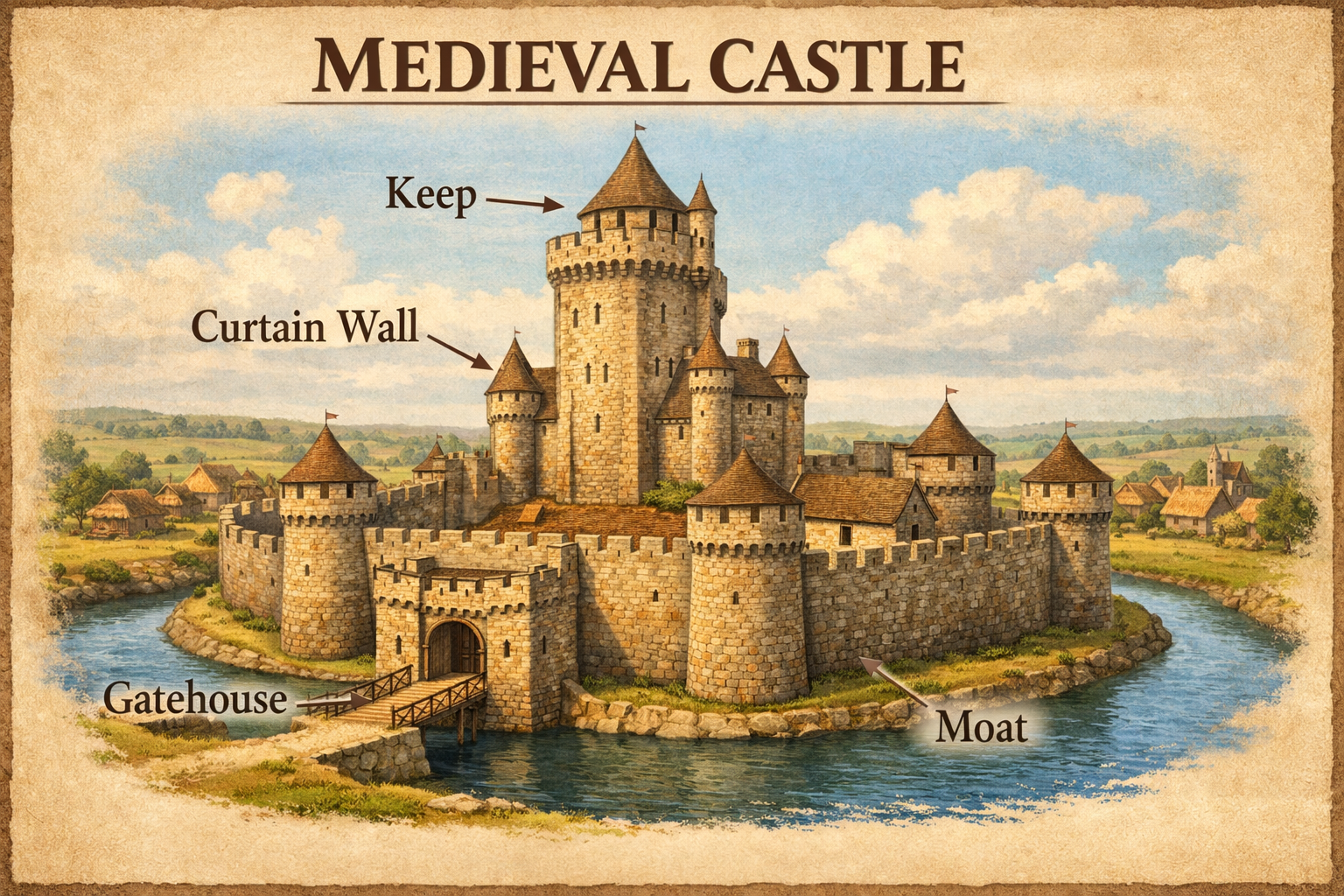
| Part | Purpose |
|---|---|
| Moat | Water-filled ditch for protection |
| Drawbridge | Could be raised to block entry |
| Curtain Wall | Outer wall with walkways for guards |
| Keep/Tower | Central fortified tower - last defense |
| Great Hall | Main room for eating, meetings |
1. At what age did a boy typically become a page? __________
2. Name 3 parts of a castle:
__________, __________, __________
The Catholic Church was the center of medieval life. It provided education, hospitals, and spiritual guidance. The Pope was the most powerful figure in Europe, able to crown or depose kings.
The medieval church had drifted far from biblical Christianity:
Despite church corruption, faithful believers preserved truth:
1. What were "indulgences"? __________
2. Why did the church want to keep the Bible in Latin?
__________________________________________________
The Crusades were holy wars to recapture the Holy Land (Jerusalem) from Muslim control. Brave Christian knights fought to protect pilgrims and defend Christianity.
The Crusades were far more complex and often brutal:
Yahusha said "love your enemies" (Matthew 5:44), not "kill them for holy land."
| Crusade | Date | Result |
|---|---|---|
| First | 1096-1099 | Captured Jerusalem (massacre followed) |
| Second | 1147-1149 | Failed |
| Third | 1189-1192 | Richard vs Saladin - stalemate |
| Fourth | 1202-1204 | Attacked Constantinople instead! |
| Children's | 1212 | Disaster - children died or enslaved |
1. How long did the Crusades last? __________ years
2. Does Yahusha teach us to fight "holy wars"? What does Matthew 5:44 say?
__________________________________________________
The Black Death (bubonic plague) was one of the deadliest pandemics in human history. It killed 30-60% of Europe's population - perhaps 75-200 million people!
The plague revealed the corruption of the medieval church:
| Short-term | Long-term |
|---|---|
| Mass death | Labor shortage = higher wages for survivors |
| Fear and panic | Peasants gained power (could demand better treatment) |
| Blamed Jews (wrongly!) | End of feudalism began |
| Many priests died | People questioned the church |
1. What percentage of Europe's population died? __________
2. How was the plague spread? __________
3. What long-term effect helped peasants? __________
Renaissance means "rebirth" in French. It was a rebirth of interest in classical (Greek and Roman) learning, art, and ideas.
The Renaissance began in Italian city-states like:
| Medieval View | Renaissance View |
|---|---|
| Life is about the afterlife | Life on earth matters too (humanism) |
| Accept church teaching | Question and investigate |
| Art serves religion | Art celebrates humanity |
| Only clergy are educated | Everyone should learn |
While the Renaissance brought positive changes (art, learning, questioning), "humanism" put MAN at the center instead of Yahuah. This planted seeds of secular thinking that continue today. We should value learning and art, but always keep Yahuah first!
1. What does "Renaissance" mean? __________
2. In what country did the Renaissance begin? __________
3. What is a danger of "humanism"? __________
Around 1440, Gutenberg invented the printing press with movable type in Germany. This changed EVERYTHING!
| Before (Hand-copying) | After (Printing Press) |
|---|---|
| One book took months/years | Hundreds of copies in days |
| Books extremely expensive | Books became affordable |
| Only church/wealthy had books | Common people could own books |
| Few could read | Literacy spread rapidly |
The Most Important Effect: The Bible could now be printed in common languages! This broke the church's control over Scripture and allowed people to read Yahuah's Word for themselves.
1. Who invented the printing press? __________
2. What was the first major book Gutenberg printed? __________
3. How did the printing press help the Reformation?
__________________________________________________
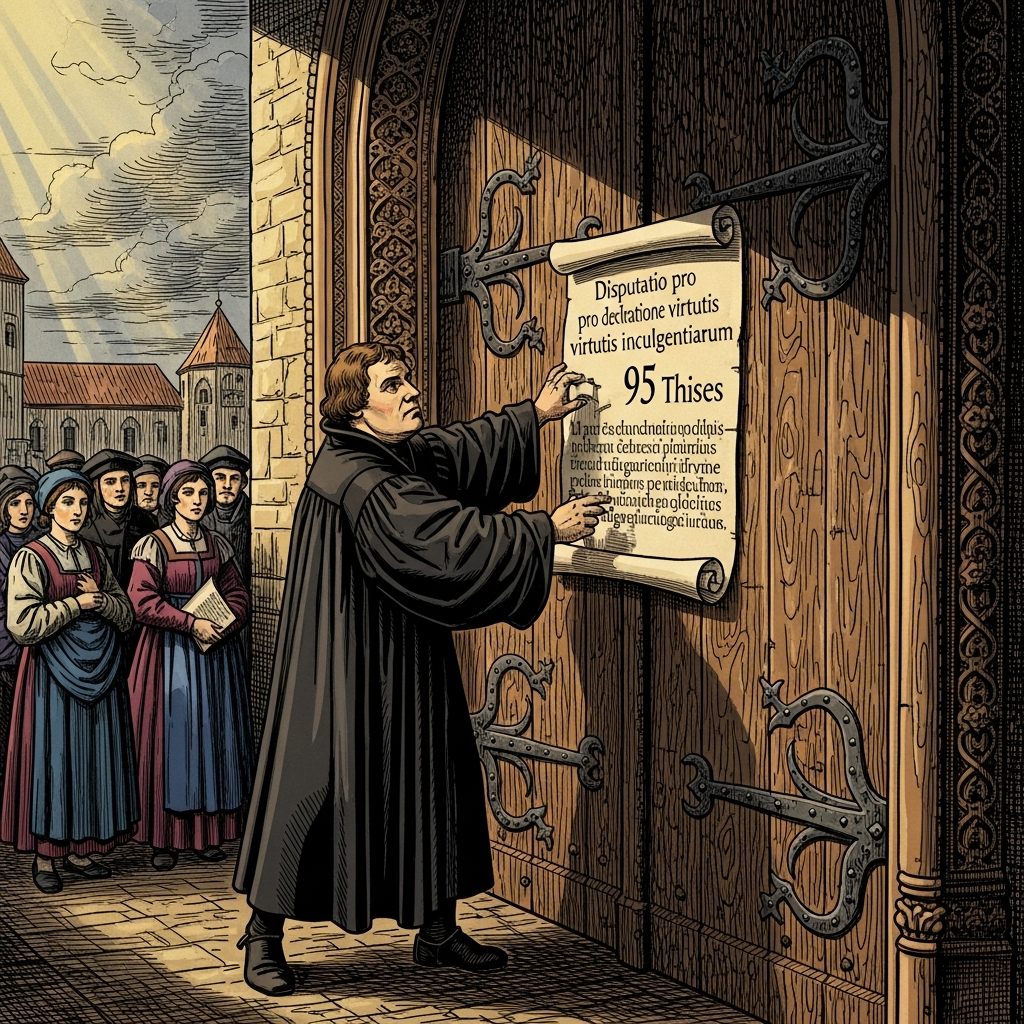
Before Martin Luther, several brave men spoke against church corruption:
| Person | Dates | Contribution |
|---|---|---|
| John Wycliffe | 1320-1384 | Translated Bible into English; called Pope the "antichrist" |
| Jan Hus | 1369-1415 | Preached against indulgences; burned at stake |
| Waldenses | 1170s onward | Kept Scripture, lived simply; persecuted for centuries |
These faithful believers faced severe persecution for standing on Scripture:
Yet the truth could not be stopped!
1. Who translated the Bible into English? __________
2. Who was burned at the stake in 1415? __________
3. Why did the church want to keep the Bible in Latin?
__________________________________________________
| Term | Definition |
|---|---|
| Feudalism | Social system based on land and loyalty |
| Serf | Peasant tied to the land |
| Crusades | Religious wars for the Holy Land |
| Black Death | Plague that killed millions |
| Renaissance | "Rebirth" of classical learning |
| Indulgences | Payments to reduce sin's punishment |
1. What was the social system of medieval Europe called? __________
2. What disease killed up to 60% of Europe? __________
3. What invention helped spread the Bible? __________
4. What does "Renaissance" mean? __________
5. Why is it important to read history with discernment?
__________________________________________________
1. 476 AD | 2. Any two: corruption, military weakness, invasions, economic problems | 3. The Catholic Church
1. King | 2. Serfs | 3. Feudalism kept people in permanent poverty; biblical Jubilee redistributed land
1. Age 7 | 2. Any three: moat, drawbridge, curtain wall, keep/tower, great hall
1. Paying money to reduce punishment for sins | 2. To keep control over what people believed
1. About 200 years | 2. No - He says to love enemies, not kill them
1. 30-60% | 2. Fleas on rats | 3. Labor shortage led to higher wages
1. Rebirth | 2. Italy | 3. It puts man at the center instead of Yahuah
1. Johannes Gutenberg | 2. The Bible | 3. Allowed rapid spread of Scripture and reformation ideas
1. John Wycliffe | 2. Jan Hus | 3. To keep control; people who couldn't read it couldn't question church teachings
1. Feudalism | 2. Black Death (bubonic plague) | 3. Printing press | 4. Rebirth | 5. Textbooks don't always tell the full truth; we need to examine history biblically