Sacred Names Pronunciation Guide
Welcome to Grammar Mastery
Language is one of the greatest gifts Yahuah gave to humanity. When He spoke, the universe came into existence. Words have power to create, heal, instruct, and inspire. As followers of truth, we must master the art of clear, persuasive, and beautiful communication.
This course goes beyond basic grammar to explore style (how you write), rhetoric (how you persuade), and mastery (how you polish your craft). Whether writing essays, giving speeches, or defending your faith, these skills will serve you for life.
Lesson 1: Advanced Sentence Structure
RECEIVE: Complex Sentences Mastered
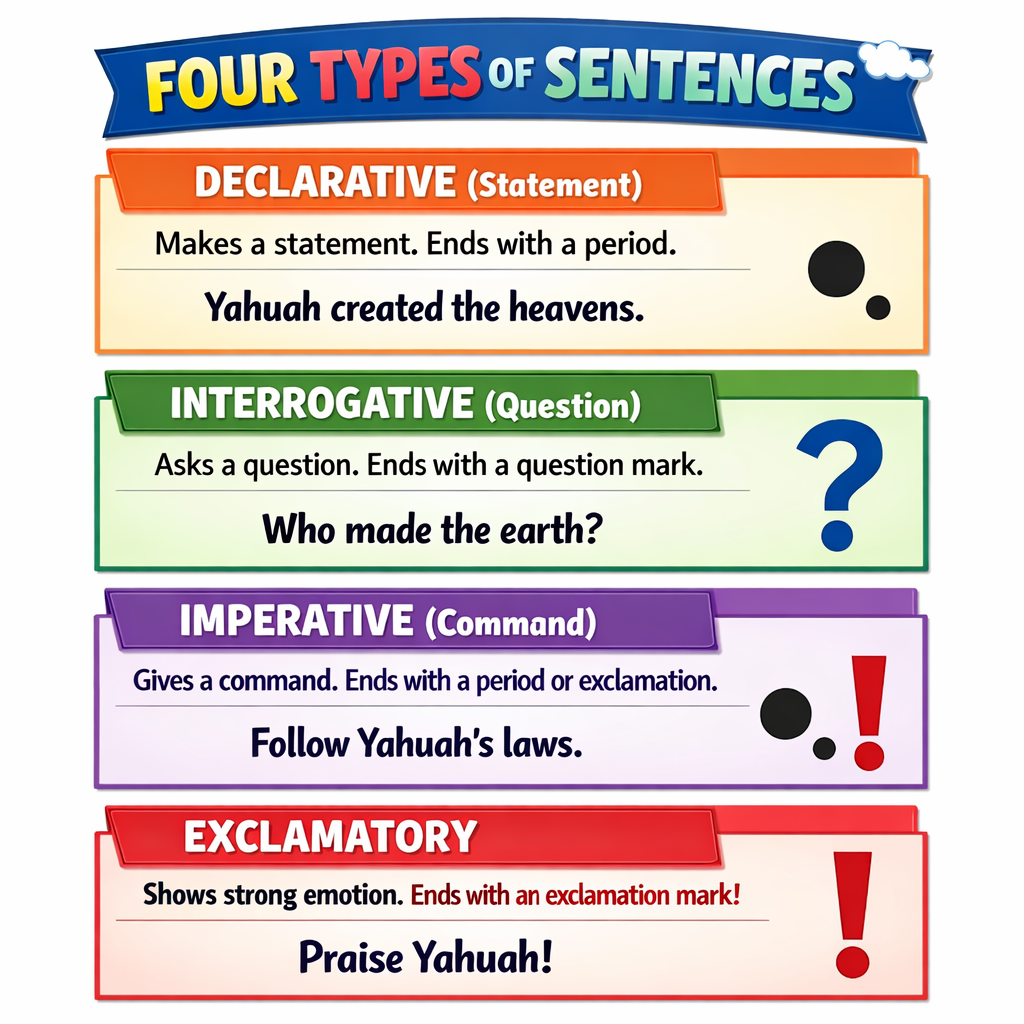
The Four Sentence Types by Structure:
- Simple: One independent clause (The sun rose.)
- Compound: Two independent clauses joined by conjunction (The sun rose, and the birds sang.)
- Complex: One independent + one dependent clause (When the sun rose, the birds sang.)
- Compound-Complex: Two independent + one or more dependent clauses
"Although Yahuah created the world in six days, He rested on the seventh, and He blessed that day as holy."
[Dependent clause] + [Independent clause], and [Independent clause]
REFLECT: Sentence Variety in Scripture
The Power of Sentence Structure
Notice how Genesis uses short, declarative sentences for power: "Let there be light: and there was light." The simplicity conveys authority. When Yahuah speaks, it happens immediately. No qualifications, no hesitation. Learn when to use short sentences for impact.
RECALL: Practice Exercises
Identify the Sentence Type:
Combine These Simple Sentences into One Compound-Complex Sentence:
RESPOND: Application
Write a paragraph (5-7 sentences) about creation using ALL FOUR sentence types. Label each sentence type in parentheses.
Lesson 2: Parallel Structure
RECEIVE: The Power of Parallelism
Parallel structure means using the same grammatical pattern for similar ideas. It creates rhythm, clarity, and memorability.
"Yahusha came to teach, healing, and for saving the lost."
"Yahusha came to teach, to heal, and to save the lost."
Parallelism in Hebrew Poetry
Hebrew poetry is built on parallelism. The Psalms, Proverbs, and prophetic books use it constantly. There are three main types:
- Synonymous: Second line restates the first (Psalm 24:1)
- Antithetic: Second line contrasts the first (Proverbs 10:1)
- Synthetic: Second line builds on the first (Psalm 1:3)
RECALL: Fix the Parallelism
Rewrite these sentences with correct parallel structure:
RESPOND: Create Parallel Sentences
Write three sentences using parallel structure about the Fruits of the Spirit (Galatians 5:22-23):
Lesson 3: Advanced Punctuation
RECEIVE: Punctuation as a Tool
Advanced writers use punctuation not just for correctness, but for effect. Each mark controls pacing, emphasis, and tone.
| Mark | Use | Effect |
|---|---|---|
| Semicolon (;) | Links related independent clauses | Shows close relationship; adds sophistication |
| Colon (:) | Introduces lists, explanations, or emphasis | Creates anticipation; "here it comes" |
| Em dash (—) | Adds emphasis, interruption, or explanation | Creates drama; draws attention |
| Parentheses ( ) | Adds supplementary information | De-emphasizes; feels like an aside |
"Many claim to know the truth; few actually live it."
"Yahusha gave us one command: love one another."
"The world offers many paths—but only one leads to life."
RECALL: Punctuation Practice
Add the appropriate punctuation (semicolon, colon, or em dash):
RESPOND: Write with Variety
Write a paragraph about the importance of studying Scripture. Include at least one semicolon, one colon, and one em dash:
Lesson 4: The Art of Rhetoric
RECEIVE: What is Rhetoric?
Rhetoric is the art of persuasive speaking and writing. It was studied in ancient Greece and Rome, and used powerfully by the apostles and prophets.
Aristotle identified three modes of persuasion:
- Ethos: Appeal to character/credibility
- Pathos: Appeal to emotion
- Logos: Appeal to logic/reason
Paul Uses All Three in Acts 26:
Ethos: "I am a Jew, born in Tarsus, educated at the feet of Gamaliel" (establishing credibility)
Pathos: "Why should it be thought incredible that Elohim raises the dead?" (emotional appeal)
Logos: Logical progression of his conversion story and scriptural evidence
RECALL: Identify the Appeal
Label each statement as Ethos, Pathos, or Logos:
RESPOND: Use All Three Appeals
Write a short persuasive paragraph encouraging someone to keep the Sabbath. Include at least one example of ethos, pathos, and logos. Label each:
Lesson 5: Rhetorical Devices
RECEIVE: Tools of Persuasion
Great communicators use specific techniques to make their words memorable and powerful. Here are key rhetorical devices:
"For His mercy endures forever... For His mercy endures forever... For His mercy endures forever..."
"No man can serve two masters: for either he will hate the one, and love the other; or else he will hold to the one, and despise the other."
"But many that are first shall be last; and the last shall be first."
RECALL: Identify the Device
Name the rhetorical device used:
RESPOND: Create Your Own
Write one example of each device about a biblical truth:
Anaphora:
Antithesis:
Rhetorical Question:
Lesson 6: Voice and Tone
RECEIVE: Finding Your Voice
Voice is your unique writing personality—the way you express yourself that makes your writing distinctly yours.
Tone is the attitude you take toward your subject and audience in a specific piece.
Formal: "The observance of the seventh-day Sabbath remains an obligation for believers."
Conversational: "Look, the Sabbath isn't some outdated rule—it's a gift Yahuah gave us."
Urgent: "The Sabbath is coming! Are you ready to rest in Yahuah?"
Gentle: "The Sabbath is an invitation to pause, breathe, and reconnect with our Creator."
Style Tip: Match Your Tone to Your Purpose
A research paper needs formal tone. A testimony needs personal tone. A warning needs urgent tone. A letter of encouragement needs warm tone. Know your audience and purpose.
RECALL: Identify the Tone
What tone is being used? (formal, conversational, urgent, gentle, humorous, serious)
RESPOND: Practice Different Tones
Write the same message about prayer in TWO different tones:
Formal/Academic Tone:
Conversational/Personal Tone:
Lesson 7: Active vs. Passive Voice
RECEIVE: Voice in Action
Active Voice: The subject performs the action. (Yahuah created the heavens.)
Passive Voice: The subject receives the action. (The heavens were created by Yahuah.)
When to Use Each:
Active: Prefer for clarity, directness, and power. Most writing should be active.
Passive: Use when the receiver is more important than the doer, or when the doer is unknown.
"Yahusha was crucified." (The focus is on Yahusha, not the executioners.)
"Yahuah raised Yahusha from the dead." (Emphasizes Yahuah's power.)
RECALL: Convert Voice
Rewrite these passive sentences in active voice:
When might passive voice be appropriate? Explain:
Lesson 8: Conciseness and Clarity
RECEIVE: Say More with Less
Powerful writing is concise—every word earns its place. Cut unnecessary words without losing meaning.
| Wordy | Concise |
|---|---|
| Due to the fact that | Because |
| In order to | To |
| At this point in time | Now |
| In the event that | If |
| The reason why is that | Because |
| Has the ability to | Can |
RECALL: Eliminate Wordiness
Rewrite these sentences more concisely:
RESPOND: Practice Precision
Write a 3-sentence summary of the Gospel. Use no more than 50 words total:
Word count: _____
Lesson 9: Building Arguments
RECEIVE: The Structure of Argument
A strong argument has these components:
- Claim: Your main point or thesis
- Evidence: Facts, Scripture, examples supporting your claim
- Warrant: The logical connection between evidence and claim
- Counterargument: Acknowledging opposing views
- Rebuttal: Refuting the counterargument
Claim: The Sabbath remains binding for believers today.
Evidence: Yahusha said He did not come to abolish the Torah (Matthew 5:17-19).
Warrant: Since the Sabbath is part of Torah, and Torah stands, the Sabbath stands.
Counterargument: Some say Colossians 2:16 releases us from Sabbath.
Rebuttal: Paul is addressing man-made traditions about the Sabbath, not the Sabbath itself.
RECALL: Identify Argument Parts
Label each part of this argument (Claim, Evidence, Warrant, Counterargument, Rebuttal):
RESPOND: Build Your Own Argument
Choose a biblical truth and construct a complete argument with all five parts:
Topic:
Claim:
Evidence:
Warrant:
Counterargument:
Rebuttal:
Lesson 10: Recognizing Logical Fallacies
RECEIVE: Flawed Reasoning
A logical fallacy is an error in reasoning that makes an argument invalid. Learn to spot them in others' arguments—and avoid them in your own.
| Fallacy | Definition | Example |
|---|---|---|
| Ad Hominem | Attacking the person instead of the argument | "You only believe in creation because you're uneducated." |
| Straw Man | Misrepresenting someone's argument to attack it | "So you think we should just ignore science completely?" |
| Appeal to Authority | Claiming something is true because an authority says so | "Scientists say it, so it must be true." |
| False Dichotomy | Presenting only two options when more exist | "Either accept evolution or reject all science." |
| Appeal to Popularity | Claiming truth based on popularity | "Most people believe in evolution, so it must be true." |
| Circular Reasoning | Using the conclusion as a premise | "Evolution is true because we see evolution happening." |
Why This Matters
As defenders of truth, we must argue fairly and recognize when others don't. Yahusha never used fallacies—He always addressed arguments directly with wisdom and Scripture.
RECALL: Identify the Fallacy
Name the fallacy used in each statement:
RESPOND: Counter the Fallacy
Choose one fallacy from above and write a response that corrects the flawed reasoning:
Lesson 11: Analyzing Writing Style
RECEIVE: What Makes Great Writing?
When analyzing style, examine these elements:
- Diction: Word choice (formal, informal, technical, simple)
- Syntax: Sentence structure (long/short, simple/complex)
- Imagery: Sensory details and figurative language
- Tone: The writer's attitude
- Rhythm: The flow and pacing of language
Style Analysis: Isaiah 40:31
"But they that wait upon Yahuah shall renew their strength; they shall mount up with wings as eagles; they shall run, and not be weary; and they shall walk, and not faint."
Diction: Elevated, poetic, ancient
Syntax: Parallel structure, building rhythm
Imagery: Eagles soaring—visual and kinetic
Tone: Encouraging, majestic, hopeful
Rhythm: Climactic structure (mount up → run → walk)
RECALL: Analyze Scripture
Analyze the style of Psalm 23:
RESPOND: Imitate the Style
Write your own "Yahuah is my _____" metaphor passage (4-5 sentences) in the style of Psalm 23:
Lesson 12: The Persuasive Essay
RECEIVE: Essay Architecture
The Five-Paragraph Persuasive Essay:
- Introduction: Hook, background, thesis statement
- Body 1: Strongest argument + evidence
- Body 2: Second argument + evidence
- Body 3: Counterargument + rebuttal
- Conclusion: Restate thesis, call to action
Hook Techniques:
- Startling statistic or fact
- Rhetorical question
- Brief anecdote or story
- Relevant quotation
- Bold statement or claim
"The seventh-day Sabbath remains binding for believers today because Scripture never abolishes it, Yahusha observed it, and the early church kept it for centuries."
Notice: Clear claim + three supporting reasons (previews the body paragraphs)
RECALL: Plan an Essay
Create an outline for a persuasive essay on a biblical topic:
Topic:
Thesis Statement:
Body Paragraph 1 Main Point:
Body Paragraph 2 Main Point:
Counterargument to Address:
RESPOND: Write an Introduction
Using your outline above, write a complete introduction paragraph (hook + background + thesis):
Lesson 13: Revision and Editing
RECEIVE: The Art of Rewriting
"Writing is rewriting." Great writers revise multiple times. There are two levels:
- Revision: Big-picture changes (organization, arguments, clarity)
- Editing: Surface-level changes (grammar, spelling, punctuation)
Revision Checklist:
- Is my thesis clear?
- Does each paragraph support my thesis?
- Are my transitions smooth?
- Is my evidence strong enough?
- Did I address counterarguments?
- Is my conclusion compelling?
Editing Checklist:
- Subject-verb agreement?
- Correct punctuation?
- Parallel structure?
- Active voice where appropriate?
- Eliminate wordiness?
- Spelling and capitalization?
RECALL: Edit This Passage
Find and correct at least 5 errors in this paragraph:
"Due to the fact that Yahuah is holy, we as believers should be living holy lives. The Torah, which was given to Moses by Yahuah on Mount Sinai, it teaches us how to be holy. Many people says that the law was done away with, but Yahusha said he did not come to abolish the law but to fullfill it. Their is no contradiction between grace and obediance. When we love Yahuah we will want to keep his commandments."
Corrected version:
Lesson 14: From Writing to Speaking
RECEIVE: Oral Rhetoric
Speaking differs from writing. Listeners can't re-read, so speakers must:
- Use shorter sentences and simpler structure
- Repeat key points (tell them what you'll say, say it, tell them what you said)
- Use vocal variety (pace, volume, pauses)
- Connect with eye contact and body language
- Engage with rhetorical questions and direct address
Peter's Speaking Techniques
Notice how Peter uses direct address ("Ye men of Israel"), imperatives ("hear these words"), and emphatic statements ("know assuredly"). He's not reading an essay—he's commanding attention and demanding a response.
RECALL: Speaking vs. Writing
Rewrite this written sentence for oral delivery (more natural, repetitive, emphatic):
RESPOND: Prepare a Speech
Outline a 3-minute speech defending a biblical truth. Include an attention-getter, three main points, and a call to action:
Practice Assignment:
Deliver your speech to a family member or record yourself. Then evaluate: Did you maintain eye contact? Vary your voice? Pause for effect? What would you improve?
Answer Key for Parents/Teachers
Lesson 1: Sentence Types
1. Simple | 2. Compound | 3. Compound-Complex | 4. Complex
Combination example: "Although the Pharisees questioned Yahusha, He answered them wisely, and they could not trap Him."
Lesson 2: Parallel Structure Corrections
1. "We should study Scripture, pray daily, and serve others."
2. "The Torah teaches us how to love Yahuah, love our neighbor, and be holy."
3. "He was not only a great teacher but also a powerful healer."
Lesson 3: Punctuation
1. Semicolon (;) | 2. Colon (:) | 3. Em dash (—) | 4. Em dashes (— —)
Lesson 4: Rhetorical Appeals
1. Ethos | 2. Pathos | 3. Logos | 4. Logos | 5. Pathos
Lesson 5: Rhetorical Devices
1. Rhetorical Question | 2. Anaphora | 3. Antithesis | 4. Chiasmus
Lesson 6: Tone Identification
1. Formal | 2. Conversational | 3. Urgent | 4. Gentle
Lesson 7: Active Voice Conversions
1. "Yahuah gave the Torah to Moses."
2. "The Israelites destroyed the walls of Jericho."
3. "All believers should observe the Sabbath."
Lesson 8: Conciseness
1. "Because Yahuah is holy, we should live holy lives."
2. "To understand Scripture, we must pray."
3. "The Pharisees rejected Yahusha because He challenged their traditions."
Lesson 9: Argument Parts
1. Claim | 2. Evidence | 3. Warrant | 4. Counterargument | 5. Rebuttal
Lesson 10: Logical Fallacies
1. Ad Hominem | 2. False Dichotomy | 3. Appeal to Authority | 4. Appeal to Popularity | 5. Straw Man
Lesson 11: Psalm 23 Analysis
Diction: Simple, pastoral, intimate
Central Imagery: Shepherd and sheep
Tone: Peaceful, trusting, confident
Verse 4 Shift: Moves from third person ("He") to second person ("thou") - becomes more intimate in danger
Lesson 13: Editing Errors
1. "Due to the fact that" → "Because"
2. "it teaches" → "teaches" (remove redundant "it")
3. "people says" → "people say"
4. "fullfill" → "fulfill"
5. "Their" → "There"
6. "obediance" → "obedience"
7. "his" → "His" (referring to Yahuah)