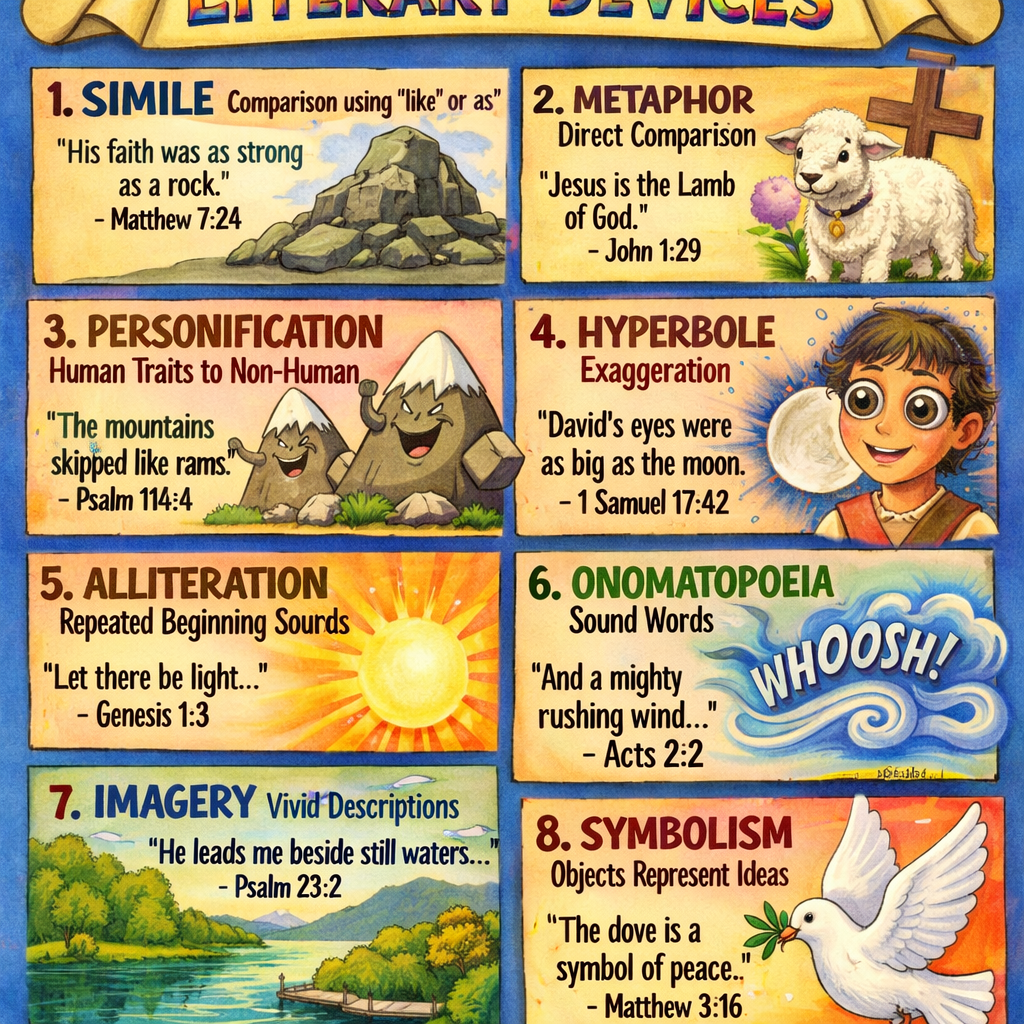
Literary devices
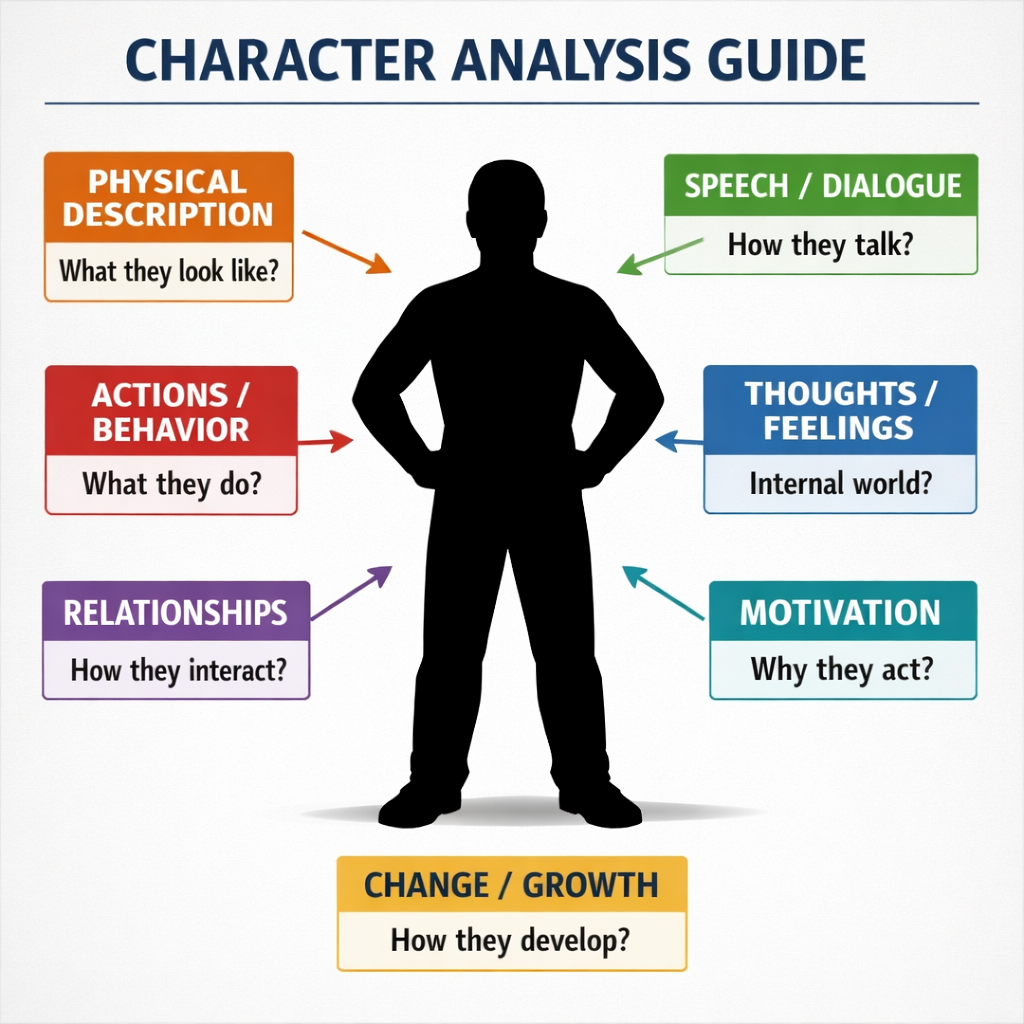
Character analysis
Classic Stories & Biblical Narratives
Grades 3-4 | Ages 8-10
Literary devices
Character analysis
Explore great stories using the 4 Rs!
"Your word is a lamp to my feet and a light to my path." - Psalm 119:105
Every good story has five main parts called story elements. Understanding these helps you enjoy stories more and become a better writer!
The people or animals in the story
Where and when the story happens
The challenge characters must face
The events that happen in order
How the problem is solved
Yahusha used stories (parables) to teach important lessons! The best stories have a theme - a message or lesson. As you read, ask: "What is this story teaching me?"
Characters: David (young shepherd), Goliath (giant warrior), King Saul, Israelite army
Setting: Valley of Elah, ancient Israel, during a war with the Philistines
Problem: Giant Goliath challenged Israel, and no one was brave enough to fight him
Plot: David arrived, heard Goliath's challenge, trusted Yahuah, and faced the giant with just a sling and stones
Solution: David defeated Goliath with one stone, trusting in Yahuah's power
Theme: Faith in Yahuah gives courage to face any challenge
1. What is the "setting" of a story?
2. What was David's secret to defeating Goliath?
Think of your favorite Bible story. Write the story elements:
Characters:
Setting:
Problem:
Solution:
Character traits are words that describe what a person is like on the inside - their personality, values, and how they act.
brave, honest, kind, faithful, patient, humble, wise, generous
selfish, proud, dishonest, cruel, jealous, lazy, foolish, greedy
Look at what a character:
What Joseph DID: Refused to sin with Potiphar's wife, forgave his brothers who sold him into slavery
What Joseph SAID: "You meant evil against me, but Elohim meant it for good" (Genesis 50:20)
Character Traits: faithful forgiving patient wise humble
1. If a character shares their food with someone hungry, they are:
2. If a character tells the truth even when it's hard, they are:
3. Joseph showed forgiveness when he:
Choose a Bible character (Noah, Moses, Ruth, Daniel, Esther, etc.). Write 3 character traits and give evidence from the Bible:
Character: ________________
Trait 1: ________________ Evidence:
Trait 2: ________________ Evidence:
The Pilgrim's Progress by John Bunyan (1678) is one of the most important books ever written! It's an allegory - a story where characters and places represent deeper meanings.
Author: John Bunyan (wrote it while in prison for preaching!)
Main Character: Christian - represents any believer
Plot: Christian's journey from the City of Destruction to the Celestial City (Heaven)
Theme: The journey of faith - struggles, helpers, and ultimate victory
Christian fell into a swamp called the Slough of Despond - representing the despair and discouragement new believers feel when they realize their sins. A helper named Help pulled him out!
Lesson: When we feel discouraged about our sins, we need help from others and must keep moving toward Yahuah!
An allegory uses characters and events to represent deeper truths. The Bible has allegories too! Yahusha's parables are short allegories - the sower represents Yahuah, the seed is His Word, different soils are different hearts.
1. What does Christian's journey represent?
2. What does the "Slough of Despond" represent?
Fables are short stories that teach a lesson called a moral. Aesop was a storyteller in ancient Greece who created hundreds of fables, often with animal characters.
A fast hare made fun of a slow tortoise. The tortoise challenged him to a race. The hare ran quickly but got overconfident and took a nap. Meanwhile, the tortoise kept going slowly and steadily. When the hare woke up, the tortoise had won!
Moral: "Slow and steady wins the race."
This fable teaches a truth also found in the Bible! "The race is not to the swift, nor the battle to the strong" (Ecclesiastes 9:11). Faithfulness over time matters more than quick starts.
A shepherd boy got bored watching sheep. For fun, he cried "Wolf! Wolf!" The villagers came running, but there was no wolf. He did this twice. When a real wolf came, he cried for help - but no one believed him. The wolf ate many sheep.
Moral: "No one believes a liar, even when they tell the truth."
While many fables teach good lessons that agree with Scripture, not all do. Some teach self-reliance instead of trusting Yahuah. Always compare what you read to the Bible - it's the standard for truth!
1. What is the moral of a fable?
2. Why did no one help the boy when the real wolf came?
Read the fable below and write what you think the moral is:
All summer, the ant worked hard storing food. The grasshopper played and made fun of the ant. When winter came, the ant had plenty to eat, but the grasshopper had nothing.
The moral is:
The book of Jonah is one of the most exciting stories in the Bible! It's a true historical narrative with powerful lessons about obedience and Yahuah's mercy.
Chapter 1: Yahuah tells Jonah to go to Nineveh. Jonah runs away on a ship. A great storm comes. Jonah is thrown overboard and swallowed by a great fish!
Chapter 2: Inside the fish for 3 days, Jonah prays and repents.
Chapter 3: The fish spits Jonah out. He goes to Nineveh and preaches. The whole city repents!
Chapter 4: Jonah is angry that Yahuah showed mercy to Nineveh. Yahuah teaches him about compassion.
Negative traits: disobedient prideful angry unforgiving
Positive traits: honest (admitted his sin on the ship) repentant (prayed in the fish)
Lesson: Even prophets struggle! Yahuah is patient with us as we learn.
Yahusha said Jonah's 3 days in the fish was a sign pointing to His own death and resurrection - 3 days in the tomb! This is called a type - an Old Testament person or event that foreshadows something in the New Testament.
1. Why did Jonah run from Yahuah?
2. What happened when Nineveh heard Jonah's message?
3. Jonah's time in the fish points to:
Is there something Yahuah wants you to do that you've been avoiding? Write about it:
Good readers compare (find similarities) and contrast (find differences) between stories. This helps us understand them better!
What do the stories have in common?
How are the stories different?
ALIKE:
DIFFERENT:
Compare David and Goliath with Gideon and the Midianites (Judges 7):
ALIKE:
DIFFERENT:
Point of view is who is narrating (telling) the story. It affects what information we get!
"I" or "we" - a character tells the story
Example: "I went to the market."
"He," "she," "they" - outside narrator
Example: "David went to fight Goliath."
Most Bible narratives use third person - "Moses went up the mountain." But some parts are first person - like when Paul writes "I, Paul, write this" or when David writes Psalms using "I."
Third Person: "The shepherd boy David walked toward the giant. The soldiers watched in fear. David put a stone in his sling."
First Person (if David told it): "I walked toward the giant. I could see my brothers watching. I put a stone in my sling and trusted Yahuah."
1. "Then Moses stretched out his hand over the sea." - What point of view?
2. "I waited patiently for Yahuah; and He inclined unto me, and heard my cry." (Psalm 40:1)
This is in third person: "Jonah ran from Yahuah. He got on a ship going the opposite direction."
Rewrite in first person (as if Jonah is telling it):
Not all books are good! As you read, always ask:
"Test all things; hold fast to what is good." (1 Thessalonians 5:21)
1. What is a story's theme?
2. An allegory is:
3. We should compare everything we read to:
Q1: Where and when it happens | Q2: He trusted in Yahuah
Q3: Generous | Q4: Honest and brave | Q5: Welcomed his brothers and didn't take revenge
Q6: The journey of faith | Q7: Discouragement about sin
Q8: The lesson it teaches | Q9: They didn't believe him because he had lied before
Ant & Grasshopper moral: Work hard and prepare for the future / Don't be lazy
Q10: He didn't want Nineveh to be saved | Q11: They repented | Q12: Yahusha's resurrection
Q13: Third person | Q14: First person
Q15: The message or lesson | Q16: A story with a deeper meaning | Q17: The Bible (Scripture)