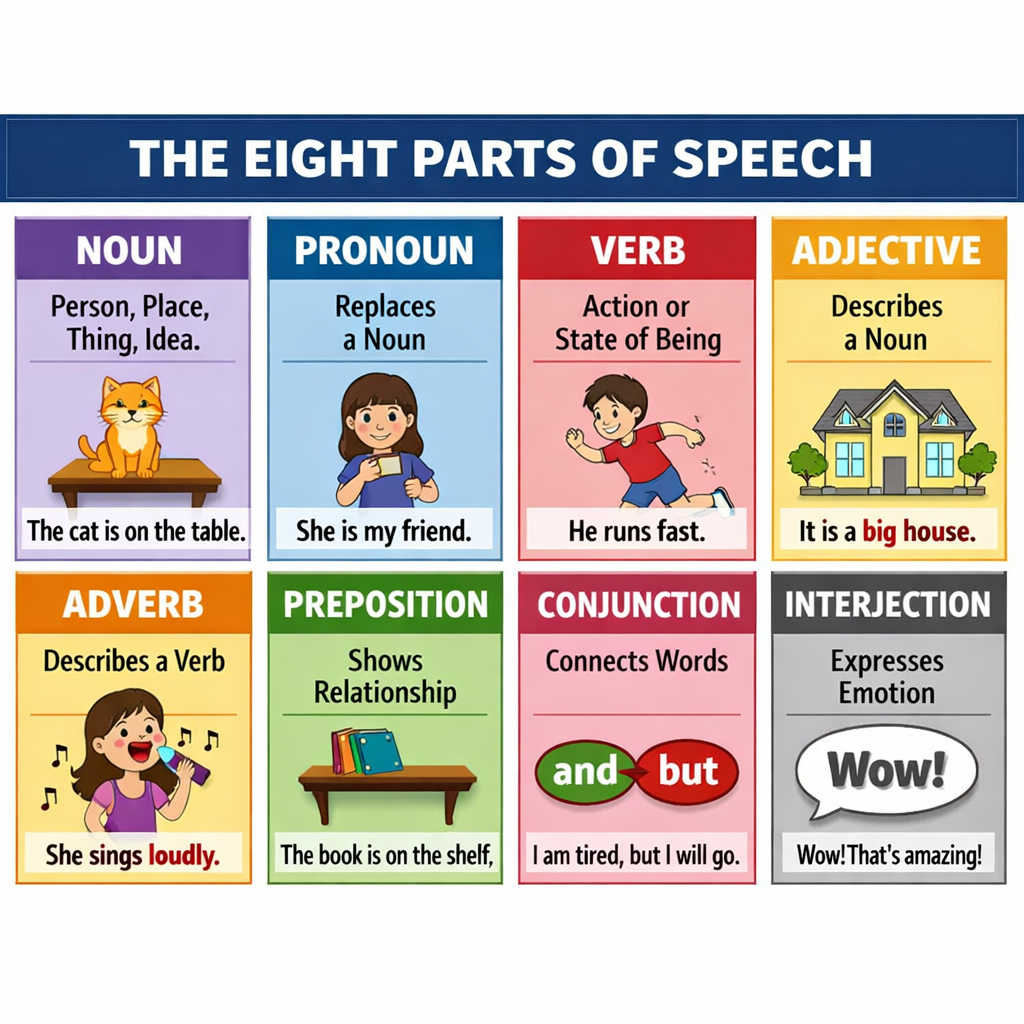
Word types
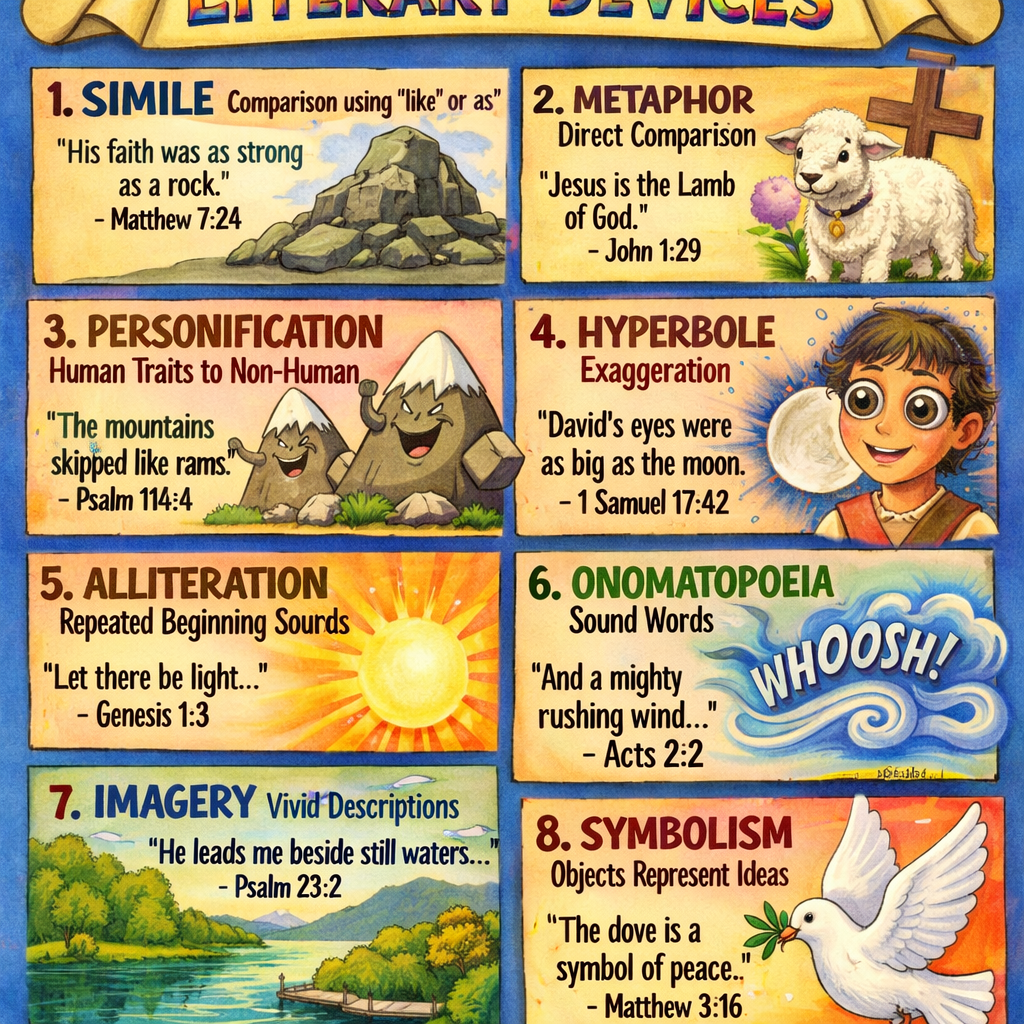
Literary vocabulary
Mastering Academic Language for Higher Education
Word types
Literary vocabulary
| Yahuah | yah-HOO-ah | The Creator's personal name, meaning "I AM" |
| Yahusha | yah-HOO-shah | The Messiah's name, meaning "Yahuah is Salvation" |
| Elohim | el-oh-HEEM | Title meaning "Mighty One(s)" |
| Torah | TOH-rah | Instruction/Law - the first five books |
Over 60% of English words come from Greek and Latin. Understanding roots unlocks the meaning of thousands of words!
The Hebrew word for truth is emet (אֱמֶת), spelled with the first, middle, and last letters of the Hebrew alphabet (Aleph, Mem, Tav). This shows that truth encompasses everything from beginning to end - Yahuah (yah-HOO-ah) is truth throughout all things!
Use your knowledge of roots to define:
Fill in the blank with the correct word:
Test Strategy: When you encounter an unfamiliar word, break it into parts. Look for prefixes (beginning), roots (middle), and suffixes (ending). Even if you don't know the exact meaning, you can often eliminate wrong answers based on root meanings.
Match the word to its meaning:
Use context and roots to choose the best word:
Magnanimous /mag-NAN-uh-mus/ adjective
Generous in forgiving; noble in spirit; rising above pettiness
"Despite the insults, she remained magnanimous and refused to retaliate."
Synonyms: generous, noble, forgiving, gracious
Antonyms: petty, vindictive, spiteful
Pragmatic /prag-MAT-ik/ adjective
Dealing with things sensibly and realistically; practical rather than idealistic
"Her pragmatic approach to problem-solving saved the company millions."
Synonyms: practical, realistic, sensible
Antonyms: idealistic, impractical, unrealistic
Obstinate /OB-stuh-nut/ adjective
Stubbornly refusing to change one's opinion or course of action
"The obstinate child refused to eat vegetables no matter what."
Synonyms: stubborn, headstrong, unyielding
Antonyms: flexible, compliant, yielding
Sycophant /SIK-uh-fant/ noun
A person who acts obsequiously toward someone to gain advantage; a flatterer
"The king was surrounded by sycophants who only told him what he wanted to hear."
Synonyms: flatterer, yes-man, toady
Parsimonious /par-suh-MOH-nee-us/ adjective
Extremely unwilling to spend money; excessively frugal
"The parsimonious landlord refused to fix the broken heater."
Synonyms: stingy, miserly, cheap
Antonyms: generous, lavish, extravagant
Scripture calls us to develop righteous character. Yahuah (yah-HOO-ah) desires us to be magnanimous (forgiving) like Yahusha (yah-HOO-shah), pragmatic in our dealings, but never sycophantic - only speaking truth, not flattery!
Choose the word that best fits:
Write a sentence using each word correctly:
5. Pragmatic:
6. Magnanimous:
Conjecture /kun-JEK-chur/ noun/verb
An opinion or conclusion formed without proof; to guess
"Without evidence, his theory remained mere conjecture."
Synonyms: speculation, guess, hypothesis
Antonyms: fact, certainty, proof
Discern /dih-SURN/ verb
To perceive or recognize clearly; to distinguish mentally
"She could discern the truth behind his false smile."
Synonyms: perceive, recognize, distinguish
Scrutinize /SKROO-tuh-nize/ verb
To examine very closely and carefully
"The detective scrutinized every piece of evidence."
Synonyms: examine, inspect, analyze
Antonyms: ignore, overlook, skim
Infer /in-FUR/ verb
To conclude from evidence and reasoning (not directly stated)
"From the wet streets, we can infer that it rained last night."
Synonyms: deduce, conclude, gather
Profound /pruh-FOWND/ adjective
Very deep or intense; showing great insight or understanding
"The philosopher offered profound insights into human nature."
Synonyms: deep, insightful, thoughtful
Antonyms: shallow, superficial, trivial
Fill in the correct word:
Which word best describes the action?
Articulate /ar-TIK-yoo-lit/ adj/verb
Having the ability to speak fluently and clearly; to express clearly
"The articulate speaker held the audience's attention for hours."
Synonyms: eloquent, fluent, expressive
Antonyms: inarticulate, tongue-tied, unclear
Verbose /vur-BOHS/ adjective
Using more words than necessary; wordy
"The verbose writer turned a simple idea into a 20-page essay."
Synonyms: wordy, long-winded, prolix
Antonyms: concise, succinct, brief
Reticent /RET-ih-sunt/ adjective
Not revealing one's thoughts or feelings readily; reserved
"She was reticent about her past, sharing little with strangers."
Synonyms: reserved, quiet, taciturn
Antonyms: talkative, open, forthcoming
Disparage /dih-SPAR-ij/ verb
To speak of in a slighting or disrespectful way; to belittle
"He constantly disparaged his coworkers' contributions."
Synonyms: belittle, criticize, denigrate
Antonyms: praise, compliment, extol
Candid /KAN-did/ adjective
Truthful and straightforward; frank
"I appreciate your candid feedback, even though it was hard to hear."
Synonyms: frank, honest, straightforward
Antonyms: deceptive, evasive, dishonest
Scripture calls believers to be candid and articulate in speaking truth. "Let your yea be yea, and your nay be nay" (Matthew 5:37). We should never disparage others or be verbose with empty words, but speak truth clearly and lovingly.
Opposites: What word means the opposite?
Context Clues: Choose the best word:
Contentious /kun-TEN-shus/ adjective
Causing or likely to cause argument; quarrelsome
"The contentious debate lasted for hours with no resolution."
Synonyms: controversial, argumentative, combative
Antonyms: agreeable, peaceable, harmonious
Reconcile /REK-un-sile/ verb
To restore friendly relations; to make compatible
"The two nations worked to reconcile their differences."
Synonyms: reunite, resolve, harmonize
Antonyms: alienate, divide, estrange
Adversary /AD-vur-sair-ee/ noun
One's opponent in a contest, conflict, or dispute
"The lawyer prepared thoroughly to face her formidable adversary in court."
Synonyms: opponent, enemy, rival
Antonyms: ally, friend, supporter
Capitulate /kuh-PICH-uh-late/ verb
To cease to resist; to surrender
"After months of siege, the city was forced to capitulate."
Synonyms: surrender, yield, submit
Antonyms: resist, fight, persevere
Placate /PLAY-kate/ verb
To make someone less angry or hostile; to calm
"He tried to placate his angry customer with a full refund."
Synonyms: appease, pacify, soothe
Antonyms: provoke, anger, antagonize
Fill in the correct word:
Transient /TRAN-shunt/ adjective
Lasting only for a short time; temporary
"The pain was transient, fading within minutes."
Synonyms: temporary, fleeting, brief
Antonyms: permanent, lasting, enduring
Immutable /ih-MYOO-tuh-bul/ adjective
Unchanging over time; permanent
"The laws of physics are immutable throughout the universe."
Synonyms: unchangeable, fixed, constant
Antonyms: changeable, mutable, variable
Volatile /VOL-uh-til/ adjective
Liable to change rapidly and unpredictably; explosive
"The volatile stock market caused many investors to worry."
Synonyms: unstable, unpredictable, erratic
Antonyms: stable, steady, predictable
Stagnant /STAG-nunt/ adjective
Not flowing or moving; lacking activity or development
"The economy remained stagnant with no growth for years."
Synonyms: still, motionless, dormant
Antonyms: flowing, active, dynamic
Ameliorate /uh-MEEL-yuh-rate/ verb
To make something bad better; to improve
"The new policies helped ameliorate the housing crisis."
Synonyms: improve, better, enhance
Antonyms: worsen, aggravate, exacerbate
Scripture teaches that Yahuah (yah-HOO-ah) is immutable - "I am Yahuah, I change not" (Malachi 3:6). While earthly things are transient and volatile, His Word and character remain constant forever. This gives us stability in an unstable world!
Match word to definition:
Which word fits?
Copious /KOH-pee-us/ adjective
Abundant in supply; plentiful
"She took copious notes during the lecture."
Synonyms: abundant, plentiful, ample
Antonyms: scarce, meager, sparse
Superfluous /soo-PUR-floo-us/ adjective
More than is needed; unnecessary
"The editor removed all superfluous words from the essay."
Synonyms: unnecessary, excess, redundant
Antonyms: essential, necessary, vital
Meager /MEE-gur/ adjective
Lacking in quantity or quality; inadequate
"The workers complained about their meager wages."
Synonyms: scanty, sparse, insufficient
Antonyms: abundant, plentiful, generous
Diminutive /dih-MIN-yoo-tiv/ adjective
Extremely or unusually small
"Despite her diminutive stature, she was a powerful speaker."
Synonyms: tiny, small, miniature
Antonyms: huge, enormous, massive
Exorbitant /ig-ZOR-bih-tunt/ adjective
Exceeding proper limits; excessive (especially prices)
"The exorbitant rent forced many families to move."
Synonyms: excessive, outrageous, unreasonable
Antonyms: reasonable, moderate, fair
Opposites:
Fill in the blank:
Hypothesis /hy-POTH-uh-sis/ noun
A proposed explanation made on limited evidence as a starting point for investigation
"The scientist formed a hypothesis before designing the experiment."
Empirical /em-PIR-ih-kul/ adjective
Based on observation or experience rather than theory
"The study relied on empirical data collected over five years."
Corroborate /kuh-ROB-uh-rate/ verb
To confirm or give support to a statement or theory
"Additional witnesses came forward to corroborate her testimony."
Anomaly /uh-NOM-uh-lee/ noun
Something that deviates from what is standard or expected
"The sudden temperature spike was an anomaly that puzzled researchers."
Synthesize /SIN-thuh-size/ verb
To combine elements into a coherent whole
"The essay synthesized ideas from multiple sources into one argument."
SAT Reading Tip: These words appear frequently in science passages. Understanding them helps you comprehend how scientists think: they form hypotheses, gather empirical evidence, look for data to corroborate their ideas, note anomalies, and synthesize conclusions!
Match the scientific process:
Allegory /AL-uh-gor-ee/ noun
A story with a hidden meaning, typically moral or political
"Pilgrim's Progress is an allegory of the Christian life."
Juxtaposition /juk-stuh-puh-ZISH-un/ noun
The act of placing things side by side for contrast
"The juxtaposition of wealth and poverty highlighted social inequality."
Ambiguous /am-BIG-yoo-us/ adjective
Open to more than one interpretation; unclear
"The ending was deliberately ambiguous, leaving readers to decide for themselves."
Didactic /dy-DAK-tik/ adjective
Intended to teach or instruct, often in a moral sense
"The didactic tone of the book made its moral lessons obvious."
Rhetorical /rih-TOR-ih-kul/ adjective
Relating to the art of persuasive speaking or writing
"The speaker used many rhetorical devices to convince the audience."
Scripture itself uses these literary techniques! Yahusha (yah-HOO-shah) taught through parables (a form of allegory). The prophets used juxtaposition to contrast righteousness and wickedness. Understanding these terms helps us better comprehend the depth of Scripture!
Identify the literary term:
You won't know every word on the SAT, but you can use context clues to figure out meanings!
Strategy: When you see an unfamiliar word, read the entire sentence and surrounding sentences. Look for signal words like "but," "however," "similarly," "for example," or "in other words" - these often introduce clues!
Use context to determine the meaning of the underlined word:
1. "Unlike his garrulous brother who never stopped talking, Mark was quiet and reserved."
Garrulous means: (talkative / shy / angry)
2. "The medicine had a deleterious effect on her health, making her condition worse rather than better."
Deleterious means: (helpful / harmful / neutral)
3. "Her ephemeral fame lasted only a few months before she was forgotten."
Ephemeral means: (lasting / short-lived / famous)
4. "The ubiquitous advertisements were everywhere - on billboards, buses, and websites."
Ubiquitous means: (rare / colorful / found everywhere)
5. "Despite his affluent background of wealth and privilege, he chose to live simply."
Affluent means: (poor / wealthy / artistic)
Vocabulary is more than memorization - it's understanding ideas deeply. As believers, we use words to speak truth, encourage others, and share the good news of Yahusha (yah-HOO-shah). Strong vocabulary helps us articulate our faith clearly and understand Scripture more deeply!
Part A: Root Analysis
Part B: Vocabulary in Context
Part C: Synonyms & Antonyms
Part D: Application
Write a paragraph using at least 5 vocabulary words from this workbook. Underline each vocabulary word you use.
Lesson 1: 1) blessing/good words, 2) wishing good/kindly, 3) not believable, 4) veracity, 5) benevolent, 6) verify
Lesson 2: 1-C, 2-A, 3-B, 4-D, 5) metamorphosis, 6) conducive
Lesson 3: 1) magnanimous, 2) sycophant, 3) parsimonious, 4) obstinate
Lesson 4: 1) scrutinize, 2) conjecture, 3) infer, 4) profound, 5) infer, 6) discern
Lesson 5: 1) concise, 2) talkative, 3) disparage, 4) candid, 5) verbose
Lesson 6: 1) placate, 2) adversary, 3) capitulate, 4) contentious, 5) reconcile
Lesson 7: 1-C, 2-A, 3-B, 4-D, 5) immutable, 6) transient
Lesson 8: 1) meager, 2) massive, 3) superfluous, 4) diminutive, 5) copious, 6) exorbitant
Lesson 9: 1) hypothesis, 2) empirical, 3) corroborate, 4) synthesize, 5) anomaly
Lesson 10: 1) allegory, 2) didactic, 3) juxtaposition, 4) ambiguous, 5) rhetorical
Lesson 11: 1) talkative, 2) harmful, 3) short-lived, 4) found everywhere, 5) wealthy
Lesson 12: 1) good, 2) truth, 3) time, 4) magnanimous, 5) verbose, 6) empirical, 7) immutable, 8) copious, 9) eloquent, 10) permanent, 11) examine, 12) provoke