Foundations of Abstract Mathematical Thinking
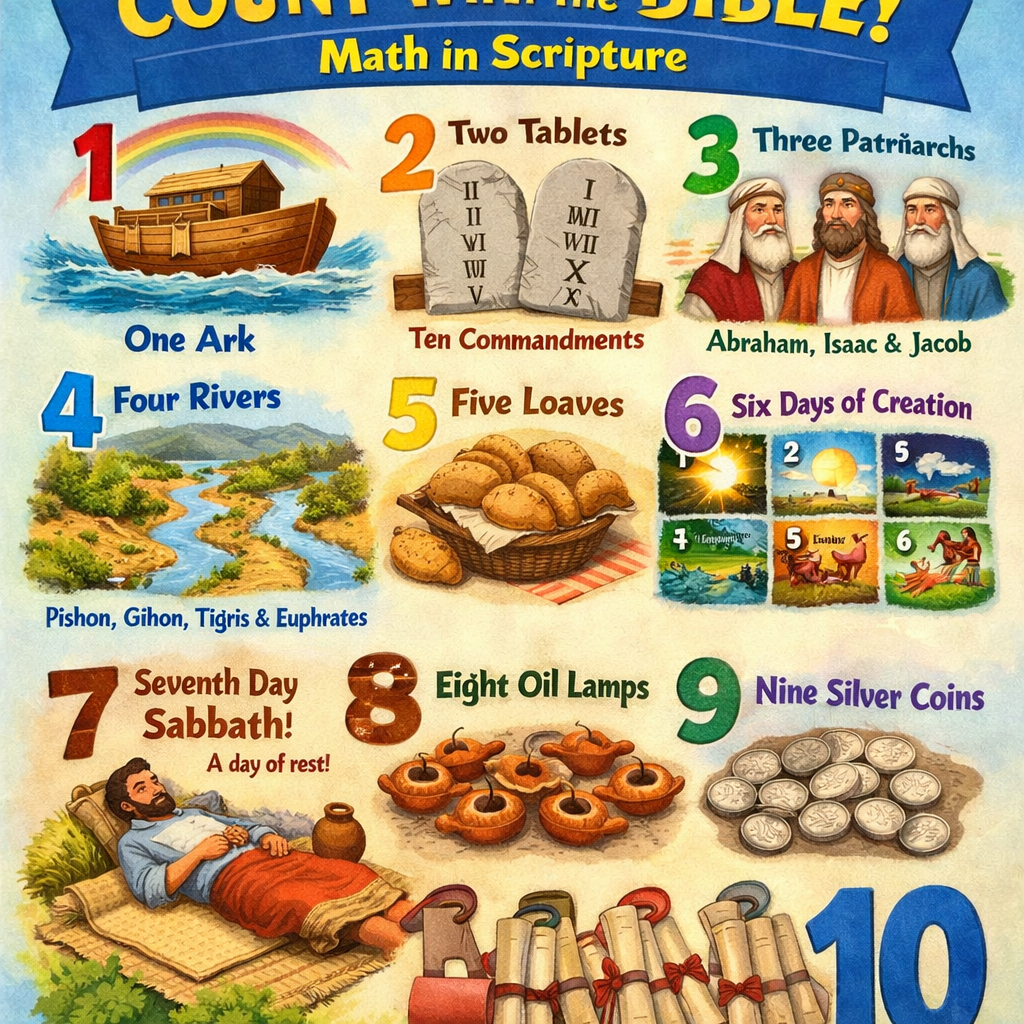
Learning to count with Yahuah!
| Yahuah | yah-HOO-ah | The Creator's personal name, meaning "I AM" |
| Yahusha | yah-HOO-shah | The Messiah's name, meaning "Yahuah is Salvation" |
| Elohim | el-oh-HEEM | Title meaning "Mighty One(s)" |
In algebra, we use variables - letters that represent unknown numbers. This allows us to write general rules that work for any number!
Variable: A letter (like x, y, n) that represents an unknown value
Expression: A combination of numbers, variables, and operations (no equal sign)
Equation: A statement that two expressions are equal (has an equal sign)
Expressions:
Evaluating: If x = 4, then 3x + 5 = 3(4) + 5 = 12 + 5 = 17
Translating Words to Algebra:
Algebra reveals the hidden patterns Yahuah (yah-HOO-ah) built into creation. Just as variables can represent any number, Yahuah's laws work consistently throughout all of creation. The universe operates by fixed mathematical principles because it has a logical Creator!
Evaluate each expression when x = 5:
Translate to algebraic expressions:
Real numbers follow specific rules that never change. These properties are the foundation of all algebraic manipulation.
Commutative Property: Order doesn't matter
Associative Property: Grouping doesn't matter
Distributive Property: Multiply across addition/subtraction
Using the Distributive Property:
Simplify: 5(2x + 3)
Identity Properties:
Inverse Properties:
Name the property illustrated:
Use the distributive property to simplify:
An equation is like a balance scale - both sides must be equal. To solve for the variable, we perform the same operation on both sides to keep it balanced.
The Golden Rule of Equations:
Whatever you do to one side, you MUST do to the other side!
Inverse Operations:
Example 1: Solve x + 7 = 12
Example 2: Solve 3x = 21
Always check your answer by substituting it back into the original equation!
Solve each equation:
Multi-step equations require multiple operations to solve. Follow this order:
Steps for Solving Multi-Step Equations:
Example: Solve 3x + 7 = 22
Example: Solve 2(x + 4) = 18
Variables on Both Sides: Solve 5x + 3 = 2x + 15
Solve each equation:
An inequality compares two expressions that are NOT equal.
Inequality Symbols:
Solving inequalities works like equations, with ONE important exception:
When you multiply or divide by a NEGATIVE number, you must FLIP the inequality sign!
Example: If -2x > 6, then x < -3 (sign flipped!)
Example 1: Solve x + 5 > 12
Example 2: Solve -3x ≤ 15
Solve each inequality:
A function is a special relationship where each input gives exactly one output.
Function Notation: f(x) is read as "f of x"
If f(x) = 2x + 3, then:
The x is the input, and f(x) is the output.
Domain: All possible input values (x-values)
Range: All possible output values (y-values)
Functions model cause and effect - input leads to output. Yahuah (yah-HOO-ah) created a world of consistent cause and effect. "Whatever a man sows, that he will also reap" (Galatians 6:7) - this is a function! The input (what you sow) determines the output (what you reap).
Given f(x) = 3x - 2, find:
Given g(x) = x² + 1, find:
A linear equation creates a straight line when graphed. The most common form is:
In y = mx + b:
Graphing y = 2x + 1:
Making a Table of Values:
| x | y = 2x + 1 | (x, y) |
|---|---|---|
| -1 | 2(-1) + 1 = -1 | (-1, -1) |
| 0 | 2(0) + 1 = 1 | (0, 1) |
| 1 | 2(1) + 1 = 3 | (1, 3) |
Identify the slope and y-intercept:
Graph y = x + 2 on the grid below:
Slope measures how steep a line is - the rate of change between any two points.
Types of Slope:
Find the slope between (2, 3) and (5, 9):
The slope is 2, meaning for every 1 unit right, the line goes up 2 units.
Slope represents rate of change - how one thing changes in relation to another. Yahuah (yah-HOO-ah) established consistent rates throughout creation: the speed of light, the rate of plant growth, the rhythm of seasons. These constant rates allow us to predict and plan!
Find the slope between each pair of points:
We can write the equation of a line if we know:
Point-Slope Form:
Use when you know the slope (m) and one point (x₁, y₁)
Write the equation with slope 3 through point (2, 5):
Write the equation through (1, 2) and (4, 8):
Write the equation in slope-intercept form (y = mx + b):
A system of equations is two or more equations with the same variables. The solution is the point where the lines intersect.
Solving by Substitution:
Solve: y = 2x + 1 and y = x + 4
Solving by Elimination:
Solve: x + y = 10 and x - y = 4
Solve each system:
Exponent Rules:
Polynomials:
The degree is the highest exponent.
Simplify: x³ · x⁴ = x^(3+4) = x⁷
Simplify: (x²)³ = x^(2·3) = x⁶
Add: (3x² + 2x) + (5x² - 4x) = 8x² - 2x
Simplify using exponent rules:
Add or subtract the polynomials:
Factoring is the reverse of distributing - finding what multiplies together to give the polynomial.
Greatest Common Factor (GCF):
Factor out the largest factor common to all terms.
Example: 6x² + 9x = 3x(2x + 3)
Factoring Trinomials (x² + bx + c):
Find two numbers that:
Factor: x² + 5x + 6
Difference of Squares:
a² - b² = (a + b)(a - b)
Example: x² - 9 = (x + 3)(x - 3)
Factor out the GCF:
Factor the trinomials:
Factor the difference of squares:
A quadratic equation has the form ax² + bx + c = 0 (highest power is 2).
Solving by Factoring:
Zero Product Property: If ab = 0, then a = 0 or b = 0
Solve: x² + 5x + 6 = 0
Solve: x² - 9 = 0
Quadratic equations describe parabolas - the path of thrown objects, the shape of satellite dishes, and the curve of suspension bridges. Yahuah (yah-HOO-ah) built these beautiful curves into creation, and algebra allows us to understand and use them!
Solve by factoring:
Algebra isn't just abstract - it solves real problems!
Problem: You're saving for a bicycle that costs $250. You have $40 and save $15 per week. How many weeks until you can buy it?
Problem: A rectangle's length is 3 more than its width. The perimeter is 26 cm. Find the dimensions.
Algebra is the language of patterns, and Yahuah (yah-HOO-ah) is the author of all patterns. From the spiral of galaxies to the growth of plants, mathematical relationships reveal His orderly design. As you master algebra, you're learning to see the world through the lens of its Creator!
Solve:
Word Problem: You have a phone plan that costs $25/month plus $0.10 per text. If your bill was $37, how many texts did you send?
Equation:
Answer: texts
Final Reflection: How does learning algebra help you see Yahuah's design in creation?
Lesson 1: 1) 13, 2) 13, 3) 26, 4) 65, 5) x+5, 6) 3x-2, 7) x²+7, 8) x/4
Lesson 2: 1) Commutative (addition), 2) Distributive, 3) Associative (mult), 4) Identity (add), 5) 3x+15, 6) 8y-12, 7) -2x-12, 8) 15a+10b
Lesson 3: 1) 6, 2) 15, 3) 7, 4) 24, 5) 40, 6) 9, 7) 75, 8) 63
Lesson 4: 1) 6, 2) 8, 3) 5, 4) 4, 5) 4, 6) 12
Lesson 5: 1) x>6, 2) y≤11, 3) n<7, 4) x<-5, 5) x≥4, 6) y>-3
Lesson 6: 1) 13, 2) -2, 3) -11, 4) 28, 5) 5, 6) 5, 7) 1, 8) 17
Lesson 7: 1) m=3, b=4, 2) m=-2, b=5, 3) m=1, b=-3, 4) m=-1/2, b=2
Lesson 8: 1) 2, 2) -1, 3) 1, 4) 0, 5) 2
Lesson 9: 1) y=2x+5, 2) y=-3x+4, 3) y=4x+3, 4) y=3x+3
Lesson 10: 1) (2,5), 2) (5,3), 3) (3,9)
Lesson 11: 1) x⁷, 2) y⁵, 3) n⁶, 4) 1, 5) 6x²+2x, 6) 3y²-3y+4
Lesson 12: 1) 4(x+2), 2) 3x(2x-3), 3) (x+3)(x+4), 4) (x+2)(x+4), 5) (x-2)(x-3), 6) (x+4)(x-4), 7) (x+5)(x-5)
Lesson 13: 1) -1,-3, 2) 2,5, 3) 4,-4, 4) 2,-4
Lesson 14: 1) 7, 2) 4, 3) 3, 4) (x+3)(x+5), 5) 2,-2; Word problem: 25+0.10t=37, 120 texts