Truth Carriers Education System
Grade 4 Math
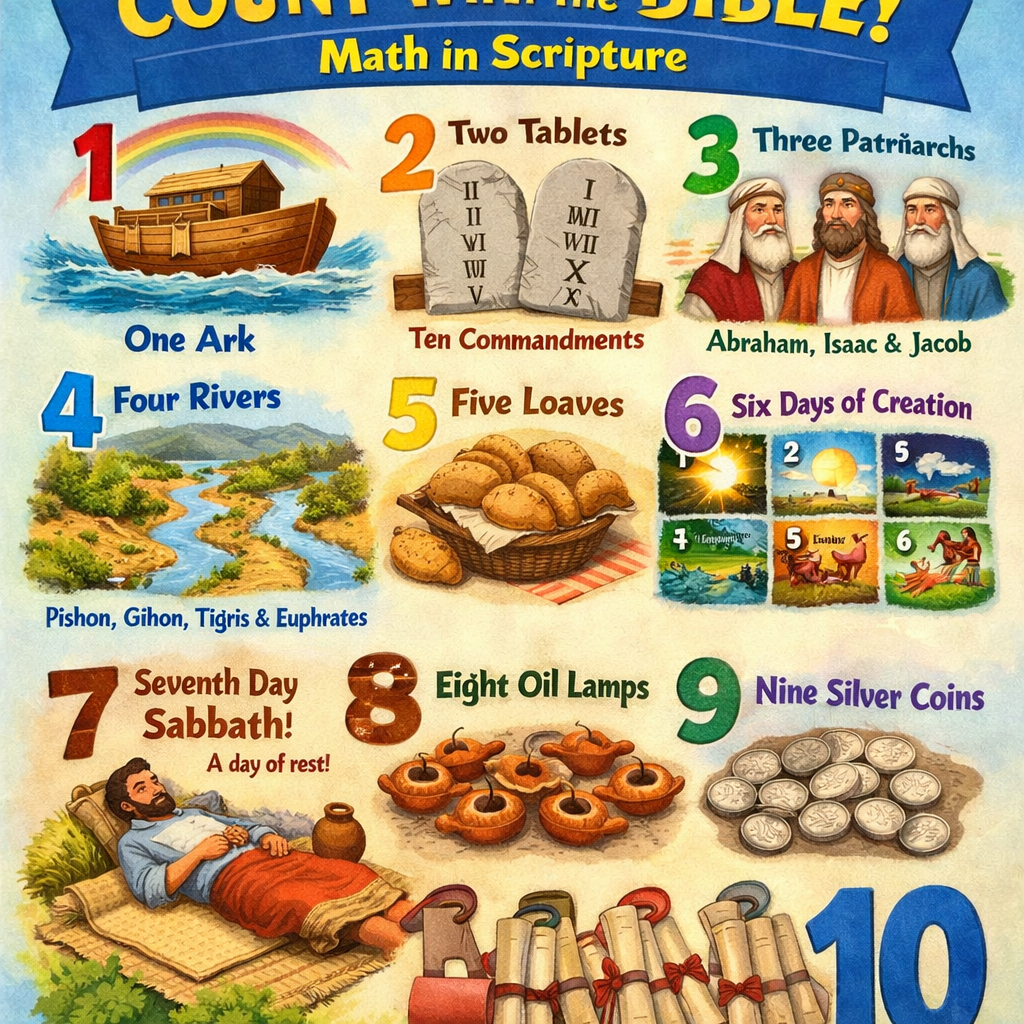
Learning to count with Yahuah!
Multi-Digit Operations, Fractions, and Decimals in Scripture
Name:
How to Use This Workbook
This workbook uses the 4Rs Method to connect math skills with biblical truth.
- RECEIVE: Read the lesson to understand the math concept and its biblical context.
- REFLECT: Solve the problems to check your understanding.
- RECALL: Draw or write to solidify the concept in your memory.
- RESPOND: Apply the math skill to a real-life activity.
Lesson 1: Large Numbers (The Census of Israel)
RECEIVE
In the book of Numbers, Yahuah commanded Moses to count the people of Israel. This was a massive task involving very large numbers! Let's look at the census of the tribes (Numbers 1).
The tribe of Reuben numbered 46,500. The tribe of Simeon numbered 59,300. To find the total, we must add these large numbers, being careful to line up the ones, tens, hundreds, thousands, and ten-thousands.
46,500
+ 59,300
--------
When we add large numbers, we start from the right (ones place) and move left, carrying over if needed.
REFLECT
1. The tribe of Judah was 74,600. The tribe of Issachar was 54,400. What is the sum?
74,600
+ 54,400
--------
2. The total number of fighting men was 603,550. If the tribe of Levi (22,000) was added, what would be the new total?
603,550 + 22,000 =
RECALL
Write out the number 603,550 in words.
RESPOND
Find a book with many pages (like a Bible). Look at the last page number. If you had 10 copies of that book, how many pages would that be in total?
Lesson 2: Multi-Digit Multiplication (Solomon's Temple)
RECEIVE
When King Solomon dedicated the Temple, the Bible says they offered massive sacrifices to Yahuah. 2 Chronicles 7:5 says, "King Solomon offered a sacrifice of 22,000 oxen and 120,000 sheep."
Multiplication helps us calculate large totals quickly. If there were 12 tribes, and each tribe gave 1,000 sheep, we multiply:
12 x 1,000 = 12,000
Let's practice multiplying 2-digit numbers. If a shepherd has 24 flocks, and each flock has 35 sheep:
35
x 24
----
First multiply 4 x 35 (140). Then multiply 20 x 35 (700). Add them together (840).
REFLECT
1. 45 x 12 =
2. 123 x 5 =
3. If Solomon offered 22,000 oxen, how many legs did those oxen have in total? (22,000 x 4)
RECALL
Draw a diagram showing 12 x 12 (like the stones on the High Priest's breastplate, or 12 tribes x 12 apostles).
RESPOND
Count the number of windows in your house. If each window has 4 panes of glass, how many panes are there? Use multiplication.
Lesson 3: Long Division (Dividing the Land)
RECEIVE
When Israel entered the Promised Land, Joshua had to divide the land among the tribes. Division is sharing equally.
If there are 144 acres of land to be shared among 12 families, how many acres does each family get?
144 ÷ 12 = 12
Let's try long division. If we have 525 shekels to divide among 5 people:
525 ÷ 5 =
Steps: 5 goes into 5 (1 time). 5 goes into 2 (0 times). 5 goes into 25 (5 times). Answer: 105.
REFLECT
1. 440 ÷ 4 =
2. 636 ÷ 3 =
3. There were 12 baskets of leftovers after feeding the 5,000. If there were 480 pieces of bread left, how many pieces were in each basket?
480 ÷ 12 =
RECALL
Write the steps of division: Divide, Multiply, Subtract, Bring Down.
RESPOND
Take a bag of dried beans or coins. Count them. Divide them into 4 equal piles. Are there any remainders?
Lesson 4: Introduction to Fractions (The Tithe)
RECEIVE
A fraction is a part of a whole. The Bible talks about the "tithe," which means "a tenth." This is a fraction!
A tithe is written as 110.
The top number (1) is the Numerator (how many parts we have).
The bottom number (10) is the Denominator (how many parts make a whole).
If you have 10 apples and give 1 to Yahuah, you have given 110.
REFLECT
1. Circle the Numerator in this fraction: 34
☐ 3 ☐ 4
2. If you divide a loaf of unleavened bread into 2 pieces, what fraction is one piece?
☐ 110 ☐ 12 ☐ 21
3. Which is larger? 12 or 14?
☐ 12 ☐ 14
RECALL
Draw a circle (like a pizza). Divide it into 8 slices. Shade in 1 slice. Write the fraction.
RESPOND
Help prepare a meal. Measure out 12 cup of water or 14 teaspoon of salt.
Lesson 5: Adding Fractions (Building the Wall)
RECEIVE
When Nehemiah built the wall of Jerusalem, different families built different sections. They added their parts together to make a whole wall.
When we add fractions with the same denominator (bottom number), we just add the numerators (top numbers).
14 + 24 = 34
If one family built 28 of the wall, and another built 38, how much is built?
28 + 38 = 8
REFLECT
1. 13 + 13 = 3
2. 310 + 410 = 10
3. 512 - 212 = 12 (Subtraction works the same way!)
RECALL
Draw a rectangle divided into 5 parts. Color 2 parts blue and 1 part red. What fraction is colored in total?
RESPOND
Use Lego blocks or coins. Make a pile of 10. Take 3 away. What fraction did you take? (310). Put 2 back. What fraction do you have now?
Lesson 6: Introduction to Decimals (Shekels and Gerahs)
RECEIVE
Decimals are another way to write fractions. They are based on the number 10.
In the Bible, money was weighed. Exodus 30:13 says, "a shekel is twenty gerahs." (This isn't a base-10 system, but let's imagine a system where 10 gerahs = 1 shekel for easy math!).
0.1 is the same as 110 (one tenth).
0.01 is the same as 1100 (one hundredth).
Money uses decimals. $1.50 means 1 whole dollar and 50 hundredths of a dollar (50 cents).
If you give a tithe (10%) of $10.00, you move the decimal point one spot to the left: $1.00.
REFLECT
1. Write 310 as a decimal:
2. Write 0.5 as a fraction: 10
3. Add these decimals: 0.2 + 0.4 =
4. If you have 1.5 shekels and find 0.5 shekels, how many do you have?
RECALL
Write down the price of your favorite toy (e.g., $12.99). Circle the numbers that represent the "cents" or "hundredths".
RESPOND
Look at a grocery receipt with your parents. Notice how all the prices use decimals. Add up the prices of two items.
Answer Key
Lesson 1: 105,800. 1. 129,000. 2. 625,550.
Lesson 2: 840. 1. 540. 2. 615. 3. 88,000.
Lesson 3: 105. 1. 110. 2. 212. 3. 40.
Lesson 4: 1. 3. 2. 12. 3. 12.
Lesson 5: 1. 5. 2. 2. 3. 7. 4. 3.
Lesson 6: 1. 0.3. 2. 5. 3. 0.6. 4. 2.0.