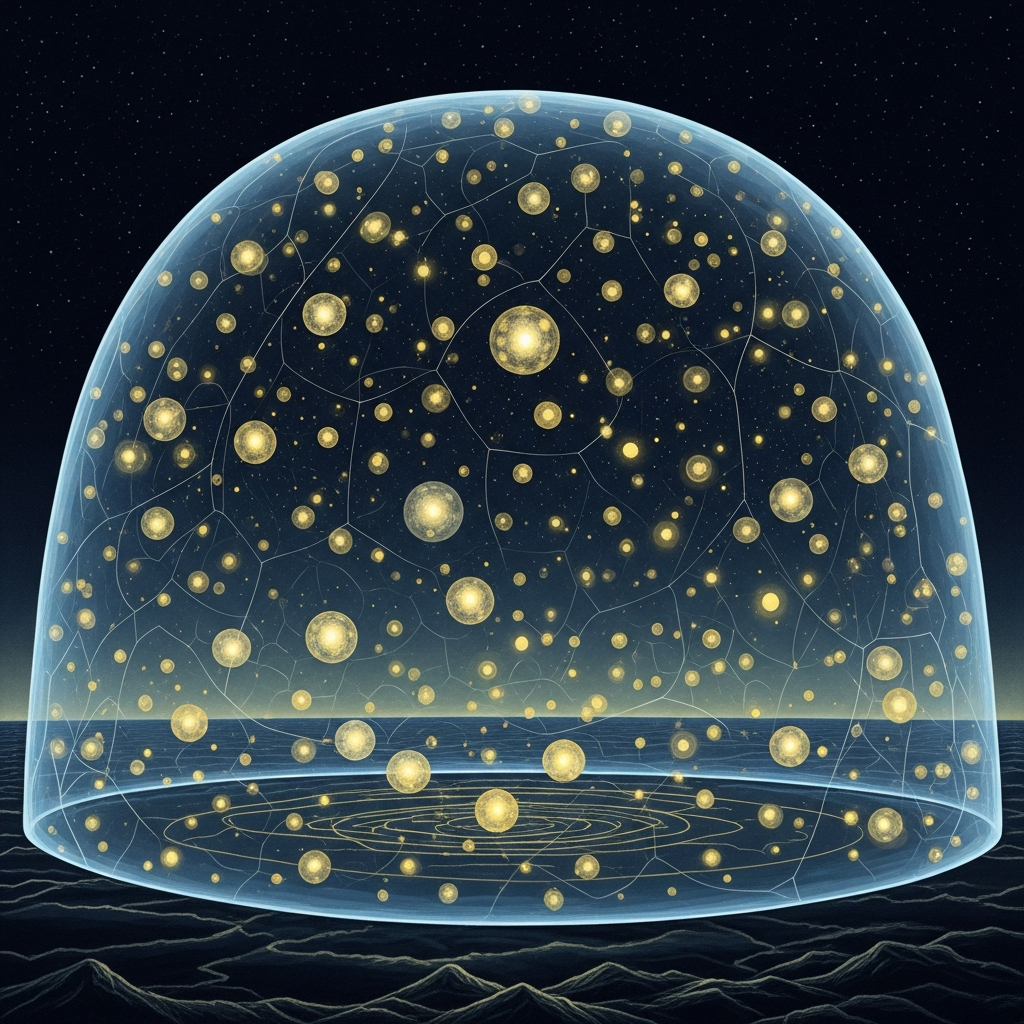
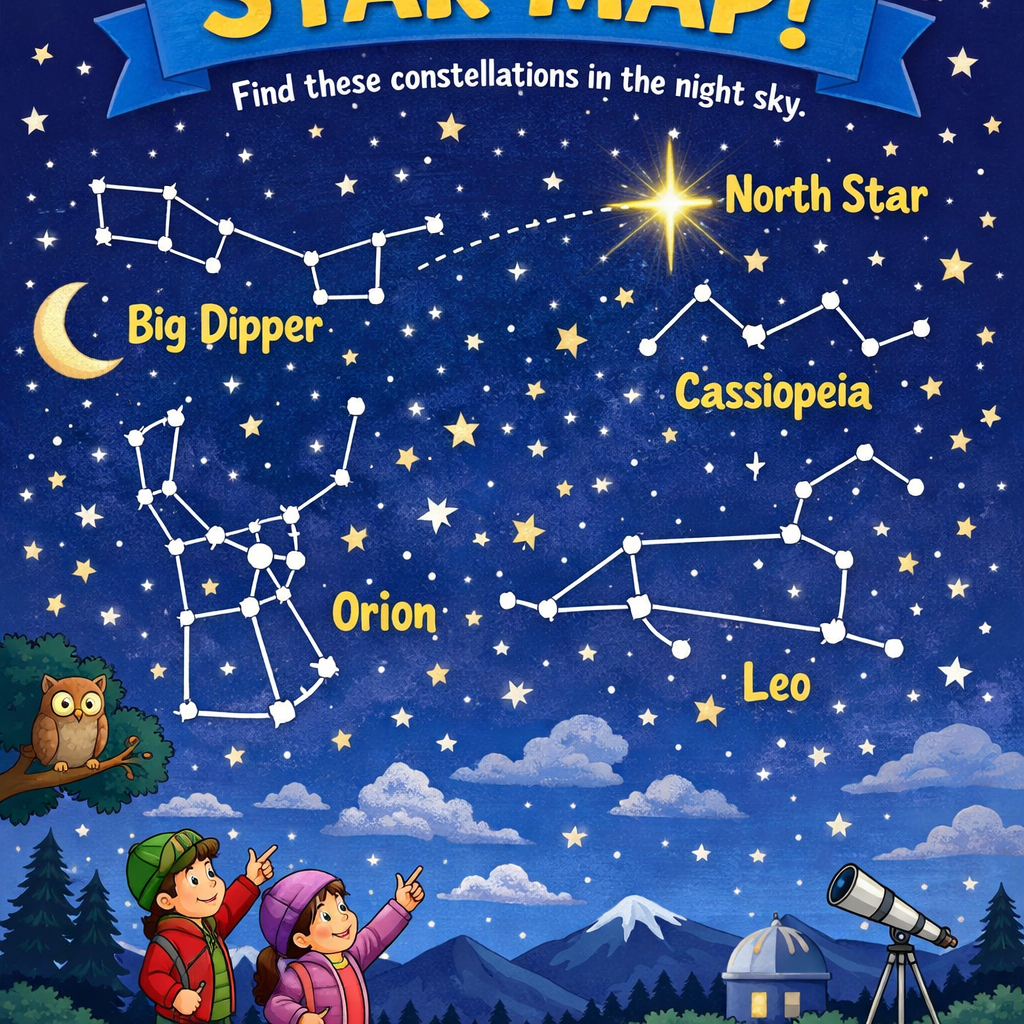
"The heavens declare the glory of El; and the firmament sheweth his handywork. Day unto day uttereth speech, and night unto night sheweth knowledge."
— Psalm 19:1-2
Receive Learn it
Reflect Think about it
Recall Remember it
Respond Apply it
What Is Astronomy?
Astronomy is the scientific study of celestial objects and phenomena beyond Earth's atmosphere. It includes the study of stars, planets, moons, comets, galaxies, and the universe as a whole.
Why Study Astronomy with Discernment?
Modern astronomy is presented alongside naturalistic cosmological theories that attempt to explain the universe without a Creator. As students, we must learn the observable science while critically evaluating interpretive frameworks.
🔬 What Textbooks Teach
Universe began 13.8 billion years ago (Big Bang)
Stars and galaxies formed naturally
Solar system is 4.6 billion years old
Life arose on Earth by chance
Earth is an ordinary planet
📖 Biblical Framework
Yahuah created the heavens and earth
Stars made on Day 4 of Creation
Universe is thousands of years old
Earth is specially designed for life
The heavens declare His glory
Observable vs. Historical Science
We must distinguish between:
Observable (operational) science — Repeatable experiments in the present (orbits, composition, distances)
Historical science — Interpretations about the unobserved past (origins, ages, formation)
✏️ Fill in the Blanks
Astronomy is the study of celestial objects beyond Earth's .
The mainstream view says the universe is billion years old.
Psalm 19 says the declare the glory of El.
Observable science involves experiments in the present.
Historical science involves about the unobserved past.
Lesson 2: Our Sun - A Unique Star
"And Elohim made two great lights; the greater light to rule the day, and the lesser light to rule the night: he made the stars also."
— Genesis 1:16
The Sun's Structure
The Sun is a G-type main-sequence star (G2V) composed primarily of hydrogen and helium:
Core — Where nuclear fusion occurs (15 million °C)
Radiative zone — Energy transferred by radiation
Convective zone — Energy transferred by convection
Photosphere — Visible "surface" (~5,500 °C)
Chromosphere — Lower atmosphere
Corona — Outer atmosphere (visible during eclipses)
Solar Statistics
Property
Value
Diameter
1.4 million km (109 × Earth)
Mass
1.99 × 10³⁰ kg (333,000 × Earth)
Distance from Earth
150 million km (1 AU)
Surface temperature
~5,500 °C
Core temperature
~15 million °C
Composition
~73% Hydrogen, ~25% Helium
Solar Activity
Sunspots — Cooler, darker regions (magnetic disturbances)
Solar flares — Intense bursts of radiation
Coronal mass ejections — Plasma expelled into space
Solar wind — Stream of charged particles
Solar cycle — ~11-year cycle of activity
🔍 Design Evidence
The Sun is precisely positioned and sized to support life on Earth. A slightly larger or smaller sun, or a different distance, would make Earth uninhabitable. This "fine-tuning" points to intentional design.
✏️ Fill in the Blanks
Nuclear fusion occurs in the Sun's .
The visible "surface" of the Sun is called the .
The Sun is about million km from Earth.
The Sun is composed primarily of hydrogen and .
The solar cycle of activity lasts about years.
Lesson 3: The Inner Planets (Terrestrial Planets)
"When I consider thy heavens, the work of thy fingers, the moon and the stars, which thou hast ordained; What is man, that thou art mindful of him?"
— Psalm 8:3-4
The Rocky Inner Planets
The four inner planets are small, rocky bodies with solid surfaces:
Mercury
Closest planet to the Sun (0.39 AU)
No atmosphere (too hot, too weak gravity)
Extreme temperature range: -180°C to 430°C
Heavily cratered surface
Has a large iron core
Venus
Similar size to Earth (0.72 AU from Sun)
Dense CO₂ atmosphere (90× Earth's pressure)
Hottest planet: ~465°C (greenhouse effect)
Rotates backwards (retrograde)
Volcanic features on surface
Earth
Only known planet with liquid water
Nitrogen-oxygen atmosphere
Protected by magnetic field
Perfect temperature for life
One large moon
Mars
"Red Planet" (iron oxide surface)
Thin CO₂ atmosphere (1% of Earth's)
Evidence of past water (channels, polar ice)
Largest volcano: Olympus Mons
Two small moons: Phobos, Deimos
🔍 Earth's Uniqueness
Comparing Earth to other planets reveals how specially designed it is for life. Mercury is too hot/cold, Venus is too hot, Mars is too cold and has no protection from radiation. Earth occupies the precise "habitable zone" with dozens of factors perfectly calibrated for life.
✏️ Fill in the Blanks
Mercury is the planet to the Sun.
Venus is the planet due to its greenhouse effect.
Earth is the only known planet with liquid .
Mars is called the " Planet" due to iron oxide.
The inner planets are also called planets.
Lesson 4: The Outer Planets (Gas and Ice Giants)
"He telleth the number of the stars; he calleth them all by their names. Great is our Master, and of great power: his understanding is infinite."
— Psalm 147:4-5
The Giant Planets
The four outer planets are much larger than the inner planets and are composed primarily of gases and ices:
Jupiter (Gas Giant)
Largest planet (11× Earth's diameter)
318× Earth's mass
Composed of hydrogen and helium
Great Red Spot: Giant storm (larger than Earth)
79+ known moons (Io, Europa, Ganymede, Callisto are largest)
Faint ring system
Saturn (Gas Giant)
Famous ring system (ice and rock particles)
Second largest planet (9× Earth's diameter)
Least dense planet (would float in water)
82+ known moons (Titan is largest)
Hexagonal storm at north pole
Uranus (Ice Giant)
Rotates on its side (97.8° axial tilt)
Blue-green color from methane
27 known moons
Faint ring system
Very cold: -224°C
Neptune (Ice Giant)
Farthest planet from Sun (30 AU)
Strongest winds in solar system
Deep blue color from methane
14 known moons (Triton is largest)
Faint ring system
🔍 Young-Earth Evidence in Planets
Jupiter's moons — Io has active volcanoes (should have cooled if billions of years old)
Saturn's rings — Too bright and clean for billions of years
Planetary magnetic fields — Decaying faster than expected
✏️ Fill in the Blanks
Jupiter is the planet in our solar system.
Saturn is famous for its system.
Uranus rotates on its (unusual axial tilt).
Neptune has the strongest in the solar system.
Jupiter and Saturn are called giants.
Lesson 5: Moons, Asteroids, and Comets
"He appointed the moon for seasons: the sun knoweth his going down."
— Psalm 104:19
Our Moon
Earth's Moon is unusually large for a planet our size:
Diameter: 3,474 km (about 1/4 of Earth's)
Average distance: 384,400 km
Tidally locked (same face always toward Earth)
Causes ocean tides
Stabilizes Earth's axial tilt
Surface: craters, maria (dark plains)
Interesting Moons of Other Planets
Io (Jupiter) — Most volcanically active body in solar system
Europa (Jupiter) — Ice-covered; possible subsurface ocean
Titan (Saturn) — Has thick atmosphere and liquid methane lakes
Enceladus (Saturn) — Water geysers from south pole
Rocky bodies, mostly in asteroid belt (between Mars and Jupiter)
Largest: Ceres (dwarf planet, ~950 km diameter)
Millions of asteroids exist
Composition varies: rock, metal, carbon-rich
Comets
"Dirty snowballs" — ice, dust, rock
Develop tails when approaching Sun
Short-period comets: Kuiper Belt origin
Long-period comets: Hypothetical Oort Cloud
🔍 Comets as Young-Earth Evidence
Comets lose material with each orbit around the Sun. Short-period comets should have completely dissipated within ~100,000 years. If the solar system is billions of years old, why do comets still exist? The hypothetical Oort Cloud (never observed) was invented to explain this problem.
✏️ Fill in the Blanks
Earth's Moon causes ocean .
Io is the most volcanically body in the solar system.
Most asteroids are found in the asteroid .
Comets are called "dirty " due to their composition.
Short-period comets should dissipate within about years.
Lesson 6: Stars - Classification and Life Cycles
"There is one glory of the sun, and another glory of the moon, and another glory of the stars: for one star differeth from another star in glory."
— 1 Corinthians 15:41
Stellar Properties
Stars are classified by several properties:
Temperature — Determines color (hottest=blue, coolest=red)
Luminosity — Brightness (compared to Sun)
Size — Ranges from neutron stars to supergiants
Mass — Determines how the star evolves
Spectral Classification
Stars are classified by their spectra: O B A F G K M (hottest to coolest)
Memory aid: "Oh Be A Fine Girl/Guy, Kiss Me"
Class
Color
Temperature (K)
O
Blue
30,000-50,000
B
Blue-white
10,000-30,000
A
White
7,500-10,000
F
Yellow-white
6,000-7,500
G
Yellow (like our Sun)
5,200-6,000
K
Orange
3,700-5,200
M
Red
2,400-3,700
Mainstream Stellar Evolution Theory
🔬 Textbook View
Stars form from collapsing gas clouds, spend most of their "life" on the main sequence, then evolve into giants, and finally become white dwarfs, neutron stars, or black holes depending on mass. This process takes millions to billions of years.
📖 Biblical View
Yahuah created stars on Day 4 of Creation Week. We observe different types of stars, but the naturalistic "evolution" of stars over billions of years is an interpretation, not an observation. No one has watched a star form or evolve through the proposed stages.
✏️ Fill in the Blanks
The hottest stars are in color.
Our Sun is a G-type star, which is in color.
The coolest stars are in color (type M).
Stellar over millions of years is an interpretation, not observation.
Stars were created on Day of Creation Week.
Lesson 7: Galaxies - Island Universes
"Lift up your eyes on high, and behold who hath created these things, that bringeth out their host by number: he calleth them all by names by the greatness of his might."
— Isaiah 40:26
What Is a Galaxy?
A galaxy is a massive collection of stars, gas, dust, and dark matter, bound together by gravity. There are hundreds of billions of galaxies in the observable universe.
Types of Galaxies
Spiral Galaxies
Flat disk with spiral arms
Central bulge with older stars
Arms contain younger stars, gas, dust
Example: Milky Way, Andromeda (M31)
Elliptical Galaxies
Spherical to elongated shape
Mostly older stars
Little gas and dust
Range from dwarf to giant
Irregular Galaxies
No regular shape
Often result of gravitational interactions
Example: Large/Small Magellanic Clouds
The Milky Way Galaxy
Our home galaxy
Barred spiral type
100,000-180,000 light-years in diameter
100-400 billion stars
Solar system located in Orion Arm, about 26,000 light-years from center
🔍 The Spiral Galaxy Problem
Spiral galaxies should "wind up" over billions of years because inner stars orbit faster than outer ones. After a few hundred million years, arms should be completely wound around the galaxy. Yet we see clear spiral structure everywhere. This is evidence that galaxies are not billions of years old.
✏️ Fill in the Blanks
Our galaxy, the Way, is a barred spiral galaxy.
Elliptical galaxies have mostly stars.
The spiral arms of galaxies should wind up if they were of years old.
Our solar system is about light-years from the galactic center.
Irregular galaxies often result from gravitational .
Lesson 8: The Big Bang Theory - What It Claims
"In the beginning Elohim created the heaven and the earth."
— Genesis 1:1
What the Big Bang Theory Claims
The Big Bang is the dominant cosmological model in mainstream science. It proposes:
The universe began ~13.8 billion years ago
All matter, energy, space, and time originated from a singularity
The universe has been expanding ever since
Galaxies, stars, and planets formed naturally over billions of years
Evidence Cited for the Big Bang
Cosmic Microwave Background (CMB) — Faint radiation throughout space
Redshift of galaxies — Interpreted as expansion (Hubble's Law)
Abundance of light elements — Hydrogen, helium ratios
Galaxy evolution — Distant galaxies appear different
Problems with the Big Bang
🔍 Scientific Challenges
Horizon Problem — CMB is too uniform; distant regions had no way to equilibrate
Flatness Problem — Universe too precisely flat to be coincidence
Missing antimatter — Equal matter/antimatter should have formed
Dark matter/dark energy — 95% of universe is unobserved (invented to make theory work)
Galaxy formation — No satisfactory explanation for how galaxies formed
Population III stars — First-generation stars never observed
🔬 Mainstream Response
Inflation theory solves horizon and flatness problems. Dark matter/energy are real but undetected. Models are refined as observations improve. Big Bang is the best scientific explanation.
📖 Biblical Response
The Big Bang contradicts Genesis, which says Earth was created before stars (Day 1 vs. Day 4). The theory requires constant revision and imaginary entities. It's a philosophical commitment to naturalism, not proven science.
✏️ Fill in the Blanks
The Big Bang claims the universe is billion years old.
The Cosmic Microwave is cited as evidence for the Big Bang.
The problem refers to the CMB being too uniform.
About % of the Big Bang universe is unobserved (dark matter/energy).
Genesis says Earth was created stars.
Lesson 9: Light Travel Time - The Distant Starlight Question
"And Elohim said, Let there be light: and there was light."
— Genesis 1:3
The Question
If the universe is only thousands of years old, how can we see light from galaxies millions or billions of light-years away? This is called the "distant starlight problem" for young-earth creationists.
Understanding the Issue
Light travels at ~300,000 km/sec (186,000 mi/sec)
A light-year is the distance light travels in one year (~9.5 trillion km)
We see galaxies billions of light-years away
If light takes billions of years to reach us, the universe must be old... right?
Proposed Solutions
1. Created Light in Transit
Yahuah created the light already reaching Earth. Problem: Some reject this as deceptive.
2. Anisotropic Synchrony Convention (Dr. Jason Lisle)
Einstein showed there's no absolute way to synchronize distant clocks. Using an alternate (equally valid) synchrony convention, incoming light could be instantaneous. This is physics, not a trick.
3. Time Dilation Models (Dr. Russell Humphreys)
General relativity allows time to pass at different rates in different places. If Earth was in a gravitational well during Creation, millions of years could pass in space while only days passed on Earth.
4. Speed of Light Decay
Some suggest light was faster in the past. Evidence is mixed and controversial.
🔍 Important Perspective
The Big Bang also has a "light travel time problem" (the horizon problem). Naturalists solve it with inflation—an unobserved, ad hoc addition. Both frameworks face challenges. The young-earth view has viable solutions within known physics.
✏️ Fill in the Blanks
Light travels at about km/sec.
A -year is the distance light travels in one year.
Dr. Lisle's model uses an alternate convention.
Time allows time to pass at different rates in different places.
The Big Bang's light travel problem is called the problem.
Lesson 10: Exoplanets and the Search for Life
"And he made the stars also."
— Genesis 1:16
What Are Exoplanets?
Exoplanets are planets orbiting stars other than our Sun. Since 1992, over 5,000 exoplanets have been confirmed.
Detection Methods
Transit method — Planet crosses in front of star, dimming its light
Radial velocity — Star wobbles due to planet's gravity
Direct imaging — Actually photographing the planet (rare)
Hot Jupiters — Gas giants very close to their stars
Super-Earths — Rocky planets larger than Earth
Mini-Neptunes — Smaller ice giants
Earth-like — Similar size/orbit to Earth (rare)
The "Habitable Zone"
The region around a star where liquid water could exist on a planet's surface. Also called the "Goldilocks zone"—not too hot, not too cold.
🔬 Mainstream Hope
Finding Earth-like planets in habitable zones increases chances of finding extraterrestrial life. Evolution should have produced life elsewhere if it's common. SETI searches for signals from intelligent aliens.
📖 Biblical Perspective
Scripture presents Earth as unique—created for human habitation. Extraterrestrial life is not taught in Scripture. The search reflects naturalistic philosophy that life arises easily by chance. Exoplanet diversity actually challenges formation theories.
🔍 Exoplanet Challenges to Naturalism
Hot Jupiters shouldn't exist according to formation models
Planet compositions don't match predictions
Orbital configurations are often "impossible" by standard theory
No true Earth analog found yet
✏️ Fill in the Blanks
Exoplanets orbit stars other than our .
The method detects planets by dimming of starlight.
The habitable zone is where liquid could exist.
Over exoplanets have been confirmed.
Scripture presents as uniquely created for human habitation.
Lesson 11: Astronomical Observations and Tools
"Seek him that maketh the seven stars and Orion, and turneth the shadow of death into the morning."
— Amos 5:8
The Electromagnetic Spectrum
Astronomers observe the universe across many wavelengths:
Type
Wavelength
What It Shows
Radio
Longest
Cold gas, pulsars, cosmic background
Microwave
Cosmic Microwave Background
Infrared
Cool stars, dust, heat
Visible
Stars, galaxies (what we see)
Ultraviolet
Hot stars, active galaxies
X-ray
Very hot gas, neutron stars
Gamma ray
Shortest
Extreme energy events
Telescopes
Optical Telescopes
Refracting — Use lenses (limited size)
Reflecting — Use mirrors (can be very large)
Ground-based: Affected by atmosphere
Space-based: No atmospheric distortion (Hubble, James Webb)
Radio Telescopes
Large dish antennas
Detect radio waves from space
Can work day or night, through clouds
Measuring Distance
Parallax — Shift in apparent position as Earth orbits (works for nearby stars)
Cepheid variables — Pulsating stars with known luminosity
Type Ia supernovae — "Standard candles" for distant galaxies
Redshift — For very distant objects (assumes expansion interpretation)
✏️ Fill in the Blanks
The spectrum includes radio, visible, X-ray, and other types of light.
Reflecting telescopes use instead of lenses.
is the shift in apparent position as Earth orbits.
The James Webb Space Telescope observes primarily in wavelengths.
Radio telescopes can work through and at night.
Lesson 12: The Biblical Heavens
"It is he that sitteth upon the circle of the earth, and the inhabitants thereof are as grasshoppers; that stretcheth out the heavens as a curtain, and spreadeth them out as a tent to dwell in."
— Isaiah 40:22
What Scripture Says About the Heavens
The Bible describes the heavens with specific vocabulary:
The Firmament (Raqia)
Created on Day 2 (Genesis 1:6-8)
Divides waters above from waters below
Sun, moon, and stars placed "in" it (Day 4)
Called "Heaven" by Yahuah
Key Scripture Descriptions
Heavens "stretched out" like a tent/curtain (Isaiah 40:22, 42:5)
Stars differ in glory (1 Corinthians 15:41)
Stars "set" in their courses (Judges 5:20)
Heavens declare Yahuah's glory (Psalm 19:1)
Stars can be numbered by Yahuah (Psalm 147:4)
The Purpose of the Stars
Genesis 1:14-18 gives four purposes:
Signs — Indicators (navigation, prophecy?)
Seasons — Mark the appointed times (Hebrew: moadim)
Days and years — Time measurement
Light — Illumination for the earth
The Mazzaroth (Zodiac)
Job 38:32 mentions the Mazzaroth—the twelve constellations of the zodiac. Some believe these originally told the Gospel story before being corrupted into pagan astrology.
💬 Discussion: Science and Scripture
How should we interpret poetic language about the heavens in Scripture?
What is the difference between biblical astronomy (studying Yahuah's creation) and astrology (forbidden divination)?
How do the heavens "declare the glory of El" to you personally?
✏️ Fill in the Blanks
The firmament (raqia) was created on Day .
The heavens are compared to a or curtain.
Genesis 1:14 says stars are for signs, seasons, days, and .
The Mazzaroth is the Hebrew name for the .
Yahuah calls all the stars by (Psalm 147:4).
Lesson 13: Critical Thinking in Astronomy
"O Timothy, keep that which is committed to thy trust, avoiding profane and vain babblings, and oppositions of science falsely so called."
— 1 Timothy 6:20
Distinguishing Observation from Interpretation
In astronomy, it's critical to distinguish:
Observations — What we actually see/measure (light, spectra, positions)
Interpretations — What we conclude about the unobserved (history, ages, origins)
Questions to Ask
What was actually observed vs. interpreted?
What assumptions underlie the conclusion?
Could the data be explained differently?
Does this conflict with Scripture? If so, reconsider the interpretation.
Common Assumptions in Mainstream Astronomy
Naturalism — No supernatural causes allowed
Uniformitarianism — Processes unchanged over time
Deep time — Billions of years assumed
Evolution — Cosmic, stellar, and biological
Case Study: Age of the Universe
🔍 How "13.8 Billion Years" Is Derived
Assume Big Bang is true
Assume cosmic expansion has always occurred
Measure current expansion rate (Hubble constant)
Calculate backward to singularity
This is interpretation built on assumptions—not direct observation of the past.
🔍 Practice: Identify Observations vs. Interpretations
For each statement, mark O (observation) or I (interpretation):
We detect microwave radiation from all directions. ______
This radiation is from the Big Bang. ______
Galaxies show redshift. ______
The universe is expanding. ______
We see different types of stars. ______
Stars evolve over millions of years. ______
✏️ Fill in the Blanks
We must distinguish from interpretation.
is the assumption that no supernatural causes are allowed.
The age "13.8 billion years" is derived from , not direct observation.
1 Timothy 6:20 warns against "science so called."
If an interpretation conflicts with Scripture, we should reconsider the .
Lesson 14: Course Review - The Heavens Declare His Glory
"For the invisible things of him from the creation of the world are clearly seen, being understood by the things that are made, even his eternal power and Godhead."
— Romans 1:20
Course Summary
This course examined astronomy through both mainstream and biblical perspectives:
Observable Facts We Learned
The Sun's structure, composition, and activity
Properties of planets, moons, asteroids, and comets
Star classification and properties
Galaxy types and structures
Exoplanet detection methods
Astronomical observation tools
Interpretive Issues Examined
Big Bang theory and its problems
Distant starlight question and solutions
Naturalistic assumptions in cosmology
Young-universe evidences
The Big Picture
Astronomy reveals Yahuah's power and glory when rightly understood:
Design evidence — Fine-tuning, complexity, beauty
Young-universe evidence — Comets, spiral arms, magnetic fields
Prophetic significance — Signs in the heavens
Worship response — The heavens declare His glory
📝 Final Review
Match each term:
Big Bang ______ A. Distance light travels in one year
Light-year ______ B. Stars created on this day
Day 4 ______ C. Mainstream origin theory
Redshift ______ D. Proposed solutions to distant starlight
Time dilation ______ E. Galaxies moving away (interpretation)
💬 Final Reflection
How has this course changed your understanding of astronomy?
What evidence for a young universe did you find most compelling?
How do the heavens declare Yahuah's glory to you?
How can you use astronomy to point others to the Creator?
"The heavens declare the glory of El; and the firmament sheweth his handywork. Day unto day uttereth speech, and night unto night sheweth knowledge. There is no speech nor language, where their voice is not heard."
— Psalm 19:1-3
📋 Answer Key (For Parents/Teachers)
Lesson 1
atmosphere
13.8
heavens
repeatable
interpretations
Lesson 2
core
photosphere
150
helium
11
Lesson 3
closest
hottest
water
Red
terrestrial
Lesson 4
largest
ring
side
winds
gas
Lesson 5
tides
active
belt
snowballs
100,000
Lesson 6
blue
yellow
red
evolution
4 (or Four)
Lesson 7
Milky
older
billions
26,000
interactions
Lesson 8
13.8
Background
horizon
95
before
Lesson 9
300,000
light
synchrony
dilation
horizon
Lesson 10
Sun
transit
water
5,000
Earth
Lesson 11
electromagnetic
mirrors
Parallax
infrared
clouds
Lesson 12
2 (or Two)
tent (or curtain)
years
zodiac
names (or name)
Lesson 13
observation
Naturalism
assumptions (or interpretation)
falsely
interpretation
Observation vs. Interpretation exercise: 1-O, 2-I, 3-O, 4-I, 5-O, 6-I