"I will praise thee; for I am fearfully and wonderfully made: marvellous are thy works; and that my soul knoweth right well."
— Psalm 139:14
Receive Learn it
Reflect Think about it
Recall Remember it
Respond Apply it
The Molecular Foundation of Life
Molecular biology studies life at its most fundamental level—the level of molecules. At this level, we discover astounding complexity that points unmistakably to intelligent design. Every cell in your body contains machinery more sophisticated than anything human engineers have ever created.
The Central Dogma of Molecular Biology
The "central dogma" describes how genetic information flows:
Information Flow
DNA → (Transcription) → RNA → (Translation) → Protein
DNA stores information | RNA carries the message | Proteins do the work
🔬 Mainstream Perspective
Molecular biology emerged from gradual evolutionary processes over billions of years. Random mutations and natural selection gradually assembled these complex systems from simpler precursors.
📖 Biblical Perspective
The sophistication of molecular systems reflects the wisdom of Yahuah, the Master Designer. These irreducibly complex systems could not have arisen gradually—they had to be created complete and functional from the beginning.
Key Terms
Molecular Biology
The study of biological activity at the molecular level
Macromolecules
Large molecules essential for life: proteins, nucleic acids, carbohydrates, lipids
Central Dogma
The flow of genetic information from DNA to RNA to protein
Transcription
The process of copying DNA into RNA
Translation
The process of building proteins from RNA instructions
✏️ Fill in the Blanks
Molecular biology studies life at the level of .
The four major macromolecules are proteins, nucleic acids, carbohydrates, and .
The central dogma describes how genetic flows in cells.
DNA is copied into RNA through a process called .
Proteins are built from RNA instructions through .
💬 Discussion Questions
Why does the complexity at the molecular level point to design rather than chance?
How does Psalm 139:14 relate to what we observe in molecular biology?
What is the difference between "molecules-to-man" evolution and what we actually observe?
Lesson 2: The Structure of DNA
"Thine eyes did see my substance, yet being unperfect; and in thy book all my members were written, which in continuance were fashioned, when as yet there was none of them."
— Psalm 139:16
DNA: The Molecule of Heredity
DNA (deoxyribonucleic acid) is the molecule that stores genetic information. It was discovered in 1869 by Friedrich Miescher, but its structure was not determined until 1953 by Watson and Crick (with crucial X-ray data from Rosalind Franklin).
The Double Helix Structure
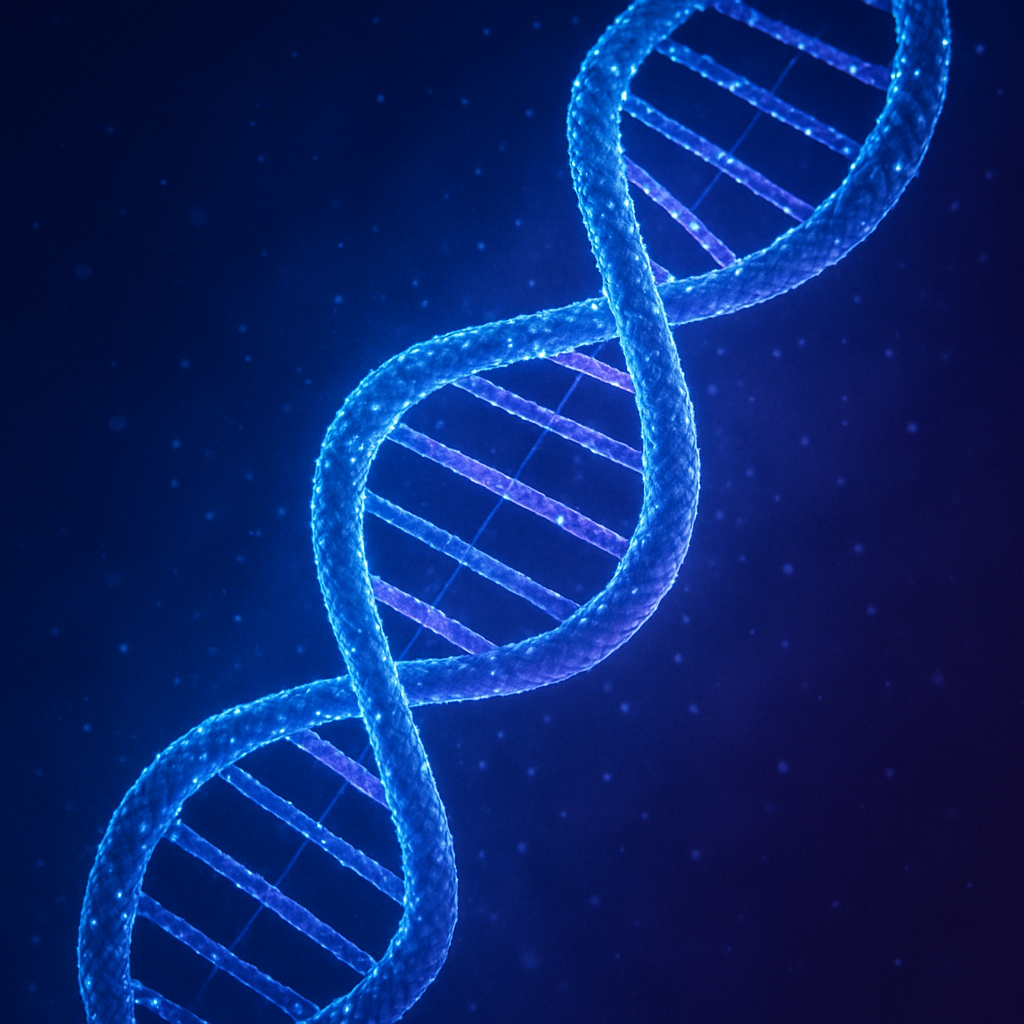
DNA has a characteristic double helix structure—like a twisted ladder:
Sugar-phosphate backbone — The "rails" of the ladder
Nitrogenous bases — The "rungs" of the ladder
Base pairs — Adenine (A) pairs with Thymine (T); Guanine (G) pairs with Cytosine (C)
Base Pairing Rules
A — T (2 hydrogen bonds)
G ≡ C (3 hydrogen bonds)
These pairing rules ensure accurate replication
DNA as Information Storage
DNA is not just a molecule—it is an information storage system. The sequence of bases (A, T, G, C) encodes instructions for building and operating the organism. This is comparable to the letters in a book, except:
Human DNA contains approximately 3 billion base pairs
If printed in standard font, it would fill about 200 phone books
The information density far exceeds any human technology
🎯 Design Evidence: Information Requires Intelligence
Information science shows that specified, complex information always comes from an intelligent source. We never observe books writing themselves or computer programs appearing by chance. The genetic code in DNA represents the most sophisticated information system known—pointing directly to an Intelligent Designer.
✏️ Fill in the Blanks
DNA stands for acid.
DNA has a characteristic helix structure.
Adenine (A) pairs with (T).
Guanine (G) pairs with (C).
Human DNA contains approximately billion base pairs.
🔍 Practice: Base Pairing
If one strand of DNA reads: 5'-ATGCCGTA-3'
What would the complementary strand read? 3'- -5'
Lesson 3: DNA Replication
"So Elohim created man in his own image, in the image of Elohim created he him; male and female created he them."
— Genesis 1:27
The Process of DNA Replication
Before a cell divides, it must copy its DNA so each daughter cell receives a complete set of genetic instructions. This process is called DNA replication and involves remarkable molecular machinery.
Key Enzymes in Replication
Helicase — Unwinds the double helix by breaking hydrogen bonds between base pairs
Primase — Lays down short RNA primers to start replication
DNA Polymerase — The main enzyme that adds nucleotides, building new strands
Ligase — Joins DNA fragments together
Semiconservative Replication
DNA replication is "semiconservative"—each new DNA molecule contains one original strand and one newly synthesized strand. This was confirmed by the famous Meselson-Stahl experiment (1958).
Leading vs. Lagging Strand
Because DNA polymerase can only add nucleotides in the 5' to 3' direction:
Leading strand — Synthesized continuously toward the replication fork
Lagging strand — Synthesized in fragments (Okazaki fragments) away from the fork
🎯 Design Evidence: Error Correction Systems
DNA polymerase includes proofreading capabilities that check each base pair as it's added. If a mistake is made, the enzyme can back up and correct it. Additional repair systems patrol the DNA looking for errors. These quality control systems reduce the error rate to about 1 in 10 billion—far more accurate than any human copying system.
✏️ Fill in the Blanks
unwinds the DNA double helix.
DNA is the main enzyme that adds nucleotides.
Replication is called semiconservative because each new molecule has one strand and one new strand.
The lagging strand is synthesized in fragments called fragments.
joins DNA fragments together.
🔍 Enzyme Matching
Match each enzyme to its function:
Helicase ______ A. Adds nucleotides
Primase ______ B. Joins fragments
DNA Polymerase ______ C. Unwinds DNA
Ligase ______ D. Makes RNA primers
Lesson 4: Transcription - DNA to RNA
"The entrance of thy words giveth light; it giveth understanding unto the simple."
— Psalm 119:130
What Is Transcription?
Transcription is the process of copying a gene's information from DNA into RNA. Think of DNA as a master library book that never leaves the nucleus—RNA is like a photocopy that carries the information out to the cell's protein-making machinery.
The Transcription Process
Initiation — RNA polymerase binds to the promoter region of a gene
Elongation — RNA polymerase moves along the DNA, building the RNA transcript
Termination — RNA polymerase reaches a stop signal and releases the RNA
Key Differences: DNA vs. RNA
RNA uses ribose sugar (DNA uses deoxyribose)
RNA uses Uracil (U) instead of Thymine (T)
RNA is typically single-stranded (DNA is double-stranded)
Transcription Base Pairing
DNA: A → RNA: U
DNA: T → RNA: A
DNA: G → RNA: C
DNA: C → RNA: G
Types of RNA
mRNA (messenger RNA) — Carries the genetic message to ribosomes
tRNA (transfer RNA) — Brings amino acids to the ribosome
rRNA (ribosomal RNA) — Forms part of the ribosome structure
RNA Processing (in Eukaryotes)
Before mRNA leaves the nucleus, it undergoes processing:
5' cap — A modified nucleotide added to the beginning
3' poly-A tail — A string of adenines added to the end
Splicing — Introns (non-coding regions) are removed; exons (coding regions) are joined
✏️ Fill in the Blanks
Transcription copies information from DNA into .
RNA uses the base instead of thymine.
The enzyme that builds RNA is called RNA .
mRNA carries the genetic to ribosomes.
Non-coding regions called are removed during splicing.
🔍 Practice: Transcription
If the template DNA strand reads: 3'-TACGGATCC-5'
What would the mRNA transcript read? 5'- -3'
Lesson 5: Translation - RNA to Protein
"For we are his workmanship, created in Messiah Yahusha unto good works, which Elohim hath before ordained that we should walk in them."
— Ephesians 2:10
What Is Translation?
Translation is the process of reading mRNA and building a protein according to its instructions. This occurs at ribosomes—the protein factories of the cell.
The Genetic Code
The genetic code is a set of rules that specifies which amino acid corresponds to each three-nucleotide sequence (codon). Key features:
Triplet code — Three nucleotides = one codon = one amino acid
64 codons — Code for 20 amino acids (redundancy)
Universal — Nearly all organisms use the same code
Start codon — AUG (codes for Methionine)
Stop codons — UAA, UAG, UGA (signal end of protein)
The Translation Process
Initiation — Ribosome assembles on mRNA at start codon (AUG)
Elongation — tRNA molecules bring amino acids; peptide bonds form
Termination — Ribosome reaches stop codon; protein is released
The Role of tRNA
tRNA molecules are the "translators"—they have:
Anticodon — Three bases that match (are complementary to) the mRNA codon
Amino acid attachment site — Carries the correct amino acid
🎯 Design Evidence: The Genetic Code
The genetic code is a true language system—with syntax, grammar, and meaning. It requires multiple coordinated components to function: DNA, RNA, ribosomes, tRNA, amino acids, and dozens of enzymes. None of these work without the others. This irreducible complexity could not have evolved gradually—it had to be designed as a complete, integrated system.
✏️ Fill in the Blanks
Translation builds from mRNA instructions.
A codon consists of nucleotides.
The start codon is , which codes for methionine.
tRNA has an that matches the mRNA codon.
Stop codons signal the of protein synthesis.
🔍 Practice: Codon Translation
Using a codon chart, translate this mRNA sequence into amino acids:
5'-AUG-GCU-UAC-UGA-3'
Amino acids:
Lesson 6: Protein Structure and Function
"And Elohim said, Let us make man in our image, after our likeness."
— Genesis 1:26
Proteins: The Workers of the Cell
Proteins perform virtually every function in living organisms. They are molecular machines, each precisely designed for its specific task.
The Four Levels of Protein Structure
Primary Structure
The linear sequence of amino acids in the polypeptide chain. Like letters spelling a word—the order matters.
Secondary Structure
Local folding patterns formed by hydrogen bonding:
Alpha helix (α-helix) — A spiral shape
Beta sheet (β-sheet) — Folded pleats side by side
Tertiary Structure
The overall 3D shape of a single polypeptide, stabilized by various interactions between R-groups (side chains).
Quaternary Structure
The arrangement of multiple polypeptide chains (subunits) working together. Example: Hemoglobin has four subunits.
Protein Functions
Enzymes — Catalyze chemical reactions (e.g., DNA polymerase)
Structural — Provide support (e.g., collagen, keratin)
Transport — Move substances (e.g., hemoglobin carries oxygen)
Defense — Fight pathogens (e.g., antibodies)
Signaling — Communication (e.g., insulin hormone)
Motor — Movement (e.g., myosin in muscles)
🎯 Design Evidence: Protein Folding
A protein must fold into exactly the right 3D shape to function. The number of possible folding configurations for even a small protein is astronomical—greater than the number of atoms in the universe. Yet proteins fold correctly in milliseconds. Special "chaperone" proteins guide this process. Random chance cannot explain this precision.
✏️ Fill in the Blanks
The linear sequence of amino acids is called structure.
Alpha helices and beta sheets are examples of structure.
The overall 3D shape of a single polypeptide is structure.
Hemoglobin has structure because it has multiple subunits.
Proteins that catalyze reactions are called .
Lesson 7: Enzymes - Biological Catalysts
"O Yahuah, how manifold are thy works! in wisdom hast thou made them all: the earth is full of thy riches."
— Psalm 104:24
What Are Enzymes?
Enzymes are proteins that act as biological catalysts—they speed up chemical reactions without being consumed. Without enzymes, most biochemical reactions would take years or never occur at all.
How Enzymes Work
The lock-and-key model explains enzyme specificity:
Active site — A pocket on the enzyme where the substrate binds
Substrate — The molecule(s) the enzyme acts on
Enzyme-substrate complex — Temporary binding during the reaction
Product — The result of the reaction
The induced fit model (more accurate) shows that the enzyme's active site changes shape slightly to better fit the substrate.
Factors Affecting Enzyme Activity
Temperature — Activity increases with temperature until denaturation
pH — Each enzyme has an optimal pH
Substrate concentration — More substrate increases rate until saturation
Enzyme concentration — More enzyme means faster reaction
Enzyme Regulation
Competitive inhibition — Molecule blocks the active site
Allosteric regulation — Regulatory molecules control enzyme activity
Feedback inhibition — End product inhibits an earlier enzyme in the pathway
🎯 Design Evidence: Enzyme Precision
Enzymes are extraordinarily specific—like keys for locks. They speed up reactions by factors of millions to billions. The precision required for enzyme function points to intelligent design. A single amino acid change can destroy enzyme function entirely.
✏️ Fill in the Blanks
Enzymes are biological that speed up reactions.
The substrate binds at the enzyme's site.
When the active site changes shape to fit the substrate, this is the fit model.
When the end product inhibits an earlier enzyme, this is inhibition.
Each enzyme has an optimal at which it works best.
Lesson 8: Cellular Respiration - Energy from Food
"And Yahuah Elohim formed man of the dust of the ground, and breathed into his nostrils the breath of life; and man became a living soul."
— Genesis 2:7
What Is Cellular Respiration?
Cellular respiration is the process by which cells extract energy from glucose and store it in ATP (adenosine triphosphate). This is how food becomes usable energy.
Overall Equation
C₆H₁₂O₆ + 6O₂ → 6CO₂ + 6H₂O + ATP
Glucose + Oxygen → Carbon Dioxide + Water + Energy
The Three Stages
1. Glycolysis (in cytoplasm)
Glucose (6C) → 2 Pyruvate (3C)
Net gain: 2 ATP, 2 NADH
Occurs in all living cells (anaerobic—no oxygen needed)
2. Krebs Cycle (in mitochondrial matrix)
Pyruvate converted to Acetyl-CoA, then processed
Produces: 2 ATP, 6 NADH, 2 FADH₂, CO₂
Requires oxygen (aerobic)
3. Electron Transport Chain (inner mitochondrial membrane)
NADH and FADH₂ donate electrons
Electrons pass through protein complexes
Proton gradient drives ATP synthesis (chemiosmosis)
Produces: ~32-34 ATP
Oxygen is final electron acceptor → forms water
Total ATP Yield
One glucose molecule can produce approximately 36-38 ATP (theoretical maximum).
🎯 Design Evidence: ATP Synthase
ATP synthase is a molecular rotary motor—it actually spins! As protons flow through it, it rotates and mechanically produces ATP. This nano-machine operates at nearly 100% efficiency. Human engineers have never created anything approaching this level of miniaturization and efficiency. ATP synthase is powerful evidence for intelligent design.
✏️ Fill in the Blanks
Cellular respiration converts glucose into .
Glycolysis occurs in the of the cell.
The Krebs cycle takes place in the matrix.
The electron transport chain produces approximately ATP.
is the final electron acceptor in the ETC.
Lesson 9: Photosynthesis - Energy from Light
"And Elohim said, Let the earth bring forth grass, the herb yielding seed, and the fruit tree yielding fruit after his kind."
— Genesis 1:11
What Is Photosynthesis?
Photosynthesis is the process by which plants, algae, and some bacteria convert light energy into chemical energy (glucose). It's the foundation of almost all food chains.
Photosynthesis captures light and converts it to chemical energy with remarkable efficiency. The reaction center of photosystem II has been called "the most important enzyme on Earth" because it produces the oxygen we breathe. The complexity of photosynthesis—requiring multiple coordinated systems—defies evolutionary explanation.
✏️ Fill in the Blanks
Photosynthesis converts light energy into energy.
Light-dependent reactions occur in the membranes.
The Calvin cycle occurs in the .
The enzyme that fixes CO₂ is called .
Oxygen is released when is split.
Lesson 10: Cell Signaling and Communication
"For as the body is one, and hath many members, and all the members of that one body, being many, are one body: so also is Messiah."
— 1 Corinthians 12:12
Why Cells Communicate
Just as members of a body must work together, cells in an organism must communicate to coordinate their activities. This communication is essential for growth, development, immune responses, and maintaining homeostasis.
Types of Cell Signaling
Endocrine signaling — Hormones travel through bloodstream to distant cells
Paracrine signaling — Signals affect nearby cells
Autocrine signaling — Cell signals itself
Direct contact — Cells touch and communicate (gap junctions, cell-surface markers)
Signal Transduction Pathways
When a signal reaches a cell, it triggers a cascade of events:
Reception — Signal molecule (ligand) binds to receptor protein
Transduction — Signal is converted into cellular response (often a cascade)
G-proteins — Molecular switches activated by receptors
Second messengers — Small molecules that relay signals inside cell (cAMP, Ca²⁺)
Protein kinases — Enzymes that add phosphate groups to activate proteins
Transcription factors — Proteins that turn genes on or off
🎯 Design Evidence: Signal Amplification
Cell signaling systems amplify signals exponentially. One hormone molecule can trigger the production of millions of product molecules. This amplification requires precisely calibrated cascades. The coordination required for these systems to function points to intelligent design.
✏️ Fill in the Blanks
Hormones traveling through the bloodstream is signaling.
The three stages of signal transduction are reception, transduction, and .
cAMP and calcium ions are examples of messengers.
Protein add phosphate groups to activate proteins.
Signals affecting nearby cells is called signaling.
Lesson 11: Gene Regulation
"For thou hast possessed my reins: thou hast covered me in my mother's womb."
— Psalm 139:13
Why Gene Regulation Matters
Every cell in your body contains the same DNA, yet cells are very different—a muscle cell is nothing like a neuron. The difference lies in gene regulation—which genes are turned on or off in each cell type.
Levels of Gene Regulation
1. Transcriptional Control
Promoters — DNA sequences where transcription begins
Enhancers — DNA sequences that increase transcription (can be far from gene)
Silencers — DNA sequences that decrease transcription
Transcription factors — Proteins that bind DNA and control transcription
2. Epigenetic Control
DNA methylation — Adding methyl groups silences genes
Histone modification — Chemical changes to histone proteins affect gene access
3. Post-Transcriptional Control
Alternative splicing — Different proteins from same gene
mRNA stability — How long mRNA lasts
microRNAs — Small RNAs that silence genes
4. Translational and Post-Translational Control
Regulation of translation initiation
Protein modification, folding, transport
Protein degradation
The lac Operon (Bacterial Example)
In bacteria, genes are often grouped into operons. The lac operon demonstrates how genes are regulated:
Repressor protein — Blocks transcription when lactose is absent
Gene regulation explains why different cell types have different .
Proteins that bind DNA and control transcription are called factors.
Adding methyl groups to DNA is called DNA .
Small RNAs that silence genes are called .
In the lac operon, the protein blocks transcription when lactose is absent.
Lesson 12: Mutations and Genetic Variation
"And Elohim said, Let the earth bring forth the living creature after his kind."
— Genesis 1:24
What Are Mutations?
Mutations are changes in DNA sequence. They occur naturally during DNA replication or can be caused by environmental factors (mutagens like radiation or chemicals).
Types of Mutations
Point Mutations (Single Nucleotide)
Silent — No change in amino acid (due to redundancy in genetic code)
Missense — Different amino acid produced
Nonsense — Creates a stop codon → truncated protein
Frameshift Mutations
Insertion — Extra nucleotide(s) added
Deletion — Nucleotide(s) removed
Both shift the reading frame, often destroying protein function
Chromosomal Mutations
Deletion, duplication, inversion, translocation of chromosome segments
🔬 Mainstream Claim
Mutations are the raw material for evolution. Beneficial mutations accumulate over time, leading to new features and eventually new species.
📖 Biblical Response
Observable mutations are overwhelmingly neutral or harmful. We see variation within kinds but not the addition of genuinely new genetic information. Mutations cause genetic deterioration, not upward evolution—consistent with the biblical view of a fallen creation.
🎯 Scientific Reality: Mutations and Information
Information theory shows that random changes to a coded message decrease information, not increase it. Similarly, mutations overwhelmingly degrade genetic information. The few "beneficial" mutations cited by evolutionists typically involve loss of function that happens to be advantageous in a specific environment (e.g., antibiotic resistance through loss of a protein).
✏️ Fill in the Blanks
Mutations are in DNA sequence.
A missense mutation results in a amino acid.
Insertions and deletions cause mutations.
A mutation creates a premature stop codon.
Observable mutations overwhelmingly cause genetic .
Lesson 13: Irreducible Complexity and Design
"For the invisible things of him from the creation of the world are clearly seen, being understood by the things that are made, even his eternal power and Godhead."
— Romans 1:20
What Is Irreducible Complexity?
A system is irreducibly complex if it requires multiple parts working together, and removing any part destroys the function. Such systems cannot evolve gradually because partial systems provide no advantage.
Examples of Irreducible Complexity
1. The Bacterial Flagellum
A rotary motor with 40+ protein parts:
Motor, rotor, drive shaft, hook, filament
Spins at up to 100,000 RPM
Can reverse direction in ¼ turn
Remove any part and it doesn't work
2. The Blood Clotting Cascade
A cascade of 20+ proteins that must work in precise sequence:
Too little clotting → death from bleeding
Too much clotting → death from stroke
Must be precisely calibrated
3. The Immune System
Multiple coordinated systems:
Recognition of foreign invaders
Antibody production
Memory cells for future defense
4. The Eye
Even Darwin admitted difficulty:
Lens, retina, optic nerve, brain processing
All parts needed for function
🎯 The Design Inference
When we see a watch, we infer a watchmaker. When we see a computer program, we infer a programmer. When we see molecular machines far more sophisticated than anything humans have created, the logical inference is an Intelligent Designer—Yahuah, the Creator.
✏️ Fill in the Blanks
Irreducible complexity means a system requires parts working together.
The bacterial is a rotary motor with 40+ proteins.
The blood clotting involves 20+ proteins in precise sequence.
When we see complex specified information, we infer .
Romans 1:20 says the invisible things of Yahuah are clearly through creation.
💬 Discussion Questions
Why can't irreducibly complex systems evolve gradually?
How do evolutionists attempt to explain these systems? Are their explanations adequate?
How does Romans 1:20 relate to what we learn in molecular biology?
Lesson 14: Course Review and Application
"The heavens declare the glory of El; and the firmament sheweth his handywork."
— Psalm 19:1
Course Summary
This course has explored the molecular foundation of life, revealing extraordinary complexity that points to intelligent design:
Key Topics Covered
DNA Structure — Information storage system of unparalleled sophistication
DNA Replication — Precise copying with error correction
Transcription — Converting DNA information to RNA
Translation — Building proteins from genetic instructions
Protein Structure — Molecular machines with precise 3D shapes
Enzymes — Catalysts of extraordinary specificity
Cellular Respiration — ATP production with nano-motors
Photosynthesis — Light-to-chemical energy conversion
Cell Signaling — Coordinated communication systems
Gene Regulation — Sophisticated control mechanisms
Mutations — Information degradation, not creation
Irreducible Complexity — Systems that must be complete to function
Design Evidence Summary
Information systems (DNA, genetic code) require intelligence
Mutations degrade information; they don't create it
📝 Final Review Exercise
Match the term to its description:
Transcription ______ A. Reads mRNA to build protein
Translation ______ B. Copies DNA to RNA
Helicase ______ C. Energy currency of cell
ATP ______ D. Unwinds DNA
Ribosome ______ E. Site of translation
💬 Final Reflection
How has studying molecular biology affected your understanding of Yahuah as Creator?
What example of design did you find most compelling? Why?
How can you share this evidence for design with others?
What does Psalm 139:14 mean to you now after studying molecular biology?
"For by him were all things created, that are in heaven, and that are in earth, visible and invisible... all things were created by him, and for him: And he is before all things, and by him all things consist."
— Colossians 1:16-17