Sacred Names Pronunciation Guide
Welcome to Waves, Electricity & Magnetism
In this course, we explore the invisible forces that Yahuah built into His creation. Light, sound, electricity, and magnetism are all around us—powering our technology, enabling communication, and revealing the intricate design of the physical world.
These phenomena follow precise mathematical laws, demonstrating that the universe operates according to consistent, rational principles. As we study these forces, we'll see both what mainstream science teaches and how these observations point to an intelligent Creator.
Lesson 1: Introduction to Waves
RECEIVE: What is a Wave?
A wave is a disturbance that transfers energy from one place to another without transferring matter. The medium (water, air, etc.) vibrates, but the energy moves through it.
Wave Types:
- Transverse waves: Particles move perpendicular to wave direction (light, water surface)
- Longitudinal waves: Particles move parallel to wave direction (sound, compression)
Wavelength (λ): Distance between two consecutive crests/troughs
Frequency (f): Number of waves passing a point per second (Hz)
Amplitude (A): Maximum displacement from rest position
Period (T): Time for one complete wave cycle (T = 1/f)
Wave speed = frequency × wavelength
Waves as Design Evidence
The wave nature of light and sound allows for complex communication. Our ears are precisely tuned to detect longitudinal sound waves, while our eyes detect transverse electromagnetic waves. The fine-tuning required for these systems to work together suggests purposeful design.
RECALL: Wave Calculations
Calculate using v = fλ:
v =
λ =
f =
Identify each as transverse (T) or longitudinal (L):
Lesson 2: Sound Waves
RECEIVE: The Physics of Sound
Sound is a longitudinal mechanical wave that requires a medium to travel. Sound cannot travel through a vacuum.
| Medium | Speed of Sound |
|---|---|
| Air (20°C) | 343 m/s |
| Water | 1,480 m/s |
| Steel | 5,960 m/s |
Properties of Sound:
- Pitch: Determined by frequency (higher frequency = higher pitch)
- Volume: Determined by amplitude (larger amplitude = louder)
- Quality/Timbre: Determined by wave shape (harmonics)
RECALL: Sound Concepts
Answer the following:
λ =
Home Lab: Resonance
Materials: Two identical glass bottles, water
1. Fill both bottles with the same amount of water
2. Blow across one bottle to make a tone
3. Hold the second bottle close—does it vibrate?
4. This is resonance: the second bottle vibrates at the same natural frequency!
Lesson 3: The Electromagnetic Spectrum
RECEIVE: Light and Beyond
Electromagnetic (EM) waves are transverse waves that can travel through a vacuum. They all travel at the speed of light: c = 3 × 10⁸ m/s.
| Type | Wavelength | Uses |
|---|---|---|
| Radio waves | > 1 m | Communication, broadcasting |
| Microwaves | 1 mm - 1 m | Cooking, radar, cell phones |
| Infrared | 700 nm - 1 mm | Heat, night vision, remotes |
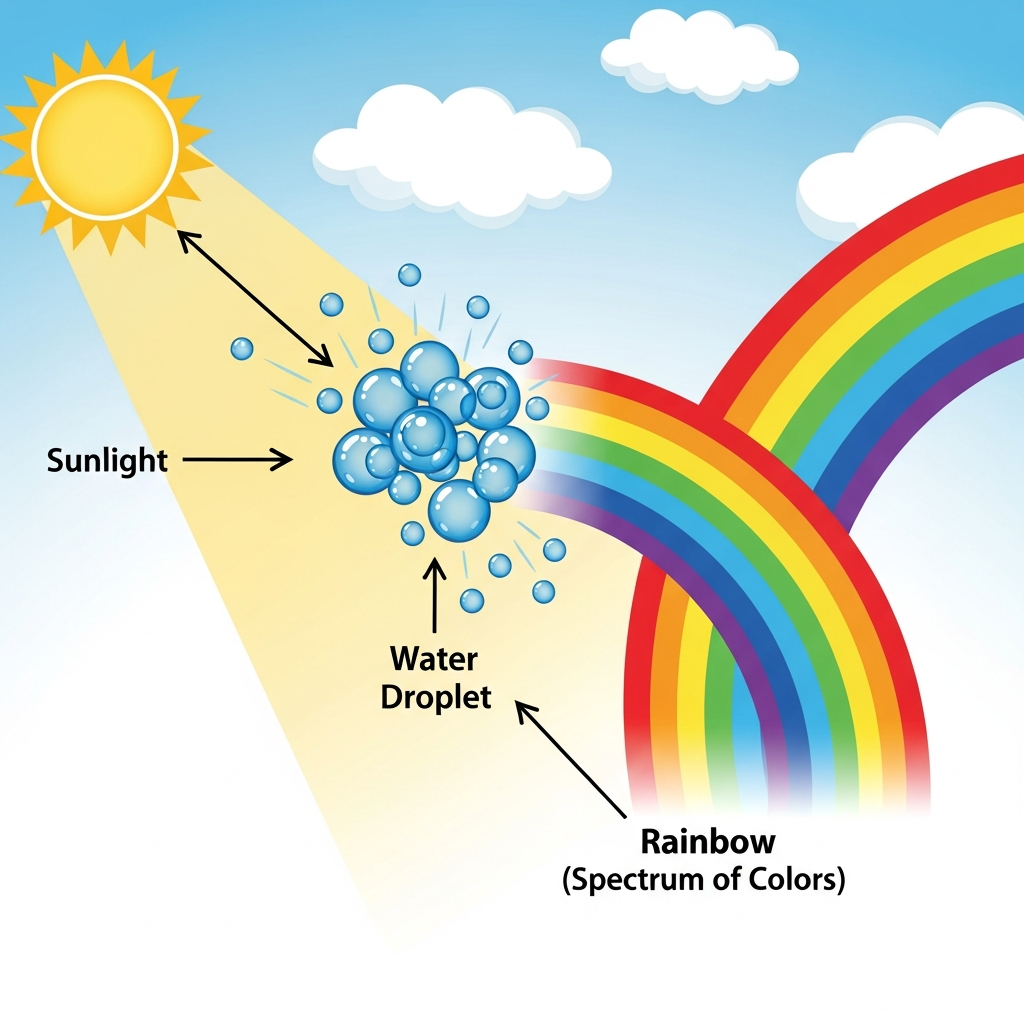
| Visible light | 400 - 700 nm | Vision (ROYGBIV) |
| Ultraviolet | 10 - 400 nm | Sterilization, vitamin D |
| X-rays | 0.01 - 10 nm | Medical imaging |
| Gamma rays | < 0.01 nm | Cancer treatment, sterilization |
Light is just one part of the electromagnetic spectrum, which arose naturally through physical processes. The sun emits all wavelengths through nuclear fusion.
Yahuah created light on Day 1, before the sun was made on Day 4. The precise tuning of visible light to match human eye sensitivity suggests design. Our atmosphere filters harmful radiation while allowing beneficial wavelengths through.
RECALL: EM Spectrum
Complete the following:
f = Hz
Lesson 4: Reflection and Refraction
RECEIVE: Light Behavior
Angle of incidence equals angle of reflection
(measured from the normal—perpendicular to surface)
n = index of refraction (ratio of light speed in vacuum to speed in medium)
n_water = 1.33 | n_glass ≈ 1.5 | n_diamond = 2.42
Why Refraction Occurs:
Light slows down when entering a denser medium, causing it to bend toward the normal. When light exits to a less dense medium, it speeds up and bends away from the normal.
RECALL: Calculate Refraction
Solve the following:
θᵣ =
θ₂ =
Lesson 5: Electric Charge
RECEIVE: The Basics of Electricity
Electric charge is a fundamental property of matter. There are two types:
- Positive (+): Protons carry positive charge
- Negative (-): Electrons carry negative charge
Key principle: Like charges repel; opposite charges attract.
F = electric force (N)
k = 8.99 × 10⁹ N·m²/C² (Coulomb's constant)
q = charge (Coulombs)
r = distance between charges (m)
Elementary charge: e = 1.6 × 10⁻¹⁹ C (charge of one proton or electron)
Electric Forces as Design
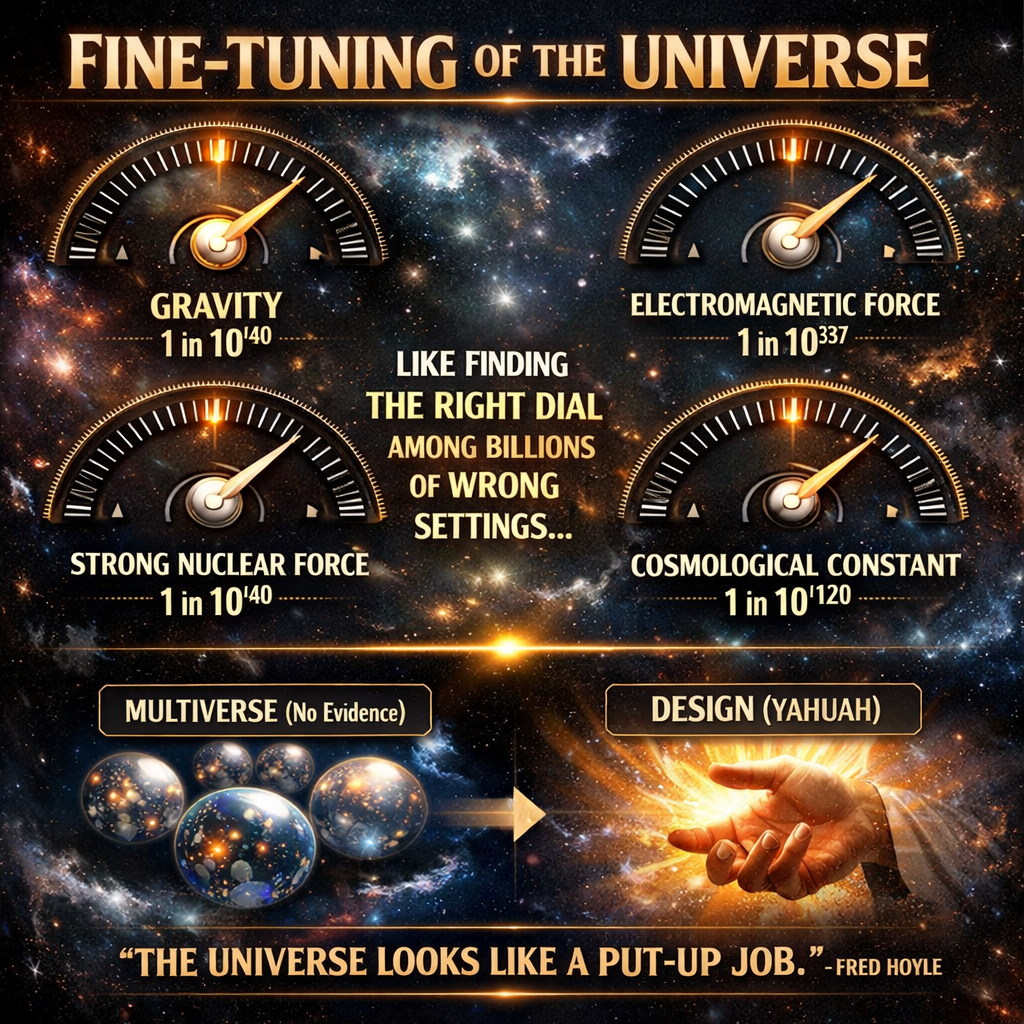
The electric force is incredibly strong—about 10³⁶ times stronger than gravity! Yet Yahuah balanced positive and negative charges so precisely that atoms are stable and matter holds together. A slight imbalance would cause everything to fly apart or collapse. This fine-tuning points to intentional design.
RECALL: Electric Charge Problems
Apply Coulomb's Law:
(1 μC = 10⁻⁶ C)
F = N
Lesson 6: Electric Current and Circuits
RECEIVE: Flowing Charge
Electric current (I) is the flow of electric charge through a conductor.
Current = Charge / Time
I = current (Amperes, A)
Q = charge (Coulombs, C)
t = time (seconds)
Circuit Components:
- Power source: Provides energy (battery, generator)
- Conductor: Wire that carries current
- Load: Device that uses energy (light bulb, motor)
- Switch: Opens/closes the circuit
Circuit Types:
- Series: Components connected in a single path (one breaks = all stop)
- Parallel: Components connected in multiple paths (one breaks = others work)
RECALL: Current Calculations
Solve the following:
I = A
Q = C
Lesson 7: Voltage and Resistance
RECEIVE: Ohm's Law
Voltage (V) = Electric potential difference; the "push" that moves charge
Resistance (R) = Opposition to current flow; measured in Ohms (Ω)
V = Voltage (Volts, V)
I = Current (Amperes, A)
R = Resistance (Ohms, Ω)
V = IR = (2 A)(60 Ω) = 120 V
Series: R_total = R₁ + R₂ + R₃ + ...
Parallel: 1/R_total = 1/R₁ + 1/R₂ + 1/R₃ + ...
RECALL: Ohm's Law Problems
Use V = IR:
I = A
V = V
R_total = Ω
R_total = Ω
Lesson 8: Electric Power
RECEIVE: Energy Usage
P = Power (Watts, W)
E = Energy (Joules or kilowatt-hours)
1 kWh = 1000 W × 1 hour = 3,600,000 J
A 60 W bulb runs for 5 hours at $0.12/kWh.
Energy = 60 W × 5 h = 300 Wh = 0.3 kWh
Cost = 0.3 kWh × $0.12 = $0.036 (about 4 cents)
RECALL: Power Calculations
Calculate power and energy:
P = W
E = kWh
Cost = $
Lesson 9: Magnetism
RECEIVE: Magnetic Fields
Magnetic poles: Every magnet has a north and south pole.
- Like poles repel; opposite poles attract
- Magnetic poles always come in pairs (no magnetic monopoles)
- Breaking a magnet creates two smaller magnets, each with N and S poles
Magnetic Field (B): A region around a magnet where magnetic force acts.
Field lines go from North pole to South pole outside the magnet.
Earth's Magnetic Field
Earth has a magnetic field that protects us from harmful solar radiation. This field is generated by electric currents in the molten iron core. Scientists observe that Earth's magnetic field is decaying—losing strength at a measurable rate. If extrapolated backwards, this suggests the earth cannot be billions of years old, as the field would have been impossibly strong in the past.
RECALL: Magnetism Concepts
Answer the following:
Lesson 10: Electromagnetism
RECEIVE: Electricity Creates Magnetism
Key Discovery: Moving electric charges create magnetic fields!
- A current-carrying wire produces a circular magnetic field around it
- Coiling the wire (solenoid) concentrates the field
- Adding an iron core creates an electromagnet
Right-Hand Rule: Point thumb in direction of current flow; fingers curl in direction of magnetic field.
Applications of Electromagnets:
- Electric motors
- Speakers and headphones
- MRI machines
- Junkyard cranes
- Hard drives
RECALL: Electromagnetism
Answer the following:
Lesson 11: Electromagnetic Induction
RECEIVE: Magnetism Creates Electricity
Faraday's Discovery: A changing magnetic field induces (creates) an electric current!
- Moving a magnet through a coil induces current
- The faster the motion, the greater the current
- More coils = more voltage
This principle powers:
- Generators: Convert mechanical energy to electrical energy
- Transformers: Change voltage levels
- Induction charging: Wireless phone charging
- Mechanical energy spins a coil of wire
- The coil rotates in a magnetic field
- Changing magnetic flux induces current
- Electrical energy is produced!
The Unity of Electricity and Magnetism
The relationship between electricity and magnetism is one of the most elegant features of physics. Moving charges create magnetic fields, and changing magnetic fields create electric currents. This deep connection was unified mathematically by Maxwell's equations. Such elegant mathematical relationships suggest a rational, orderly Creator.
RECALL: Induction
Answer the following:
→
→
Lesson 12: Wave-Particle Duality
RECEIVE: The Strange Nature of Light
One of the most puzzling discoveries in physics: Light behaves as both a wave AND a particle!
- Wave behavior: Diffraction, interference, refraction
- Particle behavior: Photoelectric effect, quantized energy
E = energy of photon (J)
h = Planck's constant = 6.63 × 10⁻³⁴ J·s
f = frequency (Hz)
Quantum mechanics shows that reality at small scales is fundamentally random and probabilistic. The wave-particle duality reflects the limits of human concepts to describe quantum reality.
The strange behavior of light at the quantum level may simply exceed our ability to fully comprehend Yahuah's creation. His ways are higher than our ways (Isaiah 55:9). The apparent "weirdness" may reflect the limits of human understanding, not the absence of design.
RECALL: Photon Energy
Calculate photon energy:
E = J
Lesson 13: Applications of Electromagnetism
RECEIVE: Technology in Action
Electric Motors: Convert electrical energy to mechanical energy
- Current flows through coil in magnetic field
- Magnetic force causes rotation
- Used in: fans, appliances, cars, tools
Transformers: Change voltage levels using induction
- Step-up: Increases voltage (power transmission)
- Step-down: Decreases voltage (household use)
- Power plants generate at high voltage for efficiency
V = voltage, N = number of coils
Wireless Communication:
- Radio transmitter: converts sound to EM waves
- Radio receiver: converts EM waves back to sound
- Wi-Fi, Bluetooth, cell phones: all use EM waves
RECALL: Applications
Answer the following:
V₂ = V
Lesson 14: Review and Reflection
RECEIVE: Connecting the Concepts
What We've Learned:
- Waves transfer energy through oscillations
- Light is an electromagnetic wave that behaves as both wave and particle
- Electric charge creates forces and can flow as current
- Ohm's Law relates voltage, current, and resistance
- Electricity and magnetism are deeply connected
- Electromagnetic induction powers our technology
The Lawgiver Behind the Laws
Throughout this course, we've seen physical laws that govern waves, electricity, and magnetism. These laws are consistent, mathematical, and predictable. The existence of such laws—described by elegant equations that humans can understand—points to a rational Lawgiver. As Psalm 19 says, the heavens declare His glory, and so does the electromagnetic force that holds atoms together.
RESPOND: Final Reflection
Write a paragraph explaining how studying physics has increased your appreciation for Yahuah's creation:
Which physics concept from this course do you find most amazing? Why?
Answer Key for Parents/Teachers
Lesson 1: Waves
1. v = 500 × 0.68 = 340 m/s | 2. λ = 340/440 = 0.77 m | 3. f = 3×10⁸/3 = 1×10⁸ Hz
4. L | 5. T | 6. T (surface waves are actually a combination)
Lesson 2: Sound
1. Molecules are closer together in solids, allowing faster energy transfer
2. λ = 340/256 = 1.33 m
3. Space is a vacuum; sound requires a medium
Lesson 3: EM Spectrum
1. 3 × 10⁸ m/s | 2. increases, increases | 3. f = 3×10⁸ / 7×10⁻⁷ = 4.3 × 10¹⁴ Hz | 4. Gamma rays
Lesson 4: Reflection and Refraction
1. θᵣ = 35° | 2. sin θ₂ = sin 30°/1.5 = 0.333, θ₂ = 19.5°
3. Light bends when passing between air and water, making the straw appear displaced
Lesson 5: Electric Charge
1. F = (8.99×10⁹)(2×10⁻⁶)(3×10⁻⁶)/(0.1)² = 5.4 N
2. Repulsive (both positive)
3. Force decreases to 1/4 (inverse square)
Lesson 6: Current
1. I = 15/5 = 3 A | 2. Q = 2 × 10 = 20 C
3. They all go out (series = single path)
Lesson 7: Ohm's Law
1. I = 12/100 = 0.12 A | 2. V = 3 × 40 = 120 V
3. R = 10 + 10 = 20 Ω | 4. 1/R = 1/10 + 1/10 = 2/10, R = 5 Ω
Lesson 8: Power
1. P = 5 × 120 = 600 W | 2. E = 1.5 × 3 = 4.5 kWh | 3. Cost = 4.5 × 0.15 = $0.675
Lesson 9: Magnetism
1. They repel | 2. Two poles each (still N and S)
3. Iron, nickel, cobalt (ferromagnetic materials)
4. Deflects harmful solar radiation
Lesson 10: Electromagnetism
1. More current, more coils, iron core
2. Can be turned on/off
3. Various answers: speakers, motors, MRI, etc.
Lesson 11: Induction
1. Speed of motion, number of coils, strength of magnetic field
2. Mechanical → Electrical | 3. Electrical → Mechanical
Lesson 12: Wave-Particle Duality
1. E = (6.63×10⁻³⁴)(5×10¹⁴) = 3.3 × 10⁻¹⁹ J
2. Blue | 3. Blue has higher frequency, so higher energy (E = hf)
Lesson 13: Applications
1. V₂ = 120 × (500/100) = 600 V | 2. Step-up
3. Various: refrigerator, washing machine, fan, blender, etc.