📚 Official Church View
- Necessary to protect the faithful from error
- A spiritual court concerned with souls
- Offered opportunity for repentance
- Death penalty was rare and regrettable
- Modern critics exaggerate the numbers
EXPOSED Inquisition
Ages 14+ | EXPOSED Series
Lesson 1
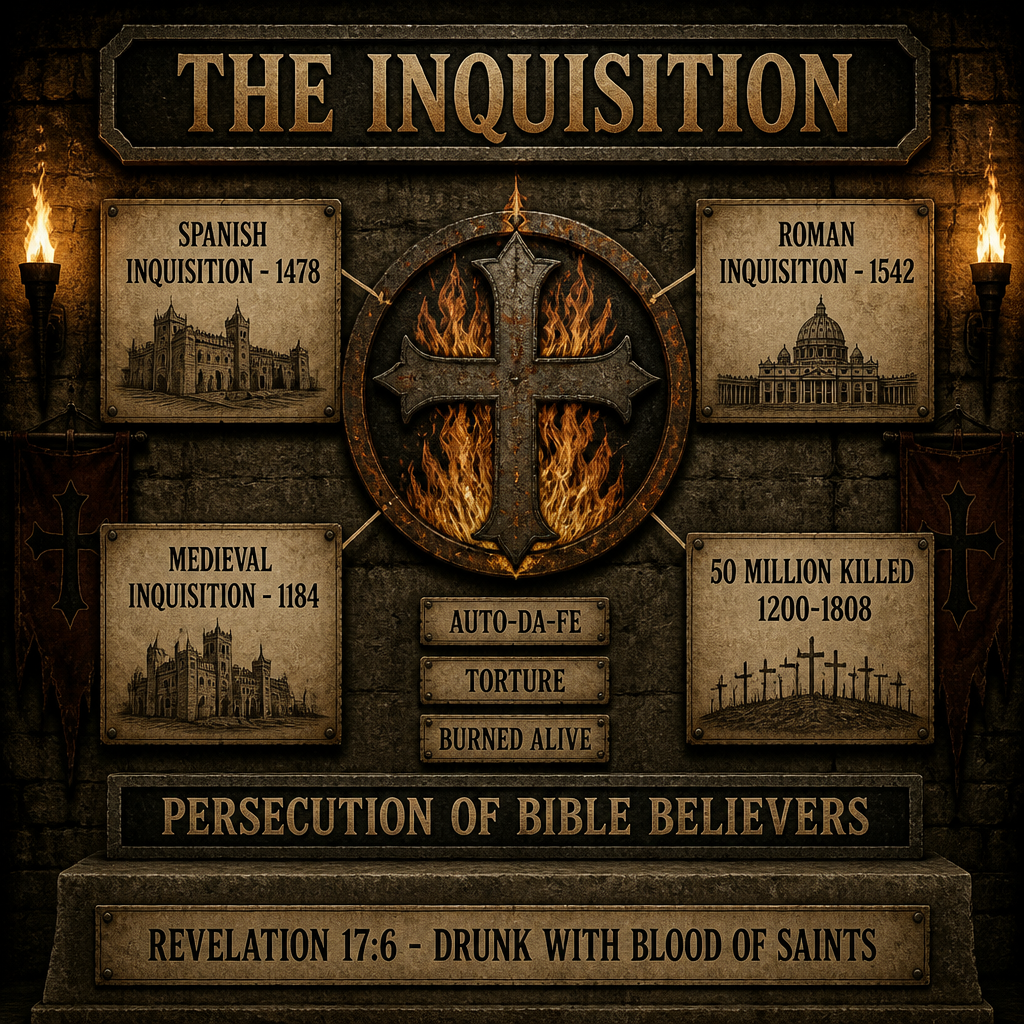
The Inquisition was a system of ecclesiastical tribunals established by the Roman Catholic Church to identify, try, and punish those deemed "heretics"—people whose beliefs differed from official Church teaching.
| Inquisition | Period | Primary Targets |
|---|---|---|
| Medieval/Papal | 1184-1230s+ | Cathars, Waldensians, other "heretics" |
| Spanish | 1478-1834 | Jews, Muslims, Protestants |
| Portuguese | 1536-1821 | Jews, New Christians |
| Roman | 1542-1965 | Protestants, scientists, freethinkers |
The Inquisition was not a brief episode—it operated for over six centuries. The Spanish Inquisition alone lasted 356 years. Generations lived under its shadow. This was systematic, institutionalized persecution on a massive scale.
Lesson 2
The Inquisition had standardized procedures that made it terrifyingly effective at suppressing dissent.
Pope Innocent IV authorized torture in 1252 (bull "Ad extirpanda"). Common methods included:
| Method | Description |
|---|---|
| The Rack | Body stretched, dislocating joints |
| Strappado | Hung by wrists tied behind back |
| Water Torture | Forced water ingestion via cloth |
| The Wheel | Limbs broken while tied to wheel |
| Fire/Burning | Applied to feet and body |
The accused could not know their accusers, could not have defense counsel, and faced a system presuming guilt. Confession—often obtained through torture—was the goal. Even recanting meant prison or death; not recanting meant the stake. There was no escape.
Lesson 3
The Inquisition targeted anyone who challenged Church authority or doctrine:
Persecuted from 1180s onward
Followers of Peter Waldo who translated Scripture into common languages, preached without Church permission, and rejected papal authority. Subject to crusade (1487-1488) and centuries of persecution. In 1655, the "Piedmont Easter" massacre killed thousands in one campaign.
12th-13th centuries
Southern French Christians who rejected Catholic sacraments. Pope Innocent III launched the Albigensian Crusade (1209-1229). At Béziers, the entire population was massacred. Over one million died in the campaign. The Inquisition was formalized partly to finish what the crusade began.
Spanish Inquisition targets
The Spanish Inquisition particularly targeted Jews who had converted to Christianity ("Conversos"), suspecting them of secretly practicing Judaism. Thousands were executed; many more lost property and lives. In 1492, all Jews were expelled from Spain.
16th century onward
After the Reformation, the Roman Inquisition (established 1542) specifically targeted Protestants. In Spain and Italy, Protestant literature was banned and possessors executed. The Netherlands saw mass executions of Reformed Christians.
Exact numbers are debated, but conservative estimates include:
Lesson 4
Many believers chose death rather than deny their faith. Their testimonies inspire us today.
Czech Reformer
Preached against indulgences and clerical corruption. Promised safe conduct to Council of Constance, then arrested and tried. Refused to recant. Burned at the stake July 6, 1415. His last words reportedly: "In 100 years, God will raise up a man whose calls for reform cannot be suppressed." Luther posted his theses 102 years later.
English Bible Translator
Translated the New Testament into English. Hunted across Europe. Betrayed, imprisoned 500 days, then strangled and burned. Last words: "Lord, open the King of England's eyes." Within four years, English Bibles were legal—using his translation.
English Protestant
Arrested for denying transubstantiation and possessing Protestant books. Tortured on the rack so severely she had to be carried to her execution in a chair. Burned at Smithfield, July 16, 1546, age 25. She refused to name others even under torture.
Italian Philosopher
Held views on cosmology and theology that contradicted Church teaching. After eight years of imprisonment, refused to recant. Burned at the stake in Rome, February 17, 1600. When the crucifix was offered, he turned away.
Lesson 5
The Church developed elaborate theological justifications for persecution. Understanding these reveals how badly Scripture can be twisted.
| Justification | Their Argument | Biblical Response |
|---|---|---|
| "Compel them to come in" (Luke 14:23) | Force is justified to bring people to salvation | Parable about invitation, not torture; love, not coercion |
| Protecting the flock | Heretics are wolves; shepherds must kill wolves | Yahusha told Peter to feed sheep, not slaughter them (John 21) |
| Church authority | "Whatever you bind on earth..." (Matthew 16:19) | Context is discipline, not torture and murder |
| Old Testament examples | Israel executed idolaters | Israel was a theocracy; Church is not a civil government |
| Saving souls | Better bodily death than eternal damnation | Faith cannot be coerced; forced confession is meaningless |
When the Church gained political power and married it to theological authority, persecution became inevitable. The Inquisition is the logical outcome of believing the Church can use force to enforce belief. This is why many Reformers (and especially Anabaptists) argued for separation of church and state.
Lesson 6
The Reformers believed the Inquisition fulfilled specific biblical prophecies about a persecuting religious power.
The phrase "wear out" (Aramaic: בְּלָא, b'la) means to harass, afflict, or mentally exhaust. The Inquisition accomplished this through:
"And I saw the woman drunken with the blood of the saints, and with the blood of the martyrs of Yahusha..."
The Reformers identified this "woman" (an unfaithful church) with the papal system and the Inquisition as evidence of being "drunk with blood."
"And in her was found the blood of prophets, and of saints, and of all that were slain upon the earth."
The call to "come out of her" (Revelation 18:4) was understood as leaving the persecuting system.
Daniel 7:25 and Revelation 12:6, 14 speak of persecution lasting "time, times, and half a time" (3.5 prophetic years = 1260 days/years). Many scholars count from 538 AD (establishment of papal supremacy) to 1798 AD (Napoleon's general arrested the pope)—exactly 1260 years of papal political power.
Lesson 7
The Catholic Church has expressed some regret about the Inquisition, but has never fully repudiated its theological basis.
The Inquisition model—using institutional power to silence dissent—appears in new forms:
| Inquisition Feature | Modern Parallel |
|---|---|
| Anonymous accusations | Social media mobs, anonymous reporting |
| Can't face accusers | Shadow banning, algorithmic suppression |
| Presumption of guilt | "Guilty until proven innocent" in court of public opinion |
| Economic punishment | Deplatforming, bank account closures, job loss |
| Thought control | "Misinformation" labels, fact-checkers |
The Inquisition's methods were physical. Today's persecution of dissent is primarily social and economic. But the spirit is the same: using power to silence those who disagree. Prophecy suggests persecution will return before Messiah's coming (Revelation 13). Understanding the Inquisition helps us recognize its patterns.
Lesson 8