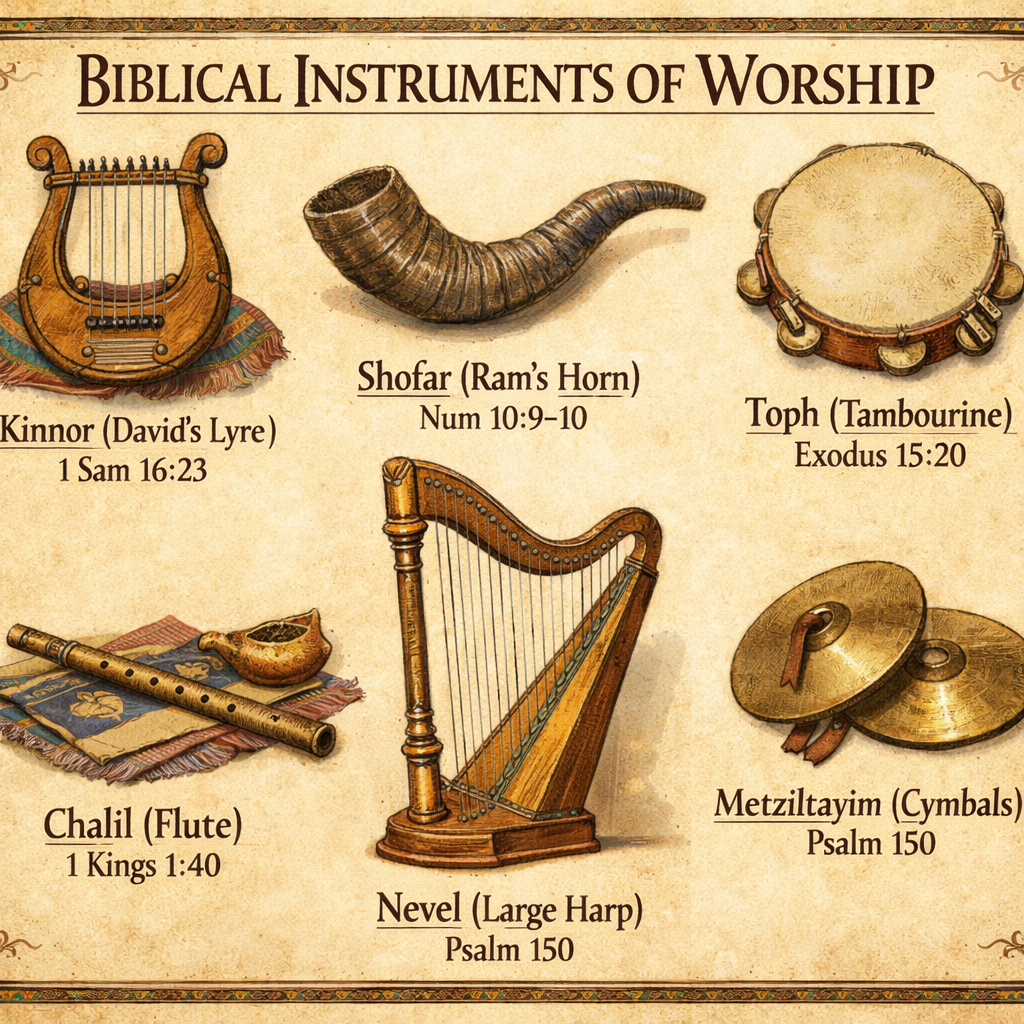
Biblical instruments
Understanding the Language of Music
Grades 6-8
Biblical instruments
Music theory is the "grammar" of music - the rules and patterns that help us understand, read, write, and perform music well. Just as grammar helps us communicate clearly with words, music theory helps us communicate clearly with sound.
By the end of this course, you'll be able to analyze music, compose simple pieces, and understand the "why" behind the sounds you hear!
The grand staff combines treble and bass clefs, connected by a brace. This is what piano music uses!
Higher pitches. The curl wraps around the G line (second line from bottom).
Lines: E - G - B - D - F (Every Good Boy Does Fine)
Spaces: F - A - C - E (spells FACE)
Lower pitches. The two dots surround the F line (second line from top).
Lines: G - B - D - F - A (Good Boys Do Fine Always)
Spaces: A - C - E - G (All Cows Eat Grass)
Notes that go above or below the staff use small lines called ledger lines. Middle C sits on its own ledger line between the two staves.
Write the letter name for each note:
A key signature tells us which notes are sharp or flat throughout the piece. It appears at the beginning of each line of music, right after the clef.
Remember: Father Charles Goes Down And Ends Battle
To find the key: Go up a half step from the last sharp = the major key
Example: 2 sharps (F# and C#) → D major
Remember: Battle Ends And Down Goes Charles' Father
To find the key: The second-to-last flat IS the major key
Example: 3 flats (Bb, Eb, Ab) → Eb major (second to last)
| Sharps/Flats | Major Key | Relative Minor |
|---|---|---|
| 0 | C major | A minor |
| 1 sharp | G major | E minor |
| 2 sharps | D major | B minor |
| 3 sharps | A major | F# minor |
| 1 flat | F major | D minor |
| 2 flats | Bb major | G minor |
| 3 flats | Eb major | C minor |
A scale is a series of notes in ascending or descending order. Major scales have a specific pattern that gives them their bright, happy sound.
W - W - H - W - W - W - H
(W = Whole step, H = Half step)
A half step is the smallest distance between two notes (like E to F, or B to C on piano).
A whole step is two half steps (like C to D).
Write out the D major scale:
D - - - - - - - D
Write out the F major scale:
F - - - - - - - F
Minor scales have a different pattern that gives them a darker, sadder, or more mysterious sound.
W - H - W - W - H - W - W
Every major key has a relative minor that shares the same key signature. The relative minor starts on the 6th degree of the major scale.
Natural Minor: W-H-W-W-H-W-W (all notes from key signature)
Harmonic Minor: Raise the 7th note by a half step
Melodic Minor: Raise 6th and 7th going up, natural going down
E - - - - - - - E
An interval is the distance between two notes. Understanding intervals helps you identify melodies by ear and build chords.
Count both the starting and ending notes. C to E = C(1), D(2), E(3) = a third.
| Interval | Half Steps | Example from C | Sound |
|---|---|---|---|
| Unison | 0 | C to C | Same note |
| Minor 2nd | 1 | C to Db | Dissonant |
| Major 2nd | 2 | C to D | Whole step |
| Minor 3rd | 3 | C to Eb | Sad |
| Major 3rd | 4 | C to E | Happy |
| Perfect 4th | 5 | C to F | "Here Comes the Bride" |
| Tritone | 6 | C to F# | Unstable |
| Perfect 5th | 7 | C to G | "Twinkle Twinkle" |
| Minor 6th | 8 | C to Ab | - |
| Major 6th | 9 | C to A | "My Bonnie" |
| Minor 7th | 10 | C to Bb | - |
| Major 7th | 11 | C to B | Leading tone |
| Octave | 12 | C to C | Same note, higher |
A chord is three or more notes played together. The most basic chord is a triad (three notes).
Triads are built by stacking thirds:
Root → skip a note → Third → skip a note → Fifth
Example: C-E-G (C major triad)
Root + M3 + m3
Happy, bright
Root + m3 + M3
Sad, dark
Root + m3 + m3
Tense, unstable
Root + M3 + M3
Mysterious
In any major key, the chords built on each scale degree follow a pattern:
In C Major: C - Dm - Em - F - G - Am - B°
| Note | Beats (in 4/4) | Rest Equivalent |
|---|---|---|
| Whole note | 4 | Whole rest |
| Half note | 2 | Half rest |
| Quarter note | 1 | Quarter rest |
| Eighth note | 1/2 | Eighth rest |
| Sixteenth note | 1/4 | Sixteenth rest |
A dot adds HALF the note's value:
A tie connects two notes of the same pitch, combining their values. A tied quarter + quarter = one note held for 2 beats.
In 6/8: There are 6 eighth notes per measure, but they group into 2 beats of 3 eighth notes each.
Count: "1-2-3, 2-2-3" or "1-and-a, 2-and-a"
Musical form is how a piece is organized. Understanding form helps you follow along and remember music better.
Two contrasting sections. Section A is different from Section B.
Example: Many folk songs
Three sections where the third returns to the first.
A = Theme | B = Contrasting section | A = Return to theme
Example: Many hymns, minuets
Most common in popular and worship music:
Intro → Verse → Chorus → Verse → Chorus → Bridge → Chorus → Outro
The chorus repeats the same words; verses change.
A main theme (A) alternates with contrasting sections (B, C, etc.)
The A section keeps coming back like a refrain.
Music is organized into phrases, like sentences in writing. Most phrases are 4 or 8 measures long. Phrases often come in pairs:
| Family | How Sound is Made | Examples |
|---|---|---|
| Strings | Vibrating strings (bow or pluck) | Violin, viola, cello, bass, harp, guitar |
| Woodwinds | Air vibrating through tube | Flute, clarinet, oboe, bassoon, saxophone |
| Brass | Buzzing lips into mouthpiece | Trumpet, trombone, French horn, tuba |
| Percussion | Striking, shaking, scraping | Drums, timpani, xylophone, cymbals |
| Keyboard | Keys triggering various mechanisms | Piano, organ, harpsichord |
| Era | Characteristics |
|---|---|
| Ancient | Temple worship, psalms, simple instruments |
| Medieval | Gregorian chant, early notation developed |
| Renaissance | Polyphony (multiple voices), more instruments |
| Baroque | Bach, Handel - complex, ornate church music |
| Classical | Mozart, Haydn - balance, clarity |
| Romantic | Emotion, expression, larger orchestras |
| Modern | Diverse styles, technology, worship bands |
Now that you understand music theory, you can:
1. A | 2. E | 3. One ledger line below treble/above bass | 4. A | 5. D
1. E major | 2. Bb major | 3. C major | 4. A major
D major: D-E-F#-G-A-B-C#-D
F major: F-G-A-Bb-C-D-E-F
1. E minor | 2. F major | E natural minor: E-F#-G-A-B-C-D-E
1. Perfect 5th | 2. Major 3rd | 3. Perfect 5th | 4. Minor 3rd
1. G-B-D | 2. D-F-A | 3. E-G#-B | 4. A-C-E
1. 3 beats | 2. 1.5 beats | 3. 6 eighth notes