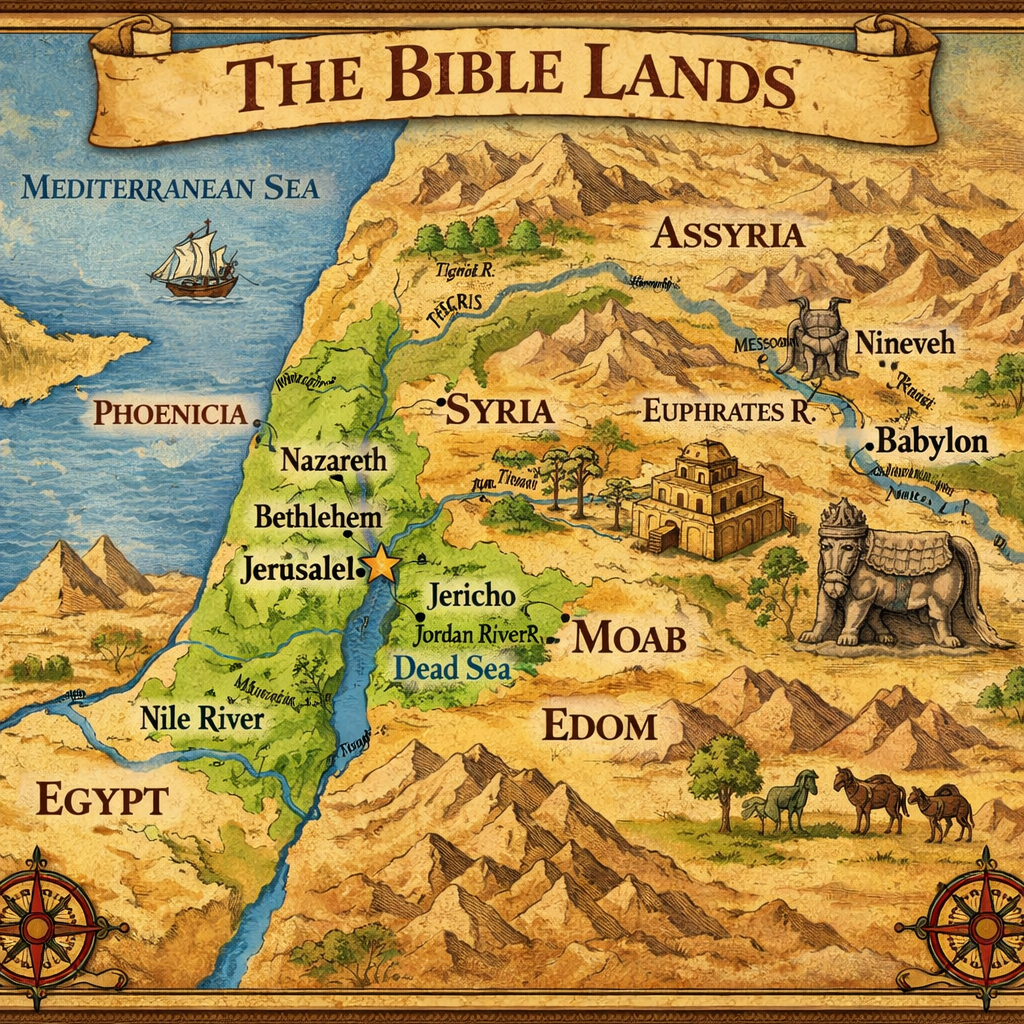
Geography is the study of Earth's physical features, climates, and how people interact with their environment. In this course, we study geography through a biblical lens, understanding Earth as Yahuah's purposeful creation.
Genesis 1:9-10 - "And Elohim said, Let the waters under the heaven be gathered together unto one place, and let the dry land appear: and it was so. And Elohim called the dry land Earth; and the gathering together of the waters called he Seas."
What is Geography?
Geography comes from Greek words meaning "earth writing" or "description of the earth." It includes:
Physical Geography: Landforms, water, climate
Human Geography: Where people live, cultures, nations
The Earth is not a random accident. Yahuah specifically designed the land, sea, atmosphere, and all features for life to flourish. Understanding geography helps us appreciate His wisdom!
Practice Questions
Lesson 2: The Seven Continents
Acts 17:26 - "And hath made of one blood all nations of men for to dwell on all the face of the earth, and hath determined the times before appointed, and the bounds of their habitation."
The Continents
Continent
Size (sq mi)
Key Features
Asia
17.2 million
Largest; Himalayas; most populated
Africa
11.7 million
Sahara Desert; Nile River; diverse wildlife
North America
9.5 million
Rocky Mountains; Great Lakes; varied climates
South America
6.9 million
Amazon Rainforest; Andes Mountains
Antarctica
5.5 million
Ice-covered; no permanent residents
Europe
3.9 million
Many nations; varied history; Alps
Australia
2.9 million
Unique wildlife; Great Barrier Reef
Biblical Perspective
According to Genesis 10:25, in the days of Peleg "the earth was divided." Some believe this refers to the separation of continents. All humanity descends from Noah's three sons and spread across these landmasses.
Practice Questions
Lesson 3: Oceans and Seas
Psalm 95:5 - "The sea is his, and he made it: and his hands formed the dry land."
The World's Oceans
Ocean
Size
Key Facts
Pacific
63 million sq mi
Largest; deepest (Mariana Trench)
Atlantic
41 million sq mi
Separates Americas from Europe/Africa
Indian
27 million sq mi
Warmest ocean; monsoon patterns
Southern (Antarctic)
8 million sq mi
Surrounds Antarctica; coldest
Arctic
5 million sq mi
Smallest; much ice cover
Biblical Seas
Mediterranean Sea: "The Great Sea" - major trade route
Red Sea: Crossed by Israel in the Exodus
Dead Sea: Lowest point on earth; extremely salty
Sea of Galilee: Where Yahusha walked on water
Lesson 4: Mountains and Valleys
Psalm 121:1-2 - "I will lift up mine eyes unto the hills, from whence cometh my help. My help cometh from Yahuah, which made heaven and earth."
Major Mountain Ranges
Range
Location
Highest Peak
Himalayas
Asia
Mt. Everest (29,032 ft)
Andes
South America
Aconcagua (22,841 ft)
Rocky Mountains
North America
Mt. Elbert (14,440 ft)
Alps
Europe
Mont Blanc (15,774 ft)
Atlas
Africa
Toubkal (13,671 ft)
Biblical Mountains
Mt. Sinai: Where Torah was given
Mt. Ararat: Where Noah's ark rested
Mt. Moriah: Where Abraham offered Isaac; Temple Mount
Mt. of Olives: Where Yahusha will return
Mt. Carmel: Where Elijah defeated Baal's prophets
Lesson 5: Rivers and Lakes
Revelation 22:1 - "And he shewed me a pure river of water of life, clear as crystal, proceeding out of the throne of Elohim and of the Lamb."
Major World Rivers
River
Length
Continent
Nile
4,132 miles
Africa
Amazon
3,976 miles
South America
Yangtze
3,917 miles
Asia
Mississippi-Missouri
3,902 miles
North America
Euphrates
1,740 miles
Middle East
Rivers of Eden (Genesis 2:10-14)
Pishon: Surrounded land of Havilah (gold)
Gihon: Surrounded land of Cush
Hiddekel (Tigris): East of Assyria
Euphrates: Still exists today
Lesson 6: Climate and Weather
Genesis 8:22 - "While the earth remaineth, seedtime and harvest, and cold and heat, and summer and winter, and day and night shall not cease."
Climate Zones
Zone
Location
Characteristics
Tropical
Near equator
Hot year-round; heavy rainfall
Dry/Arid
Desert regions
Little rainfall; extreme temperatures
Temperate
Mid-latitudes
Four seasons; moderate rainfall
Continental
Interior continents
Hot summers; cold winters
Polar
Near poles
Cold year-round; ice and snow
Yahuah's Promise
After the Flood, Yahuah promised seasons would continue "while the earth remaineth" (Genesis 8:22). This is a covenant of stability in creation!
Lesson 7: Bible Lands - The Middle East
Genesis 12:1 - "Now Yahuah had said unto Abram, Get thee out of thy country, and from thy kindred, and from thy father's house, unto a land that I will shew thee."
Key Biblical Locations
Place
Modern Location
Biblical Significance
Israel/Canaan
Israel
Promised Land; Temple
Ur of Chaldees
Iraq
Abraham's birthplace
Egypt
Egypt
Exodus; refuge
Babylon
Iraq
Exile; Tower of Babel
Assyria
Iraq/Syria
Northern Kingdom exile
Persia
Iran
Cyrus; return from exile
The Land of Israel
Israel sits at the crossroads of three continents (Africa, Asia, Europe). This strategic location made it central to ancient trade routes and the spread of the gospel.
Lesson 8: The Nations from Noah
Genesis 10:32 - "These are the families of the sons of Noah, after their generations, in their nations: and by these were the nations divided in the earth after the flood."
Table of Nations (Genesis 10)
Son of Noah
Descendants
Settled
Shem
Semitic peoples: Hebrews, Arabs, Assyrians
Middle East
Ham
Canaanites, Egyptians, Africans, Philistines
Africa, Canaan
Japheth
Indo-Europeans: Greeks, Persians, Europeans
Europe, Asia
One Human Family
All humanity descends from Noah's three sons. "Race" is a modern invention - the Bible speaks of nations and languages, not races. We are all one blood (Acts 17:26).
Lesson 9: Natural Resources
Deuteronomy 8:7-9 - "For Yahuah thy Elohim bringeth thee into a good land... a land whose stones are iron, and out of whose hills thou mayest dig brass."
Types of Natural Resources
Category
Examples
Biblical Reference
Minerals
Gold, silver, iron, copper
Genesis 2:11-12; Deut 8:9
Water
Rivers, springs, wells
Genesis 21:19; Exodus 17:6
Soil
Fertile land for crops
Genesis 1:11; Isaiah 28:24
Timber
Cedars, oaks, olive trees
1 Kings 5:6; Psalm 104:16
Livestock
Cattle, sheep, fish
Genesis 1:24-26
Lesson 10: Stewardship of the Earth
Genesis 2:15 - "And Yahuah Elohim took the man, and put him into the garden of Eden to dress it and to keep it."
Our Responsibility
Yahuah gave humanity the responsibility to steward (care for) the earth:
"Dress it" (abad) = Work, cultivate, serve
"Keep it" (shamar) = Guard, protect, preserve
We are not owners but caretakers of Yahuah's creation.
Biblical Principles of Stewardship
The earth belongs to Yahuah (Psalm 24:1)
We are accountable for how we treat creation
Don't exploit or destroy unnecessarily
Leave resources for future generations
Work and rest the land (Sabbath for land - Lev 25)
Practice Questions
Answer Key
Lesson 1
1. "Earth writing" or description of the earth 2. Physical, Human, Biblical 3. Dry land = Earth; Waters = Seas
Lesson 2
1. Asia 2. South America 3. "The earth was divided"
Lesson 10
1. Caring for and managing the earth as Yahuah's representatives 2. Abad (work/serve) and Shamar (keep/guard) 3. Personal answers