Exploring Yahuah's Earth
Geography is the study of the earth - its lands, peoples, and features. As believers, we study geography knowing that Yahuah created this world and placed every nation in its appointed place. This workbook explores the world's major regions while connecting geography to Scripture and history.
Table of Contents
Lesson 1: The Biblical Foundation of Geography
RECEIVE
Geography begins with Yahuah as Creator. He made the earth, divided the waters from the land, and placed mankind upon it. After the Flood of Noah, He scattered the nations across the earth at the Tower of Babel (Genesis 11).
Key Geographic Events in Scripture
- Creation: Yahuah formed the earth, seas, and continents (Genesis 1)
- The Garden of Eden: The first home of mankind, near four rivers
- The Great Flood: Dramatically reshaped the earth's geography
- Tower of Babel: Languages confused, nations scattered
- Promised Land: Yahuah gave Israel a specific territory
Five Themes of Geography
- Location: Where is it? (coordinates, relative position)
- Place: What is it like? (physical and human characteristics)
- Human-Environment Interaction: How do people affect the land?
- Movement: How do people, goods, and ideas travel?
- Region: What areas share common characteristics?
REFLECT
If Yahuah "determined the bounds" of where nations would live, what does this mean about borders and peoples today?
RECALL
Fill in the blanks:
- Acts 17:26 says Yahuah made all nations of blood.
- After the , the earth's geography was dramatically changed.
- At the Tower of , Yahuah confused languages and scattered nations.
- The five themes of geography are Location, Place, Human-Environment Interaction, , and Region.
RECITE
Write this verse from memory:
REVIEW
Answer these questions:
- How does the biblical worldview differ from the secular view of how nations came to be?
- Name the four rivers mentioned near the Garden of Eden (Genesis 2:10-14):
RESPOND
Why is it important to study geography from a biblical perspective?
Lesson 2: The Middle East - Cradle of Civilization
RECEIVE
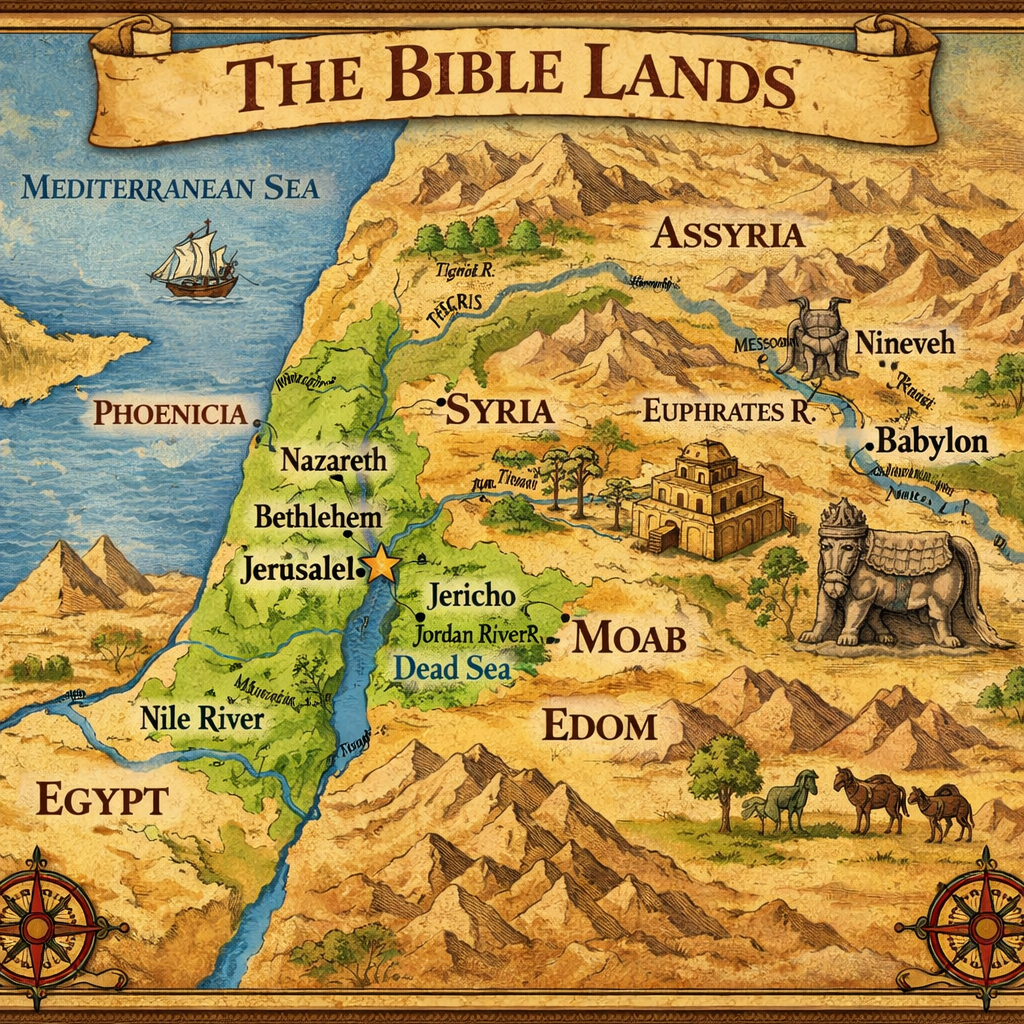
The Middle East is where biblical history unfolded. From the Garden of Eden to the ministry of Yahusha, this region is central to Scripture and world history.
Physical Geography
- Location: Where Africa, Asia, and Europe meet
- Climate: Mostly arid (desert) with some Mediterranean areas
- Key Water Bodies: Mediterranean Sea, Red Sea, Persian Gulf, Dead Sea
- Major Rivers: Tigris, Euphrates, Nile, Jordan
- Terrain: Deserts, mountains, fertile river valleys
Biblical Significance
- Mesopotamia: "Land between the rivers" - where civilization began
- Israel: The Promised Land given to Abraham's descendants
- Egypt: Where Israel was enslaved and delivered from
- Jerusalem: The holy city, site of the Temple
- Babylon: Where Israel was exiled; symbol of world system
Modern Middle East
Today the Middle East includes: Israel, Jordan, Lebanon, Syria, Iraq, Iran, Saudi Arabia, Yemen, Oman, UAE, Qatar, Bahrain, Kuwait, Turkey, and Egypt.
The region contains about 65% of the world's known oil reserves, making it strategically important.
REFLECT
Why do you think Yahuah chose this specific region for most of biblical history?
RECALL
Fill in the blanks:
- Mesopotamia means "land between the ."
- The two major rivers of Mesopotamia are the and .
- The Middle East is where the continents of , Asia, and Europe meet.
- The city of is the holy city where the Temple stood.
RECITE
Write the key promise from memory:
REVIEW
Match the location to its biblical significance:
| Location | Significance |
|---|---|
| Egypt | |
| Babylon | |
| Jordan River | |
| Mount Sinai |
RESPOND
Research one modern Middle Eastern country and describe its geography and how it connects to biblical history:
Lesson 3: Africa - Land of Ancient Kingdoms
RECEIVE
Africa is the second-largest continent, home to ancient civilizations, diverse peoples, and rich natural resources. It has deep connections to biblical history.
Physical Geography
- Size: About 11.7 million square miles (3x the size of USA)
- Climate Zones: Desert (Sahara), tropical rainforest, savanna, Mediterranean
- Major Rivers: Nile (world's longest), Congo, Niger, Zambezi
- Key Features: Sahara Desert, Great Rift Valley, Mount Kilimanjaro
- Countries: 54 nations
Africa in Scripture
- Egypt: Major world power, where Israel was enslaved
- Ethiopia (Cush): Mentioned frequently; Ethiopian eunuch (Acts 8)
- Libya (Put): North African region mentioned in prophecy
- The Nile: River that sustained Egypt, site of Moses' rescue
- Refuge: Joseph, Mary, and Yahusha fled to Egypt
Ancient African Kingdoms
- Egypt: Built pyramids, advanced in medicine and astronomy
- Kush/Nubia: Powerful kingdom south of Egypt
- Axum (Ethiopia): One of the first Christian kingdoms
- Great Zimbabwe: Stone city ruins in southern Africa
REFLECT
How does knowing Africa's biblical connections change how you view this continent?
RECALL
Fill in the blanks:
- Africa has countries.
- The is the world's longest river.
- The Desert is the largest hot desert on Earth.
- Ethiopia was called in the Bible.
RECITE
Write this verse from memory:
REVIEW
- Name three climate zones found in Africa: , ,
- Why was Egypt significant in biblical history?
RESPOND
The Ethiopian eunuch (Acts 8:26-40) was reading Isaiah when Philip met him. What does this story teach us about Africa's connection to the faith?
Lesson 4: Europe - From Rome to Reformation
RECEIVE
Europe is the second-smallest continent but has had enormous influence on world history. From the Roman Empire to the Protestant Reformation, Europe shaped the spread of Christianity and world events.
Physical Geography
- Size: About 3.9 million square miles
- Climate: Temperate in most areas; Mediterranean in south
- Mountains: Alps, Pyrenees, Carpathians
- Major Rivers: Danube, Rhine, Volga
- Countries: About 50 nations
Europe in Scripture and History
- Rome: The empire that ruled during Yahusha's time
- Greece: Paul's missionary journeys reached Greek cities
- Descendants of Japheth: Many Europeans descended from Noah's son Japheth
- Spread of the Gospel: Early believers spread faith across the Roman Empire
Key European Developments
- Roman Empire: Provided roads and common language for Gospel spread
- Medieval Period: Catholic Church dominated; Scripture restricted
- Protestant Reformation (1517): Luther, Calvin challenged Rome
- Printing Press: Made the Bible accessible to common people
REFLECT
How did the Roman Empire - often seen as an enemy of early believers - actually help spread the Gospel?
RECALL
Fill in the blanks:
- The Empire ruled the known world during Yahusha's time.
- Many Europeans are descended from , son of Noah.
- The Protestant Reformation began in (year).
- The Press made Bibles available to common people.
RECITE
Write this verse from memory:
REVIEW
- Name three European mountain ranges: , ,
- What was the Macedonian call and why was it significant?
RESPOND
Research one European country and its religious history:
Lesson 5: Asia - Ancient Empires
RECEIVE
Asia is the largest and most populous continent, home to over 4.5 billion people. It includes regions from the Middle East (already covered) to the Far East.
Physical Geography
- Size: About 17.2 million square miles (largest continent)
- Population: Over 60% of world's people
- Climate: Every type - arctic, desert, tropical, temperate
- Mountains: Himalayas (world's highest), Urals
- Major Rivers: Yangtze, Ganges, Mekong, Indus
Asia in Scripture
- The Magi: Wise men came "from the east" to see Yahusha
- Persia: Empire that freed Israel from Babylon (Cyrus)
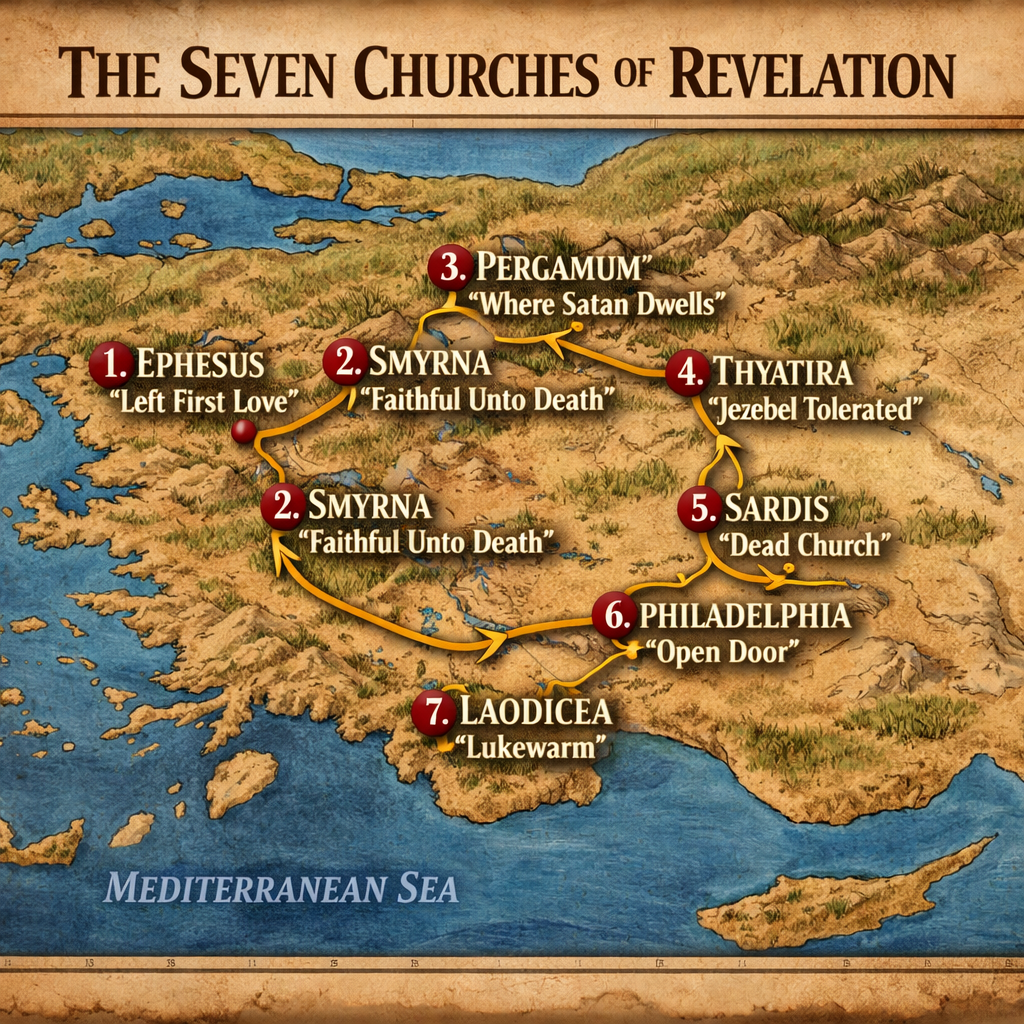
- Seven Churches: Revelation's letters sent to churches in Asia Minor
- Thomas: Tradition says he brought the Gospel to India
- Silk Road: Ancient trade route that connected East and West
Major Regions of Asia
- Central Asia: Kazakhstan, Uzbekistan, etc. - Silk Road region
- South Asia: India, Pakistan, Bangladesh - very populous
- East Asia: China, Japan, Korea - ancient civilizations
- Southeast Asia: Vietnam, Thailand, Indonesia - tropical islands
REFLECT
Asia has billions of people who don't know the truth. How should this affect our prayers and missions?
RECALL
Fill in the blanks:
- Asia is the and most populous continent.
- The are the world's highest mountain range.
- The came from the east to worship baby Yahusha.
- King of Persia freed Israel from Babylonian captivity.
RECITE
Write this verse from memory:
REVIEW
- What percentage of the world's population lives in Asia? %
- Name two major rivers of Asia: ,
RESPOND
The Seven Churches of Revelation were in Asia Minor (modern Turkey). List their names and look up one message:
Lesson 6: North America - The New World
RECEIVE
North America includes Canada, the United States, Mexico, Central America, and the Caribbean. European explorers called it the "New World," though indigenous peoples had lived there for generations.
Physical Geography
- Size: About 9.5 million square miles
- Climate: Arctic in north, tropical in south, varied in between
- Mountains: Rocky Mountains, Appalachians, Sierra Nevada
- Major Rivers: Mississippi, Missouri, Colorado, Rio Grande
- Key Features: Great Plains, Great Lakes, Grand Canyon
Settlement History
- Indigenous Peoples: Many tribes with diverse cultures
- European Exploration: Columbus 1492, later English, Spanish, French
- Colonial Period: Settlements established for religious freedom
- Pilgrims & Puritans: Sought to worship according to Scripture
A Nation Founded on Biblical Principles?
Many of America's founders referenced Scripture and biblical principles. However, the history is complex - including both godly influence and serious sins like slavery and treatment of native peoples. We must honestly evaluate history while learning from it.
REFLECT
The Pilgrims came seeking religious freedom. How should believers today think about their heritage - both the good and the problematic parts?
RECALL
Fill in the blanks:
- The Mountains run along the western part of North America.
- The River is one of the longest in North America.
- Columbus reached the Americas in (year).
- The came seeking freedom to worship according to Scripture.
RECITE
Write this verse from memory:
REVIEW
- Name the five Great Lakes:
- What are three major mountain ranges in North America? , ,
RESPOND
Research your own state or province. What are its physical features and history?
Lesson 7: South America - Diverse Lands
RECEIVE
South America is a continent of incredible diversity - from the Amazon rainforest to the Andes mountains, from tropical beaches to frozen glaciers.
Physical Geography
- Size: About 6.9 million square miles
- Countries: 12 independent nations
- Climate: Mostly tropical, with temperate areas in the south
- Mountains: Andes (longest continental range)
- Major Rivers: Amazon (largest by volume), Orinoco, Paraná
Remarkable Features
- Amazon Rainforest: Largest tropical rainforest - produces 20% of Earth's oxygen
- Atacama Desert: Driest place on Earth (parts had no rain for 400 years)
- Angel Falls: World's highest waterfall (Venezuela)
- Galápagos Islands: Unique wildlife off Ecuador's coast
Faith in South America
Spanish and Portuguese colonizers brought Catholicism in the 1500s, often mixing it with indigenous practices. Today, evangelical Christianity is growing rapidly across the continent. Many indigenous peoples are hearing the Gospel in their own languages for the first time.
REFLECT
The Amazon is sometimes called the "lungs of the Earth." What does biblical stewardship look like regarding such important ecosystems?
RECALL
Fill in the blanks:
- The is the longest mountain range in the world.
- The River is the largest by water volume.
- South America has independent countries.
- The Desert is the driest place on Earth.
RECITE
Write this verse from memory:
REVIEW
Match the feature to the country:
| Feature | Country |
|---|---|
| Amazon Rainforest (majority) | |
| Angel Falls | |
| Galápagos Islands | |
| Machu Picchu |
RESPOND
Research a South American country's geography and current spiritual climate:
Lesson 8: Australia & Oceania - Island Continents
RECEIVE
Australia is both a country and a continent - the smallest continent but sixth-largest country. Oceania includes the Pacific islands scattered across the vast Pacific Ocean.
Australia - Physical Geography
- Size: About 3 million square miles
- Climate: Mostly arid interior ("Outback"), tropical north, temperate coasts
- Key Features: Great Barrier Reef, Uluru (Ayers Rock), Great Dividing Range
- Unique Wildlife: Kangaroos, koalas, platypus - found nowhere else
Oceania - Pacific Islands
- Three Regions: Melanesia, Micronesia, Polynesia
- Major Nations: New Zealand, Fiji, Papua New Guinea, Hawaii (US)
- Geography: Volcanic islands, coral atolls, scattered across vast ocean
- Navigation: Ancient Polynesians navigated by stars - remarkable skill
The Gospel in the Pacific
Missionaries brought Christianity to Pacific islands in the 1800s. Many islands became strongly Christian. Today, some Pacific nations have the highest church attendance rates in the world.
REFLECT
Australia and Oceania were among the last regions to hear the Gospel. What does this teach about Yahuah's timing and reaching all peoples?
RECALL
Fill in the blanks:
- Australia is the continent.
- The three regions of Oceania are Melanesia, Micronesia, and .
- The Barrier Reef is the world's largest coral reef system.
- Ancient Polynesians navigated across the ocean using the .
RECITE
Write this verse from memory:
REVIEW
- Name two unique animals found only in Australia: ,
- What is the "Outback"?
RESPOND
Research one Pacific island nation. What is its geography and spiritual condition?
Lesson 9: The Poles & World Climates
RECEIVE
The Arctic (North Pole) and Antarctic (South Pole) are Earth's coldest regions. Understanding climate zones helps us see how Yahuah designed the earth for diverse life.
Arctic vs. Antarctic
| Feature | Arctic | Antarctic |
|---|---|---|
| Location | North Pole | South Pole |
| Land/Water | Frozen ocean | Ice-covered continent |
| Wildlife | Polar bears, seals | Penguins, seals |
| Inhabitants | Indigenous peoples | Research stations only |
World Climate Zones
- Tropical: Hot year-round, near equator (rainforest, savanna)
- Dry: Little precipitation (desert, semi-arid)
- Temperate: Moderate temperatures, distinct seasons
- Continental: Large temperature swings, cold winters
- Polar: Extremely cold, ice and permafrost
Climate in Scripture
"While the earth remaineth, seedtime and harvest, and cold and heat, and summer and winter, and day and night shall not cease." (Genesis 8:22)
After the Flood, Yahuah promised the seasons and climate patterns would continue.
REFLECT
How do different climates show Yahuah's design for different types of life to flourish in different regions?
RECALL
Fill in the blanks:
- The is frozen ocean, while is an ice-covered continent.
- Polar bears live in the , penguins live in the .
- The five main climate zones are: tropical, dry, temperate, continental, and .
- Genesis 8:22 promises that and harvest will continue.
RECITE
Write this verse from memory:
REVIEW
- What climate zone do you live in?
- Why can't people live permanently in Antarctica?
RESPOND
How do the polar regions demonstrate Yahuah's power and creativity?
Lesson 10: Nations, Borders & Prophecy
RECEIVE
Scripture teaches that Yahuah established nations and their boundaries. As we study geography, we see His sovereign hand moving through history and preparing for end-time events.
Nations in End-Times Prophecy
- Israel: Regathered as a nation (Ezekiel 37) - fulfilled 1948
- Gog and Magog: Northern coalition attacks Israel (Ezekiel 38-39)
- Kings of the East: 200 million army from across Euphrates (Revelation 9:16)
- Babylon: Both literal place and symbolic world system
- All Nations: Will be gathered for judgment (Matthew 25:32)
The World Today
- Countries: About 195 recognized nations
- Languages: About 7,000 languages spoken
- Unreached Peoples: Thousands of groups still need the Gospel
- Globalization: World becoming more connected
Key Prophetic Regions to Watch
- Middle East: Center of end-times events
- Israel: The prophetic clock - watch Jerusalem
- Europe: Revived Roman Empire? (Daniel 2, 7)
- Asia: Rising powers, kings of the east
REFLECT
How does understanding geography help us understand Bible prophecy better?
RECALL
Fill in the blanks:
- Israel became a nation again in (year).
- There are about recognized countries today.
- About languages are spoken in the world.
- Gog and Magog refers to a coalition that attacks Israel.
RECITE
Write this verse from memory:
REVIEW
Create a summary chart of what you've learned:
| Continent | One Key Geographic Feature | Biblical Connection |
|---|---|---|
| Middle East | ||
| Africa | ||
| Europe | ||
| Asia | ||
| North America | ||
| South America | ||
| Australia/Oceania |
RESPOND
How has this study of world geography deepened your understanding of Yahuah's plan for the nations?
Answer Key
Lesson 1: Biblical Foundation
- one
- Flood
- Babel
- Movement
Lesson 2: Middle East
- rivers
- Tigris, Euphrates
- Africa
- Jerusalem
Lesson 3: Africa
- 54
- Nile
- Sahara
- Cush
Lesson 4: Europe
- Roman
- Japheth
- 1517
- Printing
Lesson 5: Asia
- largest
- Himalayas
- Magi (or Wise Men)
- Cyrus
Lesson 6: North America
- Rocky
- Mississippi
- 1492
- Pilgrims
Great Lakes: Superior, Michigan, Huron, Erie, Ontario
Lesson 7: South America
- Andes
- Amazon
- 12
- Atacama
Matching: Brazil, Venezuela, Ecuador, Peru
Lesson 8: Australia & Oceania
- smallest
- Polynesia
- Great
- stars
Lesson 9: Poles & Climates
- Arctic, Antarctica
- Arctic, Antarctic
- polar
- seedtime
Lesson 10: Nations & Prophecy
- 1948
- 195
- 7,000
- northern