Ancient Civilizations

History Through the Biblical Timeline

Youth Tier 2 | Grades 7-9

Welcome, Truth Seeker!

In this workbook, you'll explore ancient history through the lens of Scripture. While mainstream history books ignore the Bible, we'll see how archaeology and ancient records actually confirm the biblical account. From the post-Flood world to the empires of Bible times, history makes sense when we start with Yahuah's Word.

The 6Rs Learning Method: RECEIVE the teaching, REFLECT on its meaning, RECALL the key facts, RECITE Scripture connections, REVIEW through exercises, and RESPOND with application.

Your Progress

0 of 10 lessons completed

Lesson 1: The Biblical Timeline

RECEIVE - Learn the Truth

Why Timeline Matters

Mainstream history textbooks claim humans have existed for hundreds of thousands of years and civilizations began around 10,000 BC. But the Bible provides a different timeline - one that can be calculated from the genealogies in Scripture.

Biblical Timeline Highlights:

  • Creation - Approximately 4000 BC (about 6,000 years ago)
  • The Flood - Approximately 2348 BC (about 1,656 years after creation)
  • Tower of Babel - Approximately 2242 BC (about 100 years after Flood)
  • Abraham born - Approximately 1996 BC
  • Exodus from Egypt - Approximately 1446 BC
  • Solomon's Temple - Approximately 966 BC
  • Babylonian Exile - 586 BC
  • Yahusha's birth - Approximately 4-6 BC

Modern humans evolved 300,000 years ago. Civilization began independently in multiple locations around 10,000-5,000 BC. The biblical genealogies are mythological, not historical.

Yahuah created humans about 6,000 years ago. All humans descend from Adam and Eve, then from Noah after the Flood. The genealogies are real history, confirmed by archaeology.

How Do We Calculate the Timeline?

Genesis 5 and 11 provide detailed genealogies with ages. By adding these together, scholars have calculated approximately 1,656 years from Adam to the Flood, and about 350 years from the Flood to Abraham. Cross-referencing with known dates (like Solomon's temple in 1 Kings 6:1), we can establish the biblical chronology.
"This is the book of the generations of Adam. In the day when Elohim created man, He made him in the likeness of Elohim." (Genesis 5:1) The genealogies are presented as real history, not myth.
REFLECT - Consider the Meaning

If the Bible's timeline is accurate, then all of human civilization developed after the Flood - within the last 4,300 years. This explains why we find advanced civilizations appearing "suddenly" in the archaeological record, and why all cultures have flood legends. History confirms Scripture!

RECALL - Remember the Facts
1 According to biblical chronology, creation occurred approximately 6,000 years ago.
2 The global Flood occurred approximately 2348 BC.
3 The genealogies in Genesis 5 and 11 help calculate the timeline.
4 All humans descend from Adam and Eve, and after the Flood, from Noah.
REVIEW - Practice Questions
5 Why does the mainstream timeline claim humans are hundreds of thousands of years old?
6 How do flood legends around the world support the biblical timeline?
RESPOND - Apply Your Knowledge
7 Why is it important to trust the biblical timeline rather than evolutionary assumptions?

Lesson 2: The Post-Flood World

RECEIVE - Learn the Truth

After the Flood

When Noah and his family left the Ark, they faced a dramatically changed world. The Flood had reshaped Earth's surface, buried billions of organisms (creating fossils), and altered the climate. Noah's three sons - Shem, Ham, and Japheth - would become the ancestors of all nations.

Noah's Sons and Their Descendants:
  • Shem - Ancestor of the Semitic peoples (Hebrews, Arabs, Assyrians). Abraham came from Shem's line.
  • Ham - Ancestor of African and Canaanite peoples (Egyptians, Cush/Ethiopia, Canaan, Put/Libya)
  • Japheth - Ancestor of European and Asian peoples (Greeks, Medes, peoples who spread north and west)

The Ice Age

Creation scientists believe the Flood triggered an Ice Age. Warm oceans (heated by volcanic activity during the Flood) produced massive evaporation, while volcanic ash cooled the continents. This led to heavy snowfall that built up into ice sheets. The Ice Age lasted a few hundred years, not millions.

Lower Sea Levels

During the Ice Age, so much water was locked in ice that sea levels were 300+ feet lower. This created land bridges (like between Asia and North America), allowing people and animals to spread across the earth after Babel.

"Now these are the records of the generations of Shem, Ham, and Japheth, the sons of Noah; and sons were born to them after the flood." (Genesis 10:1) Genesis 10 is called the "Table of Nations" - a historical record of how humanity spread across the earth.
REFLECT - Consider the Meaning

The post-Flood world was harsh but Yahuah preserved humanity through Noah. The Ice Age, rather than being millions of years ago, was a consequence of the Flood and helped people migrate across the globe. All of human history since then is really only about 4,300 years - plenty of time for civilizations to develop, but not the vast ages secular history claims.

RECALL - Remember the Facts
1 Noah's three sons were Shem, Ham, and Japheth.
2 Abraham descended from the line of Shem.
3 The Egyptians descended from Ham.
4 During the Ice Age, sea levels were lower, creating land bridges.
REVIEW - Practice Questions
5 How did the Flood trigger the Ice Age according to creation scientists?
6 Why were land bridges important for the spread of people after Babel?
RESPOND - Apply Your Knowledge
7 Genesis 10 is called the "Table of Nations." Why is this chapter important for understanding history?

Lesson 3: Tower of Babel & the Nations

RECEIVE - Learn the Truth

The Rebellion at Babel

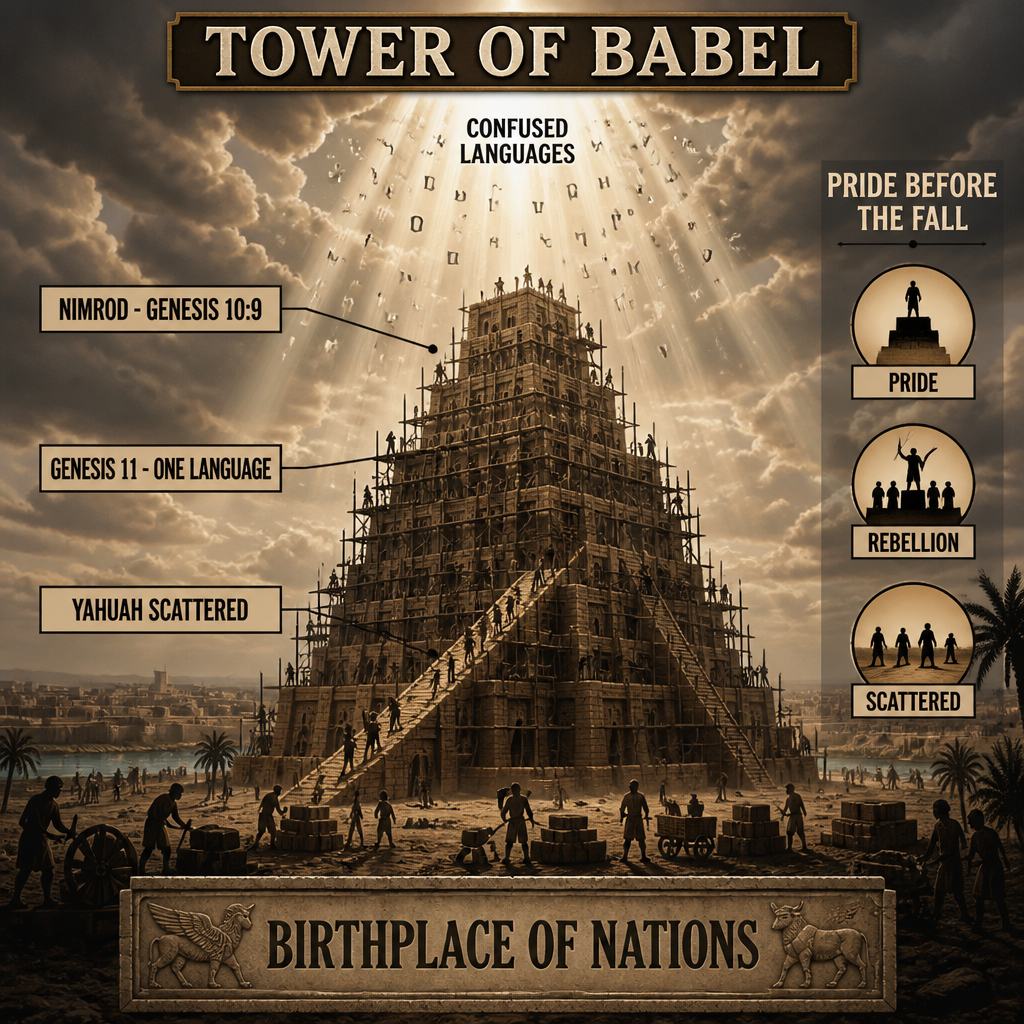
After the Flood, Yahuah commanded Noah's descendants to "fill the earth" (Genesis 9:1). But instead, they gathered in the plain of Shinar (Mesopotamia) and decided to build a city and tower "with its top in the heavens" to make a name for themselves and avoid being scattered.

This was direct rebellion against Yahuah's command. The leader of this rebellion was likely Nimrod, described as "a mighty hunter before Yahuah" - a phrase suggesting opposition, not honor. Nimrod founded Babel (Babylon) and other cities.

Yahuah's Response

Yahuah confused their language, causing them to scatter across the earth - exactly what He had commanded. This explains why there are thousands of different languages and why all cultures have flood legends and similar ancient beliefs.

"Come, let Us go down and there confuse their language, so that they will not understand one another's speech. So Yahuah scattered them abroad from there over the face of the whole earth." (Genesis 11:7-8)

Language Families Today

Linguists group languages into families that trace back to common origins. The major language families may reflect the original groups formed at Babel. The sudden appearance of different language families in history supports the Babel account - languages didn't slowly evolve from grunts!

Trace the Migration: Using a world map, mark where Noah's Ark landed (Ararat region, modern Turkey), then Babel (southern Iraq). Draw arrows showing how people spread: Japheth's descendants north and west to Europe; Ham's descendants south to Africa and Canaan; Shem's descendants remaining in the Middle East.
REFLECT - Consider the Meaning

The Tower of Babel shows humanity's tendency toward rebellion and pride - trying to reach heaven on our own terms. But it also shows Yahuah's sovereignty. He easily scattered them with confusion of language. Today we see the same pride - mankind building systems (financial, political, religious) apart from Yahuah. End-times "Babylon" represents this same rebellious spirit.

RECALL - Remember the Facts
1 The Tower of Babel was built in the plain of Shinar.
2 Nimrod was the mighty hunter who founded Babel.
3 Yahuah confused their language to scatter them.
4 Yahuah had commanded them to fill the earth, but they refused.
REVIEW - Practice Questions
5 Why was building the tower an act of rebellion against Yahuah?
6 How does the existence of many language families support the Babel account?
RESPOND - Apply Your Knowledge
7 What parallels do you see between the Tower of Babel and modern society's attempts to build systems apart from Yahuah?

Lesson 4: Ancient Mesopotamia

RECEIVE - Learn the Truth

The Cradle of Civilization

Mesopotamia ("between the rivers" - Tigris and Euphrates) is where civilization began after the Flood. This is exactly where we'd expect based on the Bible - near where the Ark landed and where Babel was built.

The Sumerians

The earliest known civilization in Mesopotamia was Sumer (southern Iraq). The Sumerians developed:

  • Writing (cuneiform) - the earliest known writing system
  • The wheel and wheeled vehicles
  • Advanced mathematics (base-60 system - still used in our 60-minute hour)
  • Astronomy and calendars
  • Ziggurats (stepped temple towers - possibly inspired by Babel)

The Sumerian King List

Ancient Sumerian tablets record a list of kings - and remarkably, it mentions a great flood that divides history into "before the flood" and "after the flood." Pre-flood kings have impossibly long reigns (similar to Genesis long lifespans). This confirms the biblical account from a non-biblical source!

Abraham's Origins: Abraham came from Ur of the Chaldees - a Sumerian city. He would have been familiar with Mesopotamian culture, ziggurats, and idol worship. Yahuah called him OUT of this pagan culture to follow Him.
"Terah took Abram his son, and Lot... and they went out together from Ur of the Chaldeans in order to enter the land of Canaan." (Genesis 11:31) Abraham's journey began in Mesopotamia.
REFLECT - Consider the Meaning

Mainstream historians are puzzled by how civilization appeared "suddenly" in Mesopotamia with advanced technology. But this makes perfect sense biblically - Noah's family brought pre-Flood knowledge and quickly rebuilt civilization. Humans have always been intelligent, not primitive!

RECALL - Remember the Facts
1 Mesopotamia means "between the rivers."
2 The Sumerians developed the earliest known writing system.
3 Abraham came from Ur of the Chaldees.
4 The Sumerian King List mentions a great flood that divides history.
REVIEW - Practice Questions
5 Why does it make sense that civilization began in Mesopotamia according to the biblical account?
6 How does the Sumerian King List support the biblical account of the Flood?
RESPOND - Apply Your Knowledge
7 What can we learn from Abraham being called out of sophisticated but pagan Mesopotamia?

Lesson 5: Ancient Egypt

RECEIVE - Learn the Truth

Egypt in the Bible

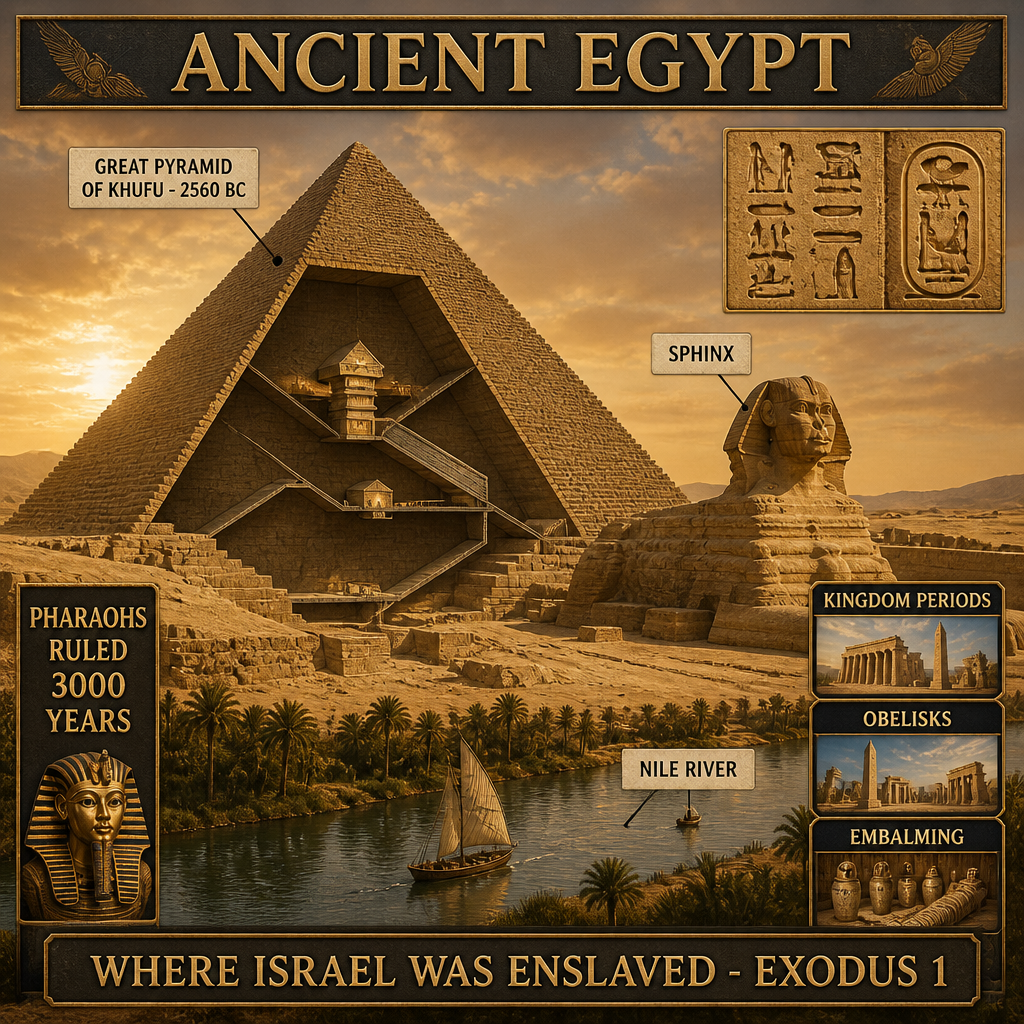
Egypt (Mizraim in Hebrew) was founded by descendants of Ham through Mizraim. Egypt appears throughout Scripture - Abraham visited during a famine, Joseph ruled there, Israel was enslaved and delivered through the Exodus.

Egyptian Achievements:

  • Pyramids - massive engineering achievements built early in Egyptian history
  • Hieroglyphic writing system
  • Advanced medicine and mummification
  • Mathematics and surveying
  • Complex government and record-keeping

When Were the Pyramids Built?

The Great Pyramid of Giza was built during the "Old Kingdom" period. In biblical chronology, this would have been within a few centuries after the Flood and Babel dispersion. This explains why the earliest pyramids are often the most impressive - the builders were closer to pre-Flood knowledge!

Pyramids were built around 2560 BC by primitive people who somehow had advanced engineering. There's no archaeological evidence for Israelites in Egypt or the Exodus.

Pyramids were built by intelligent post-Flood descendants of Ham. Evidence for Israel in Egypt exists but is often ignored or misdated. The Exodus occurred around 1446 BC.

Joseph in Egypt: Joseph rose from slave to second-in-command of Egypt. He oversaw 7 years of storing grain followed by 7 years of famine. This brought his family (70 people) to Egypt, where Israel would grow into a nation over 400 years.
"Now a new king arose over Egypt, who did not know Joseph. He said to his people, 'Behold, the people of the sons of Israel are more and mightier than we.'" (Exodus 1:8-9)
RECALL - Remember the Facts
1 Egypt was founded by descendants of Ham through Mizraim.
2 Joseph rose from slave to second-in-command of Egypt.
3 Israel grew from 70 people to a nation over 400 years in Egypt.
4 The Exodus occurred approximately 1446 BC.
REVIEW - Practice Questions
5 Why might the earliest pyramids be the most impressive according to the biblical model?
6 Why is the Exodus important in biblical history?
RESPOND - Apply Your Knowledge
7 How does Yahuah's deliverance of Israel from Egypt foreshadow Yahusha's deliverance of us from sin?

Lesson 6: The Patriarchs in History

RECEIVE - Learn the Truth

Real People in Real History

Abraham, Isaac, Jacob, and Joseph weren't mythological figures - they were real people living in a real historical context. Archaeology has confirmed many details of their stories.

Abraham's World (c. 2000-1900 BC):

  • Traveled from Ur to Haran to Canaan - real places that have been excavated
  • Made covenants and treaties in the legal style of that period
  • Encountered peoples like the Hittites - once thought mythical, now confirmed by archaeology
  • Purchased land with silver (Genesis 23) - matching economic practices of the period

Archaeological Confirmations:

  • The city of Ur has been excavated, showing advanced civilization
  • Customs in Genesis (adoption, inheritance, servant surrogacy) match Mesopotamian laws
  • The names Abraham, Isaac, and Jacob appear in ancient Near Eastern records
  • The "kings of the East" in Genesis 14 match known regional powers
"Now Yahuah said to Abram, 'Go forth from your country, and from your relatives, and from your father's house, to the land which I will show you; and I will make you a great nation.'" (Genesis 12:1-2)

The Patriarchal Promises:

Yahuah made covenant promises to Abraham that continue through history:

  • A great nation would come from him (Israel)
  • The land of Canaan would belong to his descendants
  • All nations would be blessed through his seed (fulfilled in Yahusha)
RECALL - Remember the Facts
1 Abraham traveled from Ur to Haran to Canaan.
2 The Hittites were once thought mythical but have been confirmed by archaeology.
3 The promise that all nations would be blessed through Abraham's seed was fulfilled in Yahusha.
REVIEW - Practice Questions
4 Give two examples of how archaeology has confirmed details in the patriarchal narratives:
5 What three promises did Yahuah make to Abraham?
RESPOND - Apply Your Knowledge
6 How does archaeological confirmation of biblical accounts strengthen your faith?

Lesson 7: Israel & Surrounding Nations

RECEIVE - Learn the Truth

Israel in the Promised Land

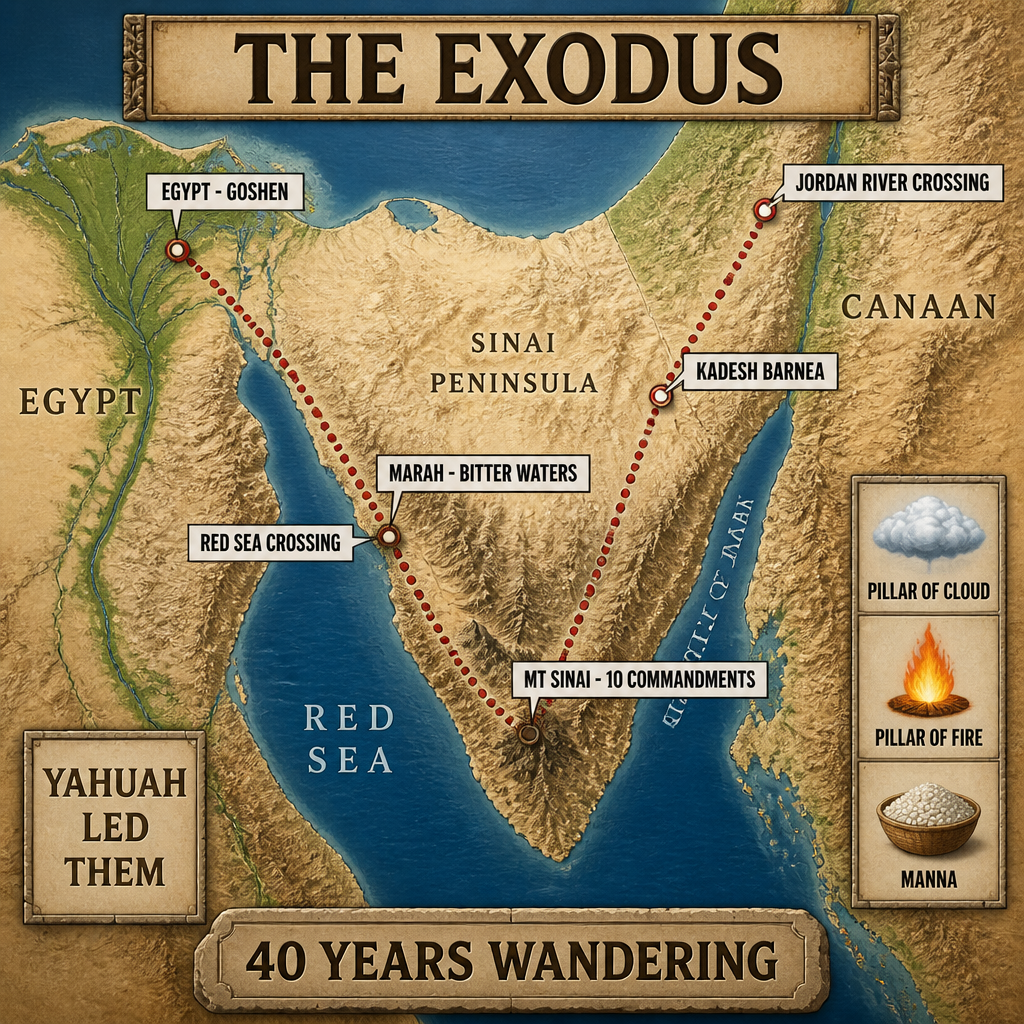
After the Exodus and 40 years in the wilderness, Israel conquered Canaan under Joshua. For the next 400+ years (Judges period), Israel lived among neighboring peoples, often falling into idolatry.

Key Surrounding Nations:

  • Canaanites - Descendants of Ham's son Canaan. Practiced child sacrifice and temple prostitution.
  • Philistines - Sea peoples who settled the coastal plain. Enemies of Israel (Goliath was a Philistine).
  • Moabites & Ammonites - Descended from Lot. East of the Jordan River.
  • Edomites - Descended from Esau. South of the Dead Sea.
  • Phoenicians - Coastal traders (Tyre, Sidon). Known for purple dye and sailing.
  • Arameans (Syria) - Northern neighbors, centered at Damascus.

The United Kingdom

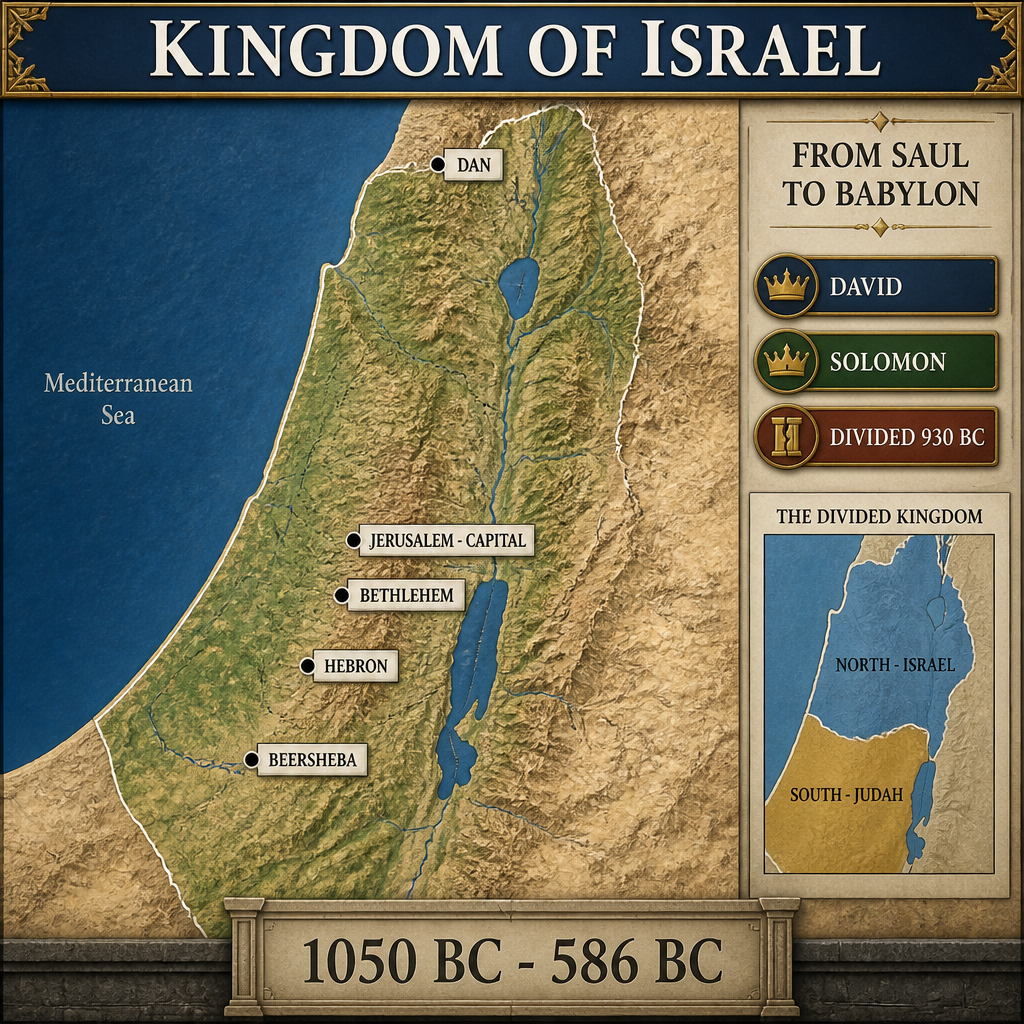
Israel became a kingdom under Saul, then David, then Solomon. David conquered Jerusalem and made it the capital. Solomon built the Temple. After Solomon, the kingdom divided into Israel (north) and Judah (south).

  • Saul - First king, c. 1050-1010 BC
  • David - United the kingdom, c. 1010-970 BC
  • Solomon - Built the Temple, c. 970-930 BC
  • Kingdom divides - 930 BC
"Now it came about in the four hundred and eightieth year after the sons of Israel came out of the land of Egypt, in the fourth year of Solomon's reign over Israel... that he began to build the house of Yahuah." (1 Kings 6:1)
RECALL - Remember the Facts
1 Israel conquered Canaan under Joshua.
2 The Philistines were enemies of Israel; Goliath was a Philistine.
3 David conquered Jerusalem and made it the capital.
4 Solomon built the Temple.
5 After Solomon, the kingdom divided into Israel (north) and Judah (south).
REVIEW - Practice Questions
6 Why did Yahuah command Israel to drive out the Canaanites?
7 Use 1 Kings 6:1 to calculate approximately when the Exodus occurred (Solomon's 4th year was about 966 BC).
RESPOND - Apply Your Knowledge
8 Israel often adopted the idolatry of surrounding nations. What warning does this hold for believers today?

Lesson 8: Assyria & Babylon

RECEIVE - Learn the Truth

The Assyrian Empire

Assyria was centered in northern Mesopotamia (modern Iraq). They built a fearsome empire known for military brutality. Yahuah used Assyria to punish the northern kingdom of Israel.

Key Events:

  • 722 BC - Assyria conquered Israel (northern kingdom), deporting the people. These became the "lost tribes."
  • 701 BC - Assyria attacked Judah; Yahuah miraculously saved Jerusalem under King Hezekiah (2 Kings 19).
  • 612 BC - Nineveh (Assyria's capital) fell, as prophesied by Nahum.

The Babylonian Empire

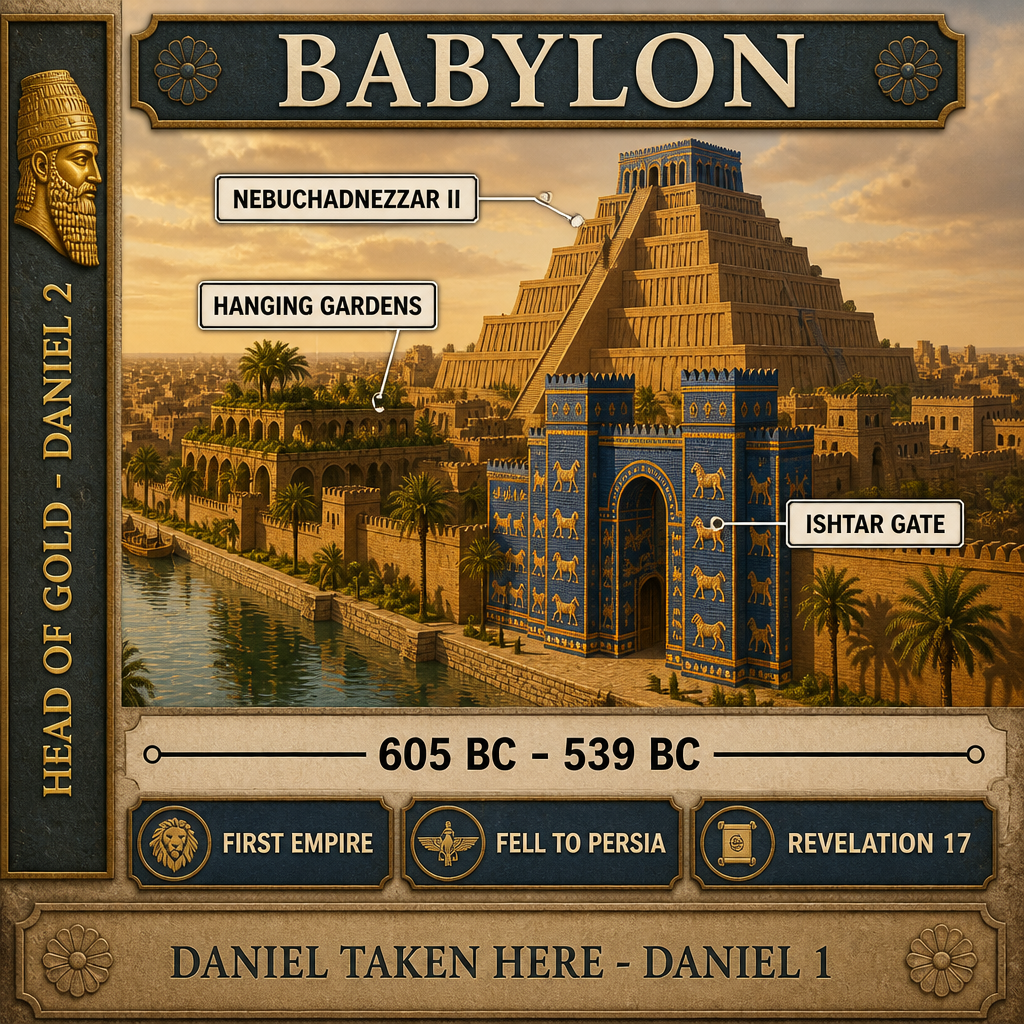
Babylon rose after Assyria's fall. Under Nebuchadnezzar II, Babylon became a world empire and conquered Judah.

  • 605 BC - First deportation (Daniel taken captive)
  • 597 BC - Second deportation (Ezekiel taken captive)
  • 586 BC - Jerusalem and Temple destroyed, major deportation
  • 539 BC - Babylon fell to Persia (Daniel 5 - handwriting on the wall)
Daniel in Babylon: Daniel served in the courts of both Babylon and Persia. His prophecies outline world history from Babylon through Rome to the end times. Nebuchadnezzar's dream (Daniel 2) shows successive empires: Babylon (gold), Medo-Persia (silver), Greece (bronze), Rome (iron).
"This is the interpretation, O king... You are the head of gold. After you there will arise another kingdom inferior to you, then another third kingdom of bronze... then there will be a fourth kingdom as strong as iron." (Daniel 2:36-40)
RECALL - Remember the Facts
1 Assyria conquered the northern kingdom of Israel in 722 BC.
2 Babylon destroyed Jerusalem and the Temple in 586 BC.
3 Daniel interpreted Nebuchadnezzar's dream about world empires.
4 Babylon fell to Persia in 539 BC.
REVIEW - Practice Questions
5 What are the four empires represented in Nebuchadnezzar's dream (Daniel 2)?
6 How did Yahuah use pagan empires like Assyria and Babylon to accomplish His purposes?
RESPOND - Apply Your Knowledge
7 Daniel remained faithful to Yahuah even in a pagan empire. What can we learn from his example?

Lesson 9: Persia & Greece

RECEIVE - Learn the Truth

The Persian Empire

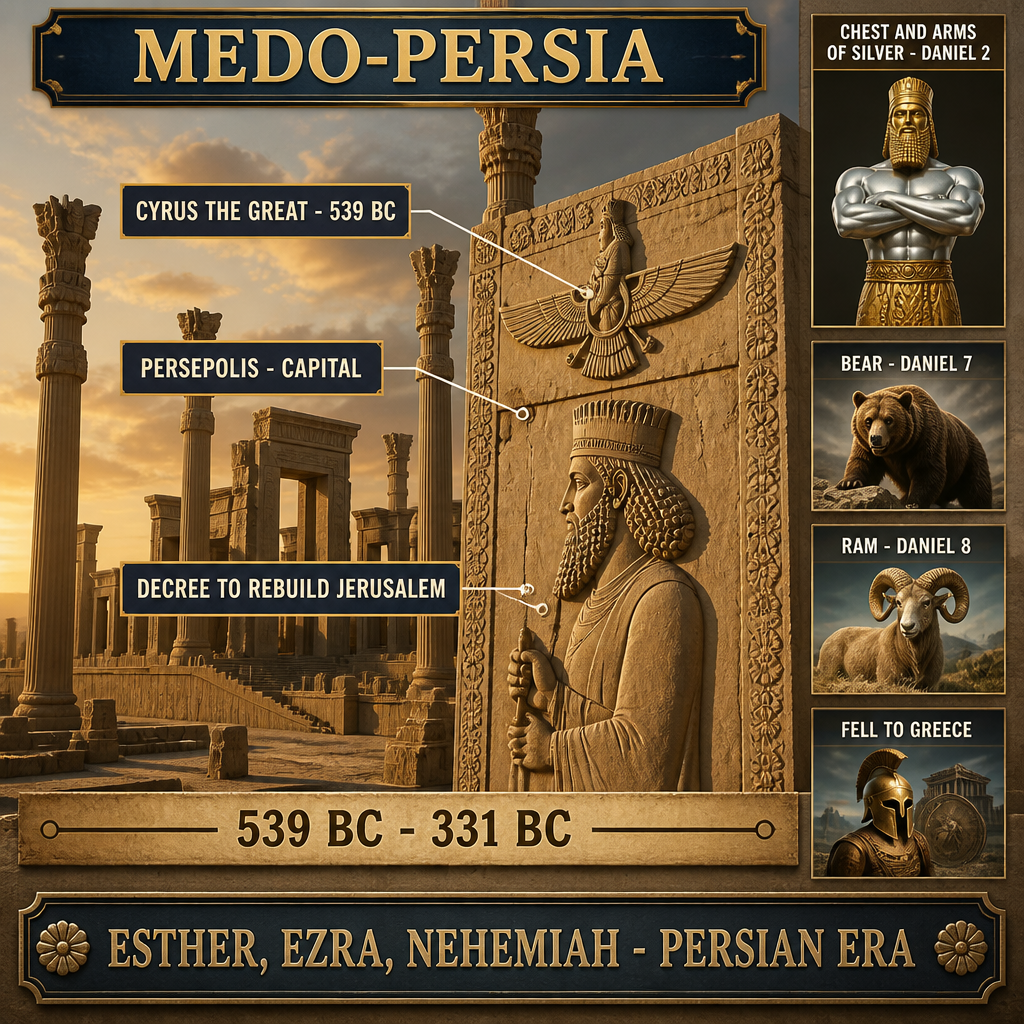
Persia (modern Iran) conquered Babylon in 539 BC. Persian kings allowed the Jews to return home and rebuild the Temple - fulfilling prophecy!

Key Persian Kings in Scripture:

  • Cyrus - Called by name in prophecy 150 years before his birth (Isaiah 44:28). He issued the decree to rebuild Jerusalem.
  • Darius I - The Temple was completed in his reign (516 BC).
  • Xerxes (Ahasuerus) - Husband of Esther. The Purim story occurred during his reign.
  • Artaxerxes - Sent Ezra and Nehemiah to restore Jerusalem.

The Greek Empire

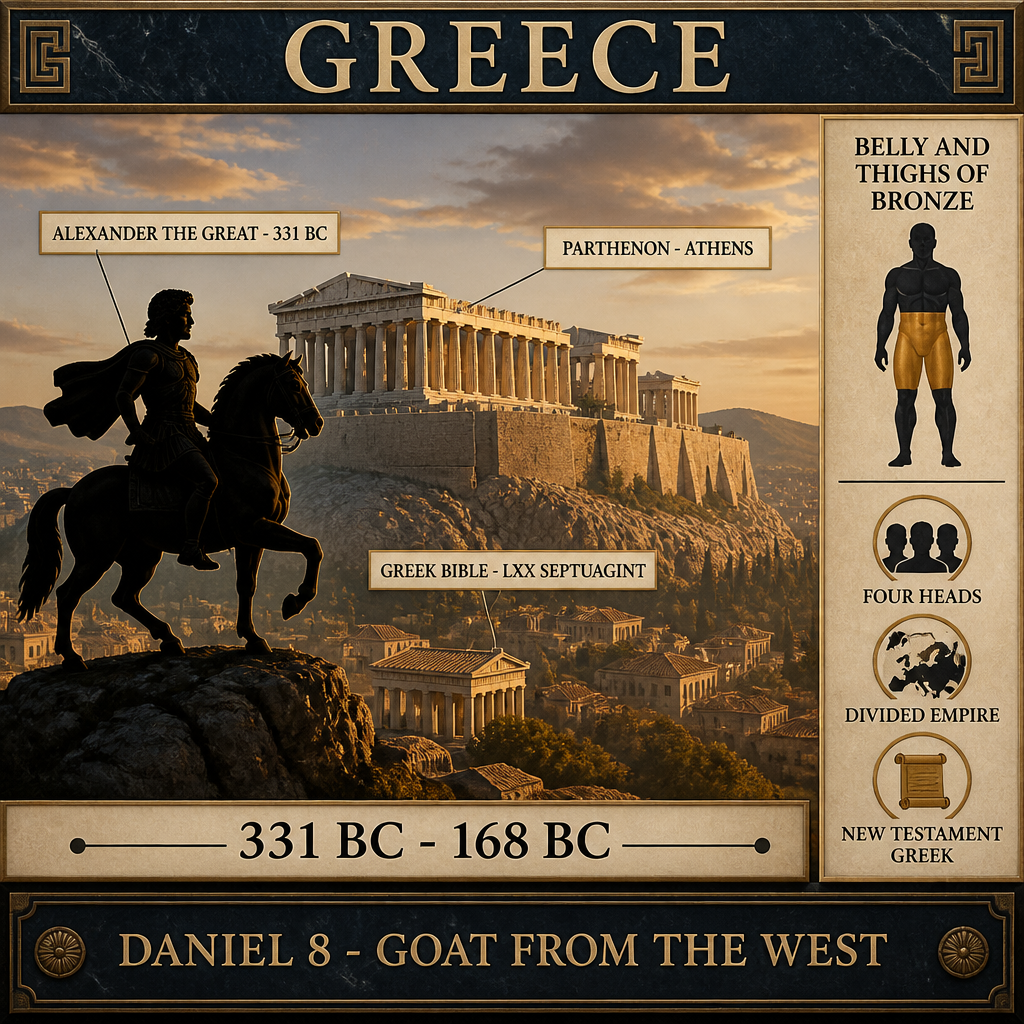
Alexander the Great conquered Persia (334-323 BC), creating an empire from Greece to India. Greek culture (Hellenism) spread everywhere. After Alexander's death, his empire divided among four generals.

Prophesied in Daniel:

  • The "male goat" (Greece) defeating the "ram" (Persia) - Daniel 8
  • The large horn (Alexander) breaking into four horns (four kingdoms) - Daniel 8:8
  • The "king of Greece" - Daniel 10:20

Impact on Israel:

Greek rule led to the Maccabean revolt when Antiochus Epiphanes desecrated the Temple (167 BC) - commemorated in Hanukkah. The Greek language became widespread, which is why the New Testament was written in Greek.

"Thus says Yahuah to Cyrus His anointed... 'I have also called you by your name; I have given you a title of honor though you have not known Me.'" (Isaiah 45:1,4) Yahuah called Cyrus by name 150 years before he was born!
RECALL - Remember the Facts
1 Cyrus issued the decree for Jews to return and rebuild Jerusalem.
2 The book of Esther took place during the reign of Xerxes.
3 Alexander the Great conquered Persia and spread Greek culture.
4 Antiochus Epiphanes desecrated the Temple, leading to the Maccabean revolt.
REVIEW - Practice Questions
5 How does Isaiah's prophecy about Cyrus (150 years early) demonstrate Yahuah's sovereignty?
6 How did Daniel 8 predict the Greek conquest of Persia?
RESPOND - Apply Your Knowledge
7 How does fulfilled prophecy strengthen our confidence in Scripture?

Lesson 10: Rome & the Messiah

RECEIVE - Learn the Truth

The Roman Empire

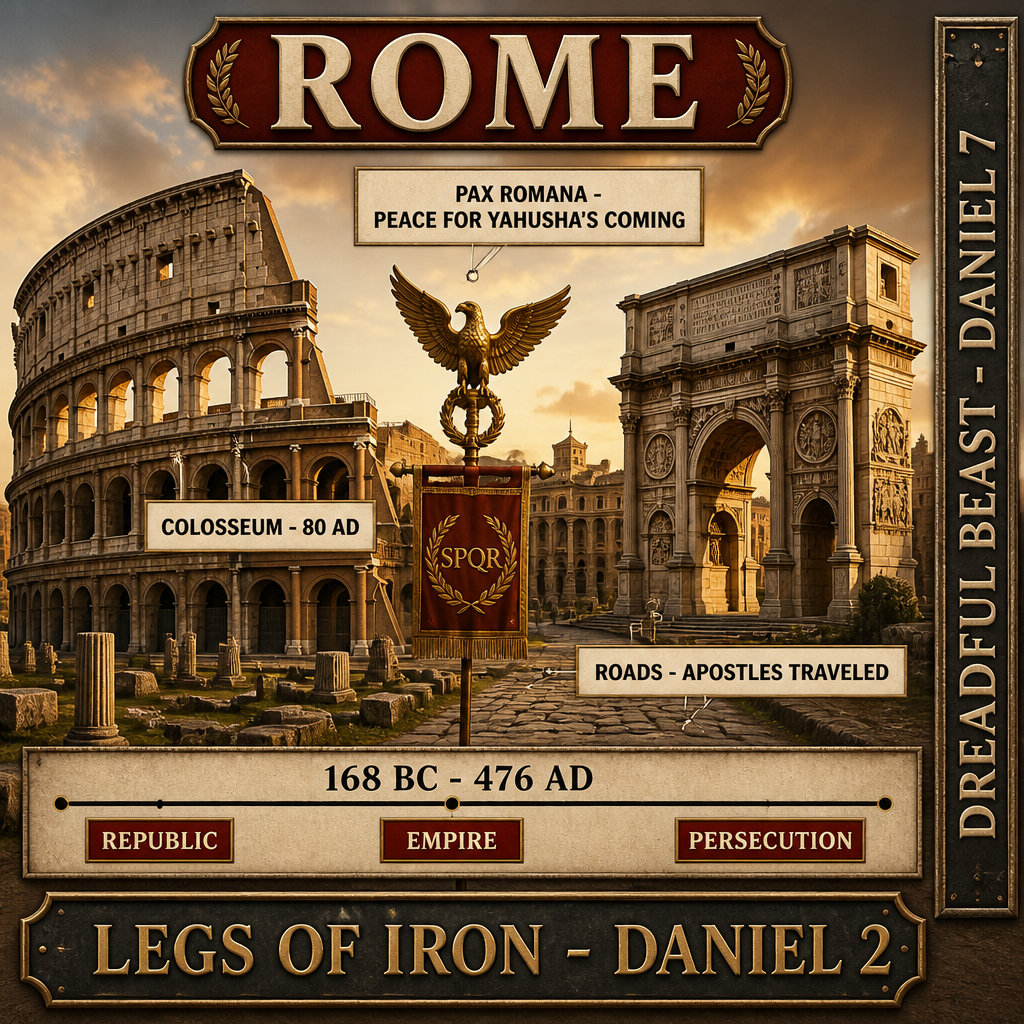
Rome conquered the Mediterranean world, including Israel (63 BC). Rome is the "iron" kingdom in Daniel's prophecy - strong, crushing, and long-lasting. The Roman Empire set the stage for the Messiah's arrival.

Pax Romana ("Roman Peace"):

Roman rule brought:

  • Roads connecting the empire - allowing gospel spread
  • Common language (Greek for culture, Latin for government)
  • Relative peace and stability
  • Safe travel for trade and message-spreading

The Fullness of Time

Yahusha was born during the reign of Caesar Augustus. "When the fullness of time came, Elohim sent forth His Son" (Galatians 4:4). Everything was prepared - prophecies, language, roads, peace - for the Gospel to spread.

Rome and Israel:

  • Herod the Great ruled Judea when Yahusha was born
  • Pontius Pilate was Roman governor when Yahusha was crucified
  • 70 AD - Rome destroyed Jerusalem and the Temple, as Yahusha prophesied
  • Jews scattered among the nations (diaspora)
"But when the fullness of the time came, Elohim sent forth His Son, born of a woman, born under the Law, so that He might redeem those who were under the Law." (Galatians 4:4-5)

The Stone That Crushes

In Daniel 2, a stone "cut without hands" strikes the statue and becomes a mountain filling the earth. This is Yahusha's kingdom - not made by human hands, destined to destroy all earthly kingdoms and reign forever.

RECALL - Remember the Facts
1 Rome is the iron kingdom in Daniel's prophecy.
2 Yahusha was born during the reign of Caesar Augustus.
3 Pontius Pilate was the Roman governor who sentenced Yahusha.
4 Rome destroyed Jerusalem in 70 AD.
5 The stone that destroys the statue in Daniel 2 represents Yahusha's/Messiah's kingdom.
REVIEW - Practice Questions
6 How did Roman roads, peace, and common language help spread the Gospel?
7 What did Yahusha prophesy about Jerusalem that was fulfilled in 70 AD?
RESPOND - Apply Your Knowledge
8 How does seeing all history leading to Yahusha affect your view of Yahuah's plan?
9 The stone kingdom will "fill the whole earth." How should this future reality affect how we live today?

Answer Key

For parent/teacher use.

Lesson 1: The Biblical Timeline

1. 6,000 | 2. 2348 | 3. 5, 11 | 4. Adam and Eve, Noah | 5. Based on evolutionary assumptions, not evidence | 6. All cultures have similar flood legends, suggesting shared memory of real event | 7. Answers vary - Scripture is reliable, evolutionary ages are assumptions

Lesson 2: The Post-Flood World

1. Shem, Ham, Japheth | 2. Shem | 3. Ham | 4. lower | 5. Warm oceans + volcanic ash = heavy snow = ice sheets | 6. Allowed migration to Americas, Australia, etc. | 7. Shows how all nations trace to Noah's family

Lesson 3: Tower of Babel

1. Shinar | 2. Nimrod | 3. language | 4. fill the earth | 5. They refused to scatter as commanded | 6. Languages appear suddenly in distinct families, not slowly evolving | 7. Answers vary - globalism, secular systems, etc.

Lesson 4: Ancient Mesopotamia

1. between the rivers | 2. Sumerians | 3. Ur of the Chaldees | 4. flood | 5. Near Ararat and Babel - where people started after Flood | 6. It mentions flood dividing history and long-lived pre-flood kings | 7. Answers vary - called to be separate, follow Yahuah

Lesson 5: Ancient Egypt

1. Ham, Mizraim | 2. Joseph | 3. 70, 400 | 4. 1446 | 5. Closer to pre-Flood knowledge; humans were always intelligent | 6. Birth of Israel as a nation, Yahuah's power over false gods | 7. Both involve deliverance from bondage through blood

Lesson 6: The Patriarchs

1. Ur, Haran, Canaan | 2. Hittites | 3. Yahusha | 4. Examples: Ur excavated, customs match laws, Hittites confirmed | 5. Great nation, land, blessing to all nations | 6. Answers vary

Lesson 7: Israel & Surrounding Nations

1. Joshua | 2. Goliath | 3. David | 4. Solomon | 5. Israel, Judah | 6. Their practices (child sacrifice, etc.) were abominations | 7. 966 + 480 = ~1446 BC | 8. Answers vary - don't adopt world's practices

Lesson 8: Assyria & Babylon

1. Assyria | 2. Babylon | 3. Daniel | 4. Persia | 5. Babylon (gold), Medo-Persia (silver), Greece (bronze), Rome (iron) | 6. As instruments of judgment, yet held accountable themselves | 7. Answers vary - faithfulness in difficult circumstances

Lesson 9: Persia & Greece

1. Cyrus | 2. Esther | 3. Alexander the Great | 4. Antiochus Epiphanes | 5. Shows Yahuah knows and controls the future | 6. Male goat defeating ram; large horn breaking into four | 7. Answers vary - Yahuah knows the future

Lesson 10: Rome & the Messiah

1. iron | 2. Caesar Augustus | 3. Pontius Pilate | 4. 70 | 5. Yahusha's/Messiah's | 6. Easy travel, common language, safety for missionaries | 7. Temple destroyed, not one stone on another | 8-9. Answers vary