In this workbook, you'll learn about ancient Greece, Rome, and the early church from two perspectives:
What Textbooks Teach (Mainstream View)
This is what most public schools and secular textbooks teach. You need to know this material for tests, but you should also understand what gets left out or distorted.
What Scripture Says (Biblical Truth)
This is how the Bible and biblical history illuminate these events. Scripture provides the TRUE framework for understanding all of history.
What Textbooks Miss or Distort
Here we examine what secular history often ignores or gets wrong - the hidden truths that change how we understand the past.
Hidden History Revealed
Documented facts that mainstream education often suppresses or ignores because they don't fit the secular narrative.
"Remember the former things of old: for I am El, and there is none else; I am Elohim, and there is none like Me, declaring the end from the beginning." - Isaiah 46:9-10
1Ancient Greece - Birthplace of Western Civilization
Civilization: An advanced society with cities, government, writing, and organized religion.
What Textbooks Teach
Ancient Greece (800-146 BC) is called the "cradle of Western civilization." Textbooks emphasize:
Democracy: Athens invented democracy - rule by the people
Philosophy: Greek thinkers like Socrates, Plato, and Aristotle shaped Western thought
Science: Greeks pioneered mathematics, astronomy, and medicine
Art: Greek architecture, sculpture, and theater influence us today
Olympics: Started in 776 BC to honor their gods
What Scripture Says
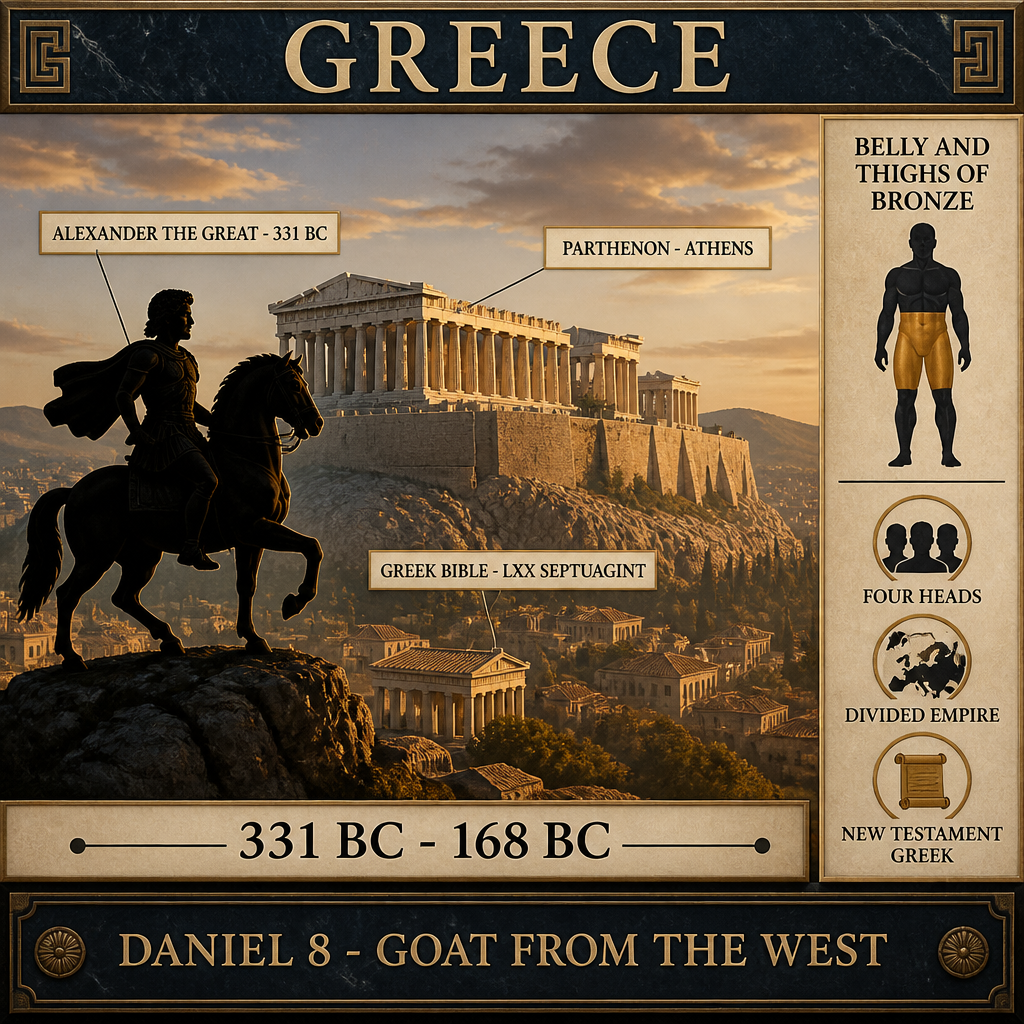
Greece appears in Bible prophecy! Daniel called it the "kingdom of bronze" (Daniel 2:39) and saw a "male goat" representing Greece (Daniel 8:21). The prophet wrote this over 200 years before Alexander the Great fulfilled these prophecies!
Greece is mentioned in the Table of Nations as "Javan" (Genesis 10:2) - son of Japheth
Greek became the language the New Testament was written in
Yahuah used Greek culture to prepare the world for the Gospel
What Textbooks Miss
Greek religion was demonic: Greeks worshiped false gods (Zeus, Apollo, Athena) - really demons deceiving people
Democracy had limits: Only free adult males could vote - women, slaves, and foreigners couldn't
Greek morality was corrupt: Many practices celebrated by Greeks would be considered highly immoral today
Philosophy had problems: Greek philosophers denied the Creator and promoted ideas contrary to Scripture
Key City-States
Athens: Known for democracy, philosophy, and art. But also pagan temples and immoral practices.
Sparta: Military state where boys were taken from families at age 7 to train as soldiers. Cruel practices were common.
"Beware lest any man spoil you through philosophy and vain deceit, after the tradition of men, after the rudiments of the world, and not after Messiah." - Colossians 2:8
Practice
1. What did Daniel call Greece in his prophecy?
2. In Greek "democracy," who could NOT vote? (Check all that apply)
3. Why should we be careful about Greek philosophy according to Colossians 2:8?
Family Discussion
2Greek Philosophy vs. Biblical Wisdom
Philosophy: From Greek "philosophia" meaning "love of wisdom." The study of fundamental questions about existence, knowledge, and ethics.
What Textbooks Teach
Greek philosophers are presented as the founders of rational thought:
Socrates (470-399 BC): Taught through questions; "Know thyself"
Plato (428-348 BC): Student of Socrates; taught about ideal forms and the immortal soul
Aristotle (384-322 BC): Student of Plato; taught logic, science, and politics
Textbooks claim Greek philosophy is the foundation of science and Western thought.
What Scripture Says
True wisdom doesn't come from human philosophy - it comes from Yahuah!
"The fear of Yahuah is the beginning of wisdom" (Proverbs 9:10)
"For the wisdom of this world is foolishness with Elohim" (1 Corinthians 3:19)
Greek philosophers rejected the knowledge of the true Creator
Paul encountered Greek philosophers in Athens (Acts 17) - some mocked him
Greek Philosophy
Biblical Wisdom
Man is the measure of all things
Yahuah is the measure of all things
Truth is discovered through human reason
Truth is revealed by Yahuah
The soul is naturally immortal
Only Yahuah has immortality (1 Timothy 6:16)
Many gods or impersonal forces
One Creator - Yahuah
Matter is eternal
Yahuah created everything from nothing
Dangerous Ideas from Greek Philosophy
Plato's "immortal soul": Led to false doctrine that the soul never dies - contradicts Scripture (Ezekiel 18:4)
Gnosticism: Mixed Greek ideas with Christianity - taught matter is evil and secret knowledge saves
Dualism: Separated "spiritual" from "physical" - contradicts Yahuah's creation of a good physical world
These Greek ideas corrupted early Christianity!
Hidden History: Where Did Greek Wisdom Come From?
Many Greek philosophers actually learned from MORE ANCIENT sources:
Plato traveled to Egypt and learned from their priests
Pythagoras learned mathematics in Babylon and Egypt
Some ideas may trace back to knowledge preserved from before the Flood
The original source of all true knowledge is Yahuah, who taught Adam
"Where is the wise? where is the scribe? where is the disputer of this world? has not Elohim made foolish the wisdom of this world?" - 1 Corinthians 1:20
Practice
1. According to Proverbs 9:10, what is the BEGINNING of wisdom?
2. Match the philosopher with their teaching:
___ Socrates A. Taught about ideal forms and immortal soul
___ Plato B. Taught through questions; "Know thyself"
___ Aristotle C. Taught logic and science
3. How did Greek philosophy corrupt early Christianity?
Family Discussion
3Alexander the Great and the Spread of Greek Culture
Hellenization: The spread of Greek language, culture, and ideas throughout the ancient world.
What Textbooks Teach
Alexander the Great (356-323 BC) conquered the Persian Empire in just 11 years
By age 30, he ruled from Greece to India - the largest empire yet
He spread Greek language and culture everywhere (Hellenization)
He founded over 70 cities, including Alexandria in Egypt
He died mysteriously at age 32; his empire was divided among his generals
What Scripture Says
Daniel prophesied about Alexander with stunning accuracy - 200 years before Alexander was born!
Daniel 8:5-8, 21: A male goat (Greece) with a prominent horn (Alexander) would defeat the ram (Persia)
Daniel 8:8: The large horn would be broken at the height of power - Alexander died suddenly at 32
Daniel 8:22: Four kingdoms would arise in its place - exactly what happened when Alexander's generals divided the empire
Daniel 11:3-4: A mighty king (Alexander) whose kingdom would be divided "toward the four winds"
Timeline: Alexander's Conquests
334 BCAlexander invades Persian Empire
333 BCDefeats Darius III at Issus
332 BCConquers Tyre and Egypt; founds Alexandria
331 BCFinal defeat of Persia at Gaugamela
326 BCReaches India; army refuses to go further
323 BCDies in Babylon at age 32
Hidden History: Alexander and the Jews
According to Jewish historian Josephus, when Alexander approached Jerusalem, the High Priest showed him the prophecies in Daniel about a Greek king conquering Persia. Alexander was amazed that he had been prophesied centuries earlier! He honored the Temple and the Jews.
The Problem with Greek Culture Spreading
Greek religion and idol worship spread everywhere
Greek theaters promoted immoral entertainment
Gymnasiums promoted Greek values that conflicted with Torah
Later, Greek rulers would persecute Jews who refused to abandon Yahuah
"And a mighty king shall stand up, that shall rule with great dominion, and do according to his will. And when he shall stand up, his kingdom shall be broken, and shall be divided toward the four winds of heaven." - Daniel 11:3-4
Practice
1. How old was Alexander when he died?
years old
2. According to Daniel 8, what animal represented Greece?
3. After Alexander died, how many kingdoms was his empire divided into?
4. Why is Daniel's prophecy about Alexander so remarkable?
Family Discussion
4The Rise of Rome
Republic: A government where citizens elect representatives to make decisions (from Latin "res publica" - public thing).
What Textbooks Teach
Rome began as a small city-state in Italy and grew to control the entire Mediterranean world:
753 BC: Legendary founding of Rome by Romulus and Remus
509 BC: Romans overthrew their king and established a Republic
264-146 BC: Punic Wars - Rome defeated Carthage and became dominant
146 BC: Rome conquered Greece
63 BC: Rome conquered Judea (the Jewish homeland)
27 BC: Republic became an Empire under Augustus Caesar
What Scripture Says
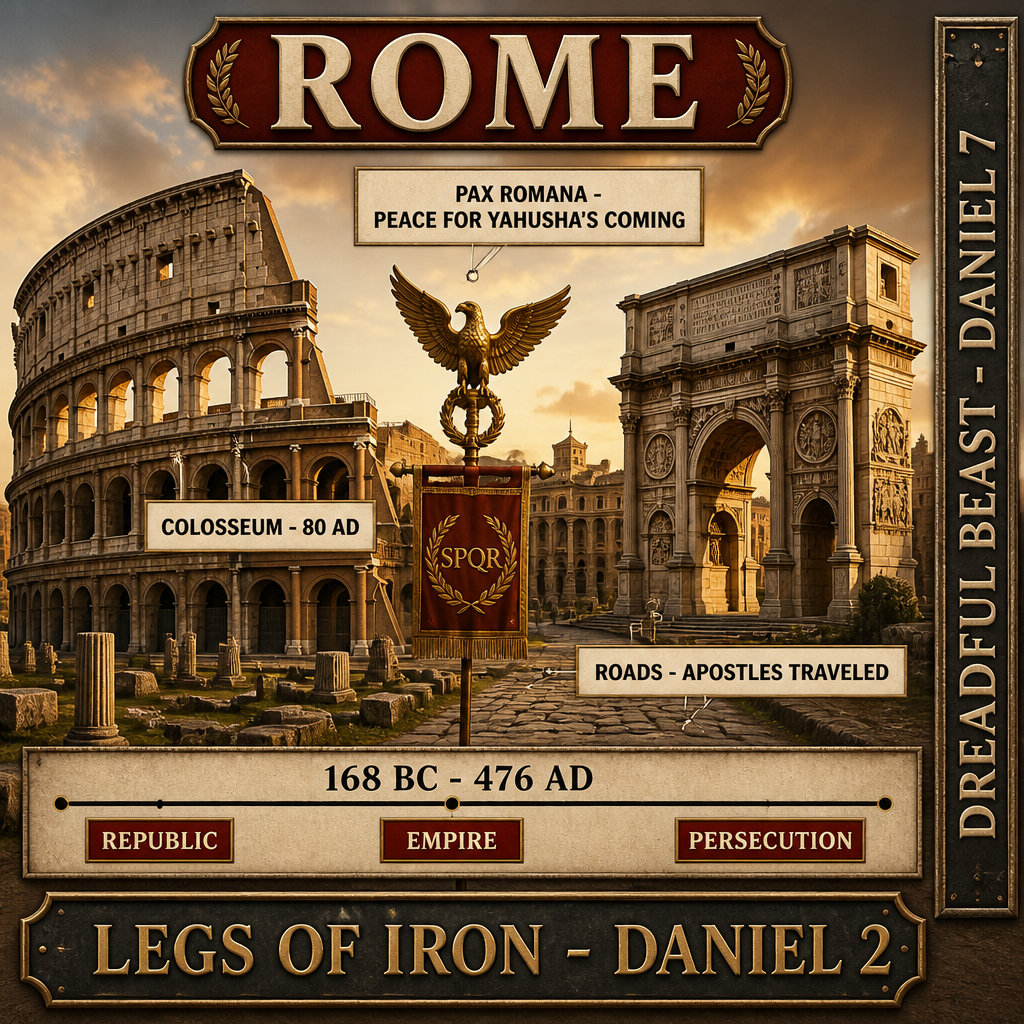
Rome is the fourth kingdom in Daniel's prophecies - represented by iron:
Daniel 2:40: "The fourth kingdom shall be strong as iron" - Rome crushed all opposition
Daniel 7:7: A terrifying beast with iron teeth that devoured and trampled
Rome ruled when Yahusha was born (Luke 2:1 - Caesar Augustus)
Rome crucified Yahusha (John 19:15-16)
Rome persecuted the early believers
The Roman Government
Senate: 300 wealthy men who made laws and controlled money
Consuls: Two leaders elected for one year each
Tribunes: Represented common people; could veto laws
Later - Emperors: One ruler with absolute power (starting with Augustus)
What Textbooks Miss About Rome
Brutal conquest: Rome killed and enslaved millions in its conquests
Slavery: 1/3 of Rome's population were slaves with no rights
Gladiator games: People were killed for entertainment
Pagan religion: Romans worshiped many false gods and later, the emperor himself
Persecution: Rome brutally persecuted followers of Yahusha
Hidden History: Rome and Israel
In 63 BC, Roman general Pompey conquered Jerusalem. When he forced his way into the Most Holy Place of the Temple (where only the High Priest could enter once a year), he found... nothing! This shocked the Romans who expected to find a statue of a god. This showed Yahuah is not like pagan gods.
Map Activity
On a map, locate the Roman Empire at its greatest extent. Find: Rome (capital), Jerusalem, Alexandria, Carthage, Athens, and the Mediterranean Sea.
"And in the days of these kings shall the Elohim of heaven set up a kingdom, which shall never be destroyed... it shall break in pieces and consume all these kingdoms." - Daniel 2:44
Practice
1. What metal represented Rome in Daniel's vision?
2. When did Rome conquer Judea (the Jewish homeland)?
BC
3. What type of government did Rome have before emperors?
4. Name two terrible things about Roman society:
Family Discussion
5The Roman Empire and Pax Romana
Pax Romana: Latin for "Roman Peace" - a 200-year period of relative stability in the Roman Empire (27 BC - 180 AD).
What Textbooks Teach
The Roman Empire is celebrated for its achievements:
Roads: 50,000 miles of paved roads connecting the empire
Aqueducts: Brought water to cities
Law: Roman law influenced modern legal systems
Language: Latin became the basis for French, Spanish, Italian
Engineering: Arches, domes, concrete - still admired today
What Scripture Says
Yahuah used the Roman Empire's infrastructure to spread the Gospel!
Roman roads: Paul and other apostles traveled on them to spread the Good News
Greek language: Common throughout the empire - the New Testament was written in Greek
Pax Romana: Relatively safe travel allowed missionaries to go everywhere
Galatians 4:4: Yahusha came "in the fullness of time" - the perfect moment in history
How Rome Prepared the World for Yahusha
Roman Contribution
How It Helped the Gospel
Road system
Missionaries could travel quickly and safely
Common language (Greek)
Everyone could understand the Scriptures
Peace (Pax Romana)
Travel was safer than any time in history
Jewish diaspora
Synagogues in every city were starting points for evangelism
Roman citizenship
Paul used his citizenship to appeal to Caesar (Acts 25:11)
The Dark Side of the Empire
Emperor worship: Citizens had to declare "Caesar is Lord" - believers refused and were killed
Persecution: Christians were thrown to lions, burned alive, and crucified
Immoral entertainment: Gladiator fights, executions as public spectacles
Herod's dynasty: Roman-appointed kings who killed Jewish babies (Matthew 2) and John the Baptist
Key Emperors
Augustus (27 BC - 14 AD): Ruled when Yahusha was born (Luke 2:1)
Tiberius (14-37 AD): Ruled during Yahusha's ministry and crucifixion
Nero (54-68 AD): First emperor to systematically persecute believers; blamed them for the Great Fire of Rome
Vespasian/Titus (69-81 AD): Destroyed Jerusalem and the Temple in 70 AD
"And it came to pass in those days, that there went out a decree from Caesar Augustus, that all the world should be taxed." - Luke 2:1
Practice
1. What does "Pax Romana" mean?
2. Which emperor ruled when Yahusha was born?
3. List THREE ways Rome helped spread the Gospel:
4. In what year was Jerusalem and the Temple destroyed?
AD
Family Discussion
6The Early Church
Church (Ekklesia): Greek word meaning "called out ones" - the community of believers in Yahusha.
What Textbooks Teach
Secular textbooks typically present Christianity as:
Just another religion that arose in the Roman Empire
Started by Jesus, a Jewish teacher, around 30 AD
Spread by his followers, especially Paul
Eventually became the official religion of Rome under Constantine (313 AD)
Similar to other "mystery religions" of the time
What Scripture Says
The church is not just another religion - it is Yahuah's plan from the beginning!
Acts 2: The church began at Pentecost with the outpouring of the Holy Spirit
Believers met daily, shared everything, and thousands were added (Acts 2:42-47)
The apostles taught Torah-observance AND faith in Yahusha (Acts 21:20-24)
The Gospel spread from Jerusalem to Judea, Samaria, and the ends of the earth (Acts 1:8)
Early believers were called "followers of the Way" (Acts 9:2)
What Most Don't Know About the Early Church
They kept Sabbath: Believers continued observing the seventh-day Sabbath (Acts 13:14, 42-44; Acts 18:4)
They kept the Feasts: Paul kept Passover and Pentecost (Acts 20:6, 16; 1 Corinthians 5:7-8)
They ate clean foods: Acts 15 addressed gentiles - no indication dietary laws were abandoned
They used Hebrew names: "Yahusha" not "Jesus" (which came later through Greek/Latin translation)
They were Jewish! For decades, most believers were Torah-observant Jews
Key Figures in the Early Church
Peter: Led the church in Jerusalem; opened door to Gentiles (Acts 10)
Paul: Apostle to the Gentiles; wrote 13 New Testament letters; traveled the Roman world
James: Brother of Yahusha; led the Jerusalem church; emphasized faith WITH works
John: Wrote Gospel, epistles, and Revelation; last surviving apostle
Common Misconceptions
False: Early Christians abandoned the Torah/Law
True: They taught that salvation is by faith, but faith produces obedience (James 2:17-26)
False: Sunday worship began with the apostles
True: Sabbath was kept until pressure from Roman anti-Jewish laws centuries later
False: Christianity and Judaism split immediately
True: The split happened gradually over centuries
"And they continued steadfastly in the apostles' doctrine and fellowship, and in breaking of bread, and in prayers... And Yahuah added to the church daily such as should be saved." - Acts 2:42, 47
Practice
1. What does "ekklesia" (church) mean?
2. Where did the church begin, and what happened there?
3. What were believers called before "Christians"?
4. According to Acts 2:42, what four things did early believers do?
Family Discussion
7Persecution and the Spread of the Faith
Persecution: Cruel treatment or harassment because of one's beliefs or identity.
What Textbooks Teach
Christians were persecuted by Rome because:
They refused to worship the Roman gods
They refused to call Caesar "Lord"
They were accused of atheism (denying Roman gods)
They were blamed for disasters (like Nero blaming them for the fire of Rome)
Their secret meetings seemed suspicious
What Scripture Says
Yahusha warned His followers that persecution would come:
"If they have persecuted Me, they will also persecute you" (John 15:20)
"In the world you shall have tribulation: but be of good cheer; I have overcome the world" (John 16:33)
"Blessed are they which are persecuted for righteousness' sake" (Matthew 5:10)
Persecution actually SPREAD the faith - when believers fled, they took the Gospel with them (Acts 8:1-4)
64-68 ADNero's persecution - Christians burned as torches
81-96 ADDomitian demands worship; John exiled to Patmos
249-251 ADDecius - Empire-wide persecution
303-311 ADGreat Persecution under Diocletian - the worst
Faithful Martyrs
Stephen: First martyr; saw heaven opened as he died (Acts 7)
James (son of Zebedee): Killed by Herod (Acts 12:2)
Peter: Tradition says crucified upside down in Rome
Paul: Tradition says beheaded in Rome under Nero
Polycarp (69-155 AD): Refused to deny Yahusha; burned at the stake at age 86
Hidden History: The Blood of Martyrs
The church father Tertullian wrote: "The blood of the martyrs is the seed of the church." The more Rome persecuted believers, the faster Christianity grew! People saw how believers died with courage and peace, and they wanted to know the source of such faith.
By 313 AD, despite 280 years of persecution, approximately 10% of the Roman Empire had become believers!
Lessons from Persecution
True faith cannot be destroyed by persecution
Many "Christians" abandoned their faith during persecution - showing their faith was superficial
Persecution separated true believers from nominal ones
The same pattern continues today - believers are persecuted in many countries
"And they overcame him by the blood of the Lamb, and by the word of their testimony; and they loved not their lives unto the death." - Revelation 12:11
Practice
1. Why did Rome persecute believers?
2. Who was the first Christian martyr?
3. What happened when believers were scattered by persecution? (See Acts 8:4)
4. What did Tertullian mean by "the blood of martyrs is the seed of the church"?
Family Discussion
8Constantine and Changes to the Church
Edict of Milan (313 AD): Constantine's decree making Christianity legal and ending persecution.
What Textbooks Teach
Constantine became emperor in 306 AD
Before the Battle of Milvian Bridge (312 AD), he reportedly saw a cross in the sky
He legalized Christianity with the Edict of Milan (313 AD)
He called the Council of Nicea (325 AD) to unify Christian doctrine
By 380 AD, Christianity became the OFFICIAL religion of the Roman Empire
Textbooks present this as Christianity's great triumph
What Scripture Says
Yahusha never sought political power, and He warned about wolves in sheep's clothing:
"My kingdom is not of this world" (John 18:36)
"Beware of false prophets, which come to you in sheep's clothing" (Matthew 7:15)
Paul warned: "Grievous wolves shall enter in among you, not sparing the flock" (Acts 20:29)
When the church married the state, major compromises followed
The REAL Story of Constantine's Changes
Constantine wasn't really converted: He was baptized only on his deathbed and continued many pagan practices
Sunday law (321 AD): Constantine commanded rest on "the venerable day of the Sun" (Sunday) - a pagan day. This began the shift away from Sabbath.
Easter replaced Passover: Council of Nicea separated Christian celebrations from Jewish calendar
Pagan symbols entered: Many "Christian" symbols and holidays came from Roman paganism
Anti-Jewish laws: Constantine passed laws separating Christianity from its Jewish roots
Hidden History: How the Church Changed
Early Church Practice
After Constantine
Sabbath (7th day)
Sunday (1st day)
Passover
Easter (with pagan elements)
Simple worship
Elaborate ceremonies from paganism
No clergy/laity division
Priests in special robes like pagan priests
Hebrew names (Yahuah, Yahusha)
Greek/Latin names (Lord, Jesus)
Torah-observant
"Law was abolished" teaching
Constantine's Anti-Jewish Statement
At the Council of Nicea, Constantine wrote: "Let us have nothing in common with the detestable Jewish crowd." This marked a tragic separation of Christianity from its Hebrew roots - the very foundation laid by Yahusha and the apostles!
What This Means for Us Today
Many church traditions we think are "Christian" actually came from:
Roman paganism
Constantine's political compromises
Later church councils that changed biblical practices
We must return to the faith "once delivered to the saints" (Jude 1:3) - the faith of Yahusha and the apostles, not the compromised version that developed later!
"Beloved, when I gave all diligence to write unto you of the common salvation, it was needful for me to write unto you, and exhort you that ye should earnestly contend for the faith which was once delivered unto the saints." - Jude 1:3
Practice
1. What did the Edict of Milan (313 AD) do?
2. What day did Constantine command people to rest on in 321 AD?
3. List THREE ways the church changed after Constantine:
4. According to Jude 1:3, what should we contend for?
Family Discussion
RReview: Greece, Rome & Early Church
Complete Timeline
800 BCGreek city-states develop
509 BCRoman Republic begins
334 BCAlexander conquers Persian Empire
63 BCRome conquers Judea
~4 BCYahusha born
30 ADYahusha crucified and resurrected
33 ADChurch begins at Pentecost
70 ADRome destroys Jerusalem
313 ADConstantine legalizes Christianity
380 ADChristianity becomes official Roman religion
Key Lessons
Prophecy proves the Bible: Daniel predicted Greece and Rome centuries before they arose
Yahuah controls history: He used pagan empires to prepare the world for Yahusha
Greek philosophy is dangerous: It corrupted the church with false ideas
Persecution spreads the faith: The church grew fastest when persecuted
Political power corrupts: When the church gained power, it compromised with paganism
We must return to truth: Many church traditions aren't biblical - we must follow Scripture
Final Review
1. Put these empires in order (Daniel 2): Persia, Rome, Greece, Babylon
3. Why is Daniel's prophecy about Greece remarkable?
4. What was wrong with Constantine's "conversion" of the empire?
Course Complete!
Answer Key (For Parents)
Lesson 1: Ancient Greece
YOUTH Hist Egypt Detail
1. Kingdom of bronze / male goat | 2. Women, Slaves, Foreigners | 3. It can lead us away from Messiah through vain deceit and human traditions
Lesson 2: Greek Philosophy
YOUTH Hist Babylon
1. The fear of Yahuah | 2. B, A, C | 3. Ideas like the immortal soul, Gnosticism, and dualism came from Greek philosophy and corrupted biblical teaching
Lesson 3: Alexander the Great
YOUTH Hist Persia
1. 32 years old | 2. A male goat | 3. Four kingdoms | 4. Daniel prophesied about Alexander over 200 years before he was born - only Yahuah could know the future
Lesson 4: Rise of Rome
YOUTH Hist Greece
1. Iron | 2. 63 BC | 3. Republic | 4. Any two: slavery, gladiator games, persecution, pagan worship, emperor worship, etc.
Lesson 5: Roman Empire
YOUTH Hist Rome
1. Roman Peace | 2. Augustus | 3. Roman roads, Greek language, Pax Romana, Jewish synagogues everywhere, Roman citizenship | 4. 70 AD
Lesson 6: Early Church
YOUTH Hist Israel Kingdom
1. Called out ones | 2. Jerusalem at Pentecost - the Holy Spirit was poured out | 3. Followers of the Way | 4. Apostles' doctrine, fellowship, breaking of bread, prayers
Lesson 7: Persecution
YOUTH Hist Exodus Route
1. They refused to worship Roman gods or call Caesar "Lord" | 2. Stephen | 3. They went everywhere preaching the word | 4. When believers were killed for their faith, it caused more people to believe - persecution caused growth
Lesson 8: Constantine
YOUTH Hist Babel Detail
1. Made Christianity legal, ended persecution | 2. Sunday | 3. Any three: Sabbath to Sunday, Passover to Easter, elaborate ceremonies, clergy class, name changes, Torah abandoned | 4. The faith once delivered to the saints
Review
1. Babylon, Persia, Greece, Rome | 2. B, A, D, C | 3. Written 200+ years before Alexander was born | 4. The church compromised with paganism, changed Sabbath to Sunday, added pagan practices, separated from Jewish roots