What Textbooks Teach (Mainstream View)
This is what most public schools and secular textbooks teach. You need to know this material for tests, but you should also understand what gets left out or distorted.
Early Modern History Through Two Lenses
Grades 6-7
Early modern period
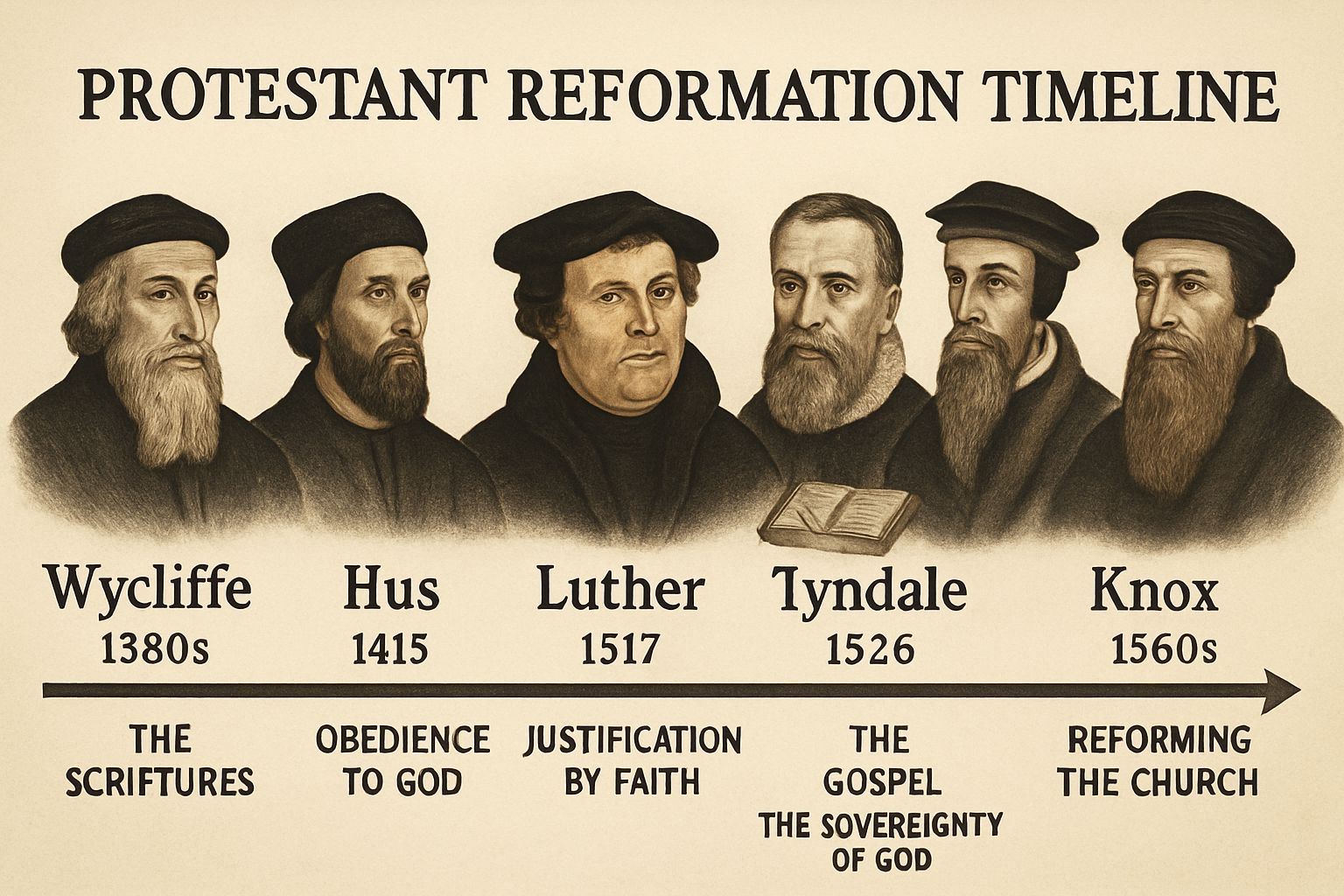
Reformation timeline
In this workbook, you'll learn about the colonial era and revolutions from two perspectives:
This is what most public schools and secular textbooks teach. You need to know this material for tests, but you should also understand what gets left out or distorted.
This is how the Bible and biblical principles illuminate these events. Scripture provides the TRUE framework for understanding all of history.
Here we examine what secular history often ignores or gets wrong - the hidden truths that change how we understand the past.
Documented facts that mainstream education often suppresses or ignores because they don't fit the secular narrative.
By the 1700s, Britain had established 13 colonies along the Atlantic coast, divided into three regions:
The founding of these colonies had mixed motivations. Some sought genuine religious freedom to worship Yahuah according to Scripture. The Pilgrims and Puritans wanted to create communities based on biblical principles.
However, others came primarily for wealth, and the Southern plantation economy was built on the sin of slavery. Yahuah's Torah strictly forbids man-stealing (Exodus 21:16).
The Sabbath Keepers: Among the colonists were Sabbath-keeping believers who continued observing the seventh day. Rhode Island's religious freedom allowed them to worship openly. Stephen Mumford established the first Sabbath-keeping congregation in Newport in 1671.
Pennsylvania's Experiment: William Penn's "Holy Experiment" genuinely sought to treat Native Americans fairly. He actually purchased land from the Lenape and maintained peace for decades - proof that biblical principles WORK when applied.
| Region | Economy | Religion | Hidden Issue |
|---|---|---|---|
| New England | Trade, fishing, shipbuilding | Puritan (Congregationalist) | Religious intolerance |
| Middle | Farming, trade | Diverse - Quakers, others | Profit from slave trade |
| Southern | Plantations (tobacco, rice) | Anglican (Church of England) | Built on slavery |
Read Leviticus 25:10. Why do you think this verse was chosen for the Liberty Bell? Did the colonies fully practice the liberty Yahuah commanded?
The transatlantic slave trade was a massive violation of Yahuah's law! The Torah explicitly says:
Enslaving Africans was MAN-STEALING - a death-penalty offense under Torah. The entire slave trade was condemned by Scripture from the beginning. Those who participated or profited were guilty of grievous sin.
Biblical "servitude" (temporary, with rights, ending at Jubilee) was completely different from chattel slavery (permanent, no rights, hereditary).
Early Abolitionists: The Germantown Quaker Petition of 1688 was the first organized protest against slavery in America. These German Quakers argued that slavery violated the Golden Rule (Matthew 7:12).
The Curse of Ham Lie: Slaveholders claimed Noah cursed Ham's descendants to be slaves. But read Genesis 9:25 carefully - CANAAN was cursed, not Ham or all Africans. This was deliberate Bible twisting to justify sin.
John Woolman: This Quaker traveled throughout the colonies in the 1740s-1770s convincing other Quakers to free their slaves. By 1776, Quakers had banned slaveholding among members.
| What Slaveholders Claimed | What the Bible Actually Says |
|---|---|
| Africans were "cursed" to be slaves | Canaan was cursed (Genesis 9:25), not Ham or all Africans |
| The Bible supports slavery | Man-stealing is punishable by death (Exodus 21:16) |
| Slaves weren't fully human | All humans are made in Elohim's image (Genesis 1:27) |
| Masters had absolute authority | Yahuah will judge those who oppress workers (James 5:4) |
Read Exodus 21:16 and James 5:1-6. What does Yahuah say about those who profit from exploiting workers? Why is it important to know that the Bible condemned slavery from the beginning?
This war was essentially about GREED - two empires fighting over land that belonged to neither of them. Native peoples were caught in the middle, used as pawns by both sides.
Yahuah's Torah established clear principles about land: it belongs to Him, and He assigns it to nations (Deuteronomy 32:8). European powers had no divine right to divide up America among themselves.
Washington's First Battle: Young George Washington's attack on French forces at Jumonville Glen (1754) may have started the war. A French diplomat was killed, possibly while trying to deliver a message. The French called it an assassination.
Germ Warfare: Letters from British commander Lord Amherst in 1763 discuss giving smallpox-infected blankets to Native Americans. This is one of the earliest documented proposals for biological warfare.
The Real Winners: Neither Britain nor France truly "won." Britain's victory led to debt, taxation, revolution, and loss of the colonies. France got revenge by helping America gain independence. Native peoples lost the most.
Read James 4:1-3. According to this passage, what causes wars? How did greed drive the French & Indian War?
The question of taxation and government authority is addressed in Scripture. Romans 13:1-7 teaches submission to governing authorities and paying taxes. However, there are limits - when government commands what God forbids or forbids what God commands, believers must obey God rather than men (Acts 5:29).
Were the colonists justified in rebellion? This was debated even among believers at the time. Some saw it as righteous resistance to tyranny; others saw it as disobedience to authority.
Propaganda Masters: Patriots like Samuel Adams were skilled at propaganda. The "Boston Massacre" was a street fight that patriots turned into a rallying cry. Paul Revere's famous engraving exaggerated the event.
Crispus Attucks: The first person killed in the Boston Massacre was Crispus Attucks, a man of African and Native American descent - possibly an escaped slave. His sacrifice for "liberty" highlights the contradiction of fighting for freedom while practicing slavery.
The Stamp Act & Freemasonry: Many revolutionary leaders were Freemasons. Some historians note that Masonic lodges provided organizing spaces and networks for the revolution.
Read Romans 13:1-7 and Acts 5:29. When is it right to submit to government? When might it be right to resist? Was the American Revolution justified according to Scripture?
"We hold these truths to be self-evident, that all men are created equal, that they are endowed by their Creator with certain unalienable Rights, that among these are Life, Liberty and the pursuit of Happiness."
The Declaration's claim that rights come from "the Creator" acknowledges Yahuah as the source of human rights - not government. This is a biblical principle! Yet the document's beautiful words were betrayed by the ugly reality of slavery.
If "all men are created equal," how could slavery continue? This contradiction haunted America from the beginning.
Lord Dunmore's Proclamation: In 1775, British Governor Dunmore offered freedom to enslaved people who escaped and joined the British. Thousands did! The British offered more freedom than the "Patriots."
Founding Fathers & Deism: Several founders (Franklin, Jefferson) were influenced by Deism - belief in a distant Creator who doesn't intervene in the world. This was different from biblical Christianity.
Freemasonry Connection: Many revolutionary leaders were Freemasons: Washington, Franklin, Hancock, and others. Masonic ideals influenced the new nation, for better or worse.
Role: Commander of Continental Army, later first President
Faith: Attended church but rarely discussed personal beliefs; some scholars debate whether he was Christian or Deist
Contradiction: Fought for liberty while owning 300+ enslaved people; freed them only in his will after death
Read the quote from the Declaration of Independence above. How do these words reflect biblical principles? How did slavery contradict these principles?
Unlike the American Revolution (which at least claimed religious foundation), the French Revolution was explicitly anti-religious. The revolutionaries:
When humans reject Yahuah and make themselves the ultimate authority, chaos and violence follow.
Papal Captivity: In 1798, French forces captured Pope Pius VI and imprisoned him - he died in captivity. Some Bible students see this as fulfillment of Revelation 13:3 ("deadly wound").
Edmund Burke's Prophecy: British statesman Burke predicted in 1790 that the French Revolution would lead to tyranny and war. He was mocked but proved exactly right.
Illuminati Connection: The Bavarian Illuminati, a secret society founded in 1776, may have influenced some revolutionary leaders. Documents seized in 1786 revealed plans to overthrow governments and religions.
| American Revolution | French Revolution |
|---|---|
| Claimed divine foundation ("Creator") | Rejected God; worshiped "Reason" |
| Limited violence; constitutional government | Reign of Terror; mass executions |
| Established stable republic | Led to Napoleon's dictatorship |
| Protected religious practice (mostly) | Destroyed churches, killed priests |
Compare the outcomes of the American and French revolutions. What happens when a society tries to build a new order without Yahuah? Read Psalm 127:1.
Some founders studied the Hebrew republic described in Scripture. The separation of powers may have been influenced by Isaiah 33:22: "For Yahuah is our Judge [Judicial], Yahuah is our Lawgiver [Legislative], Yahuah is our King [Executive]."
The Bill of Rights protects important freedoms like religion, speech, and assembly. Yet the Constitution also protected slavery through the 3/5 clause - counting enslaved people as 3/5 of a person for representation while denying them rights.
No Christian Requirements: Article VI prohibits religious tests for office - the first nation to do so. This protected religious liberty but also opened government to non-believers.
Iroquois Influence: Some scholars argue the Iroquois Confederacy's democratic structure influenced the Constitution. The founders knew about native governments.
Shays' Rebellion: This 1786-87 farmer uprising scared elites into creating stronger government - to protect property owners from rebellions by the poor.
"Congress shall make no law respecting an establishment of religion, or prohibiting the free exercise thereof; or abridging the freedom of speech, or of the press; or the right of the people peaceably to assemble, and to petition the Government for a redress of grievances."
Read the First Amendment above. Why is religious freedom important? How does it allow believers to worship Yahuah according to Scripture?
What was the most important thing you learned in this workbook? How can understanding the true history of the founding era help us be better followers of Yahusha today?