Welcome, Truth Seeker!
This workbook covers the full story of America from its earliest inhabitants to modern times. You'll learn what standard textbooks teach, but you'll also discover hidden truths that most schools don't share. We'll examine American history through the lens of Scripture and see how Yahuah's hand has moved throughout this nation's story.
How to Use This Workbook: Read each section carefully, complete the fill-in-the-blank exercises, and discuss the questions with your family. Always test what you learn against Scripture!
Note: Your progress is automatically saved in your browser. Print this page to keep a physical copy of your work.
Acts 17:26-27 - "And hath made of one blood all nations of men for to dwell on all the face of the earth, and hath determined the times before appointed, and the bounds of their habitation; That they should seek Yahuah..."
Before European exploration, millions of people lived across North and South America. Understanding their history and where they came from is essential to understanding American history.
What Textbooks Teach
Standard textbooks say Native Americans descended from Asian peoples who crossed a "land bridge" (Beringia) from Siberia to Alaska during the last Ice Age, approximately 12,000-15,000 years ago. They developed diverse cultures and civilizations over thousands of years, including the mound builders, cliff dwellers, and great confederacies like the Iroquois.
What Scripture Reveals
The Bible teaches that all humans descended from Noah's sons after the Flood (Genesis 9-10). Native Americans, like all peoples, trace back to this common ancestry. Some researchers suggest possible Hebrew or even Israelite connections based on certain cultural and linguistic similarities. The timeline is much shorter than secular claims - roughly 4,300 years rather than 15,000.
Hidden History
Evidence suggests ancient peoples from various civilizations may have visited or even settled in the Americas long before Columbus:
- Phoenician connections: Ancient inscriptions found in various locations
- Hebrew artifacts: The Los Lunas Decalogue Stone in New Mexico contains the Ten Commandments in ancient Hebrew script
- Giant remains: Newspaper accounts from the 1800s report discovery of giant skeletons in Native American mounds
- Advanced mound builders: Massive earthworks showing sophisticated engineering knowledge
Key Timeline
- ~2300 BC: Tower of Babel dispersion (Biblical dating)
- ~1000 BC: Possible Phoenician/Israelite voyages
- ~1000 AD: Norse (Viking) settlements in Newfoundland
- 1492: Columbus reaches the Caribbean
Family Discussion
- Why might schools want to promote the "land bridge" theory while ignoring evidence of other early explorers?
- How does understanding that all humans come from one blood (Acts 17:26) change how we view different peoples?
Proverbs 25:2 - "It is the glory of Elohim to conceal a thing: but the honour of kings is to search out a matter."
The "Age of Exploration" brought European powers to the Americas, forever changing the course of history for all peoples involved.
What Textbooks Teach
Columbus "discovered" America in 1492 while seeking a western route to Asia. Spain, Portugal, France, England, and the Netherlands competed to claim territories and resources. The Spanish conquered the Aztec and Inca empires. European diseases devastated Native populations. The Columbian Exchange brought new plants, animals, and ideas between hemispheres.
What Scripture Reveals
Columbus himself wrote in his journal that he believed he was fulfilling biblical prophecy and spreading Christianity. Many explorers saw their missions in spiritual terms - some sincerely, others hypocritically. We must evaluate their actions by Scripture: did they show love to their neighbors? Did they spread truth or use religion to justify sin?
Problems with the Mainstream View
- Columbus didn't "discover" anything - millions of people already lived there
- Textbooks often sanitize the brutality of the conquest
- The religious motivations of explorers are minimized in modern texts
- Evidence of pre-Columbian contact is typically ignored
Hidden History
Columbus's Private Writings: Columbus wrote extensively about wanting to fund a new Crusade to retake Jerusalem and believed he was living in the end times. His motivations were more complex than just "gold and glory."
The Spanish Requirement (Requerimiento): Before attacking, Spanish conquistadors were required to read a document demanding Native submission to the Pope and Spanish crown - often read in Spanish to people who didn't understand, or from shipboard before anyone could hear.
Key Figure: Bartolomé de las Casas
A Spanish priest who first participated in the conquest but then became one of the first advocates for Native rights. He documented Spanish atrocities in "A Short Account of the Destruction of the Indies" (1542). His writings show that even in that era, some Christians recognized the injustice being committed.
Family Discussion
- How should we evaluate historical figures who claimed to serve Yahuah but committed terrible acts?
- What lessons can we learn about not using faith to justify injustice?
Psalm 33:12 - "Blessed is the nation whose Elohim is Yahuah; and the people whom he hath chosen for his own inheritance."
The English colonies that eventually became the United States were founded for various reasons - some religious, some commercial. Understanding their diverse origins helps explain later American culture.
Colonial Foundations
- 1607: Jamestown, Virginia - Commercial venture (Virginia Company)
- 1620: Plymouth, Massachusetts - Pilgrims seeking religious freedom
- 1630: Massachusetts Bay - Puritans creating a "City on a Hill"
- 1634: Maryland - Haven for Catholics
- 1636: Rhode Island - Religious liberty (Roger Williams)
- 1681: Pennsylvania - Quaker colony (William Penn)
- 1733: Georgia - Buffer colony and debtor refuge
What Textbooks Teach
The colonies developed distinct regional characteristics: New England focused on shipping and trade; Middle colonies were diverse "breadbasket" regions; Southern colonies developed plantation agriculture dependent on enslaved labor. Colonial governments developed traditions of self-rule through assemblies like the Virginia House of Burgesses (1619).
What Scripture Reveals
Many colonists genuinely sought to build societies based on biblical principles. The Mayflower Compact (1620) explicitly stated they came "for the glory of God, and advancement of the Christian faith." However, we must honestly acknowledge that many also violated Scripture through:
- Enslaving fellow humans created in Yahuah's image
- Breaking treaties with Native peoples
- Religious persecution (even by those who came seeking freedom)
Primary Source: Mayflower Compact (1620)
"Having undertaken, for the Glory of God, and advancement of the Christian Faith, and Honour of our King and Country, a Voyage to plant the first Colony in the Northern Parts of Virginia, do by these presents solemnly and mutually in the presence of God, and one of another, covenant and combine ourselves together into a civil body politic..."
Hidden History
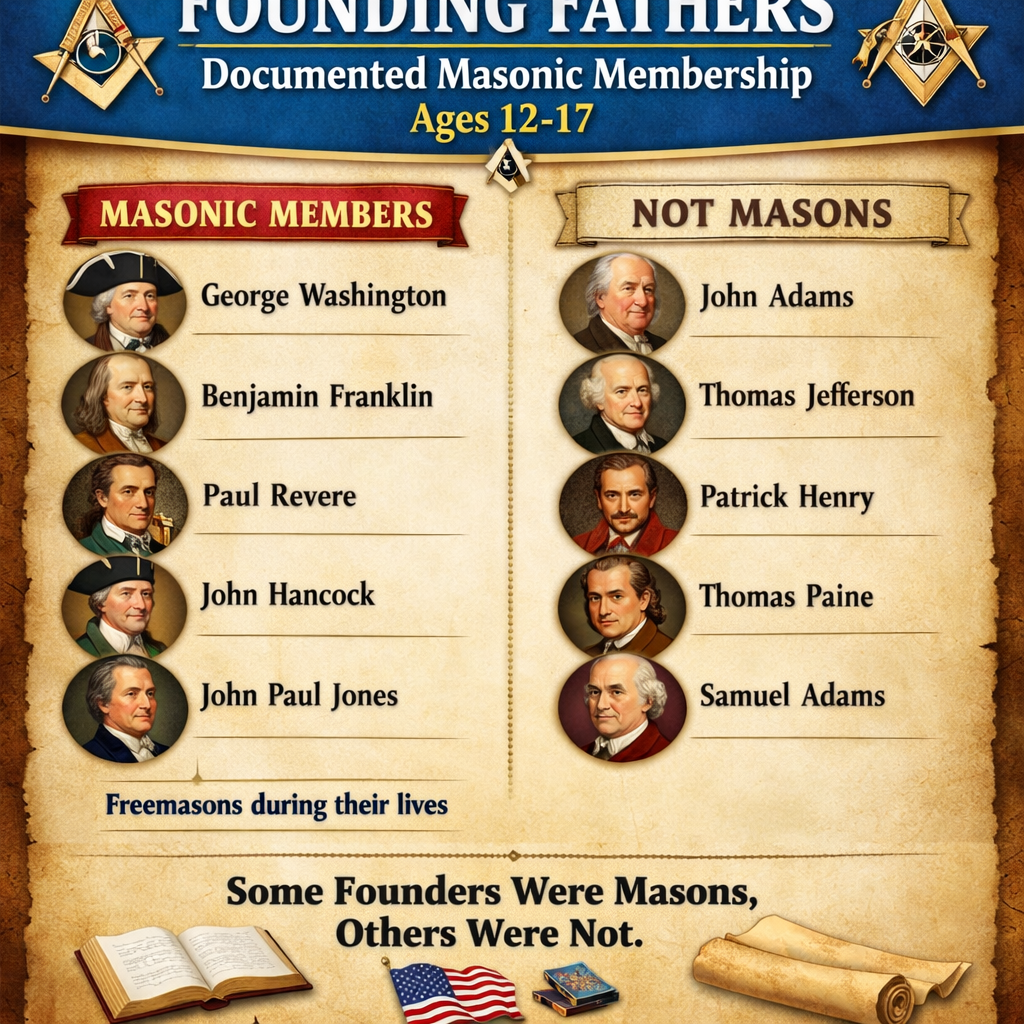
Freemasonry in Colonial America: By the 1730s, Masonic lodges were established throughout the colonies. Many colonial leaders were Freemasons, raising questions about competing influences on America's founding.
The Slavery Contradiction: By 1750, the colonies had about 240,000 enslaved Africans. This evil would become embedded in America's economic and political systems for generations.
Map Activity
On a blank map of the eastern United States, label:
- The 13 original colonies
- Mark which were New England, Middle, and Southern colonies
- Label major colonial cities: Boston, Philadelphia, Charleston, New York
Family Discussion
- How can people sincerely seek to follow Yahuah while still being blind to serious sins like slavery?
- What "blind spots" might our generation have that future generations will recognize?
Galatians 5:1 - "Stand fast therefore in the liberty wherewith Messiah hath made us free, and be not entangled again with the yoke of bondage."
The events leading to American independence involved complex questions about taxation, representation, liberty, and authority - questions that still matter today.
Key Events Leading to Revolution
- 1754-1763: French and Indian War - Britain gains Canada but huge debt
- 1765: Stamp Act - "No taxation without representation!"
- 1770: Boston Massacre - British soldiers kill 5 colonists
- 1773: Boston Tea Party - Protest against Tea Act
- 1774: Intolerable Acts - British punishment of Massachusetts
- 1775: Lexington and Concord - "Shot heard round the world"
- 1776: Declaration of Independence signed
What Textbooks Teach
After the French and Indian War, Britain needed revenue and believed colonists should help pay for their defense. Colonial protests against taxes like the Stamp Act were based on the principle that only their own elected representatives could tax them. Tensions escalated until armed conflict began at Lexington and Concord.
Questions to Consider
The question of whether the American Revolution was biblically justified is debated by Christians:
- Romans 13:1-7 teaches submission to governing authorities
- Acts 5:29 says "We ought to obey Elohim rather than men"
- Did Britain violate its own laws and the colonists' rights as Englishmen?
- Is there a difference between defensive resistance and offensive rebellion?
Thoughtful believers have reached different conclusions on this question.
Hidden History
Masonic Connections: Many Revolutionary leaders were Freemasons: George Washington, Benjamin Franklin, John Hancock, Paul Revere, and others. The Boston Tea Party was organized at the Green Dragon Tavern, known as the "Headquarters of the Revolution" - it was also home to a Masonic lodge.
Economic Factors: The Currency Act of 1764 prohibited colonies from issuing their own money, forcing them to borrow from British banks at interest. Benjamin Franklin said this was a major cause of the Revolution.
Primary Source: Patrick Henry (1775)
"Is life so dear, or peace so sweet, as to be purchased at the price of chains and slavery? Forbid it, Almighty God! I know not what course others may take; but as for me, give me liberty or give me death!"
Family Discussion
- When, if ever, is it right to resist government authority? What does Scripture say?
- Why might it matter that many Founding Fathers were Freemasons?
Isaiah 33:22 - "For Yahuah is our judge, Yahuah is our lawgiver, Yahuah is our king; he will save us."
After winning independence, the new nation had to decide how to govern itself. The Constitution they created has been the law of the land for over 230 years - but was it truly founded on biblical principles?
Birth of the Republic
- 1781: Articles of Confederation ratified (weak central government)
- 1787: Constitutional Convention in Philadelphia
- 1788: Constitution ratified by nine states
- 1789: George Washington becomes first President
- 1791: Bill of Rights (first 10 amendments) added
What Textbooks Teach
The Constitution established a federal republic with separation of powers (executive, legislative, judicial) and checks and balances. Key compromises included the Great Compromise (bicameral legislature) and the Three-Fifths Compromise (counting enslaved people for representation). The Bill of Rights protected individual liberties.
What Scripture Reveals
The separation of powers actually reflects Isaiah 33:22 - Yahuah is Judge (judicial), Lawgiver (legislative), and King (executive). However, the Constitution also:
- Never mentions Yahuah or Yahusha by name
- Established that there would be "no religious test" for office
- Protected slavery through multiple provisions
Was it a Christian document? Or did it reflect Enlightenment ideas mixed with some biblical principles?
Hidden History
The Convention's Secrecy: The Constitutional Convention met in secret. Delegates were sworn to secrecy, and the windows were nailed shut. We only know what happened because James Madison took detailed notes - but they weren't published until after his death in 1836.
Anti-Federalist Warnings: Opponents of the Constitution warned it gave too much power to the federal government and would eventually lead to tyranny. Many of their predictions have come true.
| Founder |
Religious Views |
Masonic Affiliation |
| George Washington |
Anglican/Deist elements |
Yes - Master Mason |
| Benjamin Franklin |
Deist |
Yes - Grand Master |
| John Adams |
Unitarian |
No |
| Thomas Jefferson |
Deist/created own "Bible" |
Unknown |
| Samuel Adams |
Calvinist Christian |
No |
Family Discussion
- Should a truly Christian nation have permitted slavery in its founding documents?
- Does it matter what the founders personally believed, or just what principles they wrote into law?
Proverbs 14:34 - "Righteousness exalteth a nation: but sin is a reproach to any people."
The young nation expanded rapidly westward, but the unresolved sin of slavery would eventually tear the nation apart in its bloodiest war.
Expansion and Conflict
- 1803: Louisiana Purchase doubles nation's size
- 1830: Indian Removal Act - Trail of Tears
- 1846-48: Mexican-American War
- 1850: Compromise of 1850 and Fugitive Slave Act
- 1860: Abraham Lincoln elected President
- 1861-65: Civil War - over 600,000 dead
- 1863: Emancipation Proclamation
- 1865: 13th Amendment abolishes slavery
What Textbooks Teach
"Manifest Destiny" was the belief that Americans were destined to expand across the continent. The Civil War was fought primarily over slavery and states' rights. The Union victory preserved the nation and ended slavery. Reconstruction attempted to rebuild the South and integrate formerly enslaved people into society.
What Scripture Reveals
The Bible clearly teaches that kidnapping people for slavery is a capital crime (Exodus 21:16). American chattel slavery was a gross violation of Scripture. The Civil War can be seen as divine judgment on a nation that allowed this evil to continue for so long. As Abraham Lincoln said in his Second Inaugural Address, perhaps the war was God's punishment until "every drop of blood drawn with the lash shall be paid by another drawn with the sword."
The Tragedy of "Manifest Destiny"
- Used to justify taking Native American lands
- Trail of Tears: Forced removal of Cherokee and other nations
- Broken treaties and massacres
- Was westward expansion Yahuah's will, or human greed wrapped in religious language?
Hidden History
Economic Motives for Civil War: While slavery was the central issue, there were also economic factors. Northern industrialists wanted protective tariffs; Southern planters wanted free trade. The war also consolidated banking power in the North.
Lincoln's True Views: Lincoln is often portrayed as simply fighting to free enslaved people, but his views were complex. He initially said he would preserve slavery where it existed if it would save the Union. The Emancipation Proclamation only freed enslaved people in rebel territories, not loyal border states.
Family Discussion
- How should we think about historical figures who had both admirable qualities and serious sins (like slaveholding)?
- What national sins today might bring judgment if not repented of?
1 Timothy 6:10 - "For the love of money is the root of all evil: which while some coveted after, they have erred from the faith, and pierced themselves through with many sorrows."
The late 1800s and early 1900s transformed America from an agricultural nation into an industrial powerhouse - and a world power through two devastating wars.
Industrial Age to World Wars
- 1870s-1900: "Gilded Age" - rapid industrialization
- 1913: Federal Reserve System created
- 1913: 16th Amendment - income tax
- 1914-18: World War I (US enters 1917)
- 1929: Stock market crash - Great Depression begins
- 1933: FDR's New Deal programs
- 1941-45: World War II (US enters after Pearl Harbor)
What Textbooks Teach
Industrialization brought progress but also problems: child labor, dangerous factories, monopolies. The Progressive Era brought reforms. The Federal Reserve was created to stabilize the economy. The US emerged from WWI as a world power and from WWII as a superpower. The New Deal helped end the Great Depression.
Hidden History: The Federal Reserve
The Federal Reserve was created in 1913 after a secret meeting on Jekyll Island, Georgia. Despite its name, it is not fully federal (it's a private banking system) and has no reserves. It gives private bankers the power to create money and charge the government interest on it. Many believe this transferred control of America's economy from the people to international banking interests.
Questions About the World Wars
- WWI: Was the sinking of the Lusitania (carrying ammunition) a setup to bring the US into war?
- Pearl Harbor: Did FDR know the attack was coming and allow it to happen?
- Both wars: Who benefited financially from these conflicts?
- Aftermath: Both wars led to expansion of government power and international organizations
Key Figure: The Rockefellers and Carnegies
Industrial titans like John D. Rockefeller (oil) and Andrew Carnegie (steel) accumulated vast wealth. They also funded foundations that shaped American education, medicine, and culture. The Rockefeller Foundation funded the General Education Board, which helped redesign American public schools. Are these foundations benevolent, or do they serve other agendas?
Family Discussion
- What does Scripture say about debt and borrowing? (See Proverbs 22:7)
- Should a nation's money supply be controlled by private bankers? What could go wrong?
Micah 6:8 - "He hath shewed thee, O man, what is good; and what doth Yahuah require of thee, but to do justly, and to love mercy, and to walk humbly with thy Elohim?"
After WWII, America faced a new rival in the Soviet Union while also confronting its own legacy of racial injustice at home.
Cold War and Civil Rights Era
- 1947: CIA and National Security Act
- 1950-53: Korean War
- 1954: Brown v. Board of Education ends school segregation
- 1955: Montgomery Bus Boycott
- 1963: JFK assassinated
- 1964: Civil Rights Act
- 1965-73: Vietnam War
- 1968: MLK Jr. and RFK assassinated
- 1969: Moon landing
What Textbooks Teach
The Cold War was an ideological battle between capitalism and communism. The US pursued "containment" of Soviet expansion. The Civil Rights Movement, led by figures like Martin Luther King Jr., used nonviolent protest to end segregation and secure voting rights for Black Americans.
What Scripture Reveals
The Civil Rights Movement drew heavily on biblical principles. MLK Jr. was a Baptist pastor who quoted Scripture extensively. The movement rightly recognized that racial discrimination violated the biblical truth that all humans are made in Yahuah's image. However, some argue the movement was later co-opted by forces with different agendas.
Hidden History
Operation Mockingbird: The CIA ran programs to infiltrate and influence major American media outlets from the 1950s onward. How much of what Americans believed about the Cold War came from genuine journalism versus government propaganda?
JFK Assassination: The official story (lone gunman Lee Harvey Oswald) has been questioned by many researchers. The Warren Commission's findings remain controversial. What did Kennedy know or threaten that made him a target?
COINTELPRO: The FBI ran secret programs to "disrupt" civil rights and other movements, including surveillance, infiltration, and disinformation.
Family Discussion
- What can we learn from how MLK Jr. used Scripture in the Civil Rights Movement?
- Why might powerful forces want to control what information people receive?
2 Timothy 3:1-5 - "This know also, that in the last days perilous times shall come. For men shall be lovers of their own selves, covetous, boasters, proud, blasphemers... Having a form of godliness, but denying the power thereof..."
Recent American history has seen dramatic technological change, cultural shifts, and events that continue to shape our world today.
Modern Era
- 1973: Roe v. Wade legalizes abortion
- 1974: Nixon resigns (Watergate)
- 1989: Berlin Wall falls; Cold War ends
- 1991: Gulf War
- 2001: September 11 attacks; "War on Terror" begins
- 2008: Financial crisis; Obama elected
- 2020: COVID-19 pandemic; lockdowns
What Textbooks Teach
America has faced challenges including Watergate, economic ups and downs, the end of the Cold War, terrorism, and a global pandemic. Technology has transformed daily life through computers, the internet, and smartphones. America remains the world's leading power.
Questions About Recent History
- 9/11: The official story has been questioned by architects, engineers, and researchers. Building 7 collapsed without being hit by a plane.
- Endless Wars: Afghanistan (20 years), Iraq (still ongoing) - who benefits from perpetual conflict?
- Surveillance State: Edward Snowden revealed mass surveillance of American citizens
- 2020: Unprecedented lockdowns and mandates - were they about health or control?
Hidden History
The Patriot Act: Passed just weeks after 9/11, this massive law was ready to go - almost as if it had been written beforehand. It dramatically expanded government surveillance powers.
Central Bank Digital Currency: Plans are underway to replace cash with programmable digital money that could be controlled, tracked, and even turned off for individuals. This sounds like the infrastructure for Revelation 13's "mark" system.
The Great Reset: World Economic Forum's plan to reshape society, economy, and governance. Their slogan: "You will own nothing and be happy."
What Scripture Reveals
Many believers see in current events the fulfillment of end-times prophecy:
- Global governance structures forming (UN, WEF, WHO)
- Technology enabling worldwide tracking and control
- Moral decline accelerating (2 Timothy 3)
- Deception increasing (Matthew 24:24)
We must be watchful but not fearful - Yahuah is in control!
Family Discussion
- How should believers respond to increasing government control and surveillance?
- What does Revelation 13 describe, and do we see any preparations for it today?
- How do we stay informed without becoming fearful or hopeless?
Hebrews 13:8 - "Yahusha Messiah the same yesterday, and to day, and for ever."
As we conclude our survey of American history, let's review what we've learned and reflect on how to apply biblical wisdom to our understanding of history.
Reflection Questions
Write a paragraph answering each question:
1. What is one thing about American history that you learned in this workbook that surprised you most?
2. How should understanding the "hidden history" of America affect how we live as followers of Yahusha today?
3. What patterns do you see repeating throughout American history?
Final Family Discussion
- What does it mean to be "in the world but not of it" (John 17:14-16) as American citizens?
- How do we honor what was good in American history while acknowledging its sins?
- What is our ultimate citizenship? (Philippians 3:20)
- How should we prepare for whatever the future holds?
Answer Key
For parent/teacher use
Lesson 1: America Before Columbus
- Asia (or Siberia)
- Noah
- Hebrew
- Norse (or Viking)
Lesson 2: European Exploration
- 1492
- Columbian
- Bartolomé de las Casas
- diseases
Lesson 3: The Thirteen Colonies
- Jamestown
- Plymouth
- Mayflower
- William Penn
- Burgesses
Lesson 4: Road to Revolution
- taxation
- Boston
- Lexington
- 1776
Lesson 5: Constitution and Early Republic
- Confederation
- Philadelphia
- Bill of Rights
- judicial
- George Washington
Lesson 6: Expansion and Civil War
- Louisiana
- Tears
- 1865
- 13th
- 600,000
Lesson 7: Industrial America and World Wars
- Reserve
- 16th
- Depression
- Harbor
- New
Lesson 8: Cold War and Civil Rights
- Korean
- Brown
- 1964
- Mockingbird
- 1969
Lesson 9: Modern America
- Watergate
- 1989
- 2001
- Patriot
- Snowden
Lesson 10: Review
Matching:
- 1776 - Declaration of Independence
- 1787 - Constitutional Convention
- 1865 - Civil War ends / 13th Amendment
- 1913 - Federal Reserve created
- 1941 - Pearl Harbor / US enters WWII
True/False:
- FALSE - Native Americans lived there; Vikings came earlier
- FALSE - Neither name appears in the Constitution
- TRUE
- TRUE
- TRUE
Congratulations!
You have completed the US History Survey workbook. Remember: history is not just about memorizing dates and events. It's about understanding how Yahuah works through human affairs, recognizing patterns of good and evil, and learning wisdom for our own times.
"Those who cannot remember the past are condemned to repeat it." - George Santayana
"The fear of Yahuah is the beginning of wisdom." - Proverbs 9:10