Mastering the Structure of Language
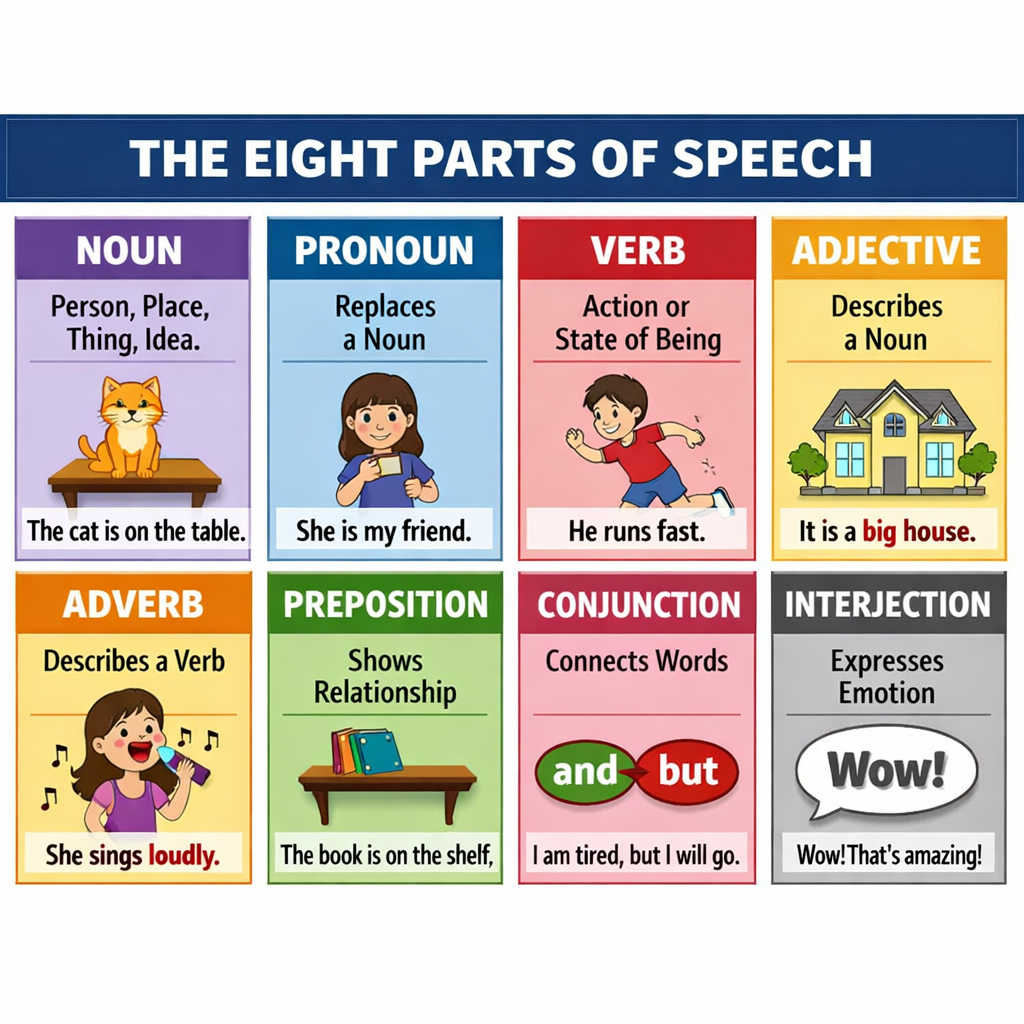
Mastering the Eight Parts of Speech
Before advancing to complex grammar, we must have complete mastery of the eight parts of speech.
| Part of Speech | Function | Example |
|---|---|---|
| Noun | Names a person, place, thing, or idea | Yahuah, Jerusalem, scroll, truth |
| Pronoun | Replaces a noun | He, she, it, they, who, which |
| Verb | Shows action or state of being | speaks, is, proclaim, believe |
| Adjective | Describes a noun | holy, ancient, righteous |
| Adverb | Describes verb, adjective, or adverb | quickly, very, faithfully |
| Preposition | Shows relationship | in, on, through, before, after |
| Conjunction | Connects words or groups | and, but, or, because, although |
| Interjection | Shows emotion | Oh! Alas! Behold! Halleluyah! |
"In (prep) the (adj) beginning (noun) Elohim (noun) created (verb) the (adj) heavens (noun) and (conj) the (adj) earth (noun)." - Genesis 1:1
Identify the part of speech for each underlined word:
1. Yahuah graciously forgives.
2. The ancient scrolls contain truth.
3. They studied diligently.
4. Walk through the narrow gate.
5. Truth and mercy have met together.
Verbals are verb forms used as other parts of speech. They look like verbs but function differently!
1. GERUND = verb + -ing, used as a NOUN
2. PARTICIPLE = verb form used as an ADJECTIVE
3. INFINITIVE = "to" + verb, used as noun, adjective, or adverb
Gerund vs. Present Participle: Both end in -ing!
"Swimming is healthy." (gerund - noun, subject)
"The swimming children laughed." (participle - adjective)
Test: Can you replace it with a noun? Then it's a gerund!
Identify each underlined verbal as Gerund, Participle, or Infinitive:
1. Fasting is a spiritual discipline.
2. The risen Messiah appeared.
3. We are called to serve others.
4. The singing congregation praised Yahuah.
5. To love Yahuah is the greatest command.
A phrase is a group of related words WITHOUT both a subject and a verb. Phrases add detail to sentences.
1. PREPOSITIONAL PHRASE = preposition + object (+ modifiers)
"In the beginning" / "through His grace" / "before the foundation of the world"
2. APPOSITIVE PHRASE = noun/pronoun that renames another noun
"Yahusha, the Messiah, healed the sick."
3. PARTICIPIAL PHRASE = participle + modifiers/complements
"Walking on the water, Peter kept his eyes on Yahusha."
4. GERUND PHRASE = gerund + modifiers/complements
"Keeping the Sabbath is a sign between Yahuah and His people."
5. INFINITIVE PHRASE = infinitive + modifiers/complements
"We strive to walk in righteousness daily."
Identify each underlined phrase type:
1. Blessed by Yahuah, Abraham became a great nation.
2. David, a man after Elohim's own heart, wrote many psalms.
3. Studying Torah daily transforms the mind.
4. The prophets spoke against the idols.
5. Their goal was to restore the kingdom.
A clause is a group of words WITH both a subject and a verb.
INDEPENDENT CLAUSE = Complete thought; can stand alone as a sentence
"Yahuah is faithful." ✓ Complete sentence
DEPENDENT (SUBORDINATE) CLAUSE = Incomplete thought; cannot stand alone
"Because Yahuah is faithful" ✗ Not complete - needs more!
"Because Yahuah is faithful, we can trust Him." ✓
1. ADJECTIVE CLAUSE - describes a noun (starts with who, whom, whose, which, that)
"The man who trusts in Yahuah is blessed."
2. ADVERB CLAUSE - describes verb (starts with when, while, because, if, although...)
"When you pray, enter your closet."
3. NOUN CLAUSE - functions as a noun (starts with that, what, who, whoever...)
"What Yahuah has joined let no man separate."
Identify as Independent (I) or Dependent (D):
1. Although many are called
2. Few are chosen
3. Whoever believes in Him
4. The truth sets us free
5. Because He first loved us
Identify the dependent clause type (Adjective, Adverb, Noun):
1. The prophet who spoke truth was rejected.
2. I believe that Yahusha is the Messiah.
3. When the Sabbath begins, we rest.
SIMPLE = One independent clause
"Yahuah created the heavens."
COMPOUND = Two+ independent clauses joined by coordinating conjunction (FANBOYS)
"Yahuah created the heavens, and He made the earth."
COMPLEX = One independent + one+ dependent clause
"When Yahuah spoke, creation obeyed."
COMPOUND-COMPLEX = Two+ independent + one+ dependent clause
"Although the darkness was great, Yahuah spoke, and light appeared."
| Type | Purpose | End Punctuation | Example |
|---|---|---|---|
| Declarative | Makes a statement | Period (.) | "Yahuah is One." |
| Interrogative | Asks a question | Question mark (?) | "Who is like Yahuah?" |
| Imperative | Gives a command | Period or ! | "Remember the Sabbath." |
| Exclamatory | Shows strong emotion | Exclamation (!) | "How great is our Elohim!" |
Identify structure (Simple, Compound, Complex, Compound-Complex):
1. The wise man built his house on the rock.
2. When the storm came, the house stood firm.
3. The foolish man built on sand, and his house fell.
4. Because he ignored wisdom, the house fell, and great was its destruction.
The subject and verb must agree in number (singular/plural). This gets tricky with certain constructions!
1. Phrases between subject and verb - Ignore them!
"The book of the prophets is on the shelf." (book is - singular)
2. Compound subjects with AND - Usually plural
"Torah and the Prophets testify of Messiah."
3. Compound subjects with OR/NOR - Verb agrees with nearer subject
"Neither the scribes nor the high priest was able to answer."
4. Indefinite pronouns
5. Collective nouns - Singular when acting as one unit
"The congregation worships together." (one group)
"The congregation are returning to their homes." (individuals)
Circle the correct verb:
1. Each of the disciples (was/were) called by name.
2. Neither the Pharisees nor Pilate (was/were) innocent.
3. The assembly of believers (meets/meet) on the Sabbath.
4. Everyone in the synagogues (hear/hears) the Torah read.
5. The scrolls of Isaiah (contains/contain) prophecies of Messiah.
| Case | Function | Pronouns |
|---|---|---|
| Subjective | Subject of verb | I, we, he, she, they, who |
| Objective | Object of verb/preposition | me, us, him, her, them, whom |
| Possessive | Shows ownership | my, our, his, her, their, whose |
Error 1: "Him and me went to synagogue." ✗
Correct: "He and I went to synagogue." ✓ (subjects)
Error 2: "Between you and I" ✗
Correct: "Between you and me" ✓ (objects of preposition)
Error 3: "Everyone should bring their Bible." ✗ (everyone is singular)
Correct: "Everyone should bring his or her Bible." ✓
Who vs. Whom:
"Who called you?" (subject - Who called?)
"Whom did you call?" (object - You called whom?)
Choose the correct pronoun:
1. (Who/Whom) did the prophet rebuke?
2. The letter was written to (we/us) believers.
3. (She/Her) and (I/me) studied the Torah together.
4. Each student must complete (his or her/their) assignment.
5. The prize was given to David and (I/me).
Modifiers must be placed close to the words they describe, or confusion results!
Error: "The prophet spoke to the people holding a scroll." (Who has the scroll?)
Clear: "Holding a scroll, the prophet spoke to the people."
Error: "I only read the Bible on Sabbath." (only = just read, not study?)
Clear: "I read the Bible only on Sabbath." (only on that day)
A modifier "dangles" when the word it should modify is missing!
Error: "Walking to the temple, the sun was bright." (The sun wasn't walking!)
Clear: "Walking to the temple, we noticed the sun was bright."
Error: "After studying all night, the test was easy."
Clear: "After studying all night, I found the test easy."
Rewrite to correct the modifier error:
1. Flying through the air, Moses saw the locusts.
2. The boy found the lost sheep walking through the hills.
3. After praying earnestly, the answer came.
Parallelism means using the same grammatical form for similar ideas. It creates rhythm and clarity.
Not parallel: "Mary loved reading, to pray, and worship." (gerund, infinitive, noun)
Parallel: "Mary loved reading, praying, and worshiping." (all gerunds)
Not parallel: "The Torah teaches us to love Yahuah, serving others, and honesty."
Parallel: "The Torah teaches us to love Yahuah, to serve others, and to practice honesty."
Rewrite to make parallel:
1. David was a shepherd, warrior, and he wrote psalms.
2. Believers should pray daily, fasting regularly, and to study Scripture.
Add correct punctuation:
1. Yahuah is our refuge and strength therefore we will not fear
2. The disciples included Peter James and John
3. When the Messiah returns every knee will bow
4. Remember this truth Yahuah never changes
| Word | Meaning | Example |
|---|---|---|
| affect (v) | to influence | "Sin affects everyone." |
| effect (n) | result | "The effect of grace is transformation." |
| its | possessive of it | "The temple lost its glory." |
| it's | it is / it has | "It's written in the Torah." |
| their | possessive (people) | "Their faith was strong." |
| there | location | "Yahuah was there." |
| they're | they are | "They're faithful servants." |
| than | comparison | "Greater than all" |
| then | time/sequence | "First faith, then works" |
| lie | to recline (no object) | "Lie down and rest." |
| lay | to put (needs object) | "Lay your burdens down." |
Choose the correct word:
1. The prophet's words had a powerful (affect/effect) on the people.
2. (Its/It's) important to study Scripture daily.
3. (Their/There/They're) going to the temple to worship.
4. Yahusha is greater (than/then) any earthly king.
5. (Lie/Lay) your Isaac on the altar.
Active: Subject does the action → "Yahuah created the world." (stronger)
Passive: Subject receives the action → "The world was created by Yahuah." (weaker)
Use active voice for stronger, clearer writing!
Write a paragraph (5-7 sentences) about why grammar matters for believers.
Include: at least one complex sentence, parallel structure, and active voice.
Unit 1: 1) adverb, 2) adjective, 3) pronoun, 4) preposition, 5) conjunction
Unit 2: 1) gerund, 2) participle, 3) infinitive, 4) participle, 5) infinitive
Unit 3: 1) participial, 2) appositive, 3) gerund, 4) prepositional, 5) infinitive
Unit 4: Clauses: 1) D, 2) I, 3) D, 4) I, 5) D | Types: 1) adjective, 2) noun, 3) adverb
Unit 5: 1) simple, 2) complex, 3) compound, 4) compound-complex
Unit 6: 1) was, 2) was, 3) meets, 4) hears, 5) contain
Unit 7: 1) Whom, 2) us, 3) She, I, 4) his or her, 5) me
Unit 11: 1) effect, 2) It's, 3) They're, 4) than, 5) Lay