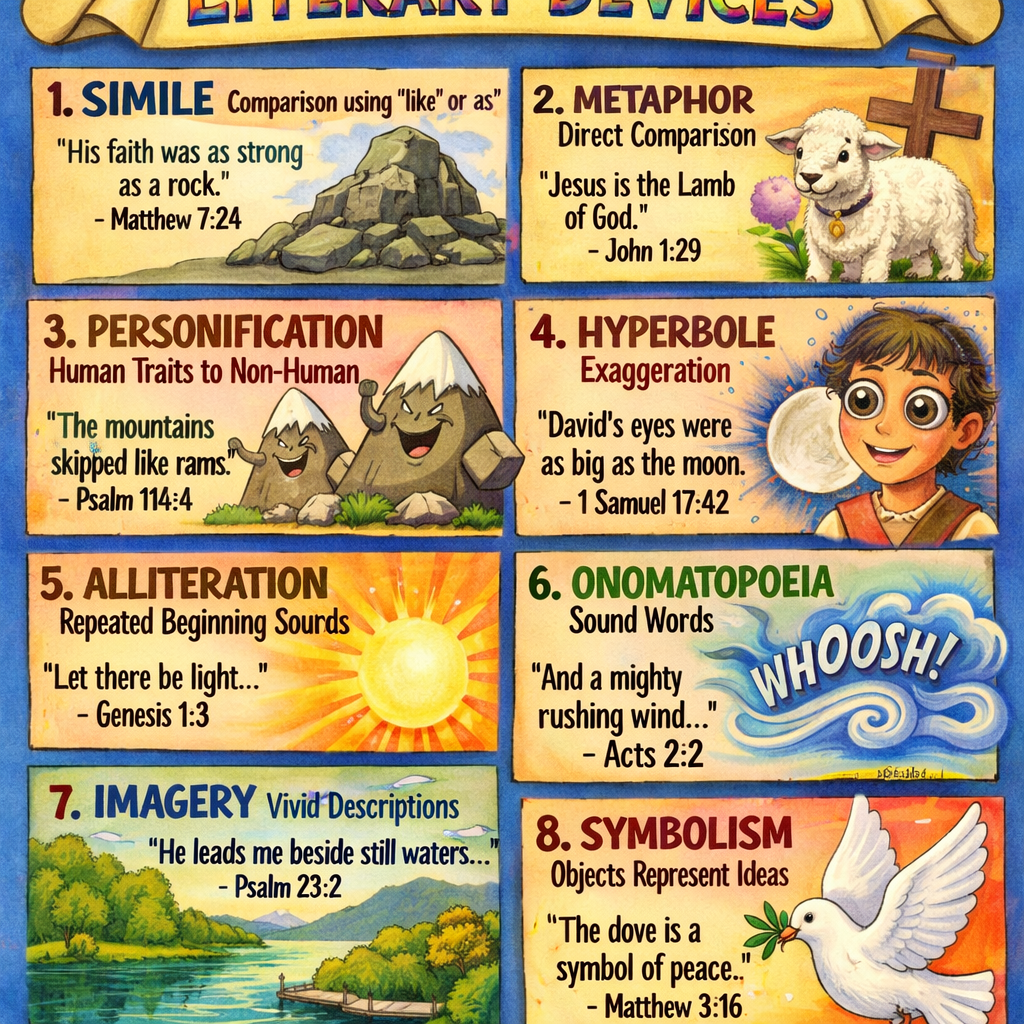
Literary devices
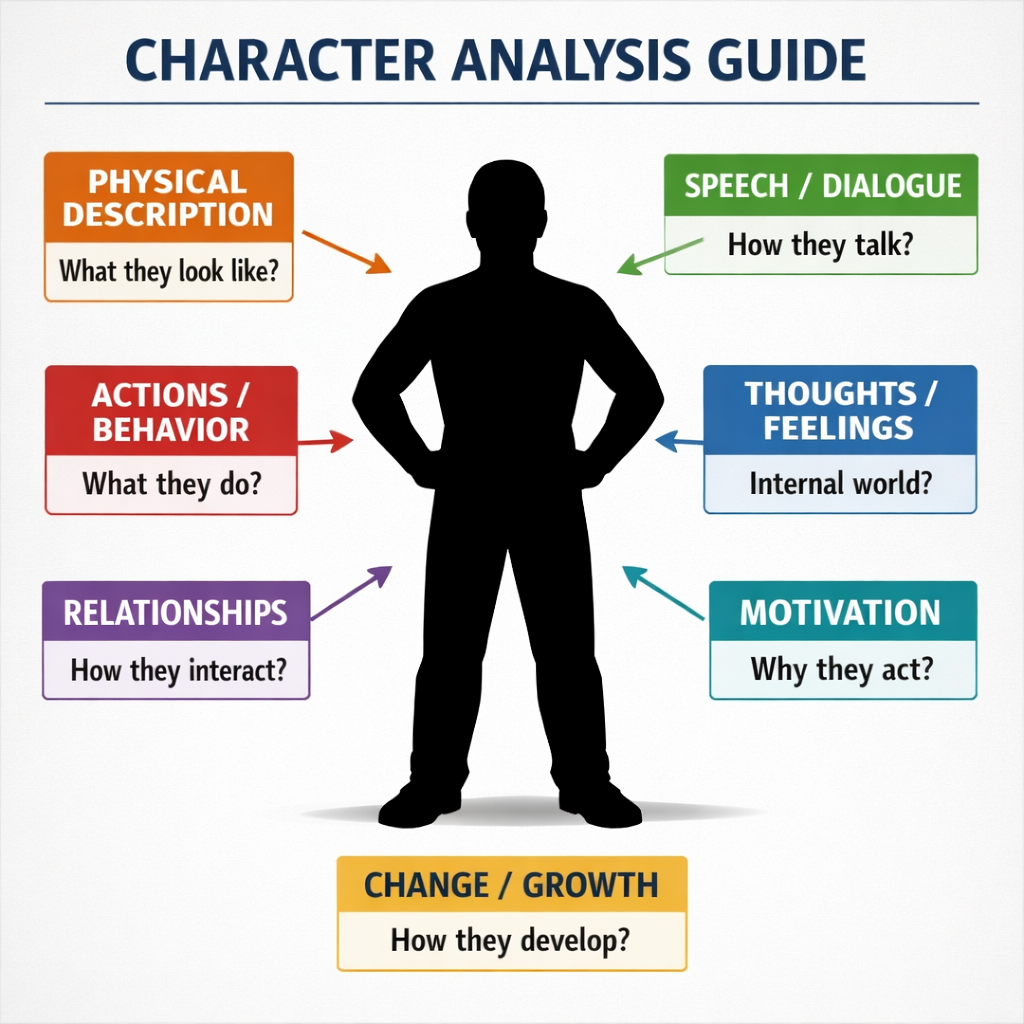
Character analysis
Historical Fiction & Biographies of Believers
Literary devices
Character analysis
As believers, we read for several important reasons:
Not all books are worth reading! We must guard our minds and hearts. Before reading any book, ask:
1. What is your favorite book? Why do you like it?
2. How does the Philippians 4:8 test apply to the books we choose?
1. CHARACTERS - The people (or creatures) in the story
2. SETTING - When and where the story takes place
3. PLOT - What happens in the story
4. CONFLICT - The problem or struggle
5. THEME - The central message or lesson
Think of a story you've read (or the story of Joseph in Genesis). Identify:
Story Title:
Protagonist:
Antagonist:
Setting:
Main Conflict:
Theme:
Historical fiction combines real historical events/settings with fictional characters and stories. It helps us experience what life was like in different times.
Setting: Israel during the time of Yahusha
Plot: Daniel, a young Jewish boy filled with hatred for the Romans, encounters Yahusha and must choose between revenge and forgiveness.
Setting: Nazi-occupied Holland, World War II
Plot: The ten Boom family hides Jews from the Nazis and faces the consequences of their faith-driven choice.
Setting: Colonial America, 1700s
Plot: The true story of an African prince sold into slavery who maintains his dignity and faith, eventually buying freedom for himself and others.
Why is it important to check historical accuracy in historical fiction?
What time period would you like to read about? Why?
| Biography | Autobiography |
|---|---|
| Written by someone else | Written by the person themselves |
| Third person (he, she, they) | First person (I, me, my) |
| Objective viewpoint | Personal, subjective viewpoint |
| Based on research | Based on memory and experience |
Why read biographies?
Choose a biography to read. As you read, note:
Person's name:
Time period they lived:
Greatest challenge they faced:
How their faith helped them:
Lesson I learned from their life:
69-155 AD
A disciple of the Apostle John, Polycarp led the assembly at Smyrna for decades. When arrested at age 86, the Roman official offered him freedom if he would curse the Messiah. Polycarp replied: "Eighty-six years have I served Him, and He never did me any injury. How can I blaspheme my King and Savior?"
Character trait: Unwavering faithfulness
Martyred 203 AD
A young noblewoman and her servant, both new believers in Carthage (North Africa). Despite pressure from family and threats of death, they refused to deny their faith. Perpetua kept a diary of her imprisonment, showing remarkable courage and peace.
Character trait: Courage in persecution
296-373 AD
Known as "Athanasius against the world" because he stood alone defending the deity of Yahusha when most leaders had compromised. Exiled five times for his beliefs, he never wavered from biblical truth.
Character trait: Standing for truth against the majority
What would you have done in Polycarp's situation?
What does "Athanasius against the world" teach us about following truth?
1320-1384
"The Morning Star of the Reformation" - Wycliffe believed everyone should read Scripture in their own language. He translated the Bible into English when it was illegal to do so. His followers, called Lollards, spread Scripture throughout England.
Legacy: First complete English Bible
1494-1536
Said to authorities: "If Elohim spare my life, before many years I will cause a boy that drives the plow to know more of the Scripture than you do." He translated the New Testament from Greek into English, was hunted as a criminal, and eventually burned at the stake. His last words: "Lord, open the King of England's eyes."
Legacy: His translation forms 90% of the King James Bible
1483-1546
A German monk who challenged the corruption of the Roman Church. In 1517, he posted 95 statements for debate. When ordered to recant, he declared: "Here I stand, I can do no other." He translated Scripture into German so common people could read it.
Legacy: Helped launch the Protestant Reformation
Why was it so important to translate the Bible into common languages?
What would you be willing to sacrifice for truth?
1892-1983
A Dutch watchmaker who hid Jews during the Holocaust. After surviving a Nazi concentration camp where her sister died, Corrie spent her life teaching about forgiveness - even forgiving a guard who had been cruel to her sister.
Famous quote: "There is no pit so deep that Elohim's love is not deeper still."
1906-1945
A German pastor who could have stayed safe in America but returned to Germany to resist Hitler. He helped smuggle Jews to safety and was executed just days before the war ended. His writings continue to challenge believers today.
Famous quote: "Silence in the face of evil is itself evil."
1909-2001
A Jewish believer in Romania who spent 14 years in Communist prisons for his faith, including 3 years in solitary confinement. After release, he founded Voice of the Martyrs to help persecuted believers worldwide.
Book: "Tortured for Christ" - tells his incredible story
1902-1970
A small English woman told she wasn't qualified for missionary work, but she saved her money, traveled to China alone, and eventually led 100 orphans across mountains to safety during the Japanese invasion.
Character trait: Determination and trust in Yahuah
Which of these heroes interests you most? Why?
Write 3 questions you would ask them if you could:
1.
2.
3.
Not every book is worth reading! Some books contain:
Before reading a book, ask:
| Question | What It Means |
|---|---|
| Is it TRUE? | Does it reflect reality and biblical truth? |
| Is it HONEST? | Does it present things fairly and accurately? |
| Is it JUST? | Does it uphold righteousness? |
| Is it PURE? | Is it free from immorality and corruption? |
| Is it LOVELY? | Does it promote beauty and goodness? |
| Is it of GOOD REPORT? | Would it honor Yahuah? |
Why should believers avoid books that positively portray witchcraft/magic?
Think of a popular book or movie. Does it pass the Philippians 4:8 test?
Title:
Analysis:
A theme is the central message, lesson, or truth that a story teaches. Great literature often explores universal themes that connect to biblical truth.
| Theme | What It Explores | Biblical Connection |
|---|---|---|
| Good vs. Evil | The battle between right and wrong | The cosmic war between Yahuah and Satan |
| Redemption | Being saved/rescued from sin or trouble | Yahusha's sacrifice for humanity |
| Sacrifice | Giving up something for a greater good | "Greater love has no man..." (John 15:13) |
| Identity | Discovering who you truly are | Our identity as children of Yahuah |
| Courage | Acting rightly despite fear | "Be strong and of good courage" (Joshua 1:9) |
| Forgiveness | Releasing bitterness and granting pardon | Yahuah's forgiveness, forgiving others |
Example: In "The Bronze Bow," Daniel learns that hatred destroys, but love (through Yahusha) heals and transforms.
Theme statement: Love is more powerful than hatred.
Think of a book you've read. What is its theme?
Book:
Theme in one sentence:
How does this connect to biblical truth?
A worldview is the set of beliefs and assumptions that shape how someone sees reality. Every author writes from a worldview - and it shows in their stories!
BIBLICAL WORLDVIEW
SECULAR/HUMANIST WORLDVIEW
Choose a book, movie, or TV show and analyze its worldview:
Title:
What worldview does it present?
How does it compare to a biblical worldview?
1. BOOK SUMMARY - What happened?
2. BOOK REVIEW - Was it good?
3. LITERARY ANALYSIS - What does it mean?
Write a book review following the structure above:
Book Title:
Author:
Your Review:
Historical Fiction:
Biographies:
Classic Literature:
Set a reading goal for this year:
I will read books this year.
List 5 books you want to read:
1.
2.
3.
4.
5.
Why is reading important for your walk with Yahuah?