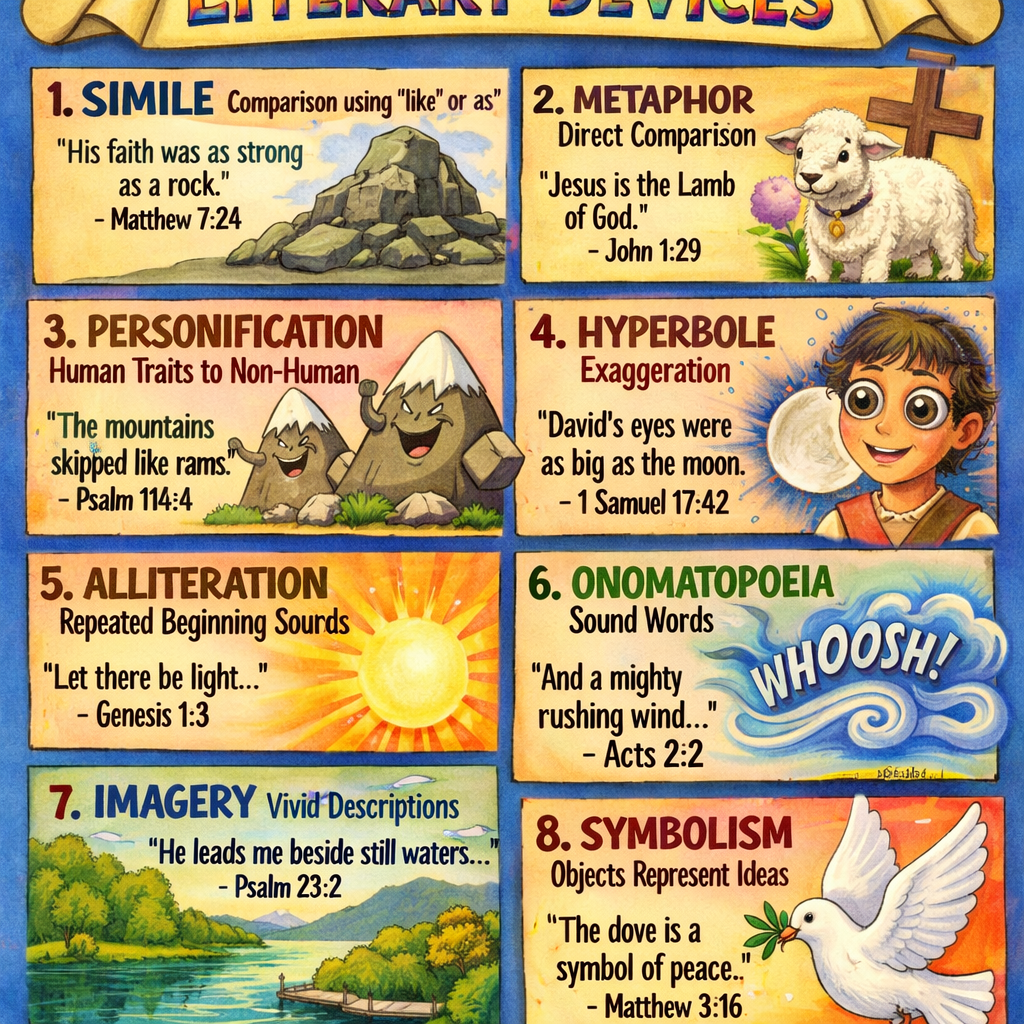
Literary devices
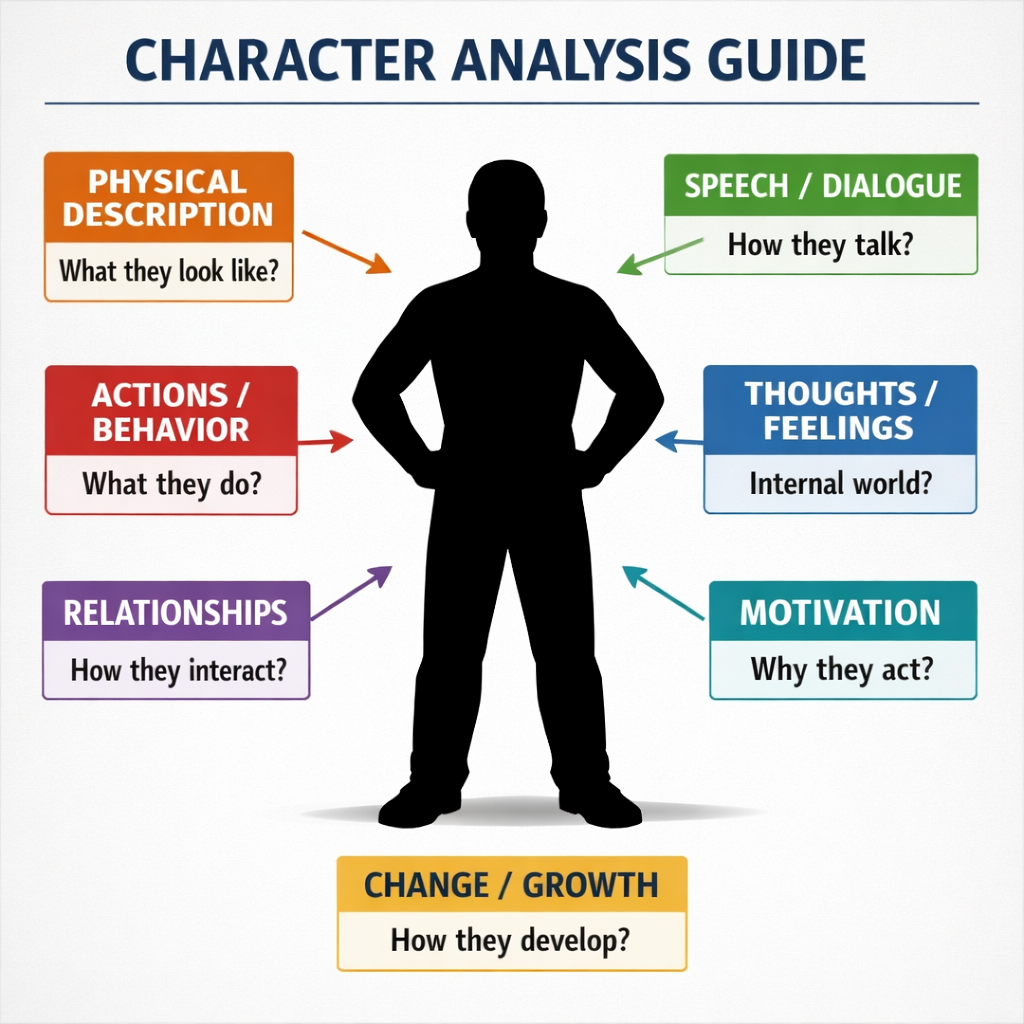
Character analysis
Analyzing Great Books Through a Biblical Lens
Literary devices
Character analysis
Classic literature refers to books that have stood the test of time - read and valued for generations. But as believers, we don't just read passively - we read with discernment!
Not everything in classic literature is good or true! Authors have worldviews - some biblical, some not. Our job is to:
Why is it important to read with discernment rather than passively accepting everything an author writes?
Every book reflects a worldview - a set of beliefs about reality, truth, and values. Here's a framework for analysis:
| Question | What It Reveals | Biblical Answer |
|---|---|---|
| 1. Origin Where did we come from? |
View of creation, human nature | Yahuah created everything; humans made in His image |
| 2. Identity Who are we? |
View of human worth, purpose | Image bearers of Yahuah, fallen but redeemable |
| 3. Meaning Why are we here? |
View of life's purpose | To glorify Yahuah and enjoy Him forever |
| 4. Morality How should we live? |
View of right and wrong | According to Yahuah's Torah (instruction) |
| 5. Destiny Where are we going? |
View of the future, afterlife | Judgment, resurrection, eternal life or death |
Think of a book, movie, or TV show. Answer the five worldview questions about it:
Title:
1. Origin - Where do characters/the world come from?
2. Identity - How are humans portrayed?
3. Meaning - What purpose drives the characters?
4. Morality - How is right/wrong determined?
5. Destiny - What is the ultimate hope presented?
ALLEGORY - A story where characters/events represent abstract ideas
Example: Pilgrim's Progress - Christian's journey = the believer's life
SYMBOLISM - Objects/images representing deeper meanings
Example: The lion Aslan = Yahusha in Narnia
IRONY - When reality contrasts with expectations
FORESHADOWING - Hints about future events
MOTIF - A recurring element that develops theme
FOIL - A character who contrasts with another, highlighting traits
Identify the literary device in each example:
1. In the story, a dove appears whenever peace is about to come.
2. The reader knows the villain is hiding behind the door, but the hero doesn't.
3. The entire story of a lion sacrifice represents Yahusha's death and resurrection.
4. The brave hero has a cowardly sidekick who makes his courage stand out.
Genre: Allegory | Setting: Symbolic journey
Summary: Christian, burdened by sin, flees the City of Destruction and travels to the Celestial City. Along the way, he faces obstacles representing spiritual struggles every believer encounters.
| Character/Place | Represents |
|---|---|
| Christian | Every believer on the journey of faith |
| The Burden | Sin and guilt |
| City of Destruction | The fallen world, life without Yahuah |
| Slough of Despond | Despair, discouragement |
| Vanity Fair | Worldly temptations, materialism |
| Giant Despair | Deep depression, hopelessness |
| Doubting Castle | Prison of unbelief |
| Celestial City | Heaven, eternal life with Yahuah |
Origin: Humans created by Elohim, born into sin
Identity: Sinners who can be redeemed
Meaning: The journey toward holiness and heaven
Morality: Defined by Scripture, narrow path is right
Destiny: Heaven for the faithful, destruction for the wicked
Verdict: Strongly biblical worldview
1. Why do you think Bunyan chose to write an allegory rather than a straightforward teaching?
2. What spiritual obstacle from the book do you most relate to? Why?
3. What does the "key of Promise" (Scripture) teach us about overcoming despair?
Genre: Adventure, Spiritual autobiography | Setting: Deserted island
Summary: A young man disobeys his father, goes to sea, survives a shipwreck, and spends 28 years on an island. Through suffering, he discovers faith in Yahuah and the value of contentment.
"I learned to look more upon the bright side of my condition, and less upon the dark side, and to consider what I enjoyed, rather than what I wanted."
- Robinson Crusoe
Strengths: Shows divine providence, conversion, the value of Scripture, gratitude
Questions to Consider: How does Defoe portray Friday and the "savages"? What does this reveal about 18th-century attitudes? How should we view this critically?
Verdict: Generally biblical worldview with cultural blind spots of its time
1. How does Crusoe's disobedience to his father parallel spiritual rebellion?
2. What role does the Bible play in Crusoe's transformation?
3. What can we learn from Crusoe about contentment in difficult circumstances?
Genre: Autobiography, Memoir | Setting: Nazi-occupied Holland, concentration camps
Summary: Corrie and her family hide Jews during the Holocaust, are betrayed, and sent to concentration camps. Despite unspeakable suffering, Corrie discovers Yahuah's love and the power of forgiveness.
"There is no pit so deep that Elohim's love is not deeper still."
- Corrie ten Boom
The Forgiveness Scene: Years after the war, Corrie met a former guard from Ravensbrück. He asked for her forgiveness. Corrie struggled - but chose to extend her hand. She later said, "I had never known Elohim's love so intensely as I did then."
Origin: Created by Elohim with inherent dignity
Identity: Every person precious to Yahuah - even enemies
Meaning: To love Yahuah and love others, even at great cost
Morality: Absolute - protecting innocents is right; murder is wrong
Destiny: Eternal life with Yahuah for believers
Verdict: Powerfully biblical worldview
1. Why did the ten Boom family risk their lives to hide Jews?
2. How did Corrie's faith sustain her in Ravensbrück?
3. What makes forgiveness so difficult? Why is it essential?
Genre: Allegory, Political satire | Setting: A farm in England
Summary: Animals overthrow their human farmer, promising equality and freedom. But the pigs gradually become tyrants worse than the humans they replaced. A warning about revolutionary movements and totalitarianism.
| Character | Represents |
|---|---|
| Old Major | Karl Marx / Lenin (revolutionary idealist) |
| Napoleon | Stalin (brutal dictator) |
| Snowball | Trotsky (exiled rival) |
| Squealer | Propaganda machine |
| Boxer | Loyal working class, exploited |
| The Dogs | Secret police, enforcers |
"All animals are equal, but some animals are more equal than others."
- The final commandment in Animal Farm
Orwell was not a believer - he was a secular socialist critical of Stalinism. While his critique of totalitarianism is valuable, he doesn't offer a biblical solution. The book shows the problem (human corruption) but not the answer (redemption through Yahusha).
1. How does Animal Farm illustrate Jeremiah 17:9 ("The heart is deceitful above all things")?
2. Why do human revolutions ultimately fail to create utopia?
3. What is the only solution to tyranny and corruption? (Biblical answer)
Propaganda is information designed to shape public opinion. It's not always obvious - often the most effective propaganda is disguised as entertainment!
| Technique | Description | Example |
|---|---|---|
| Loaded Language | Emotionally charged words | "Progressive" vs. "radical" |
| Repetition | Repeating ideas until accepted | "Evolution is a fact" repeated |
| Stereotyping | Oversimplified portrayals | Religious people always shown negatively |
| Bandwagon | "Everyone believes this" | "All scientists agree..." |
| False Dilemma | Only two choices presented | "Science OR religion" |
| Appeal to Authority | Trust experts blindly | "Experts say..." |
| Normalization | Making wrong seem normal | Sin portrayed as acceptable |
Much modern entertainment pushes secular worldviews:
Think of a recent movie, TV show, or book. What worldview messages did it promote?
Title:
Messages promoted:
Techniques used:
SYMBOLISM: One element represents something else
A dove symbolizes peace. Light symbolizes truth. A cross symbolizes sacrifice.
ALLEGORY: The entire story represents something else
Pilgrim's Progress = the Christian life. Animal Farm = Soviet Russia.
| Symbol | Often Represents | Biblical Connection |
|---|---|---|
| Light | Truth, goodness, Yahuah | "I am the light of the world" |
| Darkness | Evil, ignorance, Satan | "Rulers of the darkness of this world" |
| Water | Life, cleansing, Spirit | Living water, baptism |
| Lion | Royalty, power, Yahusha | "Lion of the tribe of Judah" |
| Lamb | Innocence, sacrifice | "Lamb of Elohim" |
| Bread | Sustenance, Yahusha | "I am the bread of life" |
| Journey | Life, spiritual growth | Israel's wilderness journey |
In C.S. Lewis's "The Lion, the Witch and the Wardrobe," what do these represent?
Aslan:
The White Witch:
Edmund's betrayal:
Aslan's death and resurrection:
The Stone Table cracking:
1. CHARACTERIZATION - How does the author reveal character?
2. MOTIVATION - What drives the character?
3. DEVELOPMENT - How do they change?
4. MORAL EVALUATION - Test against Scripture
Choose a character from a book you've read and analyze them:
Character name: Book:
How is the character revealed? (direct or indirect characterization)
What motivates them? (wants, needs, fears)
How do they change?
Biblical evaluation - what virtues or vices do they display?
INTRODUCTION
BODY PARAGRAPHS (2-4)
CONCLUSION
Introduce: "As Bunyan writes, '[quote]' (page)."
Embed: Christian discovers that "the key of Promise" opens every lock (45).
Explain: Never drop a quote without explanation!
Write a thesis statement for a literary essay on one of these topics:
Your thesis:
Choose a classic book, read it with discernment, and write a complete worldview analysis.
Book chosen:
Author:
Why I chose this book:
Reading schedule: