We live in an age of deception. Propaganda, manipulation, and faulty reasoning bombard us daily. This course teaches you how to think clearly, identify logical fallacies, evaluate arguments, and apply biblical wisdom to discern truth from error. These skills are essential for every follower of Yahusha.
Proverbs 14:15 - "The simple believeth every word: but the prudent man looketh well to his going."
Yahuah calls us to be prudent—to examine claims carefully, not believe everything we hear.
Logic is the study of correct reasoning. It provides principles and methods for distinguishing good arguments from bad ones, sound reasoning from faulty reasoning.
Why Study Logic?
Detect deception: Recognize when someone is manipulating you
Think clearly: Organize your own thoughts properly
Communicate better: Make convincing, valid arguments
Defend truth: Stand firm against false teachings
Honor Yahuah: He is a God of order and truth
Logic Reflects Yahuah's Nature
Yahuah is not the author of confusion (1 Corinthians 14:33). He is truth (John 14:6). Logic works because Yahuah made an orderly universe governed by consistent principles. The laws of logic reflect His nature.
🤔 REFLECT: The Three Laws of Logic
Three foundational laws underpin all logical thinking:
Law
Meaning
Example
Identity
A thing is what it is (A = A)
A cat is a cat
Non-Contradiction
Something cannot be both true and false at the same time
It cannot be both raining and not raining here now
Excluded Middle
A statement is either true or false—no third option
"Yahusha rose from the dead" is either true or false
✏️ RECALL: Practice Questions
Lesson 2: Biblical Foundation for Clear Thinking
YOUTH Logic Validity
📖 RECEIVE: Scripture Commands Clear Thinking
Scripture repeatedly calls us to think carefully, test everything, and use discernment. This is not optional for believers.
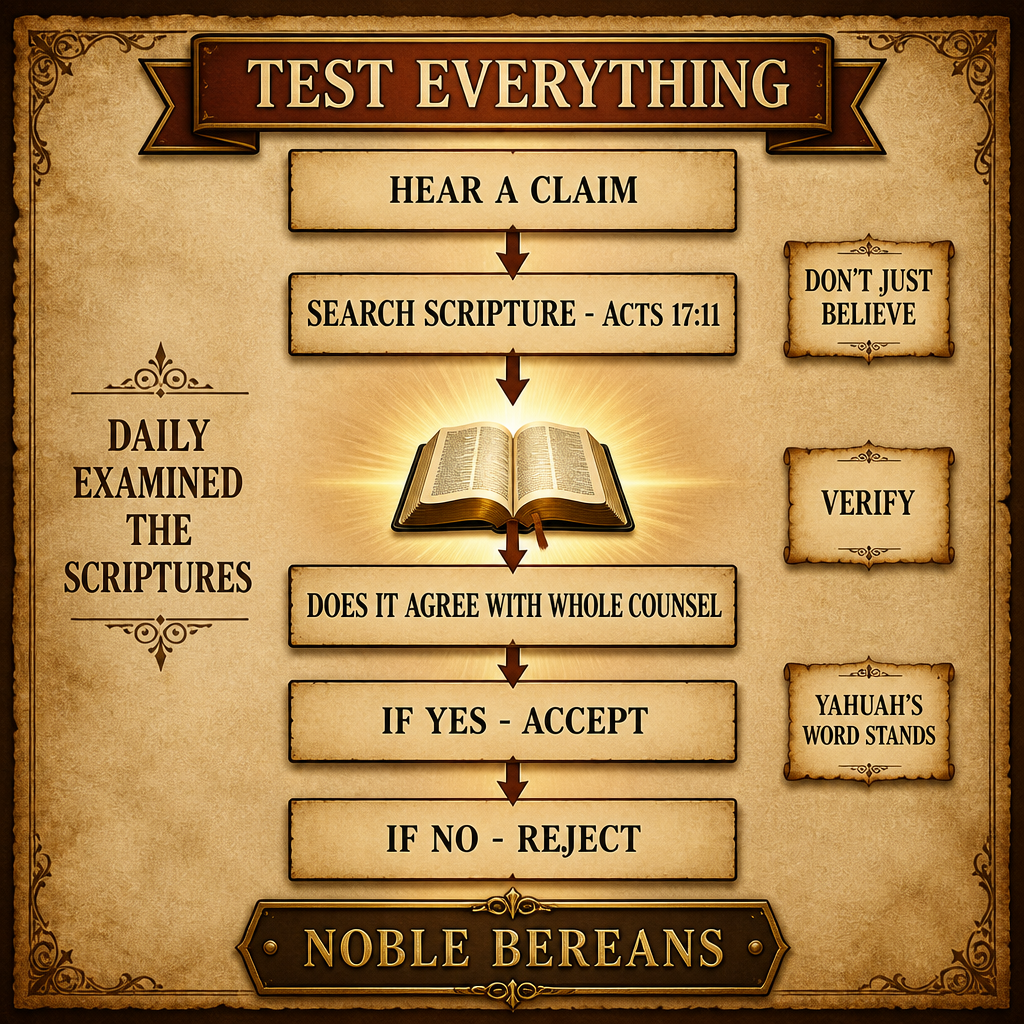
1 Thessalonians 5:21 - "Prove all things; hold fast that which is good."
Acts 17:11 - "These [Bereans] were more noble than those in Thessalonica, in that they received the word with all readiness of mind, and searched the scriptures daily, whether those things were so."
Biblical Commands for Critical Thinking:
Test everything (1 Thessalonians 5:21)
Search the Scriptures (Acts 17:11)
Be wise as serpents (Matthew 10:16)
Try the spirits (1 John 4:1)
Beware of false prophets (Matthew 7:15)
Don't be deceived (Matthew 24:4)
Reason together (Isaiah 1:18)
The Berean Standard
The Bereans are praised for not blindly accepting even Paul's teaching—they checked it against Scripture. This is our model: respectfully question everything, compare all teachings to the Word of Yahuah.
✏️ RECALL: Practice Questions
Lesson 3: Statements & Arguments
YOUTH Logic Scripture Test
📖 RECEIVE: Building Blocks of Logic
Key Definitions
Statement (Proposition): A sentence that is either true or false.
Argument: A set of statements where some (premises) support another (conclusion).
Premise: A statement given as evidence or reason.
Conclusion: The statement that the premises are meant to prove.
Examples of Statements:
"The Sabbath is the seventh day." (True or false—it's a statement)
"What time is it?" (NOT a statement—it's a question)
"Close the door!" (NOT a statement—it's a command)
"Yahusha rose on the third day." (True or false—it's a statement)
Example Argument
Premise 1: All Scripture is inspired by Yahuah.
Premise 2: The Torah is Scripture.
Conclusion: Therefore, the Torah is inspired by Yahuah.
🤔 REFLECT: Identifying Arguments
Signal Words:
Premise Indicators
Conclusion Indicators
Because, since, for, given that, as
Therefore, thus, hence, so, consequently
Example: "Since Yahuah commanded the Sabbath, and since Yahusha kept the Sabbath, therefore we should keep the Sabbath."
✏️ RECALL: Practice Questions
Lesson 4: Deductive Reasoning
YOUTH Logic Worldview
📖 RECEIVE: From General to Specific
Deductive Reasoning
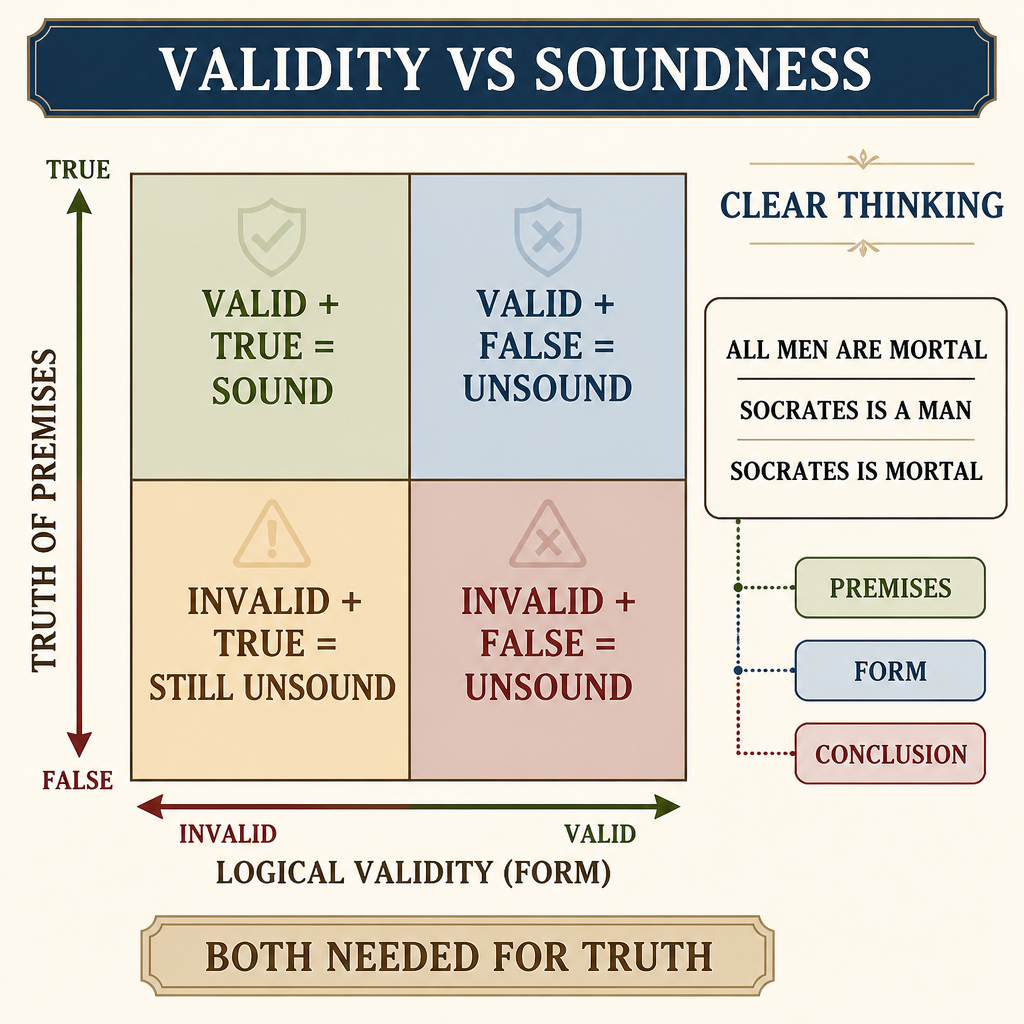
Deduction moves from general principles to specific conclusions. If the premises are true and the logic is valid, the conclusion must be true.
Key Terms:
Valid: The conclusion logically follows from the premises (structure is correct)
Sound: The argument is valid AND all premises are true
Invalid: The conclusion doesn't follow, even if premises are true
Valid & Sound Argument
Premise 1: All who break Yahuah's law are sinners.
Premise 2: All humans have broken Yahuah's law.
Conclusion: Therefore, all humans are sinners.
This is valid (the structure is correct) and sound (the premises are true according to Scripture - Romans 3:23).
Valid but Unsound Argument
Premise 1: All birds can fly.
Premise 2: Penguins are birds.
Conclusion: Therefore, penguins can fly.
This is valid (structure is correct) but unsound (Premise 1 is false—not all birds fly).
✏️ RECALL: Practice Questions
Lesson 5: Inductive Reasoning
📖 RECEIVE: From Specific to General
Inductive Reasoning
Induction moves from specific observations to general conclusions. Unlike deduction, inductive conclusions are probable, not certain.
Inductive Example
Observation: The sun rose today.
Observation: The sun rose yesterday.
Observation: The sun has risen every day in recorded history.
Conclusion: The sun will probably rise tomorrow.
This is probably true, but not certainly true—Yahuah could stop the sun if He chose.
Comparing Deduction and Induction:
Deductive
Inductive
General → Specific
Specific → General
Conclusion is certain (if sound)
Conclusion is probable
Used in logic, math, theology
Used in science, daily life
Science Uses Induction
Scientific conclusions are based on induction (observations → theory). This means scientific theories are always probable, not absolutely certain. They can be revised with new evidence. This is why we shouldn't place science above Scripture (which is certain revelation from Yahuah).
✏️ RECALL: Practice Questions
Lesson 6: Logical Fallacies (Part 1)
📖 RECEIVE: Errors in Reasoning
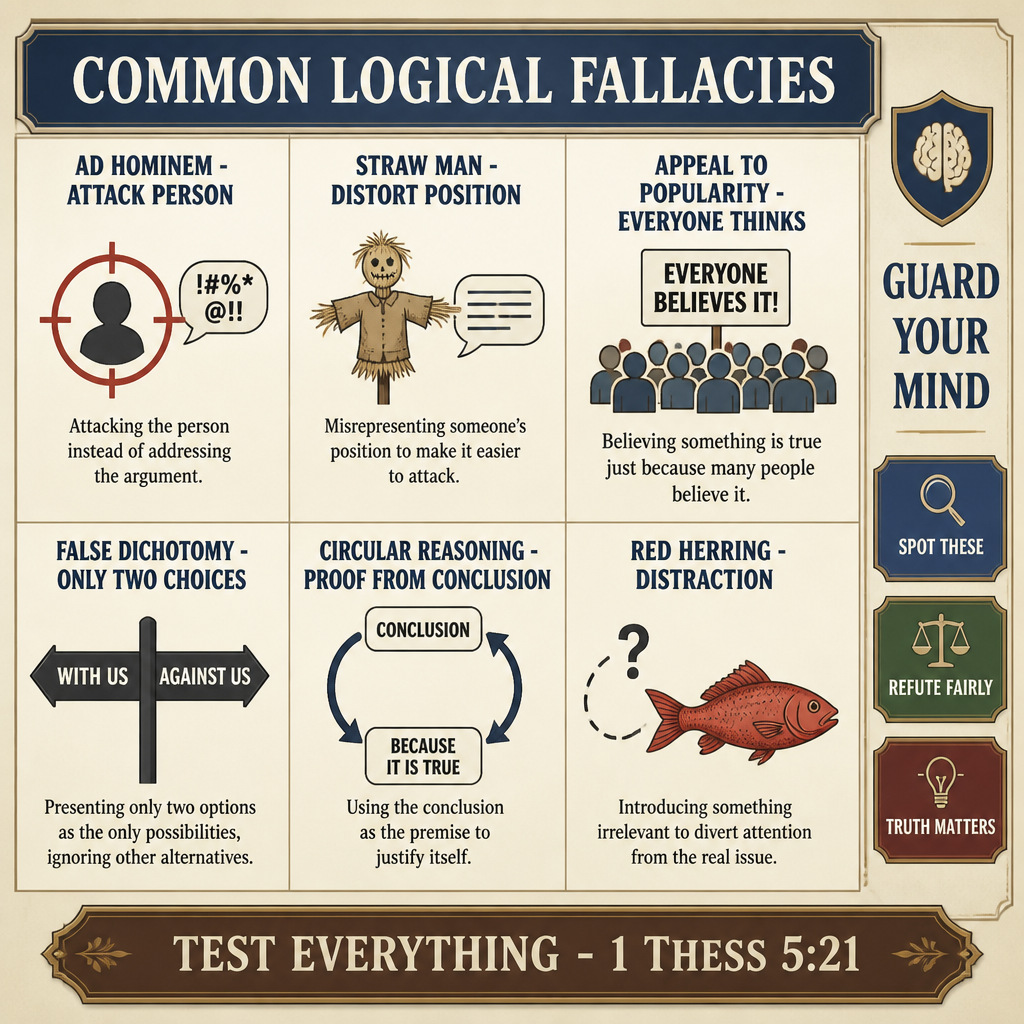
What is a Logical Fallacy?
A fallacy is an error in reasoning that makes an argument invalid. Learning fallacies helps you spot manipulation and avoid bad reasoning yourself.
1. Ad Hominem (Attack the Person)
Attacking the person making the argument instead of the argument itself.
Example: "You can't trust what he says about the Sabbath—he's not even a pastor!"
Problem: The speaker's credentials don't determine if the argument is true.
2. Straw Man
Misrepresenting someone's argument to make it easier to attack.
Example: "Torah-keepers think they can earn salvation by works!"
Problem: This misrepresents the actual position (obedience from love, not for salvation).
3. Appeal to Authority
Claiming something is true because an authority figure says so (without evidence).
Example: "Evolution must be true because all scientists believe it."
Problem: Truth isn't determined by who believes it, but by evidence.
4. Appeal to Popularity (Bandwagon)
Claiming something is true because many people believe it.
Example: "Most Christians worship on Sunday, so it must be the right day."
Problem: Majority opinion doesn't equal truth (Matthew 7:13-14).
Exodus 23:2 - "Thou shalt not follow a multitude to do evil."
✏️ RECALL: Practice Questions
Lesson 7: Logical Fallacies (Part 2)
📖 RECEIVE: More Common Fallacies
Here are more fallacies you'll encounter frequently:
5. False Dilemma (Either/Or)
Presenting only two options when more exist.
Example: "You're either with us or against us."
Problem: There may be other positions or nuances.
6. Circular Reasoning (Begging the Question)
Using the conclusion as a premise—assuming what you're trying to prove.
Example: "The Bible is true because it's the Word of God, and we know it's the Word of God because the Bible says so."
Better approach: Provide external evidence, fulfilled prophecy, etc.
7. Red Herring
Introducing an irrelevant topic to divert from the real issue.
Example: "Why worry about keeping the Sabbath when there are starving children in Africa?"
Problem: The second issue, while important, doesn't address the first.
8. Appeal to Emotion
Using emotion (fear, pity, anger) instead of logic to persuade.
Example: "If you don't accept Jesus into your heart right now, you could die tonight and go to hell!"
Problem: Fear doesn't prove the argument; it manipulates the listener.
9. Slippery Slope
Claiming one action will inevitably lead to extreme consequences without evidence.
Example: "If we keep the Sabbath, next we'll have to sacrifice animals!"
Problem: The connection isn't established; the jump is exaggerated.
10. Hasty Generalization
Drawing broad conclusions from too few examples.
Example: "I met two rude Sabbath-keepers, so all Sabbath-keepers are rude."
Problem: Two examples don't represent an entire group.
✏️ RECALL: Practice Questions
Lesson 8: Evaluating Sources & Evidence
📖 RECEIVE: Not All Sources Are Equal
In our information age, we must carefully evaluate where information comes from. Not all sources are reliable.
Questions to Ask About Any Source:
Who wrote/said it? What are their credentials and biases?
What evidence do they provide? Claims without evidence are weak.
When was it written? Is it current? Is it based on outdated information?
Why was it written? To inform? To persuade? To sell?
Does it align with Scripture? The ultimate test for believers.
Hierarchy of Evidence
Level
Source Type
Reliability
1
Scripture (properly interpreted)
Highest—Yahuah's Word
2
Primary sources (eyewitness, original documents)
High
3
Peer-reviewed research
Moderate-High
4
Expert opinion
Moderate
5
News media
Variable (check sources)
6
Social media, blogs, videos
Low (verify independently)
Identifying Bias
Every source has a perspective. Ask:
Who funds this organization?
What do they gain if I believe them?
Do they present opposing views fairly?
Are they willing to acknowledge uncertainty?
✏️ RECALL: Practice Questions
Lesson 9: Worldview & Discernment
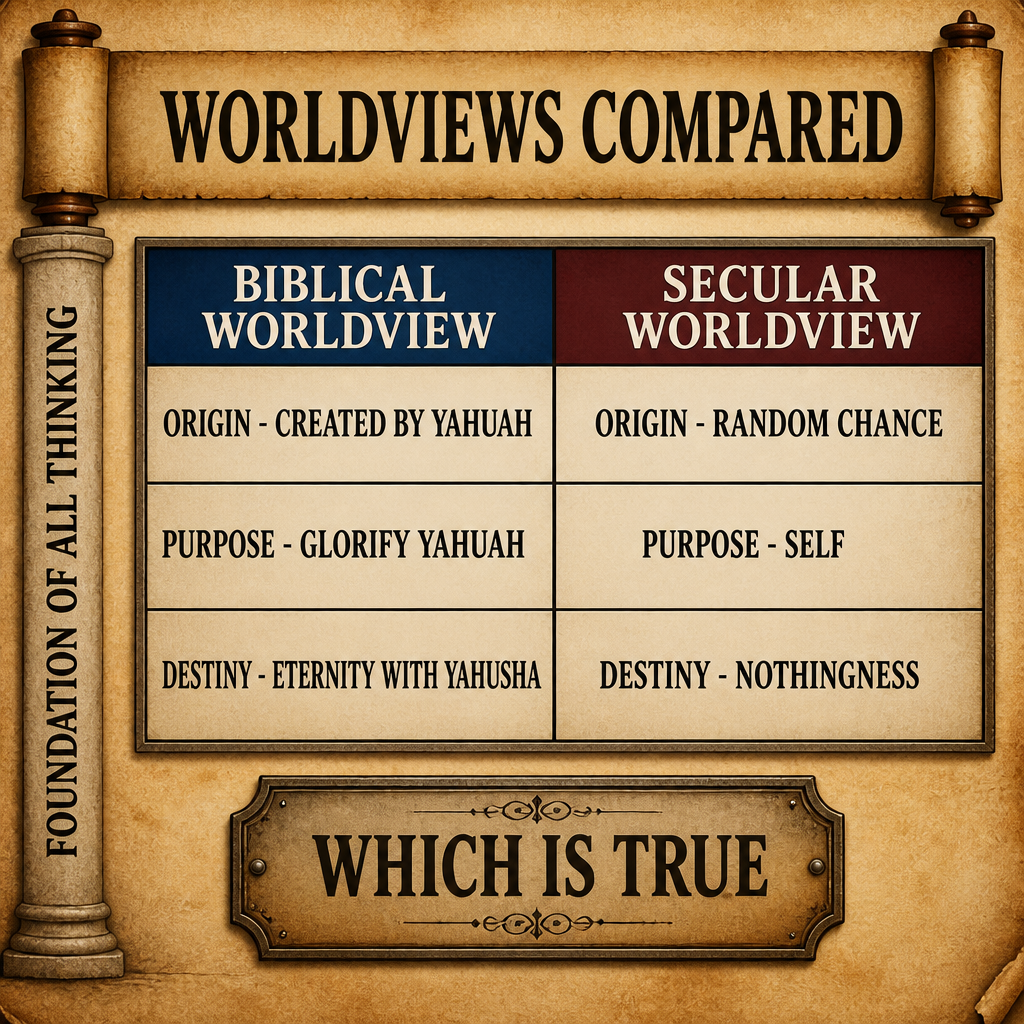
📖 RECEIVE: Everyone Has a Worldview
What is a Worldview?
A worldview is a set of foundational beliefs through which a person interprets everything. It answers: Where did we come from? What's wrong with the world? How can it be fixed? What happens after death?
Common Worldviews:
Worldview
Core Beliefs
Biblical
Yahuah created all; sin is the problem; Yahusha is the solution
Naturalism
Only matter exists; no supernatural; evolution explains life
Secular Humanism
Humans determine morality; no absolute truth; progress through science
Postmodernism
No objective truth; all perspectives are equal; reality is constructed
Worldview Affects Interpretation
Two people can look at the same evidence and reach different conclusions because of their worldviews:
Fossil: Naturalist sees "millions of years of evolution." Biblical thinker sees "evidence of the Flood."
Morality: Humanist says "society determines right and wrong." Believer says "Yahuah determines right and wrong."
Always ask: "What worldview is this person starting from?"
Colossians 2:8 - "Beware lest any man spoil you through philosophy and vain deceit, after the tradition of men, after the rudiments of the world, and not after Messiah."
✏️ RECALL: Practice Questions
Lesson 10: Applying Critical Thinking
📖 RECEIVE: Putting It All Together
Now let's apply everything we've learned to real-world situations.
Critical Thinking Checklist:
☐ What is the claim being made?
☐ What evidence supports it?
☐ What is the source? Is it reliable?
☐ Are there any logical fallacies?
☐ What worldview is behind this claim?
☐ What does Scripture say about this?
☐ Have I prayed for wisdom? (James 1:5)
Practice Scenario 1: News Article
"Scientists prove the universe is 13.8 billion years old."
Apply critical thinking:
What evidence? (Dating methods based on assumptions)
Source reliable? (Scientists have biases; peer review has limits)
Fallacies? (Appeal to authority—"scientists say")
Worldview? (Naturalistic; assumes no supernatural)
Scripture? (Genesis gives different timeline)
Practice Scenario 2: Religious Teaching
"The Sabbath was changed to Sunday to honor the resurrection."
Apply critical thinking:
Evidence? (Where in Scripture is this commanded?)
Source? (Church tradition vs. Scripture)
Fallacies? (Appeal to tradition, appeal to authority)
Scripture? (No command to change; Yahusha kept Sabbath)
James 1:5 - "If any of you lack wisdom, let him ask of Elohim, that giveth to all men liberally, and upbraideth not; and it shall be given him."
🎯 RESPOND: Final Application
Answer Key
Lesson 1
1. Logic is the study of correct reasoning / distinguishing good arguments from bad | 2. Identity, Non-Contradiction, Excluded Middle | 3. To detect deception, think clearly, defend truth, honor Yahuah
Lesson 2
1. They searched the Scriptures daily to verify what they were taught | 2. The spirits | 3. Wise as serpents and innocent/harmless as doves
Lesson 3
1. A sentence that is either true or false | 2. Premises and conclusion | 3. No—it's a request/command, not something that can be true or false | 4. "Moses was mortal"
Lesson 4
1. General to specific | 2. Valid = correct structure; Sound = valid + true premises | 3. Yes—if the premises are false, the conclusion can be false even with valid structure
Lesson 5
1. Specific to general | 2. Probable | 3. Scientific conclusions are inductive (probable), while Scripture is certain revelation from Yahuah
Lesson 6
1. Ad Hominem | 2. Straw Man | 3. Appeal to Popularity (Bandwagon) | 4. Because truth isn't determined by who says it, but by evidence
Lesson 7
1. False Dilemma | 2. Red Herring | 3. Hasty Generalization | 4. Personal examples will vary
Lesson 8
1. Scripture | 2. Any three: Who wrote it? What evidence? When written? Why written? Does it align with Scripture? | 3. Anyone can post anything; no verification; often biased; easy to spread misinformation
Lesson 9
1. A set of foundational beliefs through which a person interprets everything | 2. People interpret the same evidence differently based on their starting assumptions | 3. Philosophy and vain deceit / traditions of men