The Mathematics of Shape & Space
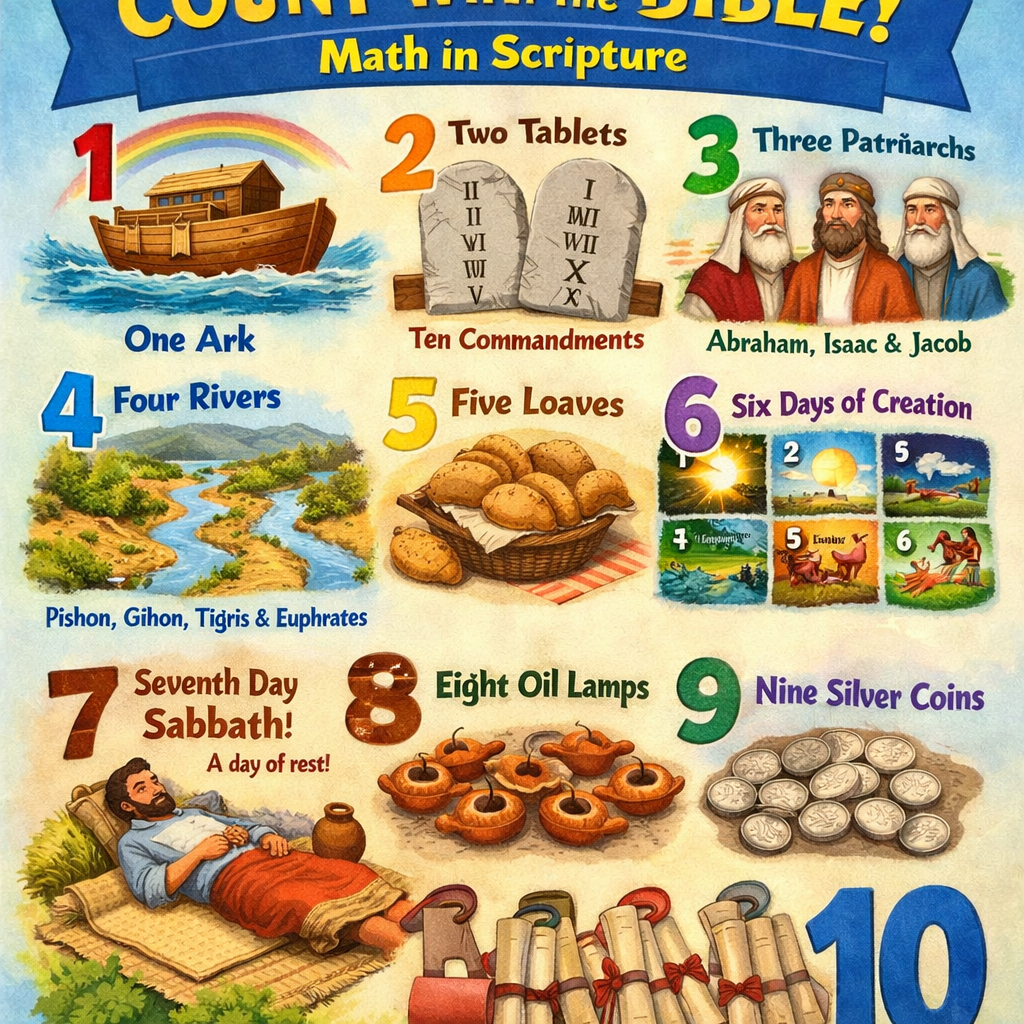
Learning to count with Yahuah!
Yahuah created a universe of precise measurements and relationships. Geometry is the study of shapes, sizes, and the properties of space—reflecting the order of creation!
These are the foundational concepts we accept without formal definition:
| Term | Definition | Symbol |
|---|---|---|
| Line Segment | Part of a line with two endpoints | AB̄ (bar over letters) |
| Ray | Part of a line with one endpoint, extending infinitely | AB→ (arrow) |
| Collinear Points | Points that lie on the same line | — |
| Coplanar Points | Points that lie in the same plane | — |
An angle is formed by two rays sharing a common endpoint (vertex).
Angles are measured in degrees (°). A full rotation is 360°.
| Type | Measure | Description |
|---|---|---|
| Acute | 0° < angle < 90° | Less than a right angle |
| Right | Exactly 90° | Forms an "L" shape (square corner) |
| Obtuse | 90° < angle < 180° | Greater than a right angle |
| Straight | Exactly 180° | Forms a straight line |
| Reflex | 180° < angle < 360° | Greater than a straight angle |
The sum of the interior angles of any triangle = 180°
| Type | Description |
|---|---|
| Equilateral | All three sides equal (all angles = 60°) |
| Isosceles | Two sides equal (two angles equal) |
| Scalene | No sides equal (no angles equal) |
| Type | Description |
|---|---|
| Acute | All angles less than 90° |
| Right | One angle equals exactly 90° |
| Obtuse | One angle greater than 90° |
In triangle ABC, angle A = 50° and angle B = 70°. Find angle C.
The mathematical harmony in creation points to an intelligent Designer!
a² + b² = c²
Where c is the hypotenuse (longest side, opposite the right angle)
and a and b are the legs
A right triangle has legs of 3 and 4. Find the hypotenuse.
A right triangle has hypotenuse 13 and one leg of 5. Find the other leg.
These are whole number sets that satisfy the theorem:
The dimensions of Noah's Ark were 300 × 50 × 30 cubits. If you walked diagonally across the floor from corner to corner, how far would you walk? (Hint: Use the theorem twice or find the diagonal of a rectangle)
All four-sided polygons are quadrilaterals. The sum of interior angles = 360°
| Shape | Properties |
|---|---|
| Parallelogram | Opposite sides parallel and equal; opposite angles equal |
| Rectangle | Parallelogram with four right angles |
| Rhombus | Parallelogram with four equal sides |
| Square | Rectangle AND rhombus (4 right angles, 4 equal sides) |
| Trapezoid | Exactly one pair of parallel sides |
| Kite | Two pairs of consecutive equal sides |
Rectangle: P = 2l + 2w | Square: P = 4s
Triangle: P = a + b + c (sum of all sides)
Rectangle: A = l × w | Square: A = s²
Triangle: A = ½ × b × h
Parallelogram: A = b × h
Trapezoid: A = ½(b₁ + b₂) × h
Circumference: C = 2πr = πd
Area: A = πr²
Surface Area: SA = 2lw + 2lh + 2wh
Volume: V = l × w × h
Surface Area: SA = 6s²
Volume: V = s³
Surface Area: SA = 2πr² + 2πrh
Volume: V = πr²h
| Type | Description | Properties Preserved |
|---|---|---|
| Translation | Slide (move without rotating) | Size, shape, orientation |
| Reflection | Flip over a line (mirror image) | Size, shape |
| Rotation | Turn around a point | Size, shape |
| Dilation | Enlarge or shrink | Shape (not size) |
1) F 2) T 3) F 4) F (need non-collinear)
1) acute 2) right 3) obtuse 4) straight 5) reflex
1) 50° 2) 105° 3) 70° 4) 65°
1) equilateral 2) 100° 3) 90° 4) right
1) 10 2) 13 3) 12 4) 15
1) square 2) trapezoid 3) rectangle 4) 90°
1) P = 28 cm, A = 49 cm² 2) P = 32 m, A = 48 m² 3) A = 30 in² 4) A = 40 ft²
1) C ≈ 43.96 cm, A ≈ 153.86 cm² 2) r = 5 m, C ≈ 31.4 m, A ≈ 78.5 m² 3) d = 20 ft
1) SA = 150 cm², V = 125 cm³ 2) V = 72 m³ 3) V ≈ 282.6 in³
1) translation 2) reflection 3) rotation 4) dilation 5) dilation