Ratios, Rates, Integers & Expressions
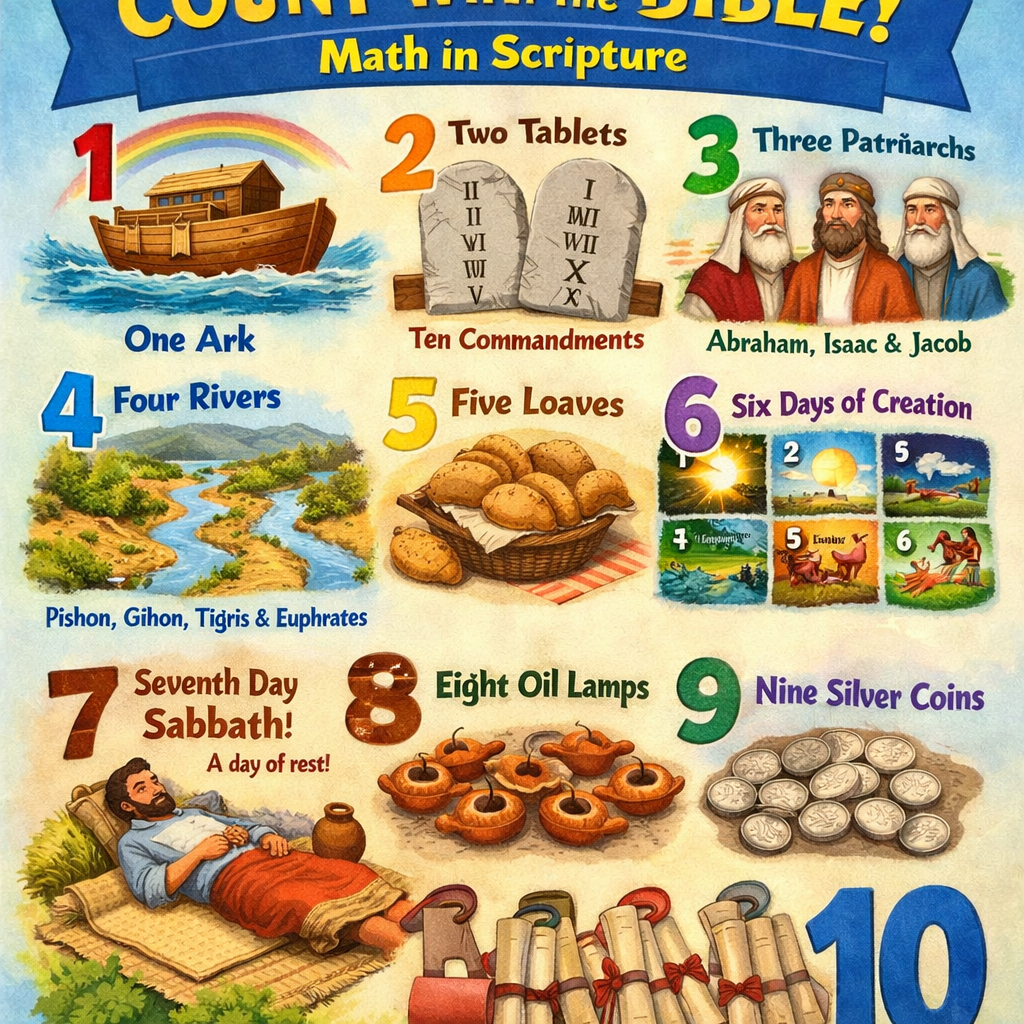
Learning to count with Yahuah!
A ratio compares two quantities. Ratios show relationships between numbers.
If there are 3 apples and 5 oranges:
Example: Noah brought animals onto the ark. If there were 14 clean animals and 2 unclean animals of a certain kind, what is the ratio of clean to unclean?
Answer: 14:2 = 7:1 (simplified)
This means for every 1 unclean animal, there were 7 clean animals!
Equivalent Ratios have the same value when simplified:
Proportions are equations stating that two ratios are equal:
Yahuah used specific ratios in designing the ark (Genesis 6:15): 300 cubits long, 50 cubits wide, 30 cubits high. The ratio 300:50:30 = 6:1:0.6. This 6:1 ratio is similar to modern cargo ships - Yahuah knew the optimal design!
1. Write each ratio three ways:
a) 12 disciples to 1 Messiah:
b) 7 days in a week, 1 is Sabbath:
2. Simplify these ratios:
a) 24:36 =
b) 15:25 =
c) 40:100 =
3. Solve for x using cross multiplication:
a) 3/4 = x/20 x =
b) 5/8 = 15/x x =
c) x/6 = 12/18 x =
4. Word Problem: The ratio of Levites to all Israelites was about 1:12. If there were 600,000 Israelites, approximately how many were Levites?
Answer: Levites
A rate is a ratio that compares two quantities with DIFFERENT units.
A unit rate has a denominator of 1. To find a unit rate, divide:
Example: The Israelites traveled 150 miles in 3 days.
Rate: 150 miles / 3 days
Unit rate: 150 ÷ 3 = 50 miles per day
Example: 5 loaves fed 5,000 men. What's the rate?
5000 ÷ 5 = 1,000 people per loaf (a miracle!)
1. Find the unit rate:
a) $24 for 6 hours of work = $ per hour
b) 280 miles in 4 hours = mph
c) 12 eggs for $3 = $ per egg
d) 40 days of rain, 960 hours total = hours per day
2. Which is the better buy?
a) 5 lb of flour for $4 OR 8 lb for $7
5 lb: $/lb 8 lb: $/lb Better buy:
3. Word Problem: The Israelites walked about 20 miles per day. If they traveled for 40 years (14,600 days), and walked 300 days per year, how many total miles?
Days walked: × Miles per day: 20 = total miles
Percent means "per hundred" (per cent = per 100). A percent is a ratio with a denominator of 100.
| Percent | Decimal | Fraction |
|---|---|---|
| 10% | 0.10 | 1/10 |
| 25% | 0.25 | 1/4 |
| 50% | 0.50 | 1/2 |
| 75% | 0.75 | 3/4 |
| 100% | 1.00 | 1/1 |
To convert:
The tithe is 10% - one tenth of what we earn belongs to Yahuah. If you earned $50, what is 10%? $50 × 0.10 = $5. Tithing teaches us that everything comes from Yahuah!
1. Convert to decimals:
a) 45% =
b) 8% =
c) 125% =
2. Convert to percents:
a) 0.35 = %
b) 0.07 = %
c) 3/5 = %
3. Find the percent of each number:
a) 20% of 150 =
b) 10% of $85 = $ (tithe)
c) 25% of 200 =
4. Word Problem: Of the 12 spies sent to Canaan, only 2 gave a good report. What percent gave a good report?
2/12 = / = %
Integers are whole numbers that can be positive, negative, or zero.
Comparing Integers:
Real-world integers:
1. Order from least to greatest:
a) 5, -3, 0, -7, 2 →
b) -1, -10, -5, 0, 3 →
2. Compare using <, >, or =:
a) -8 ___ -3
b) 0 ___ -5
c) -12 ___ -12
d) 4 ___ -9
3. Write the opposite:
a) 7 →
b) -15 →
c) 0 →
4. Real-world: The Dead Sea is at -1,400 feet. Jerusalem is at +2,500 feet. What is the difference in elevation?
Difference: feet
The absolute value of a number is its distance from zero on the number line. Distance is always positive!
We use vertical bars | | to show absolute value.
Think of it this way:
If you walk 5 steps forward (+5) or 5 steps backward (-5), you've still walked 5 steps total!
|+5| = 5 (5 steps from start)
|-5| = 5 (5 steps from start)
Absolute value reminds us that Yahuah sees the magnitude of our actions, not just the direction. Giving someone $5 has the same "size" of impact as taking $5 from them - but one is blessing, one is harm. The absolute value is the same, but the moral direction matters!
1. Find the absolute value:
a) |-12| =
b) |25| =
c) |-100| =
d) |0| =
2. Compare:
a) |-7| ___ |5|
b) |-3| ___ |-3|
c) |8| ___ |-10|
3. Solve:
a) |x| = 9, x could be or
b) |-4| + |3| =
c) |−8| − |2| =
The coordinate plane is a grid formed by two number lines: the horizontal x-axis and the vertical y-axis. They cross at the origin (0,0).
Every point is described by an ordered pair (x, y)
Remember: "Run before you jump" → x first, then y
| Quadrant | x-value | y-value | Example |
|---|---|---|---|
| I (top right) | + | + | (3, 4) |
| II (top left) | − | + | (−3, 4) |
| III (bottom left) | − | − | (−3, −4) |
| IV (bottom right) | + | − | (3, −4) |
1. Name the quadrant:
a) (5, 2) → Quadrant
b) (−3, 7) → Quadrant
c) (−4, −1) → Quadrant
d) (6, −5) → Quadrant
2. Plot these points on graph paper:
A(2, 3), B(−4, 1), C(−2, −3), D(5, −2), E(0, 4), F(−3, 0)
3. What are the coordinates of a point that is:
a) 4 units right and 3 units up from origin? (, )
b) 2 units left and 5 units down? (, )
An algebraic expression uses numbers, variables (letters), and operations. Variables represent unknown quantities.
Writing Expressions from Words:
| Words | Operation | Expression |
|---|---|---|
| 5 more than x | Addition | x + 5 |
| 3 less than y | Subtraction | y − 3 |
| twice a number n | Multiplication | 2n |
| a number divided by 4 | Division | n ÷ 4 or n/4 |
1. Write as an algebraic expression:
a) 7 more than a number n:
b) A number decreased by 4:
c) The product of 6 and x:
d) 10 less than twice y:
2. Identify the parts of: 4x + 3y − 9
Variables:
Coefficients:
Constant:
Number of terms:
To evaluate an expression means to find its value by substituting numbers for variables.
Example: Evaluate 3x + 5 when x = 4
Step 1: Replace x with 4: 3(4) + 5
Step 2: Multiply: 12 + 5
Step 3: Add: 17
If we express "praising Yahuah 7 times a day for d days" as 7d, then in 30 days we would praise Him 7 × 30 = 210 times! In one year (365 days): 7 × 365 = 2,555 times!
1. Evaluate when x = 6:
a) 2x + 3 =
b) 5x − 10 =
c) x² + 1 =
2. Evaluate when a = 3 and b = 5:
a) a + b =
b) 2a + 3b =
c) ab − 7 =
3. Word Problem: The formula for the number of days until Sabbath is: 7 − d, where d is today's day number (Sunday = 1, Saturday = 7).
If today is Tuesday (d = 3), how many days until Sabbath?
If today is Friday (d = 6), how many days until Sabbath?
An equation is a statement that two expressions are EQUAL. Solving means finding the value that makes it true.
Use inverse operations to isolate the variable:
Golden Rule: What you do to one side, you must do to the other!
Example 1: x + 5 = 12
Subtract 5 from both sides: x + 5 − 5 = 12 − 5
Solution: x = 7
Example 2: 3y = 24
Divide both sides by 3: 3y ÷ 3 = 24 ÷ 3
Solution: y = 8
1. Solve (addition/subtraction):
a) x + 7 = 15 → x =
b) y − 9 = 3 → y =
c) n + 12 = 12 → n =
2. Solve (multiplication/division):
a) 4x = 28 → x =
b) y/5 = 6 → y =
c) 7n = 49 → n =
3. Word Problems:
a) A number plus 40 equals 100. Write and solve the equation.
Equation: → x =
b) Three times a number is 36. Find the number.
Equation: → x =
An inequality compares two expressions that are NOT equal.
| Symbol | Meaning | Example |
|---|---|---|
| < | less than | 3 < 5 |
| > | greater than | 7 > 2 |
| ≤ | less than or equal to | x ≤ 10 |
| ≥ | greater than or equal to | y ≥ 5 |
| ≠ | not equal to | n ≠ 0 |
Graphing Inequalities:
Solve: x + 3 > 7
Subtract 3 from both sides: x > 4
This means x can be any number greater than 4 (like 4.1, 5, 100, etc.)
1. Write an inequality:
a) x is greater than 5:
b) y is at most 12:
c) n is no less than 3:
2. Solve:
a) x + 4 < 10 → x
b) y − 2 ≥ 5 → y
c) 3n > 15 → n
3. True or False?
a) If x > 3, is x = 3 a solution?
b) If y ≤ 7, is y = 7 a solution?
c) If n < -2, is n = 0 a solution?
Unit 1: 2) a) 2:3, b) 3:5, c) 2:5 | 3) a) 15, b) 24, c) 4 | 4) 50,000
Unit 2: 1) a) $4, b) 70, c) $0.25, d) 24
Unit 3: 1) 0.45, 0.08, 1.25 | 2) 35%, 7%, 60% | 3) 30, $8.50, 50 | 4) 1/6 ≈ 16.7%
Unit 4: 1) a) -7,-3,0,2,5 | 2) a) <, b) >, c) =, d) > | 3) a) -7, b) 15, c) 0 | 4) 3,900 ft
Unit 5: 1) 12, 25, 100, 0 | 2) a) >, b) =, c) < | 3) a) 9 or -9, b) 7, c) 6
Unit 6: 1) I, II, III, IV | 3) a) (4,3), b) (-2,-5)
Unit 7: 1) a) n+7, b) n-4, c) 6x, d) 2y-10 | 2) x,y; 4,3; -9; 3
Unit 8: 1) 15, 20, 37 | 2) 8, 21, 8 | 3) 4 days, 1 day
Unit 9: 1) 8, 12, 0 | 2) 7, 30, 7
Unit 10: 1) x>5, y≤12, n≥3 | 2) x<6, y≥7, n>5 | 3) F, T, F