Biology: Life by Design

Understanding Life Through a Creation Worldview

Youth Tier 2 | Grades 7-9

Welcome, Truth Seeker!

Biology is the study of life - and what better way to study it than to recognize the Designer behind it! In this workbook, you'll explore cells, genetics, body systems, and ecosystems while seeing how the incredible complexity of life points to Yahuah as Creator. We'll also examine why evolution fails to explain life's origin and diversity.

The 6Rs Learning Method: RECEIVE, REFLECT, RECALL, RECITE, REVIEW, RESPOND

Lesson 1: Cells - The Building Blocks of Life

RECEIVE - Learn the Truth

The Cell: Smallest Unit of Life

Every living thing is made of one or more cells. Cells are incredibly complex - even the "simplest" cell contains thousands of parts working together.

Cell Theory:

  • All living things are made of cells
  • Cells are the basic unit of life
  • All cells come from existing cells

Two Main Types:

  • Prokaryotic - No nucleus; bacteria (still incredibly complex!)
  • Eukaryotic - Has nucleus; plants, animals, fungi

Key Cell Parts (Organelles):

  • Cell Membrane - Controls what enters and exits (selective barrier)
  • Nucleus - Contains DNA; the "control center"
  • Mitochondria - Produces energy (ATP); "powerhouse of the cell"
  • Ribosomes - Makes proteins based on DNA instructions
  • Endoplasmic Reticulum - Transports materials
  • Golgi Apparatus - Packages and ships proteins

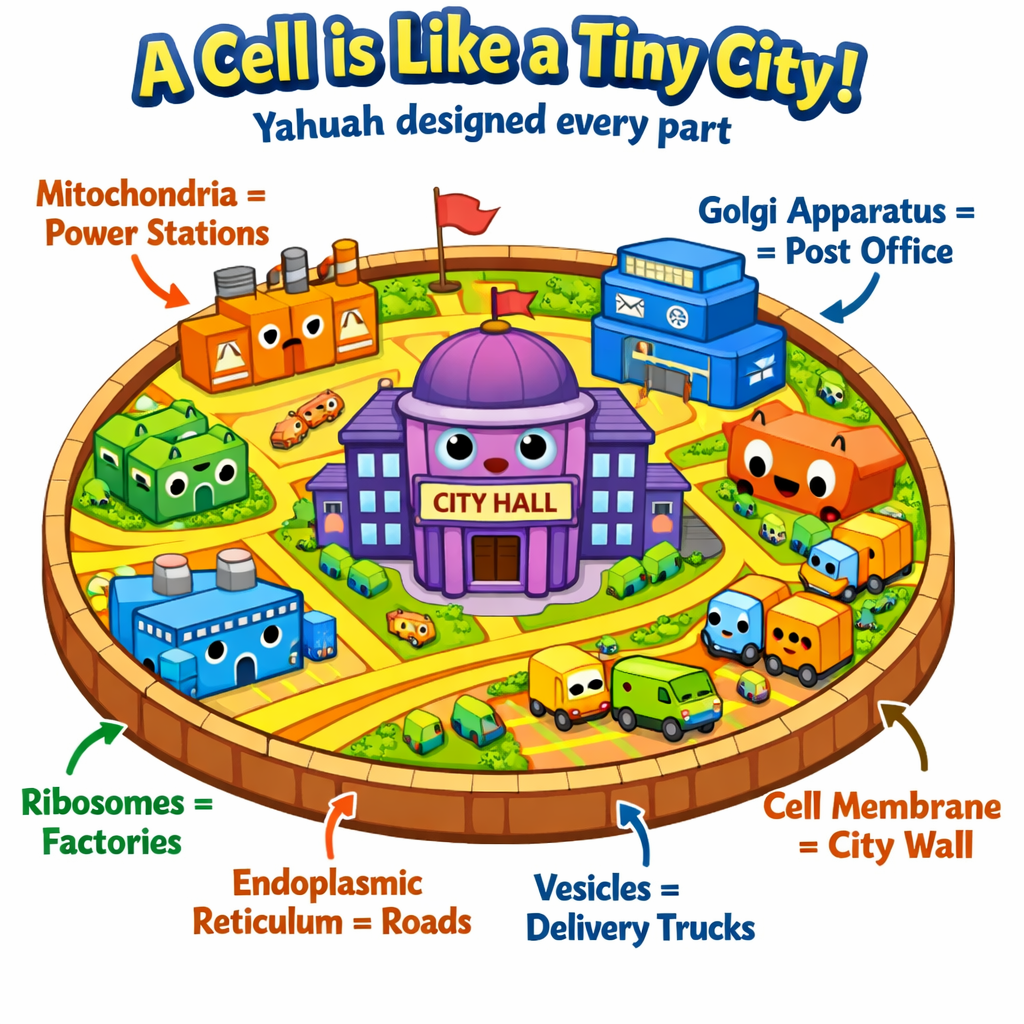
The Cell as a Factory: A cell is like a miniature city or factory with power plants (mitochondria), a library (nucleus), shipping departments (Golgi), and quality control (lysosomes). This level of organization doesn't arise by chance - it requires design!

The first cell arose by chance from non-living chemicals in a "primordial soup" billions of years ago.

Even the simplest cell is incredibly complex. The probability of a cell forming by chance is essentially zero. Life comes from life - and ultimately from the Life-Giver.

"For You formed my inward parts; You wove me in my mother's womb. I will give thanks to You, for I am fearfully and wonderfully made." (Psalm 139:13-14)
RECALL - Remember the Facts
1 The nucleus contains DNA and is the cell's control center.
2 Mitochondria produce energy and are called the "powerhouse of the cell."
3 Ribosomes make proteins based on DNA instructions.
4 Prokaryotic cells lack a nucleus (like bacteria).
RESPOND - Apply Your Knowledge
5 Why does the complexity of even the simplest cell point to intelligent design rather than chance?

Lesson 2: DNA - The Language of Life

RECEIVE - Learn the Truth

What is DNA?

DNA (Deoxyribonucleic Acid) is a molecule that contains the genetic instructions for building and operating living organisms. It's found in the nucleus of every cell.

Structure:

  • Double helix (twisted ladder shape)
  • Made of nucleotides with four bases: Adenine (A), Thymine (T), Guanine (G), Cytosine (C)
  • Base pairs: A pairs with T; G pairs with C
  • Human DNA has about 3 billion base pairs!

DNA as Information:

DNA is essentially a language - a code that contains instructions. Just as a book requires an author, information requires an intelligence to create it.

The DNA Code: If you stretched out all the DNA from one human cell, it would be about 6 feet long - yet it's packed into a nucleus only 6 micrometers across! This is like fitting 30 miles of thread into a tennis ball. The packing system is incredibly precise and purposeful.

How DNA Works:

  • Replication - DNA copies itself before cell division
  • Transcription - DNA code is copied to RNA
  • Translation - RNA code is read to build proteins

DNA arose by chance chemical reactions. Mutations in DNA drive evolution by creating new information.

Information always comes from intelligence. DNA is the most complex information storage system known - it had to be designed. Mutations lose or corrupt information; they don't create new complex features.

"Your eyes saw my unformed substance; and in Your book were all written the days that were ordained for me, when as yet there was not one of them." (Psalm 139:16) Yahuah wrote our genetic code!
RECALL - Remember the Facts
1 DNA stands for Deoxyribonucleic Acid.
2 The four DNA bases are A, T, G, C.
3 A pairs with T; G pairs with C.
4 Human DNA has about 3 billion base pairs.
RESPOND - Apply Your Knowledge
5 Why does the presence of information (code) in DNA require an intelligent source?

Lesson 3: Genetics & Inheritance

RECEIVE - Learn the Truth

Passing Traits to Offspring

Genetics is the study of how traits are inherited from parents to offspring. Gregor Mendel (a Christian monk) discovered the basic laws of inheritance in the 1860s.

Key Terms:

  • Gene - A segment of DNA that codes for a specific trait
  • Allele - Different versions of a gene (e.g., brown eyes vs. blue eyes)
  • Dominant - An allele that shows when present (even with one copy)
  • Recessive - An allele that only shows when two copies are present
  • Genotype - The genetic makeup (e.g., Bb)
  • Phenotype - The physical expression (e.g., brown eyes)

Variation Within Kinds

Genetics explains the amazing variety within created kinds. Dogs can produce many breeds - but dogs always produce dogs. This is variation within a kind, NOT evolution into a different kind.

Built-in Variation: Yahuah designed organisms with genetic diversity built in. This allows adaptation to different environments without requiring new genetic information. Dog breeds, for example, all came from wolf-like ancestors - but they're still dogs!

Natural selection acting on random mutations causes organisms to evolve into completely new kinds over millions of years.

Variation occurs within created kinds, but kinds don't change into other kinds. Natural selection can only select from existing genetic information - it can't create new complex features.

"Then Elohim said, 'Let the earth bring forth living creatures after their kind.'" (Genesis 1:24) Organisms reproduce "after their kind" - not into other kinds.
RECALL - Remember the Facts
1 A gene is a segment of DNA coding for a trait.
2 Dominant alleles show even when only one copy is present.
3 Gregor Mendel discovered the basic laws of inheritance.
4 Phenotype is the physical expression of genes.
RESPOND - Apply Your Knowledge
5 How does the biblical concept of "kinds" explain dog breeds without evolution?

Lesson 4: The Human Body - Fearfully Made

RECEIVE - Learn the Truth

The Marvel of Human Design

The human body is the most complex known structure in the universe. Every system reveals incredible design.

Amazing Body Facts:

  • 37 trillion cells, each containing complete DNA
  • 206 bones, 600+ muscles working in coordination
  • 60,000 miles of blood vessels
  • Heart beats 100,000 times per day
  • Brain has 86 billion neurons making trillions of connections
  • Eyes can distinguish 10 million colors
  • Ears can detect vibrations as small as the width of an atom

The Eye: Darwin admitted: "To suppose that the eye... could have been formed by natural selection, seems, I freely confess, absurd in the highest degree." The eye has over 2 million working parts, all interdependent. Remove any part and vision fails. This is called "irreducible complexity."

Body Systems Working Together:

  • Skeletal - Framework and protection
  • Muscular - Movement
  • Circulatory - Transports blood/nutrients
  • Respiratory - Gas exchange
  • Digestive - Processes food
  • Nervous - Control and communication
  • Immune - Defends against disease
"I will give thanks to You, for I am fearfully and wonderfully made; wonderful are Your works, and my soul knows it very well." (Psalm 139:14)
RECALL - Remember the Facts
1 The human body has approximately 37 trillion cells.
2 The brain has about 86 billion neurons.
3 Irreducible complexity describes systems that need all parts to function.
4 The circulatory system transports blood and nutrients.
RESPOND - Apply Your Knowledge
5 Why did Darwin admit the eye seemed "absurd" to have evolved? What does this teach us?

Lesson 5: Body Systems Working Together

RECEIVE - Learn the Truth

Interdependent Systems

Body systems don't work alone - they depend on each other. This interdependence points to design.

Circulatory System:

  • Heart pumps blood through arteries, capillaries, veins
  • Red blood cells carry oxygen; white blood cells fight infection
  • Blood delivers nutrients and removes waste

Respiratory System:

  • Lungs exchange oxygen and carbon dioxide
  • Works with circulatory system - blood picks up O₂ in lungs
  • 300 million alveoli provide surface area of a tennis court!

Digestive System:

  • Breaks down food into nutrients
  • Small intestine absorbs nutrients into blood
  • Works with circulatory to distribute nutrients

Nervous System:

  • Brain and spinal cord (central); nerves (peripheral)
  • Controls all other systems
  • Sends electrical signals at up to 250 mph

Systems Need Each Other: The respiratory system needs the circulatory system to distribute oxygen. The digestive system needs the nervous system to control it. The immune system protects all others. None could have evolved separately - they had to exist together from the start!

"The body is one and yet has many members, and all the members of the body, though they are many, are one body." (1 Corinthians 12:12) Paul uses the body as an example of how parts work together.
RECALL - Remember the Facts
1 Red blood cells carry oxygen.
2 The small intestine absorbs nutrients into the blood.
3 Nerve signals travel at up to 250 mph.
4 Alveoli are tiny air sacs in the lungs for gas exchange.
RESPOND - Apply Your Knowledge
5 Why does the interdependence of body systems point to creation rather than gradual evolution?

Lesson 6: Plants - Designed for Life

RECEIVE - Learn the Truth

The Amazing World of Plants

Plants are essential for life on Earth. They produce oxygen, provide food, and reveal incredible design.

Photosynthesis:

Plants convert sunlight, water, and carbon dioxide into glucose (sugar) and oxygen.

  • 6CO₂ + 6H₂O + Light Energy → C₆H₁₂O₆ + 6O₂
  • Occurs in chloroplasts using chlorophyll
  • The most important chemical reaction on Earth!

Perfect Balance: Animals breathe in oxygen and exhale CO₂. Plants take in CO₂ and release oxygen. This perfect balance can't have evolved separately - it requires design! Both systems had to exist from the beginning.

Plant Parts:

  • Roots - Absorb water and minerals; anchor plant
  • Stems - Support and transport
  • Leaves - Photosynthesis
  • Flowers - Reproduction
  • Seeds - New generation with stored food

Pollination Design:

Many plants depend on specific pollinators (bees, butterflies, birds). The plant and pollinator are designed for each other - the right flower shape, color, scent, and timing. This "co-design" points to a common Designer.

"Then Elohim said, 'Let the earth sprout vegetation, plants yielding seed, and fruit trees on the earth bearing fruit after their kind with seed in them'; and it was so." (Genesis 1:11)
RECALL - Remember the Facts
1 Photosynthesis converts sunlight, water, and CO₂ into sugar and oxygen.
2 Photosynthesis occurs in chloroplasts using chlorophyll.
3 Roots absorb water and minerals from soil.
4 Leaves are the main site of photosynthesis.
RESPOND - Apply Your Knowledge
5 How does the oxygen/CO₂ balance between plants and animals show design?

Lesson 7: Ecosystems & Interdependence

RECEIVE - Learn the Truth

Living Things Connected

An ecosystem is a community of living things interacting with each other and their environment.

Key Concepts:

  • Producers - Make their own food (plants)
  • Consumers - Eat other organisms (animals)
  • Decomposers - Break down dead matter (fungi, bacteria)
  • Food Chain - Energy flow: Producer → Herbivore → Carnivore
  • Food Web - Interconnected food chains

Symbiotic Relationships:

  • Mutualism - Both benefit (bees and flowers)
  • Commensalism - One benefits, other unaffected
  • Parasitism - One benefits at other's expense

Ecosystem Balance: Remove one species and the whole ecosystem can collapse. Wolves were removed from Yellowstone - deer overpopulated, ate too much vegetation, rivers eroded differently! Everything is connected by design.

Cycles:

  • Water Cycle - Evaporation, condensation, precipitation
  • Carbon Cycle - CO₂ between atmosphere, plants, animals
  • Nitrogen Cycle - Nitrogen fixed by bacteria for plants
"You cause the grass to grow for the cattle, and vegetation for the labor of man, so that he may bring forth food from the earth." (Psalm 104:14) Yahuah designed ecosystems to sustain life.
RECALL - Remember the Facts
1 Producers make their own food through photosynthesis.
2 Decomposers break down dead matter.
3 Mutualism is when both organisms benefit.
4 A food web shows interconnected food chains.
RESPOND - Apply Your Knowledge
5 How does the balance and interdependence in ecosystems point to a wise Creator?

Lesson 8: Evolution Examined

RECEIVE - Learn the Truth

What Evolution Claims

Darwinian evolution claims that all life descended from a common ancestor through random mutations and natural selection over billions of years.

Problems with Evolution:

1. No Mechanism for New Information

Mutations corrupt or delete genetic information - they don't create new complex features. No one has ever observed a mutation add new functional information.

2. Irreducible Complexity

Many systems need all parts to function. A mousetrap needs all parts - remove one and it doesn't work. The bacterial flagellum has 40+ parts; none can be removed. These systems can't evolve gradually.

3. The Cambrian Explosion

Most major animal body plans appear suddenly in the fossil record, fully formed, with no ancestors. This contradicts gradual evolution.

4. Living Fossils

Many organisms look identical to fossils supposedly millions of years old. If evolution is constant, why no change?

5. No Transitional Forms

Despite millions of fossils, there are no clear transitions between major kinds. Where are the half-fish/half-amphibians?

"Evolution is a fact supported by overwhelming evidence."

Variation within kinds is observable; molecules-to-man evolution is not. The evidence actually points to creation.

"For since the creation of the world His invisible attributes, His eternal power and divine nature, have been clearly seen, being understood through what has been made." (Romans 1:20)
RECALL - Remember the Facts
1 Irreducible complexity refers to systems needing all parts to function.
2 The Cambrian Explosion shows animals appearing suddenly without ancestors.
3 Living fossils are organisms unchanged from supposedly ancient forms.
4 Mutations corrupt/delete information rather than creating new features.
RESPOND - Apply Your Knowledge
5 Which problem with evolution do you find most compelling? Explain.

Lesson 9: The Fossil Record

RECEIVE - Learn the Truth

What Fossils Really Show

Evolutionists claim the fossil record proves gradual evolution over millions of years. But what does it actually show?

The Fossil Record Shows:

  • Sudden Appearance - New forms appear abruptly, fully formed
  • Stasis - Organisms remain unchanged throughout their fossil range
  • No Transitions - Missing links remain missing
  • Rapid Burial - Fossils show catastrophic, not gradual, burial

"Transitional" Forms Examined:

  • Archaeopteryx - Has fully-formed feathers, not transitional; other birds appear in same layers
  • Horse Evolution - Actually shows variety within a kind, not upward evolution
  • Human Evolution - "Ape-men" are either fully ape or fully human; many frauds exposed

Soft Tissue in Dinosaur Bones: Blood vessels, blood cells, and proteins have been found in dinosaur bones. These cannot survive millions of years! This fits a young earth with dinosaurs buried in the Flood thousands of years ago.

The fossil record shows gradual change over millions of years.

The fossil record shows sudden appearance, stasis, and rapid burial - exactly what we'd expect from creation and a global Flood.

"For in six days Yahuah made the heavens and the earth, the sea and all that is in them." (Exodus 20:11)
RECALL - Remember the Facts
1 Stasis means organisms remain unchanged in the fossil record.
2 Soft tissue found in dinosaur bones challenges millions of years.
3 Fossils show rapid/sudden burial, not gradual accumulation.
4 Most "ape-men" are either fully ape or fully human.
RESPOND - Apply Your Knowledge
5 How does the discovery of soft tissue in dinosaur bones support the biblical timeline?

Lesson 10: Origins - Creation vs. Evolution

RECEIVE - Learn the Truth

Two Worldviews

The origins debate isn't just about science - it's about worldviews. Both creation and evolution are beliefs about the unobserved past.

Evolution Requires:

  • Life from non-life (never observed)
  • Information arising by chance (contradicts information science)
  • New complex features from mutations (never observed)
  • Billions of years (assumed, not proven)
  • Transitional forms (not found)

Creation Explains:

  • Life comes from life - the Life-Giver
  • Information comes from intelligence - the Designer
  • Complex systems designed complete - irreducible complexity
  • Young earth evidence - magnetic field decay, soft tissue, etc.
  • Kinds produce after their kind - as observed

Why It Matters:

If we're created, we have purpose, meaning, and moral accountability to our Creator. If we evolved by chance, there's no ultimate purpose, meaning, or morality. The origins question affects everything!

The Real Issue: Many scientists reject creation not because of evidence, but because they don't want accountability to a Creator. As one evolutionist admitted: "We cannot allow a Divine Foot in the door."

"In the beginning Elohim created the heavens and the earth." (Genesis 1:1) The Bible's first sentence answers life's biggest question.

Standing Firm:

You may face pressure to accept evolution in school or culture. Remember: the evidence supports creation! Don't let anyone intimidate you into abandoning the truth. Study, know the evidence, and be ready to give an answer (1 Peter 3:15).

RECALL - Remember the Facts
1 Both creation and evolution are beliefs/worldviews about the unobserved past.
2 If we're created, we have purpose and accountability to our Creator.
3 Life from non-life has never been observed.
4 1 Peter 3:15 tells us to be ready to give an answer for our faith.
RESPOND - Apply Your Knowledge
5 Why does the origins question affect everything - purpose, meaning, morality?
6 How can you prepare to answer when challenged about creation?
7 What has been the most important thing you've learned in this biology course?

Answer Key

Lesson 1: Cells

1. nucleus | 2. Mitochondria | 3. Ribosomes | 4. Prokaryotic

Lesson 2: DNA

1. Deoxyribonucleic Acid | 2. A, T, G, C | 3. T, C | 4. 3 billion

Lesson 3: Genetics

1. gene | 2. Dominant | 3. Gregor Mendel | 4. Phenotype

Lesson 4: Human Body

1. 37 trillion | 2. 86 billion | 3. Irreducible complexity | 4. circulatory

Lesson 5: Body Systems

1. Red | 2. small intestine | 3. 250 | 4. Alveoli

Lesson 6: Plants

1. Photosynthesis | 2. chloroplasts | 3. Roots | 4. Leaves

Lesson 7: Ecosystems

1. Producers | 2. Decomposers | 3. Mutualism | 4. food web

Lesson 8: Evolution Examined

1. Irreducible complexity | 2. Cambrian Explosion | 3. Living fossils | 4. corrupt/delete

Lesson 9: Fossil Record

1. Stasis | 2. Soft tissue | 3. rapid/sudden | 4. ape, human

Lesson 10: Origins

1. beliefs/worldviews | 2. purpose | 3. never | 4. 1 Peter 3:15