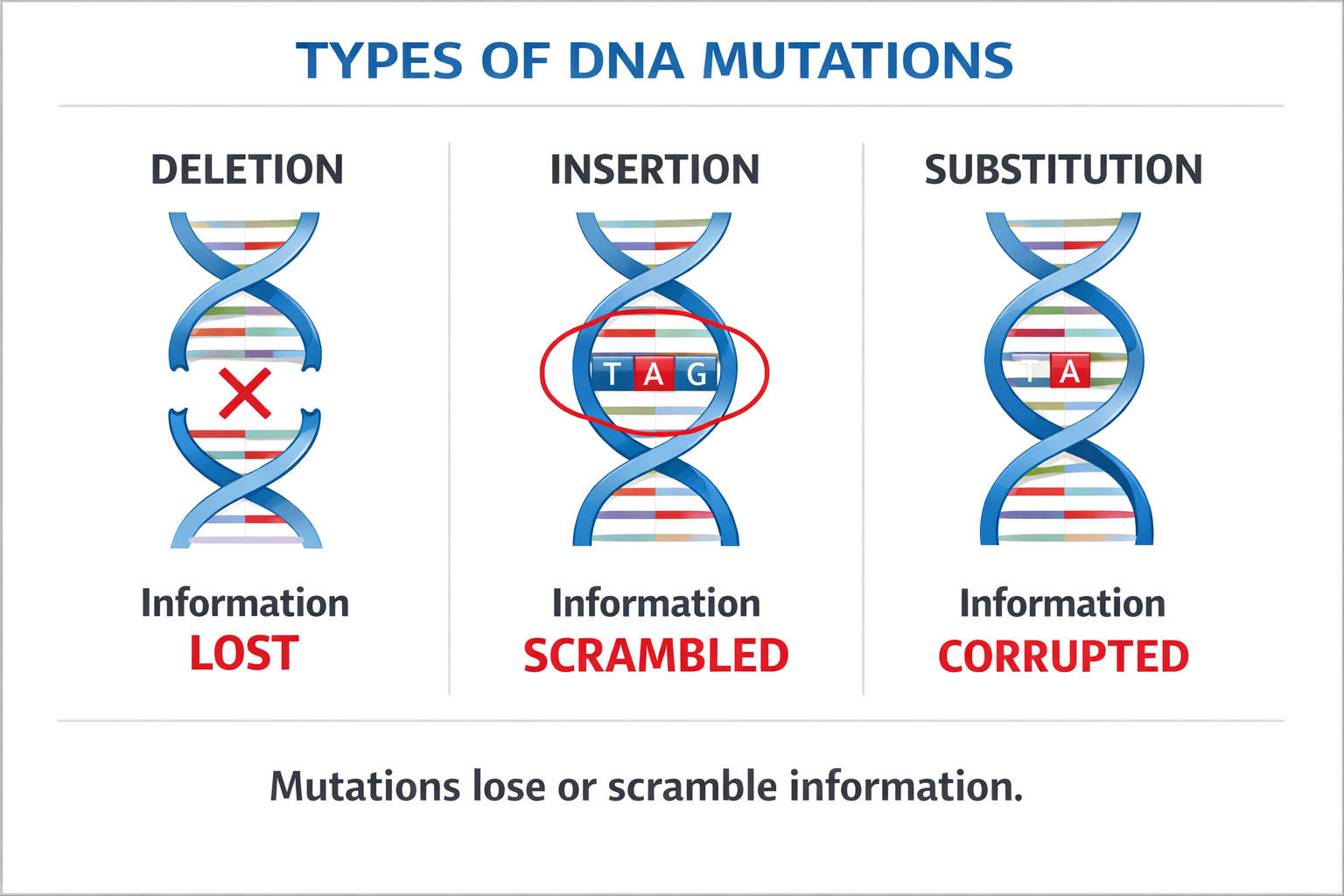
Types of mutations
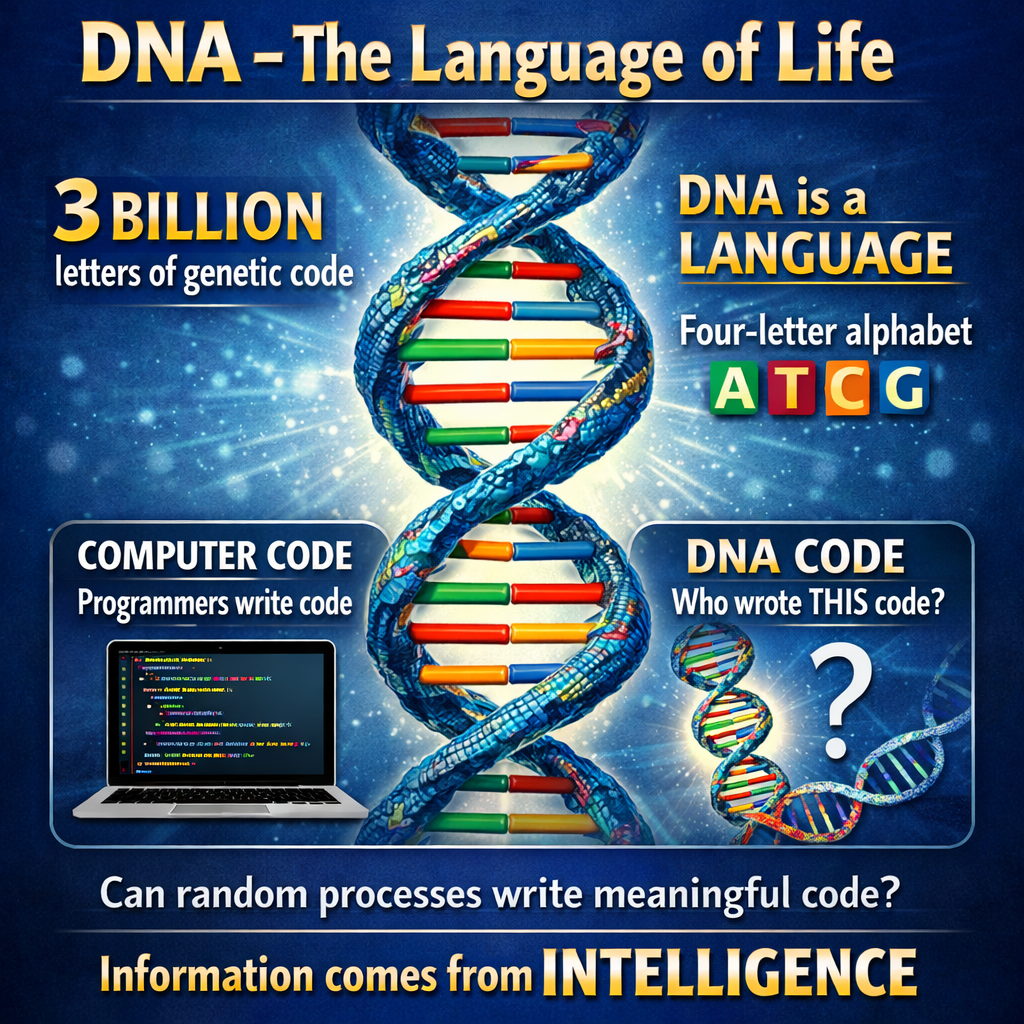
DNA information
Why Mutations Can't Create New Information
Truth Carriers Academy | All Ages
Types of mutations
DNA information
Evolution claims that all life descended from a single common ancestor. This means bacteria eventually became fish, fish became amphibians, amphibians became reptiles, and reptiles became mammals and birds.
Random mutations + natural selection = new complex features, organs, and body plans over millions of years.
In other words: Mutations CREATE new genetic information that builds complexity.
Mutations are COPYING ERRORS in DNA. They:
NEVER has a mutation been observed to create NEW, FUNCTIONAL genetic information that didn't exist before!

DNA is a massive instruction set—mutations are copying errors in that code
DNA is like a massive instruction book written in a 4-letter alphabet (A, T, G, C). Human DNA contains about 3 BILLION letters of precise code.
| Mutation Type | What Happens | Creates New Info? |
|---|---|---|
| Deletion | DNA letters removed | NO - loses information |
| Substitution | One letter replaced by another | NO - changes existing info |
| Insertion | Extra letters added | NO - usually duplicates |
| Duplication | Section copied | NO - copies don't create new |
| Inversion | Section reversed | NO - just rearranges |
Imagine a book with instructions for building a car.
If you randomly change, delete, or duplicate letters:
Typos don't write new chapters. Mutations don't create new organs.

Common mutation types: deletion, substitution, insertion, duplication
1. What is a mutation?
2. Why can't deletions or duplications create NEW information?
Studies show that mutations are:
Even the "beneficial" mutations involve LOSS or damage to information, not gain of new information.
These are what mutations ACTUALLY produce - not new organs or abilities!
"Mutations are rare, random, and overwhelmingly harmful." - Dr. Lee Spetner, Not By Chance
1. What percentage of mutations are harmful?
2. Name two diseases caused by mutations:
Claim: Bacteria evolve resistance to antibiotics - proof of evolution in action!
Antibiotic resistance usually occurs through:
No new information is created! The bacteria become more specialized (less complex), not more evolved.

Antibiotic resistance: selection of existing resistant bacteria, not creation of new information
Claim: Sickle cell provides malaria resistance - beneficial mutation!
It's like breaking your legs so you can't walk into a minefield. "Beneficial" through LOSS, not gain!
Claim: Humans evolved ability to digest milk as adults!
Again, this is LOSS of a control mechanism, not gain of new information!
Every "beneficial" mutation, when examined closely, involves:
NONE create new functional information that didn't exist before!
1. How does antibiotic resistance actually occur?
2. Why is sickle cell NOT a good example of beneficial mutation?
For a fish to become a human, evolution needs NEW genetic information for:
These require THOUSANDS of NEW genes that didn't exist in fish!
The mathematical probability of getting even ONE new functional gene by chance is essentially zero!
"The probability of life originating from accident is comparable to the probability of the Unabridged Dictionary resulting from an explosion in a printing factory." - Edwin Conklin, Princeton biologist
Imagine a library with books on car repair.
Evolution claims that by randomly changing, deleting, and duplicating letters, the library will eventually contain books on:
This is what evolution requires - random errors creating entire new "instruction manuals" for complex organs.
Has this ever been observed? NO!
1. What new features would need to evolve for a fish to become a human?
2. Why is the library analogy relevant?
Natural selection is the "creative" force of evolution - it selects beneficial mutations and builds complexity over time.
Natural selection can only:
Natural selection CANNOT:
If you have a basket of red and blue balls:
Selection works on what exists - it doesn't create what doesn't exist.
The variation we see in living things comes from:
Over time, organisms LOSE genetic diversity, they don't gain it!
1. What can natural selection do? What can it NOT do?
2. Where does genetic variety actually come from?
| Evolution Claims | Reality |
|---|---|
| Mutations create new information | Mutations lose, corrupt, or rearrange information |
| Beneficial mutations build complexity | "Beneficial" mutations work by LOSING functions |
| Natural selection creates | Natural selection only selects from what exists |
| Given enough time, anything can evolve | More time = more degradation, not improvement |
1. Why can't mutations create new genetic information?
2. Give an example of a "beneficial" mutation and explain why it's actually a LOSS:
3. What does the evidence about mutations tell us about origins?