Earth Science

Biblical Geology & Earth Studies

Youth Tier 2 | Grades 7-9

Welcome, Truth Seeker!

In this workbook, you'll explore Earth science from a biblical worldview. While mainstream science claims the earth is billions of years old and formed through slow processes, Scripture reveals a young earth shaped dramatically by Yahuah's creation and the global Flood. We'll examine both views, present evidence, and discover how true science supports the biblical account.

The 6Rs Learning Method: RECEIVE the teaching, REFLECT on its meaning, RECALL the key facts, RECITE Scripture connections, REVIEW through exercises, and RESPOND with application.

Your Progress

0 of 10 lessons completed

Lesson 1: Earth's Structure

RECEIVE - Learn the Truth

The Layers of Earth

Both mainstream and biblical scientists agree that Earth has distinct layers, though they differ on how and when these formed:

  • Crust - The thin outer layer (5-70 km thick). Includes oceanic crust (thinner, denser) and continental crust (thicker, less dense).
  • Mantle - The thick middle layer (about 2,900 km thick). Made of semi-solid rock that can flow slowly.
  • Outer Core - Liquid iron and nickel (about 2,200 km thick). Creates Earth's magnetic field.
  • Inner Core - Solid iron and nickel (about 1,200 km radius). Extremely hot but solid due to pressure.

Earth formed 4.5 billion years ago from a cloud of gas and dust. Over millions of years, dense materials sank to form the core while lighter materials rose to form the crust.

Yahuah created Earth with its structure already in place during Creation Week (Genesis 1). The layers were designed for purpose - the core generates our protective magnetic field, the mantle allows for mineral cycles.

Earth's Magnetic Field is Decaying: Measurements since 1835 show Earth's magnetic field strength is decreasing. At current decay rates, extrapolating back millions of years would mean impossibly strong fields. The data fits a young earth (thousands of years) much better than billions.
"In the beginning Elohim created the heavens and the earth." (Genesis 1:1) Yahuah created Earth complete and functional, not through billions of years of random processes.
REFLECT - Consider the Meaning

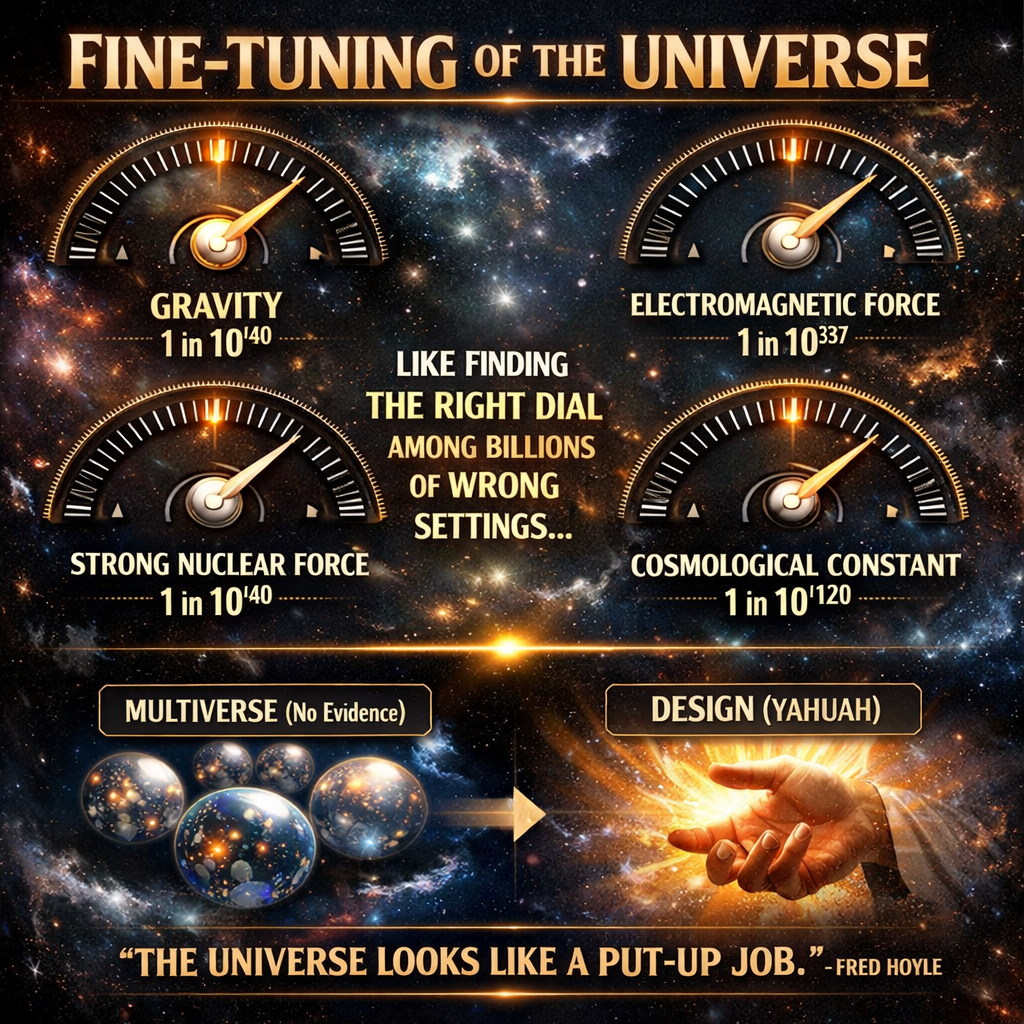
Earth's structure reveals design. The magnetic field protects us from harmful solar radiation. The crust contains the minerals and resources we need. The atmosphere is perfectly tuned for life. These features show planning and purpose, not random chance.

RECALL - Remember the Facts
1 The four main layers of Earth from outside to inside are crust, mantle, outer core, and inner core.
2 The outer core is liquid and generates Earth's magnetic field.
3 The thickest layer of Earth is the mantle.
4 Earth's magnetic field is getting weaker/decaying over time.
REVIEW - Practice Questions
5 Why is oceanic crust thinner but denser than continental crust?
6 How does the decay of Earth's magnetic field support a young earth?
RESPOND - Apply Your Knowledge
7 How does Earth's protective magnetic field demonstrate Yahuah's care for His creation?

Lesson 2: Minerals & Rocks

RECEIVE - Learn the Truth

What are Minerals?

A mineral is a naturally occurring, inorganic solid with a definite chemical composition and crystalline structure. There are over 4,000 known minerals. Common examples include quartz, feldspar, and calcite.

Properties Used to Identify Minerals:

  • Hardness - Resistance to scratching (Mohs scale 1-10)
  • Luster - How light reflects (metallic, glassy, dull, etc.)
  • Color - Can be misleading as impurities change color
  • Streak - Color of powdered mineral
  • Cleavage/Fracture - How it breaks
  • Crystal Shape - Geometric pattern

The Three Types of Rock:

  • Igneous - Formed from cooled magma/lava. Examples: granite, basalt, obsidian
  • Sedimentary - Formed from deposited sediments that compact and cement. Examples: limestone, sandstone, shale
  • Metamorphic - Changed by heat and pressure. Examples: marble (from limestone), slate (from shale)

Rapid Rock Formation: Mainstream science claims sedimentary rocks take millions of years. But we observe rocks forming rapidly today! Concrete is artificial rock made in hours. Stalactites have formed on man-made structures in decades. A hat left in a mine became petrified in 50 years. Time is not the key factor - conditions are!

"He is the Rock, His work is perfect." (Deuteronomy 32:4) Scripture often uses rock as a metaphor for Yahuah's strength and reliability.
REFLECT - Consider the Meaning

Rocks don't require millions of years to form. Given the right conditions (water, minerals, pressure), rocks can form quickly. The global Flood provided exactly these conditions on a massive scale, explaining the vast sedimentary rock layers we see today.

RECALL - Remember the Facts
1 The three types of rock are igneous, sedimentary, and metamorphic.
2 Igneous rock forms from cooled magma or lava.
3 Sedimentary rock forms from compacted and cemented sediments.
4 The Mohs scale measures mineral hardness.
REVIEW - Practice Questions
5 Give an example of rapid rock formation that challenges the "millions of years" idea:
6 What type of rock would form if limestone was subjected to intense heat and pressure? _______
Activity: Collect 3-5 rocks from your area. Use the properties listed to try identifying each one. Is it igneous, sedimentary, or metamorphic?
RESPOND - Apply Your Knowledge
7 Why is it important to know that rocks can form quickly rather than requiring millions of years?

Lesson 3: The Global Flood

RECEIVE - Learn the Truth

The Biblical Account

Genesis 6-9 describes a catastrophic global Flood sent by Yahuah as judgment for mankind's wickedness. Noah, his family, and representatives of all air-breathing land animals survived on the Ark. This wasn't a local flood - it covered "all the high mountains under the entire heavens" (Genesis 7:19).

Sources of the Flood Waters:

  • "All the fountains of the great deep burst open" (Genesis 7:11) - Massive underground water sources broke through
  • "The floodgates of the sky were opened" (Genesis 7:11) - Intense rain for 40 days
  • Waters prevailed for 150 days (Genesis 7:24)

There was no global flood. Geological features formed over millions of years through slow processes (uniformitarianism). "The present is the key to the past."

The global Flood was a real, historical event that dramatically reshaped Earth's surface. Catastrophism (sudden, large-scale events) explains geology far better than slow processes.

Evidence for the Global Flood:

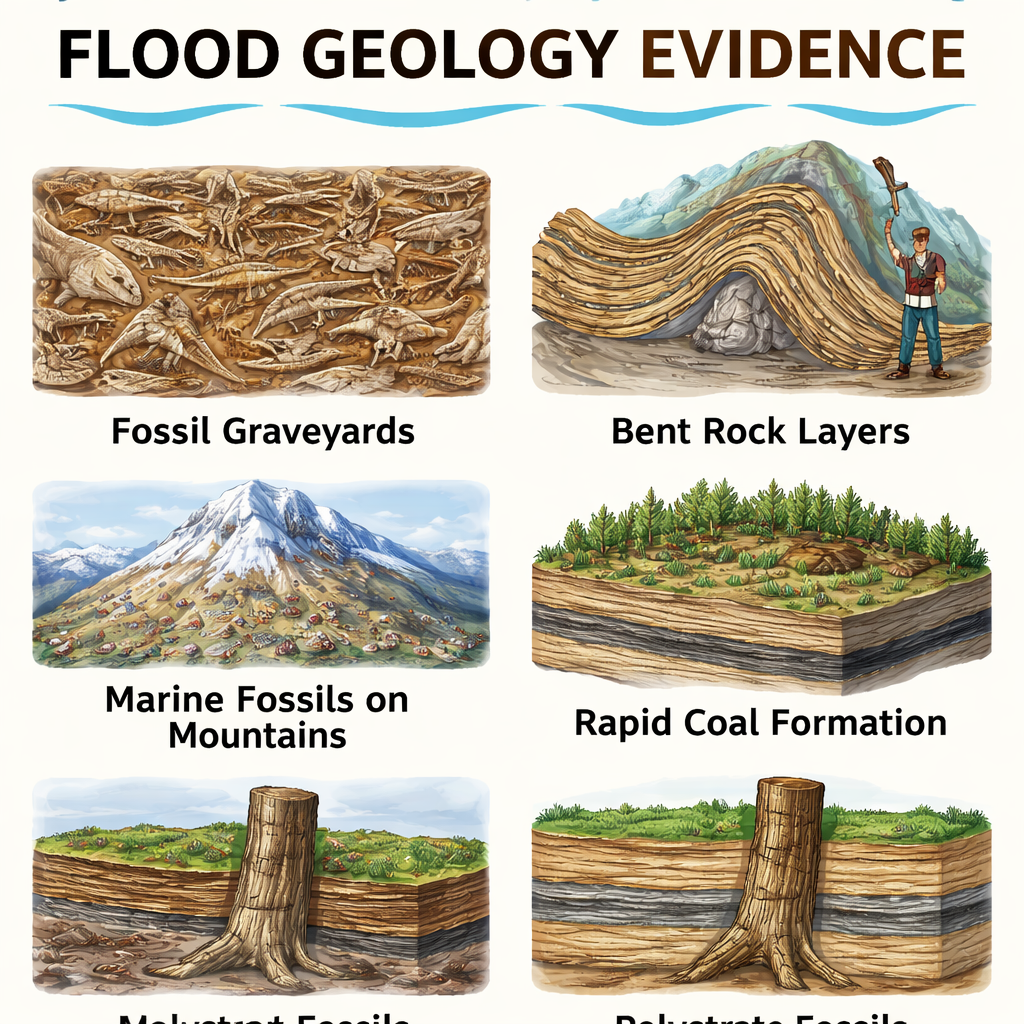
  • Marine fossils on mountaintops worldwide
  • Massive sedimentary rock layers spanning continents
  • Billions of fossils buried rapidly in water-deposited sediment
  • Polystrate fossils (trees extending through multiple "millions of years" of layers)
  • Soft tissue in dinosaur bones (shouldn't last millions of years)
  • Flood legends in virtually every ancient culture worldwide
"For after seven more days, I will send rain on the earth forty days and forty nights; and I will blot out from the face of the land every living thing that I have made." (Genesis 7:4)
REFLECT - Consider the Meaning

The Flood was Yahuah's judgment on a wicked world, but also His mercy in saving Noah's family. It demonstrates both His righteousness and His grace. The Flood reshaped Earth's entire geology in about a year - something mainstream geology attributes to hundreds of millions of years.

Yahusha Himself referred to Noah and the Flood as real history (Matthew 24:37-39), not myth. If we believe Him, we must believe the Flood account.

RECALL - Remember the Facts
1 The two sources of Flood water were the "fountains of the great deep" and the "floodgates of the sky/heaven."
2 It rained for 40 days and nights.
3 The waters prevailed on the earth for 150 days.
4 Marine/sea fossils found on mountaintops are evidence of the Flood.
REVIEW - Practice Questions
5 List three pieces of evidence that support a global flood:
6 What are "polystrate fossils" and why do they challenge mainstream geology?
7 In Matthew 24:37-39, Yahusha compared His return to what event?
RESPOND - Apply Your Knowledge
8 What does the Flood teach us about Yahuah's character - both His judgment and His mercy?

Lesson 4: Fossils Tell the Story

RECEIVE - Learn the Truth

What are Fossils?

A fossil is the preserved remains or trace of a once-living organism. Types include:

  • Body fossils - Actual remains (bones, shells, teeth)
  • Trace fossils - Evidence of activity (footprints, burrows)
  • Mold/cast fossils - Impressions in rock
  • Petrified fossils - Minerals replace original material

How Fossils Form:

Rapid burial is essential! A dead animal left on the surface decays and is scavenged - it doesn't become a fossil. Fossils require quick burial in sediment, typically by water.

The fossil record shows evolution over millions of years. Lower layers = older organisms, upper layers = newer. Transitional forms show species changing into other species.

Fossils were primarily formed during the global Flood. The order reflects burial sequence during the catastrophe (ocean floor creatures first, then lowland animals, then upland animals), not evolutionary age. There are no genuine transitional forms.

Fossil Problems for Evolution:

  • Cambrian Explosion - Complex animal life appears suddenly, fully formed, with no ancestors
  • Stasis - Fossils look the same as living creatures today (living fossils)
  • Missing Links - Despite millions of fossils, no clear transitional forms
  • Soft Tissue - Blood vessels, cells, and proteins found in dinosaur bones - can't last millions of years
  • Rapid Burial - Fossils show animals buried suddenly, often in action poses
"All flesh that moved on the earth perished, birds and cattle and beasts and every swarming thing that swarms upon the earth, and all mankind." (Genesis 7:21) The Flood buried billions of creatures, creating the fossil record we observe today.
REFLECT - Consider the Meaning

The fossil record is not a record of evolution but a record of death - specifically, death from the Flood judgment. Billions of dead things buried in rock layers laid down by water all over the earth - exactly what we'd expect from Noah's Flood.

RECALL - Remember the Facts
1 For a fossil to form, the organism must be buried rapidly/quickly.
2 The Cambrian Explosion refers to complex animals appearing suddenly in the fossil record with no ancestors.
3 Soft tissue found in dinosaur bones is evidence they are not millions of years old.
4 A living fossil is an organism that looks the same today as its fossil version.
REVIEW - Practice Questions
5 Why is rapid burial necessary for fossil formation?
6 How does the biblical Flood explain the order of fossils in rock layers?
RESPOND - Apply Your Knowledge
7 How might you respond to someone who says "fossils prove evolution"?

Lesson 5: Rock Layers & Rapid Formation

RECEIVE - Learn the Truth

Sedimentary Layers

Sedimentary rock layers (strata) are found all over the world. Mainstream geologists assign them ages of millions of years. But do the rocks actually require long ages to form?

Uniformitarianism: The assumption that present geological processes, operating at current rates, have always been the same. "The present is the key to the past."
Catastrophism: The view that major geological features were formed by large-scale, rapid catastrophic events - like the global Flood.

Evidence for Rapid Layer Formation:

  • Mt. St. Helens (1980) - A volcanic eruption deposited 25+ feet of finely layered strata in hours, not millions of years
  • No Erosion Between Layers - If millions of years passed between layers, we'd see erosion channels, soil formation, root penetration. We don't.
  • Flat Contacts - Layer boundaries are often flat and parallel, suggesting continuous deposition
  • Continent-Spanning Layers - Some layers extend across entire continents, requiring water coverage at continental scale
  • Folded Layers Without Breaking - Rock layers bent smoothly, as if still soft when folded (not brittle after millions of years)

The "Geologic Column"

Textbooks show a standard sequence of rock layers representing different "ages." But this complete sequence doesn't exist anywhere on Earth! It's a theoretical construct. In many places, "older" layers sit on top of "younger" ones, which mainstream geology explains with complex overthrust theories.

"By the word of Yahuah the heavens were made... He gathers the waters of the sea together as a heap; He lays up the deeps in storehouses." (Psalm 33:6-7) Yahuah has power over the waters - He used them both in creation and in judgment.
REFLECT - Consider the Meaning

The assumption of uniformitarianism forces interpretations of millions of years. But when we start with Scripture and expect catastrophic Flood conditions, the rock layers make much more sense. The evidence fits the biblical model better than the evolutionary model.

RECALL - Remember the Facts
1 Uniformitarianism assumes present processes at current rates explain the past.
2 Catastrophism recognizes that rapid, large-scale events shaped geology.
3 The 1980 Mt. St. Helens eruption deposited many layered strata in hours.
4 The complete "geologic column" doesn't exist anywhere on Earth.
REVIEW - Practice Questions
5 Why is the lack of erosion between rock layers evidence against millions of years?
6 How do bent/folded rock layers support rapid formation while the rock was still soft?
RESPOND - Apply Your Knowledge
7 How does starting with different assumptions (uniformitarianism vs. catastrophism) lead to different interpretations of the same rocks?

Lesson 6: Mountains & Catastrophism

RECEIVE - Learn the Truth

How Mountains Form

Mountains are formed through tectonic processes - movement of Earth's crustal plates. Types include:

  • Fold Mountains - Formed when plates collide and crust buckles (Himalayas, Appalachians)
  • Volcanic Mountains - Built from lava and ash (Mt. Fuji, Mt. St. Helens)
  • Fault-Block Mountains - Formed when blocks of crust are pushed up along faults (Sierra Nevada)

Catastrophic Plate Tectonics

Creation scientists have proposed that during the Flood, plate movements occurred rapidly rather than slowly. This "runaway subduction" would explain:

  • The breakup of a single pre-Flood continent
  • Massive volcanic activity and earthquakes
  • Rapid mountain building
  • The release of hot water from "fountains of the great deep"

Mountains Show Flood Evidence:

  • Marine fossils (sea creatures) found on top of the world's highest mountains
  • Mountains appear geologically "young" - still sharp and rugged, not worn down
  • Psalm 104:6-8 describes waters covering mountains, then mountains rising and valleys sinking as Flood waters receded
"The mountains rose; the valleys sank down to the place which You established for them. You set a boundary that they may not pass over, so that they will not return to cover the earth." (Psalm 104:8-9) After the Flood, Yahuah raised mountains and lowered valleys, then promised never to flood the whole earth again.
REFLECT - Consider the Meaning

The highest mountains today may not be the same as pre-Flood mountains. Psalm 104 suggests major topographic changes during and after the Flood. Today's towering peaks rose as the floodwaters drained into deepening ocean basins.

RECALL - Remember the Facts
1 Fold mountains form when plates collide and the crust buckles.
2 Marine/sea fossils on mountaintops indicate they were once underwater.
3 Psalm 104:8 says mountains rose and valleys sank after the Flood.
REVIEW - Practice Questions
4 How does Psalm 104:6-9 describe the end of the Flood?
5 Why would rapid plate tectonics during the Flood explain the "fountains of the great deep"?
RESPOND - Apply Your Knowledge
6 What does Yahuah's promise to never flood the earth again (Genesis 9:11) tell us about His faithfulness?

Lesson 7: Volcanoes & Earthquakes

RECEIVE - Learn the Truth

Volcanoes

A volcano is an opening in Earth's crust through which magma, gases, and ash escape. Types include:

  • Shield volcanoes - Broad, gentle slopes from fluid lava (Hawaii)
  • Cinder cones - Steep, small, built from explosive fragments
  • Composite (stratovolcanoes) - Tall, steep, layered lava and ash (Mt. St. Helens)

Earthquakes

Earthquakes occur when stress built up in rocks is suddenly released. Key terms:

  • Focus - The point underground where the earthquake starts
  • Epicenter - The point on the surface directly above the focus
  • Magnitude - Measured on the Richter scale (each number is 10× more shaking)
  • Fault - A crack in Earth's crust where movement occurs

Most earthquakes and volcanoes occur along plate boundaries, especially the "Ring of Fire" around the Pacific Ocean.

Volcanic/Seismic Activity and the Flood:

The Flood involved massive volcanic and seismic activity - "the fountains of the great deep burst open." This would have released vast amounts of hot water and triggered intense earthquakes. Creation geologists believe there was far more volcanic and seismic activity during and shortly after the Flood than we see today.

"Then the earth shook and quaked; the foundations of the mountains were trembling and were shaken, because He was angry." (Psalm 18:7) Yahuah controls earthquakes and uses them according to His purposes.
RECALL - Remember the Facts
1 The point underground where an earthquake starts is the focus.
2 The point on the surface above the focus is the epicenter.
3 The Ring of Fire is a zone of high volcanic/seismic activity around the Pacific.
4 Shield volcanoes have broad, gentle slopes.
REVIEW - Practice Questions
5 Why do most earthquakes occur along plate boundaries?
6 How does the Flood model explain intense volcanic activity in Earth's past?
RESPOND - Apply Your Knowledge
7 Scripture shows Yahuah using earthquakes in judgment and prophecy. How should this affect how we view natural disasters?

Lesson 8: Water Cycle & Weather

RECEIVE - Learn the Truth

The Water Cycle

The water cycle is the continuous movement of water through Earth's systems:

  • Evaporation - Liquid water becomes water vapor (from oceans, lakes, rivers)
  • Transpiration - Water vapor released by plants
  • Condensation - Water vapor cools and forms clouds
  • Precipitation - Water falls as rain, snow, sleet, or hail
  • Collection - Water gathers in oceans, lakes, and groundwater

Weather vs. Climate

  • Weather - Short-term atmospheric conditions (today's forecast)
  • Climate - Long-term average weather patterns for a region

Factors Affecting Weather:

  • Temperature, air pressure, humidity
  • Wind patterns and air masses
  • Fronts (where different air masses meet)

Pre-Flood Climate: Genesis suggests a different pre-Flood world - possibly no rain (Genesis 2:5-6 mentions mist watering the ground). Some creation scientists propose a more uniform, mild global climate before the Flood. The post-Flood world saw dramatic climate changes, including the Ice Age.

"For He draws up the drops of water, they distill rain from the mist, which the clouds pour down, they drip upon man abundantly." (Job 36:27-28) Scripture accurately described the water cycle thousands of years before modern science!
REFLECT - Consider the Meaning

Job 36 describes evaporation and precipitation accurately, written perhaps 3,500+ years ago. The Bible isn't a science textbook, but when it touches on science, it's accurate. This is what we'd expect from the Creator's inspired Word.

RECALL - Remember the Facts
1 Evaporation is when liquid water becomes water vapor.
2 Condensation is when water vapor forms clouds.
3 Weather refers to short-term conditions; climate refers to long-term patterns.
4 A front is where different air masses meet.
REVIEW - Practice Questions
5 List the main stages of the water cycle in order:
6 How does Job 36:27-28 describe the water cycle?
RESPOND - Apply Your Knowledge
7 What does it mean for our faith that Scripture accurately describes scientific processes?

Lesson 9: The Firmament

RECEIVE - Learn the Truth

What is the Firmament?

On Day 2 of Creation, Yahuah made the "firmament" (Hebrew: raqia) to divide the waters above from the waters below (Genesis 1:6-8). The Hebrew word raqia comes from a root meaning "to beat or spread out" - like hammering metal into a thin sheet.

"Then Elohim said, 'Let there be a firmament in the midst of the waters, and let it divide the waters from the waters.' Thus Elohim made the firmament, and divided the waters which were under the firmament from the waters which were above the firmament; and it was so. And Elohim called the firmament Heaven." (Genesis 1:6-8)

Biblical Description:

  • The firmament is called "Heaven" (Genesis 1:8)
  • Birds fly in "the open firmament of heaven" (Genesis 1:20)
  • Sun, moon, and stars are placed "in the firmament" (Genesis 1:14-17)
  • It has "windows" that can open for rain (Genesis 7:11, 8:2)
  • Described as hard, like a mirror or molten glass (Job 37:18)

Space is an infinite vacuum. Stars are billions of light years away. Earth is a spinning ball flying through space at incredible speeds. There is no "firmament" - ancient people just didn't understand astronomy.

The firmament is a solid structure Yahuah placed above the earth. The sun, moon, and stars are within or on this structure. Waters exist above the firmament. Earth is fixed and unmoved beneath it. Scripture describes cosmology very differently than mainstream science.

Consider These Scriptures:

  • "He stretches out the north over empty space and hangs the earth on nothing." (Job 26:7)
  • "The pillars of heaven tremble and are amazed at His rebuke." (Job 26:11)
  • "Can you, with Him, spread out the skies, strong as a cast metal mirror?" (Job 37:18)
  • "Praise Him, you heavens of heavens, and you waters above the heavens!" (Psalm 148:4)
REFLECT - Consider the Meaning

Mainstream cosmology has changed dramatically over centuries - from geocentric to heliocentric to Big Bang theory. But Scripture hasn't changed. Should we reinterpret the Bible to match current scientific theories, or should we take Scripture at face value and question theories that contradict it?

This is an area where believers should carefully study Scripture and be open to the possibility that what we've been taught about the universe may not align with Yahuah's Word.

RECALL - Remember the Facts
1 The Hebrew word for firmament is raqia.
2 The firmament divides the waters above from the waters below.
3 According to Genesis 1:17, the sun, moon, and stars are placed in the firmament.
4 Job 37:18 describes the skies as strong as a cast metal mirror.
REVIEW - Practice Questions
5 What does the Hebrew root of "raqia" (firmament) mean?
6 List three things Scripture says about the firmament:
RESPOND - Apply Your Knowledge
7 Why is it important to let Scripture shape our understanding of creation rather than reinterpreting Scripture to fit current scientific theories?

Lesson 10: The Sun, Moon & Stars

RECEIVE - Learn the Truth

Day 4 of Creation

On Day 4, Yahuah created the sun, moon, and stars (Genesis 1:14-19). Notice: light was created on Day 1, but the luminaries on Day 4. Yahuah doesn't need the sun to make light!

Purpose of the Luminaries:

  • To divide day from night
  • For signs and seasons (Hebrew: moedim - appointed times/feasts)
  • For days and years
  • To give light on the earth
"Then Elohim said, 'Let there be lights in the firmament of the heavens to divide the day from the night; and let them be for signs and seasons [moedim], and for days and years.'" (Genesis 1:14)

Biblical Cosmology Points:

  • The sun and moon are called the "greater light" and "lesser light" - not billions of stars/miles away
  • Stars are described as being set "in the firmament" (Genesis 1:17)
  • The sun has a circuit/path (Psalm 19:6)
  • Joshua commanded the sun to stand still, not the earth to stop rotating (Joshua 10:12-13)
  • Earth is described as fixed, immovable (Psalm 93:1, 96:10, 104:5, 1 Chronicles 16:30)

The sun is a medium-sized star 93 million miles away. The moon is 239,000 miles away. Earth rotates on its axis and orbits the sun. Stars are distant suns, some billions of light years away.

The sun, moon, and stars are lights placed in the firmament for signs, seasons, and light. Earth is stationary. The sun moves across the sky. Scripture repeatedly affirms earth doesn't move. We should trust Yahuah's Word over man's theories.

Consider:

  • We observe the sun and moon moving across the sky daily
  • We don't feel earth spinning at 1,000 mph or orbiting at 67,000 mph
  • Aircraft don't have to compensate for earth's rotation
  • Distant stars would have to move impossibly fast if earth moved
  • Scientific experiments (Michelson-Morley, Airy's Failure, Sagnac) have failed to prove earth's motion
REFLECT - Consider the Meaning

This lesson may challenge what you've been taught in school. That's okay! The Bereans were commended for searching Scripture to test what they were taught (Acts 17:11). We should hold all teachings - even scientific consensus - up to the standard of Yahuah's Word.

The sun, moon, and stars declare Yahuah's glory (Psalm 19:1). They mark His appointed times (moedim). Rather than seeing them as random cosmic objects, we can see them as purposeful creations pointing to our Creator.

RECALL - Remember the Facts
1 The sun, moon, and stars were created on Day 4.
2 Light was created on Day 1, showing Yahuah doesn't need the sun to make light.
3 The Hebrew word moedim means appointed times/seasons/feasts.
4 In Joshua 10, the sun stood still, not the earth.
REVIEW - Practice Questions
5 What are the four purposes of the sun, moon, and stars according to Genesis 1:14?
6 List two Scripture references that describe earth as fixed/unmovable:
RESPOND - Apply Your Knowledge
7 How do the sun, moon, and stars relate to Yahuah's appointed times (moedim)?
8 Why is it important to test what we're taught (even in science class) against Scripture?

Answer Key

For parent/teacher use. Encourage students to complete exercises before checking.

Lesson 1: Earth's Structure

1. crust, mantle, outer core, inner core | 2. outer core | 3. mantle | 4. weaker/decaying | 5. Different composition - oceanic is mainly basalt | 6. Extrapolating current decay backwards would give impossibly strong fields if millions of years old | 7. Shows His protective design for life

Lesson 2: Minerals & Rocks

1. igneous, sedimentary, metamorphic | 2. Igneous | 3. Sedimentary | 4. hardness | 5. Concrete, stalactites on man-made structures, petrified hat in 50 years | 6. marble | 7. Challenges the millions-of-years timeline; supports Flood geology

Lesson 3: The Global Flood

1. great deep, sky/heaven | 2. 40 | 3. 150 | 4. Marine/sea | 5. Marine fossils on mountains, continent-spanning layers, billions buried rapidly, polystrate fossils, soft tissue in dinosaur bones, worldwide flood legends | 6. Trees extending through multiple layers - couldn't stand for millions of years | 7. The Flood (Noah's day) | 8. Answers will vary - both judgment on sin and mercy in saving Noah

Lesson 4: Fossils Tell the Story

1. rapidly/quickly | 2. Cambrian Explosion | 3. Soft tissue | 4. living fossil | 5. Without rapid burial, organisms decay and are scavenged | 6. Order reflects burial sequence during catastrophe - ocean floor first, then lowland, then upland creatures | 7. Answers will vary - discuss lack of transitional forms, rapid burial evidence, Cambrian Explosion

Lesson 5: Rock Layers & Rapid Formation

1. Uniformitarianism | 2. Catastrophism | 3. Mt. St. Helens | 4. doesn't exist | 5. Millions of years between layers would show erosion, soil formation, root marks - we don't see this | 6. Rock that has hardened for millions of years would be brittle and break when bent, not fold smoothly | 7. Uniformitarianism assumes slow processes; catastrophism expects rapid events like the Flood - same rocks, different interpretations

Lesson 6: Mountains & Catastrophism

1. Fold | 2. Marine/sea | 3. rose, sank | 4. Waters covered mountains, then mountains rose and valleys sank as water drained | 5. Rapid plate movement would release hot water from underground | 6. He keeps His promises - the rainbow is a reminder

Lesson 7: Volcanoes & Earthquakes

1. focus | 2. epicenter | 3. Ring of Fire | 4. Shield | 5. That's where plates move against each other, building stress | 6. "Fountains of the great deep" bursting open implies massive tectonic activity | 7. Answers will vary - Yahuah is sovereign over nature

Lesson 8: Water Cycle & Weather

1. Evaporation | 2. Condensation | 3. Weather, climate | 4. front | 5. Evaporation → Condensation → Precipitation → Collection | 6. He draws up water drops, they distill as rain from mist, clouds pour it down | 7. Confirms Scripture's reliability and divine inspiration

Lesson 9: The Firmament

1. raqia | 2. above, below | 3. in the firmament | 4. cast metal mirror | 5. To beat or spread out (like hammering metal) | 6. Any three: divides waters, birds fly in it, sun/moon/stars placed in it, has windows, hard like mirror | 7. Scripture is our authority; theories change but Yahuah's Word doesn't

Lesson 10: The Sun, Moon & Stars

1. 4 | 2. 1 | 3. moedim | 4. the sun | 5. Divide day/night, for signs, for seasons (moedim), for days/years, to give light | 6. Any two: Psalm 93:1, 96:10, 104:5, 1 Chronicles 16:30 | 7. They mark the biblical calendar for Sabbaths and Feasts | 8. Acts 17:11 - we should be like the Bereans and test all teachings against Scripture