How to Use This Workbook
Each lesson follows the 6Rs Method:
- 📖 Receive - Learn the truth
- 💭 Reflect - Answer questions
- 🧠 Recall - Test your memory
- 🗣️ Recite - Teach someone else
- 🔄 Review - Come back to it
- ✅ Respond - Take action
Sacred Names: Yahuah (yah-HOO-ah) = the Father | Yahusha (yah-HOO-sha) = the Messiah
Lessons
1 Cells: Tiny Factories of Life
📖 RECEIVE
"I will praise thee; for I am fearfully and wonderfully made: marvellous are thy works; and that my soul knoweth right well." – Psalm 139:14
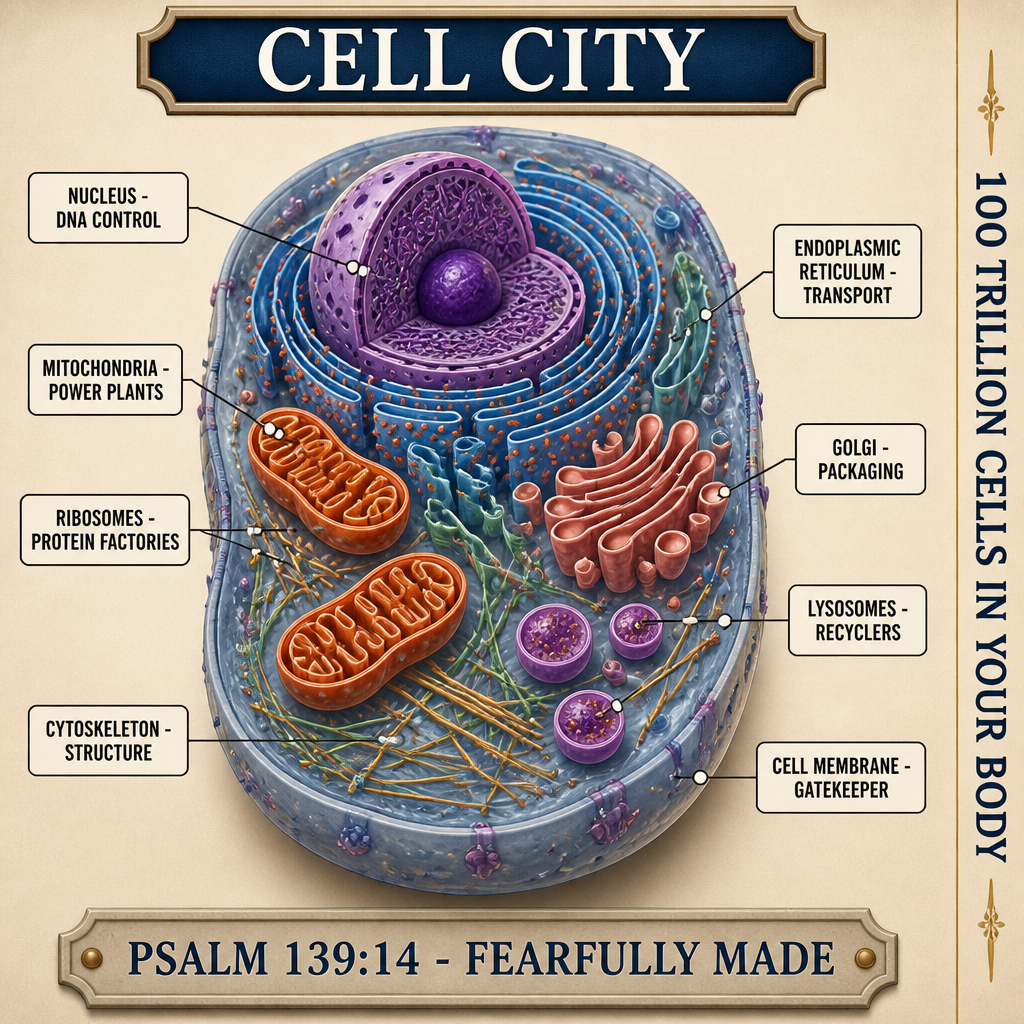
Early scientists thought cells were simple blobs of goo. They called them "protoplasm" and imagined them as basic building blocks. But today we know the truth: even the simplest cells are more complex than any factory humans have ever built!
Here's what the simplest living cell needs just to survive:
- At least 380 essential genes – remove any one and the cell dies
- A membrane to hold everything inside
- Machines to copy DNA
- Machines to make proteins
- Machines to produce energy
In 2016, scientists tried to build the simplest possible cell. They needed 473 genes just for it to work – and they still don't understand what 149 of those genes do! Even the "simplest" cell is mind-blowingly complex.
Bruce Alberts (former President of the National Academy of Sciences):
"The entire cell can be viewed as a factory that contains an elaborate network of interlocking assembly lines, each of which is composed of a set of large protein machines."
💭 REFLECT
Multiple Choice:
- The minimum number of essential genes for the simplest cell is:
a) 50 b) 150 c) 380 d) 1,000
- Early scientists called cells "protoplasm" because they thought cells were:
a) Complex factories b) Simple blobs c) Machines d) Empty shells
Fill in the Blanks:
- Even the simplest cell is more complex than any _____________ humans have built.
- A cell needs a _____________ to hold everything inside.
- Scientists built a minimal cell with 473 genes, but _____ genes still have unknown functions.
True or False:
T / F — Cells are simple structures that are easy to understand.
T / F — A cell can survive if you remove just one essential gene.
Close your workbook. List 5 things a cell needs just to survive.
🗣️ RECITE
Explain to someone why "simple cells" don't actually exist.
🔄 REVIEW
Mark when you review: Day 1 ☐ | Day 3 ☐ | Day 7 ☐ | Day 21 ☐
✅ RESPOND
How does cell complexity affect how you view creation?
2 ATP Synthase: The Spinning Motor
📖 RECEIVE
Your cells have tiny motors spinning inside them right now! ATP synthase is a molecular machine that produces ATP – the energy currency your cells use for everything.
ATP Synthase Structure:
- A rotor that spins (like a turbine)
- A stator that stays still
- Protons flowing through power the spin
Mind-Blowing Performance:
| Feature | ATP Synthase | Best Human Motors |
|---|
| Speed | Up to 21,000 RPM! | Varies |
| Efficiency | Nearly 100% | 40-60% |
| Size | Nanoscale (invisible) | Large |
ATP synthase is nearly 100% efficient – far better than any motor humans have ever made! And you have billions of them working in your body right now.
If you saw a spinning turbine in a power plant, you'd know someone designed it. Why should a molecular turbine in a cell be any different?
💭 REFLECT
Multiple Choice:
- ATP synthase works like a:
a) Simple chemical reaction b) Rotary motor/turbine c) Random process d) Static structure
- The efficiency of ATP synthase is:
a) About 10% b) About 50% c) Nearly 100% d) Unknown
Fill in the Blanks:
- ATP synthase has a _____________ that spins and a stator that stays still.
- It can spin up to _____________ RPM.
- ATP is the energy _____________ of the cell.
True or False:
T / F — Human-made motors are more efficient than ATP synthase.
T / F — ATP synthase has multiple coordinated parts working together.
Draw and label ATP synthase from memory (rotor, stator, proton flow).
🗣️ RECITE
Explain ATP synthase to someone using the turbine analogy.
🔄 REVIEW
Mark when you review: Day 1 ☐ | Day 3 ☐ | Day 7 ☐ | Day 21 ☐
✅ RESPOND
Watch a video of ATP synthase in action (search "ATP synthase animation") and describe what you see:
3 The Bacterial Flagellum: An Outboard Motor
📖 RECEIVE
"For by him were all things created, that are in heaven, and that are in earth... And he is before all things, and by him all things consist." – Colossians 1:16-17
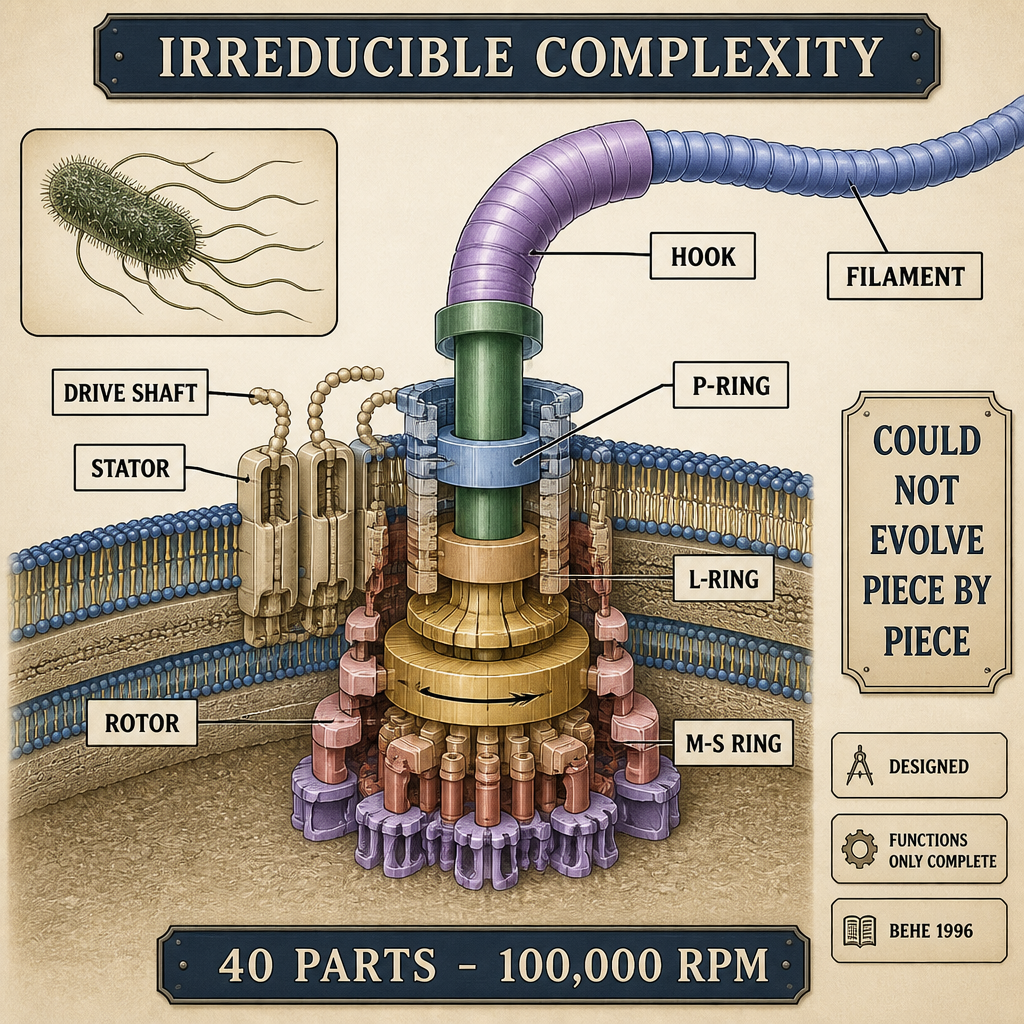
Some bacteria have a tiny outboard motor that propels them through liquid! It's called the bacterial flagellum, and it looks remarkably like something engineers would design.
Flagellum Components (20-30 different proteins):
- Rotary motor – powers the spin
- Stator units – stationary power generators
- Bushings – reduce friction
- Driveshaft – transmits rotation
- Hook – flexible joint
- Propeller/Filament – pushes through liquid
The flagellum can spin at 18,000 RPM and can switch direction INSTANTLY! It takes about 40 genes to build one.
If any critical part is removed – the hook, the motor, or the stators – the whole flagellum stops working. You can't have "half a motor" that does anything useful.
💭 REFLECT
Multiple Choice:
- How many different proteins make up a bacterial flagellum?
a) 2-3 b) 5-10 c) 20-30 d) 100+
- If you remove the hook from a flagellum:
a) It works slightly worse b) It completely fails c) Another part takes over d) It works better
Fill in the Blanks:
- The flagellum can spin at up to _____________ RPM.
- It takes about _____ genes to build a flagellum.
- The _____________ is like a flexible joint connecting the motor to the propeller.
- If any critical part is removed, the flagellum _____________ to work.
True or False:
T / F — A partial flagellum (missing parts) still provides some benefit for swimming.
T / F — The flagellum resembles human-designed outboard motors.
List the 6 main components of the flagellum from memory.
🗣️ RECITE
Explain the flagellum to someone using the outboard motor analogy.
🔄 REVIEW
Mark when you review: Day 1 ☐ | Day 3 ☐ | Day 7 ☐ | Day 21 ☐
✅ RESPOND
Why is the flagellum such strong evidence for design?
4 DNA: The Language of Life
📖 RECEIVE
"Thine eyes did see my substance, yet being unperfect; and in thy book all my members were written, which in continuance were fashioned, when as yet there was none of them." – Psalm 139:16
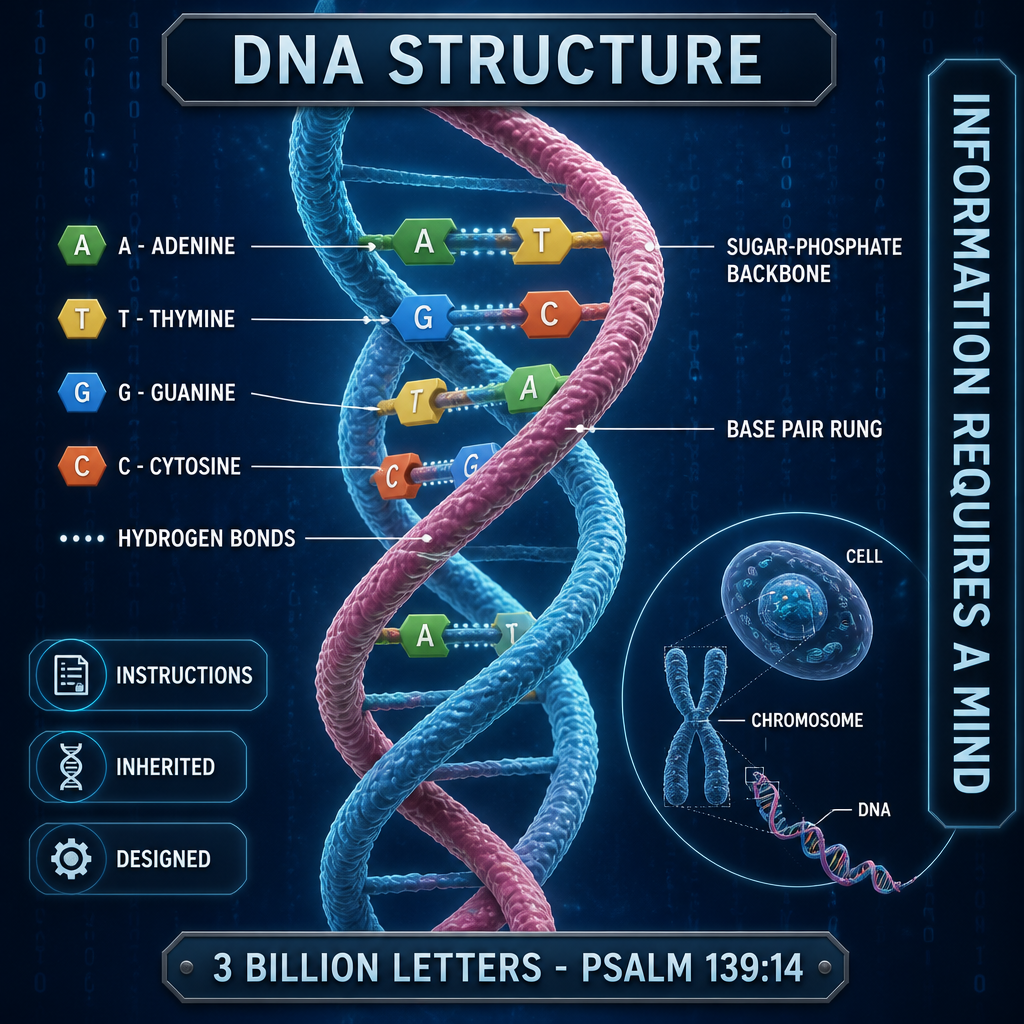
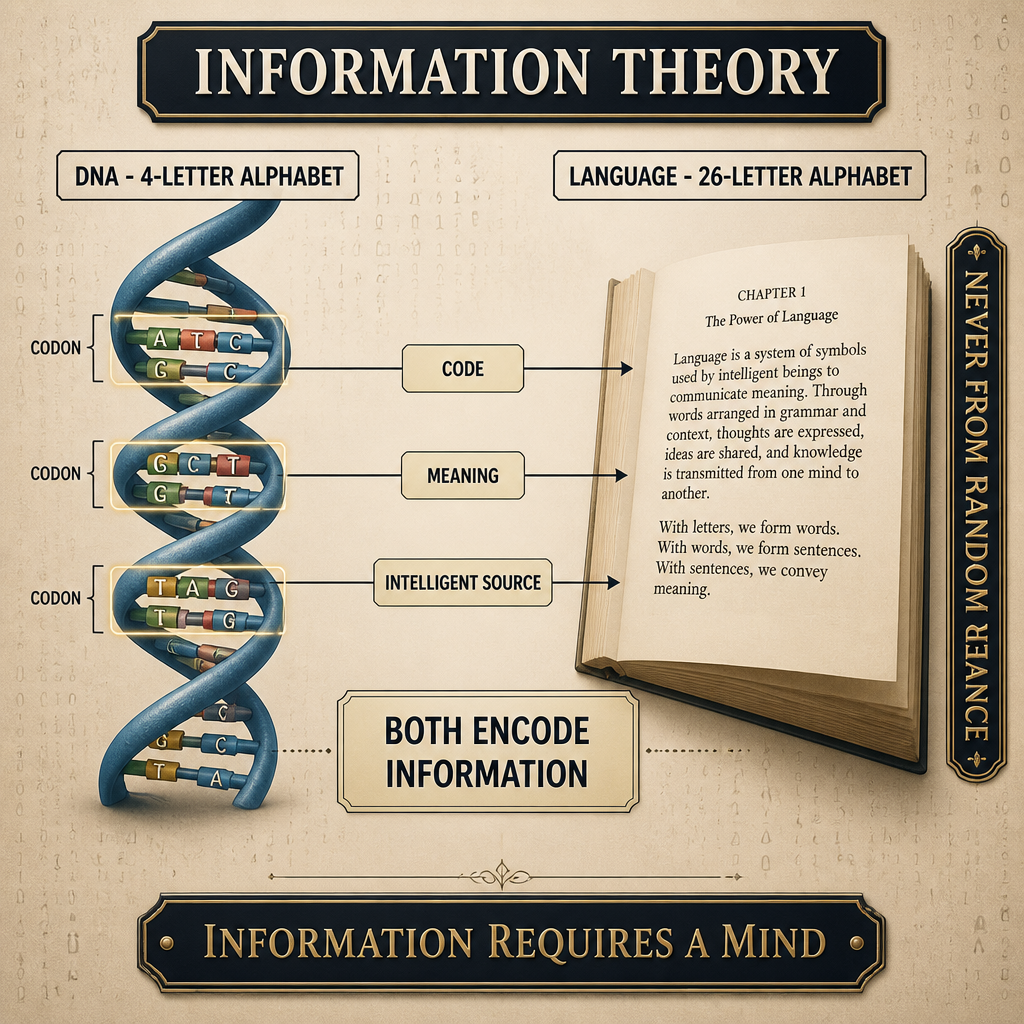
DNA is not just a chemical – it's a language! It's a code that contains instructions for building and running every living thing.
DNA Facts:
- Structure: Double helix (twisted ladder)
- Alphabet: 4 letters – A, C, G, T
- Human genome: 3.2 billion base pairs
- Equivalent data: About 700 MB (would fill a library shelf if printed!)
The Genetic Code:
- Uses 3-letter "words" called codons
- 64 possible codons code for 20 amino acids
- Works exactly like a symbolic language or computer code
Bill Gates (Microsoft founder):
"DNA is like a computer program but far, far more advanced than any software ever created."
Carl Sagan estimated that a single cell contains information equivalent to 100 million pages of Encyclopedia Britannica!
💭 REFLECT
Multiple Choice:
- The human genome contains approximately:
a) 1 million base pairs b) 3.2 billion base pairs c) 100 base pairs d) 50 billion base pairs
- Codons are:
a) 2 letters long b) 3 letters long c) 4 letters long d) Variable length
Fill in the Blanks:
- DNA uses 4 letters: A, C, G, and ____.
- There are _____ possible codons that code for 20 amino acids.
- DNA is like computer _____________ according to Bill Gates.
- The human genome equals about _____ MB of data.
True or False:
T / F — DNA is just a random chemical with no meaningful pattern.
T / F — DNA functions like a language or code.
Write from memory: The 4 DNA bases, what codons are, and Bill Gates' quote.
🗣️ RECITE
Explain to someone how DNA is like computer code.
🔄 REVIEW
Mark when you review: Day 1 ☐ | Day 3 ☐ | Day 7 ☐ | Day 21 ☐
✅ RESPOND
If DNA is a language, what does that imply about its origin?
5 The Ribosome: 3D Printer of the Cell
📖 RECEIVE
The ribosome is like a molecular 3D printer – it reads the DNA code (via messenger RNA) and builds proteins one amino acid at a time!
Ribosome Facts:
- Made of 2 subunits (like two halves of a sandwich)
- Contains about 50 proteins in bacteria, 80 in humans
- Reads mRNA "instructions"
- Assembles amino acids into proteins
- Works like an automated assembly line
A single ribosome can make proteins at incredible speed. Your cells have millions of ribosomes working constantly!
The Process:
- DNA code is copied to messenger RNA (mRNA)
- mRNA travels to the ribosome
- Ribosome reads the mRNA in 3-letter codons
- Transfer RNA (tRNA) brings the matching amino acid
- Amino acids link together to form a protein
This is like having a factory where blueprints are copied, sent to an assembly line, and products are built automatically. Who designed the factory?
💭 REFLECT
Multiple Choice:
- The ribosome is best compared to:
a) A storage container b) A 3D printer/assembly line c) A garbage disposal d) A power source
- Human ribosomes contain approximately how many proteins?
a) 5 b) 20 c) 50 d) 80
Fill in the Blanks:
- The ribosome reads _____________ RNA to build proteins.
- _____________ RNA brings amino acids to the ribosome.
- The ribosome assembles _____________ one at a time to form proteins.
True or False:
T / F — Ribosomes are simple structures with only 2-3 parts.
T / F — The ribosome works like an automated factory.
List the 5 steps of protein production from DNA to finished protein.
🗣️ RECITE
Explain how the ribosome works using the 3D printer analogy.
🔄 REVIEW
Mark when you review: Day 1 ☐ | Day 3 ☐ | Day 7 ☐ | Day 21 ☐
✅ RESPOND
How does the ribosome's complexity affect your view of random chance?
6 Irreducible Complexity: All-or-Nothing
📖 RECEIVE
Irreducible complexity means: a system where removing ANY essential part causes the whole thing to fail. There's no "partial" version that works.
The Mousetrap Example:
A standard mousetrap has 5 parts:
- Base (platform)
- Hammer (kill bar)
- Spring
- Catch (holds hammer back)
- Hold-down bar
Remove ANY ONE piece and the trap fails completely. There's no "half-mousetrap" that catches half a mouse!
Charles Darwin wrote that his theory would "absolutely break down" if any complex organ could not have been formed by "numerous, successive, slight modifications." But irreducibly complex systems can't be built step-by-step because partial versions don't work!
Biological Examples:
- Bacterial Flagellum: 40+ parts, all needed
- Blood Clotting: 12+ proteins must work together – missing one causes hemophilia
- Immune System: Multiple components must all be present
People with hemophilia are missing just ONE clotting factor out of 12+ and they can bleed dangerously. This shows the system is all-or-nothing!
💭 REFLECT
Multiple Choice:
- A mousetrap with only 3 of its 5 parts:
a) Works partially b) Fails completely c) Works better d) Catches small mice
- Hemophilia is caused by:
a) Having too many clotting factors b) Missing one clotting factor c) Exercise deficiency d) Genetic mutation that helps
Fill in the Blanks:
- Irreducible complexity means removing ANY part causes the system to _____________.
- Darwin said his theory would "break down" if organs couldn't form by _____________ modifications.
- The blood clotting system has _____+ proteins that must work together.
True or False:
T / F — Irreducibly complex systems can be built step-by-step through small changes.
T / F — The flagellum is an example of irreducible complexity.
Define irreducible complexity in your own words and give one example.
🗣️ RECITE
Explain the mousetrap example to someone.
🔄 REVIEW
Mark when you review: Day 1 ☐ | Day 3 ☐ | Day 7 ☐ | Day 21 ☐
✅ RESPOND
Can you think of another human-made system that is irreducibly complex?
7 What Scientists Admit
📖 RECEIVE
You don't have to take our word for it. Listen to what secular scientists themselves say about the design-like nature of living systems!
Francis Crick (co-discoverer of DNA's structure):
"An honest man, armed with all the knowledge available to us now, could only state that in some sense, the origin of life appears to be almost a miracle, so many are the conditions which would have had to have been satisfied to get it going."
Francis Crick (warning to biologists):
"Biologists must constantly keep in mind that what they see was not designed, but rather evolved."
Why would Crick need to WARN scientists not to think things were designed? Because biological structures look SO MUCH like designed machines that scientists need constant reminders!
Richard Dawkins (famous evolutionist):
"Biology is the study of complicated things that give the appearance of having been designed for a purpose."
Werner Gitt (information scientist):
"There is no known law of nature, no known process and no known sequence of events which can cause information to originate by itself in matter."
"For the invisible things of him from the creation of the world are clearly seen, being understood by the things that are made, even his eternal power and Godhead; so that they are without excuse." – Romans 1:20
💭 REFLECT
Multiple Choice:
- According to Francis Crick, the origin of life appears to be:
a) Simple and well-understood b) Almost a miracle c) Completely solved d) Not worth studying
- Crick warned biologists to remember that what they see was NOT:
a) Evolved b) Complex c) Designed d) Interesting
Fill in the Blanks:
- Dawkins says biology gives the _____________ of design.
- Werner Gitt says no known process can cause _____________ to originate by itself.
- Romans 1:20 says people are "without _____________" because creation clearly shows Yahuah's power.
True or False:
T / F — All scientists agree that life arose by random chance.
T / F — Even evolutionists admit biology looks designed.
Write Francis Crick's "miracle" quote and Dawkins' "appearance of design" quote from memory.
🗣️ RECITE
Share these quotes with someone and discuss what they mean.
🔄 REVIEW
Mark when you review: Day 1 ☐ | Day 3 ☐ | Day 7 ☐ | Day 21 ☐
✅ RESPOND
Why do you think some scientists acknowledge design but still reject a Designer?
8 Creation Points to the Creator
📖 RECEIVE
"For every house is builded by some man; but he that built all things is Elohim." – Hebrews 3:4
Let's review what we've learned:
- Cells are incredibly complex factories with 380+ essential parts
- ATP synthase is a motor more efficient than anything humans have built
- The flagellum is an outboard motor with 40+ coordinated parts
- DNA is a language containing billions of letters of precise code
- Ribosomes are molecular 3D printers that build proteins
- Irreducible complexity shows systems that can't be built step-by-step
- Scientists admit life looks designed, even if they deny a Designer
When we see a house, we know someone built it. When we see a computer program, we know someone wrote it. When we see a motor, we know someone designed it. Why should molecular motors, genetic code, and cellular factories be any different?
The Evidence Points to Yahuah:
- Information always comes from an intelligent source
- Codes and languages always come from minds
- Complex machines always have designers
- Life has all of these – therefore life has a Designer!
"The heavens declare the glory of El; and the firmament sheweth his handywork." – Psalm 19:1
💭 REFLECT
Fill in the Blanks (Review):
- The simplest cell needs at least _____ essential genes.
- ATP synthase efficiency is nearly _____%.
- The bacterial flagellum has _____+ proteins.
- The human genome has _____ billion base pairs.
- Information always comes from an _____________ source.
Discussion:
- If DNA is like computer code, what does that imply about its origin?
- Why can't irreducibly complex systems be built gradually?
- How does this evidence strengthen your faith?
List all 7 main topics we covered in this workbook from memory.
🗣️ RECITE
Give a 5-minute summary of this workbook to someone.
🔄 REVIEW
Mark when you review: Day 1 ☐ | Day 3 ☐ | Day 7 ☐ | Day 21 ☐
✅ RESPOND
Write a prayer of praise to Yahuah for His amazing creation:
Answer Key
Lesson 1: Cells
YOUTH Bio DNA Detail
MC: 1-c, 2-b
Fill-ins: factory, membrane, 149
T/F: F, F
Lesson 2: ATP Synthase
YOUTH Bio Cell Detail
MC: 1-b, 2-c
Fill-ins: rotor, 21,000, currency
T/F: F, T
Lesson 3: Bacterial Flagellum
YOUTH Bio Flagellum Motor
MC: 1-c, 2-b
Fill-ins: 18,000, 40, hook, fails/ceases
T/F: F, T
Lesson 4: DNA
YOUTH Bio Information
MC: 1-b, 2-b
Fill-ins: T, 64, code/program, 700
T/F: F, T
Lesson 5: Ribosome
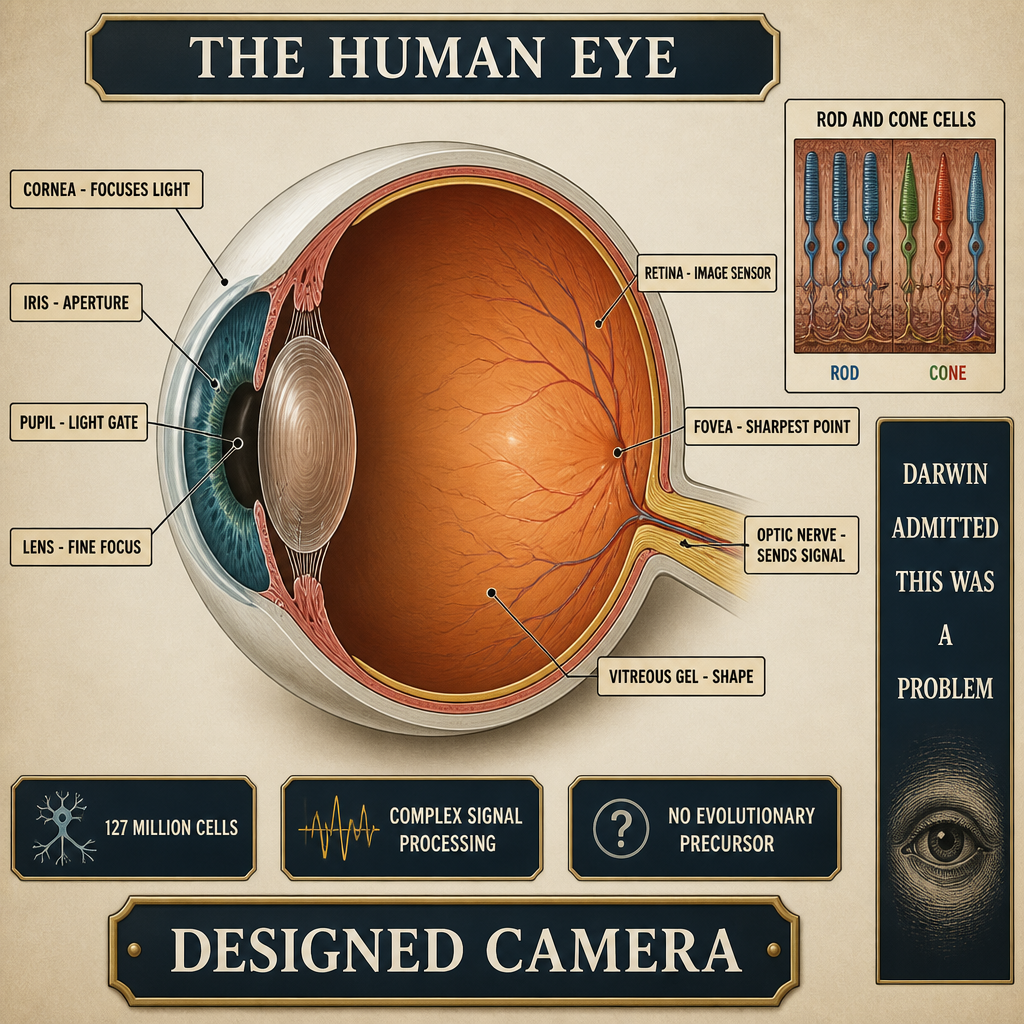
YOUTH Bio Eye Design
MC: 1-b, 2-d
Fill-ins: messenger, Transfer, amino acids
T/F: F, T
Lesson 6: Irreducible Complexity
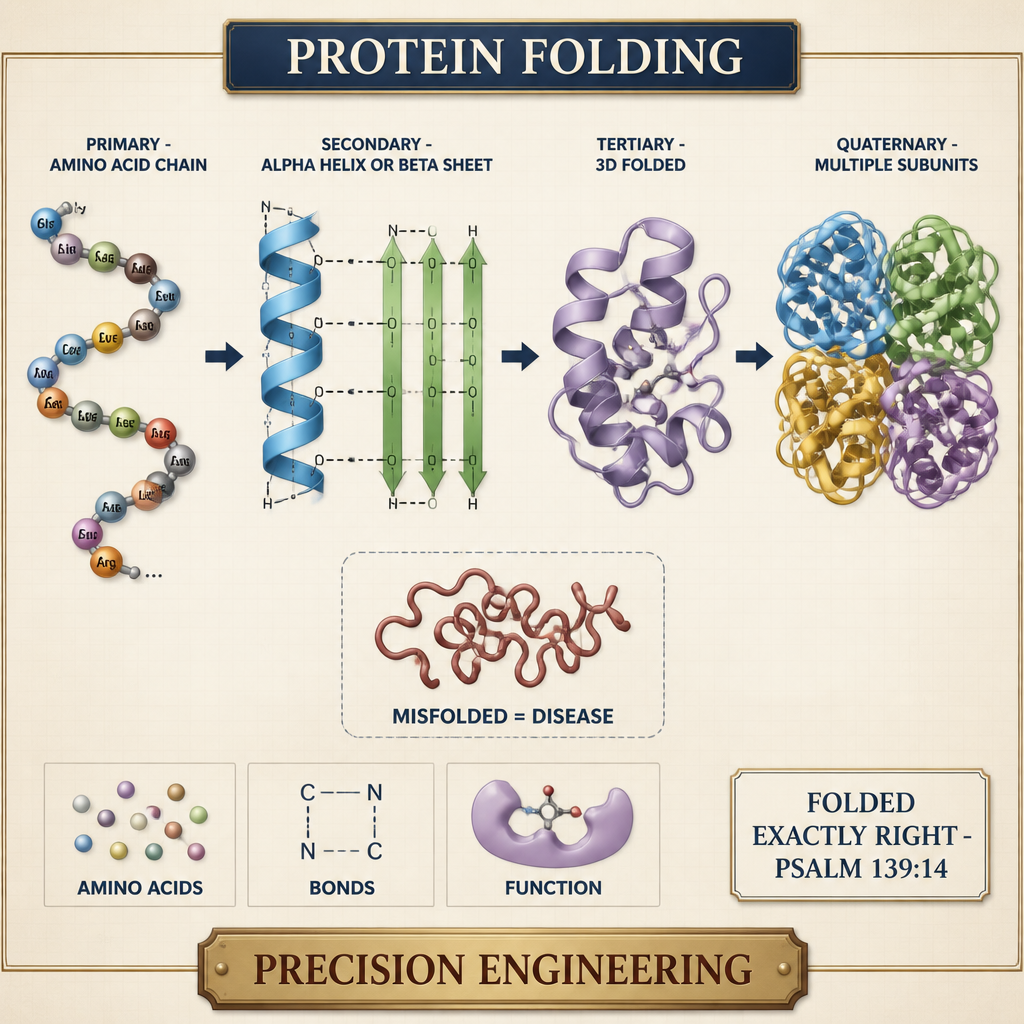
YOUTH Bio Protein Folding
MC: 1-b, 2-b
Fill-ins: fail, slight/gradual, 12
T/F: F, T
Lesson 7: What Scientists Admit
MC: 1-b, 2-c
Fill-ins: appearance, information, excuse
T/F: F, T
Lesson 8: Review
Fill-ins: 380, 100, 40, 3.2, intelligent
Spaced Review Tracker
| Lesson |
Day 1 |
Day 3 |
Day 7 |
Day 21 |
| 1. Cells | ☐ | ☐ | ☐ | ☐ |
| 2. ATP Synthase | ☐ | ☐ | ☐ | ☐ |
| 3. Flagellum | ☐ | ☐ | ☐ | ☐ |
| 4. DNA | ☐ | ☐ | ☐ | ☐ |
| 5. Ribosome | ☐ | ☐ | ☐ | ☐ |
| 6. Irreducible Complexity | ☐ | ☐ | ☐ | ☐ |
| 7. Scientists Admit | ☐ | ☐ | ☐ | ☐ |
| 8. Creator | ☐ | ☐ | ☐ | ☐ |