CARBON DATING EXPOSED

Understanding What Radiocarbon Dating Can (and Cannot) Tell Us

TRUTH CARRIERS EDUCATION SYSTEM
True Science Series - Youth Level (Ages 12-17)

Exodus 20:11
"For in six days Yahuah made heaven and earth, the sea, and all that in them is, and rested the seventh day."

WELCOME!

Have you ever heard someone say "Scientists proved this fossil is 50,000 years old using carbon dating"?

But what does that actually mean? How does carbon dating work? And is it as reliable as people claim?

In this workbook, you'll learn:

By the end, you'll be equipped to ask smart questions when you hear about carbon dating!

HOW TO USE THIS WORKBOOK

The 6 Rs Learning Method

1. RECEIVE
Read the lesson carefully. Take your time!
2. REFLECT
Answer the questions to check your understanding.
3. RECALL
Close the book and try to remember what you learned.
4. RECITE
Explain what you learned to someone else.
5. REVIEW
Come back and review at Day 1, 3, 7, 21, and 60.
6. RESPOND
Use what you learned when you hear dating claims!

TABLE OF CONTENTS

  1. Lesson 1: What is Carbon Dating?
  2. Lesson 2: The Three Big Assumptions
  3. Lesson 3: When the Atmosphere Changed
  4. Lesson 4: Contamination Problems
  5. Lesson 5: The "Old Carbon" Trick
  6. Lesson 6: Limits and Anomalies
  7. Lesson 7: What About the Flood?
  8. Lesson 8: Asking Smart Questions

KEY TERMS TO KNOW

Term Simple Definition
Carbon-14 (C14) A special type of carbon atom that slowly breaks down over time
Half-life How long it takes for half of something to break down (C14 = 5,730 years)
Isotope Different versions of the same element (like C12, C13, C14)
Assumption Something believed to be true without proof
Contamination When something unwanted gets mixed into a sample
Reservoir Effect When living things absorb "old" carbon and appear older than they are

LESSON 1: WHAT IS CARBON DATING?

YOUTH Dating Halflife

YOUTH Dating Halflife

Carbon is Everywhere!

Carbon is found in all living things - plants, animals, and you! It's one of the building blocks of life.

Most carbon atoms are called Carbon-12 (C12). They're stable and don't change.

But a tiny amount of carbon is Carbon-14 (C14). This type is special because it slowly over time.

How C14 is Made

High in the atmosphere, cosmic rays from space hit nitrogen atoms and turn them into .

This C14 mixes with oxygen to form CO2 (carbon dioxide).

Plants breathe in this CO2 during photosynthesis.

Animals eat plants (or eat animals that ate plants).

So all living things have some C14 in their !

Right now, you have Carbon-14 in your body! It got there from the food you ate.

What Happens When Something Dies?

When a plant or animal dies, it stops taking in new carbon.

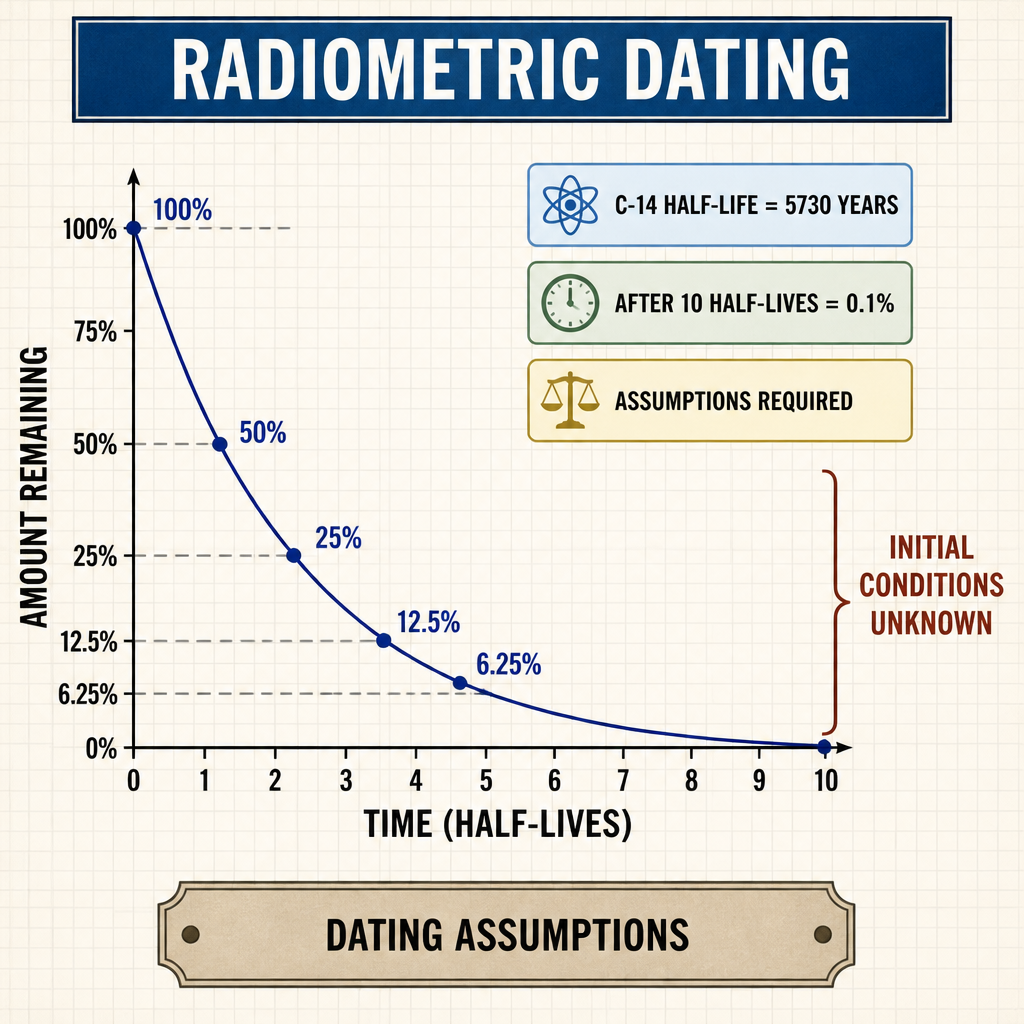
The C14 already in its body slowly breaks down (this is called ).

Scientists measure how much C14 is left to guess how long ago it .

The Half-Life Clock

C14 breaks down at a specific rate. Every 5,730 years, half of it is gone.

Time Passed C14 Remaining
0 years 100%
5,730 years 50%
11,460 years 25%
17,190 years 12.5%

Important Limitation!

Carbon dating ONLY works on things that were once .

It does NOT work on rocks, metals, or minerals!

Check Your Understanding

1. Carbon-14 is created when cosmic rays hit:

○ A) Oxygen atoms
○ B) Nitrogen atoms
○ C) Carbon atoms
○ D) Hydrogen atoms

2. The half-life of C14 is:

○ A) 57 years
○ B) 573 years
○ C) 5,730 years
○ D) 57,300 years

True or False

1. Carbon dating works on rocks and minerals.
○ True ○ False

2. All living things contain some Carbon-14.
○ True ○ False

RECALL: Close your book and answer

How does C14 get into living things?

SCRIPTURE MEMORY: Exodus 20:11

"For in six days Yahuah made heaven and earth, the sea, and all that in them is..."

LESSON 2: THE THREE BIG ASSUMPTIONS

YOUTH Dating C14 Anomalies

YOUTH Dating C14 Anomalies

What is an Assumption?

An assumption is something we believe is true without being able to prove it.

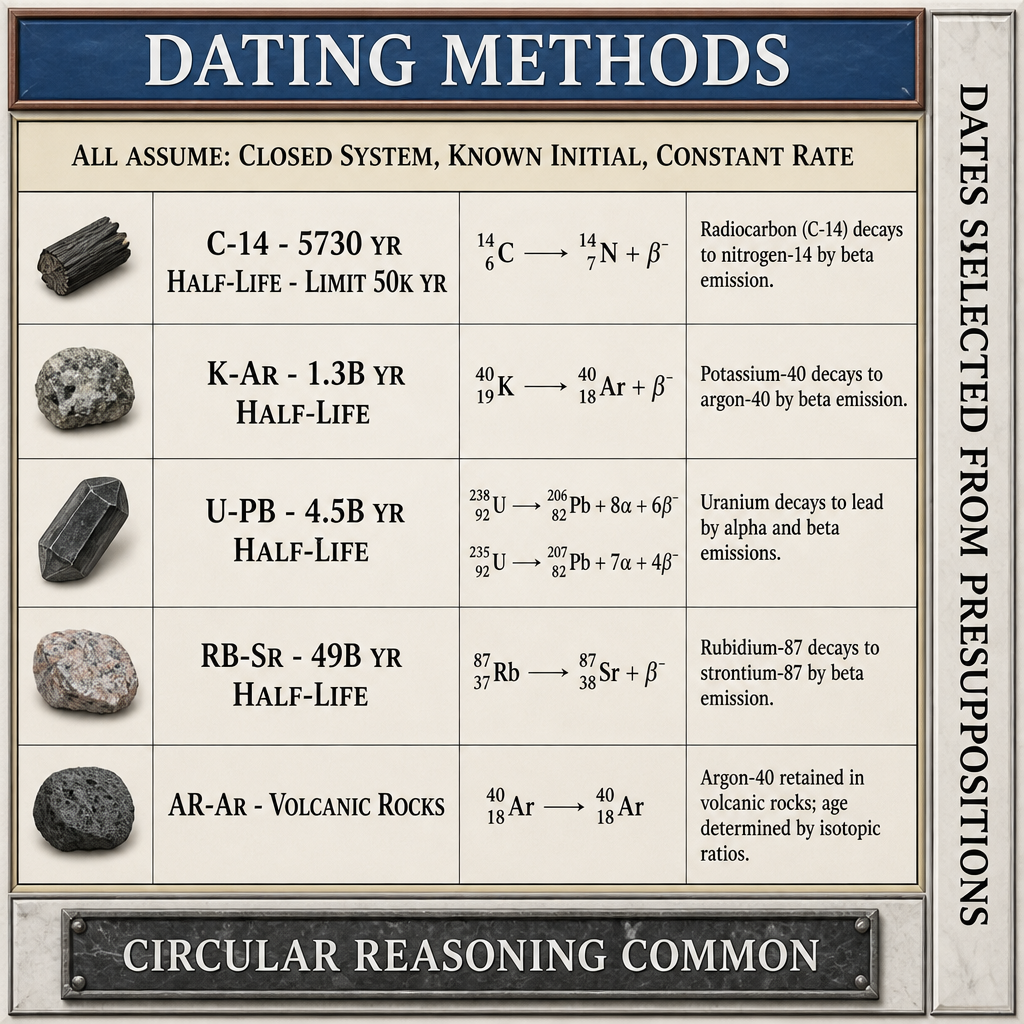
Every carbon date depends on THREE assumptions. If any one is wrong, the date is wrong!

Assumption #1: We Know the Starting Amount

Scientists assume they know how much C14 was in the organism when it .

They assume it was the same as in the atmosphere today.

The Problem: We can't go back in time to check! This is a .

Assumption #2: The Decay Rate Never Changed

Scientists assume C14 has always broken down at the exact same .

The Problem: We've only been measuring decay rates for about 100 years. How do we know it was the same thousands of years ago?

Assumption #3: Nothing Was Added or Removed

Scientists assume the sample has been a "closed system" - no carbon went in or out after death.

The Problem: Water, bacteria, and chemicals can add or remove from samples!

If I found a partially burned candle and asked you "How long was this candle burning?" - what would you need to ASSUME to answer?

Measurement vs. Assumption

What Scientists MEASURE What Scientists ASSUME
How much C14 is in the sample NOW How much C14 was there at the START
The current decay rate Decay rate was always the same
What the sample looks like today Nothing was added or removed

Check Your Understanding

1. How many assumptions does every C14 date depend on?

○ A) One
○ B) Two
○ C) Three
○ D) None

2. A "closed system" means:

○ A) The lab was locked
○ B) No carbon went in or out after death
○ C) The sample was in a closed box
○ D) Scientists closed their eyes

True or False

1. Scientists can directly measure the starting C14 of ancient samples.
○ True ○ False

2. If any assumption is wrong, the date will be wrong.
○ True ○ False

RECALL: Write the three assumptions from memory

TEACH-BACK CHALLENGE

Explain the three assumptions to a family member or friend.

Who did you teach?

LESSON 3: WHEN THE ATMOSPHERE CHANGED

YOUTH Dating Polonium Halos

YOUTH Dating Polonium Halos

The Atmosphere Isn't Constant!

Scientists discovered that raw C14 measurements don't match known historical dates.

Why? Because the amount of C14 in the atmosphere has over time!

What Changes Atmospheric C14?

1. The Sun

The sun's activity affects how many cosmic rays reach Earth.

More sun activity = fewer cosmic rays = less C14 .

2. Earth's Magnetic Field

Earth's magnetic field blocks some cosmic rays.

Evidence shows Earth's magnetic field was much in the past.

Stronger field = fewer cosmic rays = less C14!

3. Burning Fossil Fuels (Suess Effect)

Since the 1800s, humans have burned tons of coal and oil.

This releases "old" carbon (with no C14) into the atmosphere.

This the C14 ratio.

4. Nuclear Testing (Bomb Pulse)

Nuclear bomb tests in the 1950s-60s nearly atmospheric C14!

This spike is still working its way through the ecosystem.

Scientists can actually tell if wine was made before or after 1950 based on its C14 levels!

Calibration Curves

Because of these changes, scientists created "calibration curves" to adjust raw C14 dates.

They use tree rings and other methods to try to correct the dates.

But here's the thing: Those calibration methods have their own too!

Check Your Understanding

1. The "Suess Effect" refers to:

○ A) Nuclear testing
○ B) Fossil fuels diluting C14
○ C) Sun activity
○ D) Magnetic field changes

2. A stronger magnetic field in the past would mean:

○ A) More C14 was produced
○ B) Less C14 was produced
○ C) The same amount of C14
○ D) C14 doesn't exist

True or False

1. The atmosphere has always had the same amount of C14.
○ True ○ False

2. Nuclear testing increased atmospheric C14.
○ True ○ False

RECALL: List four things that change atmospheric C14

THINK ABOUT IT

If there was less C14 in the atmosphere in the past, would that make things look OLDER or YOUNGER than they really are?

LESSON 4: CONTAMINATION PROBLEMS

YOUTH Dating Isotopes

YOUTH Dating Isotopes

What is Contamination?

Contamination is when something unwanted gets mixed into a sample.

Even tiny amounts of contamination can completely mess up a carbon date!

Two Types of Contamination

Type 1: Modern Carbon Gets In

If modern carbon (high in C14) gets into an old sample, the sample will look than it really is.

Sources: touching with bare hands, bacteria, plant roots, storage materials

Type 2: Old Carbon Gets In

If old carbon (low in C14) gets into a sample, it will look than it really is.

Sources: groundwater, coal dust, petroleum products

Here's the Scary Part

For very old samples, just 1% contamination with modern carbon can make a sample with NO original C14 appear to be about 37,000 years old!

What Labs Do

Labs try to remove contamination by:

But no cleaning method can guarantee contamination is removed!

Museum specimens are often treated with preservatives that contain carbon. This can make them impossible to date accurately!

Check Your Understanding

1. Modern carbon contamination makes samples appear:

○ A) Older
○ B) Younger
○ C) The same age
○ D) More accurate

2. Just 1% modern contamination can make an "infinite age" sample appear:

○ A) 100 years old
○ B) 3,700 years old
○ C) 37,000 years old
○ D) Still infinite

True or False

1. Laboratory cleaning can guarantee all contamination is removed.
○ True ○ False

2. Old carbon contamination makes samples appear younger.
○ True ○ False

RECALL: Explain the two types of contamination

LESSON 5: THE "OLD CARBON" TRICK

YOUTH Dating Helium Diffusion

YOUTH Dating Helium Diffusion

Living Things That Appear Ancient!

Here's something amazing: some living organisms appear to be thousands of years old when tested with carbon dating - while they're still alive!

This is called the Reservoir Effect.

What is a Reservoir?

A "reservoir" is any source of carbon that has less C14 than the .

If an organism gets its carbon from a reservoir (instead of the air), it will appear much than it really is.

Example #1: Ocean Animals

Deep ocean water can be hundreds of years "old" in C14 terms.

Fish and shellfish that live in this water absorb this "old" carbon.

Result: Living sea creatures can appear 400-1,000+ years !

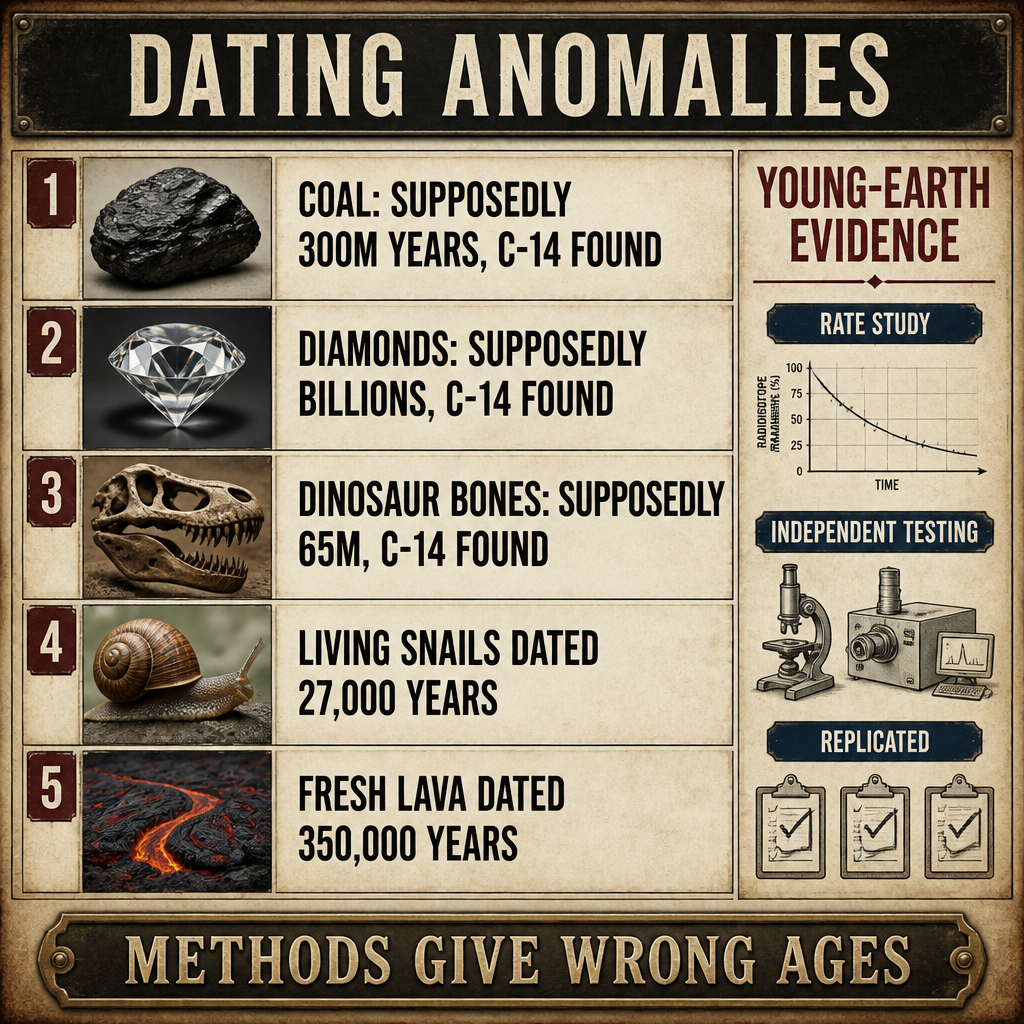
Example #2: Freshwater Snails

Real Case!

Living snails from freshwater springs in Nevada were tested.

Result: They dated at 27,000 years old!

Cause: The springs flowed through limestone, which released "old" carbon into the water.

Example #3: Plants Near Volcanoes

Volcanic gases contain CO2 with virtually no .

Plants near volcanoes absorb this CO2.

These plants (and animals that eat them) can appear thousands of years old while !

If living things can appear thousands of years old, what does that mean for dating dead things?

Check Your Understanding

1. The reservoir effect occurs because some organisms absorb:

○ A) Extra C14
○ B) "Old" carbon with less C14
○ C) No carbon at all
○ D) Too much oxygen

2. Living snails from Nevada springs dated at:

○ A) 0 years (accurate)
○ B) 270 years
○ C) 2,700 years
○ D) 27,000 years

True or False

1. All living things absorb carbon with the same C14 ratio.
○ True ○ False

2. Volcanic CO2 typically has normal C14 levels.
○ True ○ False

RECALL: Give two examples of the reservoir effect

SCRIPTURE MEMORY: 2 Peter 3:5-6

"For this they willingly are ignorant of, that by the word of Elohim the heavens were of old, and the earth... being overflowed with water, perished."

LESSON 6: LIMITS AND ANOMALIES

The Upper Limit

Carbon dating has a maximum age limit of about to 60,000 years.

Why? After about 10 half-lives, so little C14 remains that scientists can't tell it apart from background noise.

What This Means

Any C14 date over 50,000 years is really just saying: "We found a tiny signal that might be original C14, or might be contamination, or might be background noise."

The Mystery of "Old" Materials

Here's something strange: scientists have found detectable C14 in materials claimed to be millions of years old!

If these materials are really millions of years old, they should have ZERO C14 left. Why do they still have detectable amounts?

Famous Anomalies

Wood in Rock

Wood found inside volcanic rock was tested.

Method Result
C14 (wood) ~45,000 years
K-Ar (rock) ~45 million years

The wood appears 1,000 times than the rock around it!

Same Sample, Different Dates

The same sample sent to different labs often gives significantly dates.

Check Your Understanding

1. The practical age limit for C14 dating is about:

○ A) 5,000 years
○ B) 50,000-60,000 years
○ C) 1 million years
○ D) No limit

2. If coal is really millions of years old, it should contain:

○ A) Lots of C14
○ B) Some C14
○ C) Zero detectable C14
○ D) Extra C14

True or False

1. C14 has been found in diamonds claimed to be billions of years old.
○ True ○ False

2. Different labs always give the exact same C14 date for the same sample.
○ True ○ False

RECALL: Why is there a limit to C14 dating?

LESSON 7: WHAT ABOUT THE FLOOD?

Genesis 7:11-12
"In the six hundredth year of Noah's life... were all the fountains of the great deep broken up, and the windows of heaven were opened."

The Biblical Timeline

According to Scripture, Yahuah created the world about years ago.

The global Flood occurred about 4,500 years ago.

If true, how could things date to 20,000 or 50,000 years?

The Flood Changed Everything!

If the Flood really happened, it would have dramatically changed the Earth's carbon levels.

1. Before the Flood

2. During the Flood

3. After the Flood

The Effect on Dating

If the pre-Flood atmosphere had less C14, then:

A 4,500-year-old sample might appear to be 20,000-50,000 years old!

Reconciling the Data

C14 "Age" Possible Real Age
50,000 years ~4,500 years (early post-Flood)
20,000 years ~4,000 years
5,000 years ~4,000-5,000 years
3,000 years ~3,000 years (accurate)

As we get closer to the present, C14 dates become more !

Check Your Understanding

1. If the pre-Flood atmosphere had less C14, things from that time would appear:

○ A) Younger than actual
○ B) Older than actual
○ C) The same age
○ D) Impossible to date

2. The Flood would have affected carbon dating by:

○ A) Burying massive amounts of carbon
○ B) Releasing volcanic carbon
○ C) Changing the C14 ratio
○ D) All of the above

True or False

1. The pre-Flood world probably had the same C14 levels as today.
○ True ○ False

2. A global flood would have no effect on carbon dating.
○ True ○ False

RECALL: How would the Flood affect carbon dating?

TEACH-BACK CHALLENGE

Explain to someone how the Genesis Flood could affect carbon dating.

Who did you teach?

LESSON 8: ASKING SMART QUESTIONS

You're Now Equipped!

You now know more about carbon dating than most people. Use this knowledge to ask smart questions!

The Five Questions to Always Ask

When someone tells you "Scientists dated this at X years old," ask:

  1. What was actually measured? (Not interpreted - the raw data)
  2. What assumptions were made? (Initial ratio? Closed system?)
  3. What's the margin of error? (How uncertain is the date?)
  4. Was it cross-checked? (Did other methods agree?)
  5. Could there be other explanations? (Contamination? Reservoir effect?)

Measurement vs. Interpretation

What's MEASURED (observable) What's INTERPRETED (assumed)
Current C14 level in sample Starting C14 level was same as today
Counts per minute detected Decay rate never changed
Sample composition now No contamination occurred

Scripture is Our Foundation

Psalm 119:160
"The sum of Your word is truth, and every one of Your righteous judgments endures forever."

We don't reject good science. But we distinguish between:

What You've Learned

  1. C14 dating only works on materials
  2. Every date depends on three unprovable
  3. The atmosphere has changed over time
  4. Contamination is a major problem
  5. Reservoir effects make living things appear old
  6. The practical limit is ~50,000-60,000 years
  7. The Genesis Flood would dramatically affect results
  8. Always ask smart !

Final Check

1. When evaluating a dating claim, you should FIRST ask:

○ A) Is it published?
○ B) What was actually measured vs. assumed?
○ C) How old is it?
○ D) Who did the study?

2. Historical science differs from operational science because it:

○ A) Uses different equipment
○ B) Interprets the unobserved past
○ C) Is always correct
○ D) Doesn't use math

True or False

1. Dating methods are perfect and never have errors.
○ True ○ False
2. It's okay to question scientific claims respectfully.
○ True ○ False

FINAL RECALL: Write the five questions to ask

FINAL TEACH-BACK CHALLENGE

Teach someone the key problems with carbon dating and how to think critically about dating claims.

Who did you teach? Date:

FINAL SCRIPTURE: Revelation 14:7

"Fear Elohim, and give glory to Him... and worship Him that made heaven, and earth, and the sea, and the fountains of waters."

YOUR NEXT STEPS

ANSWER KEY

LESSON 1: What is Carbon Dating?

Fill-in-the-Blank:

  1. breaks down
  2. C14
  3. bodies
  4. decay
  5. died
  6. alive

Multiple Choice:

  1. B) Nitrogen atoms
  2. C) 5,730 years

True or False:

  1. False
  2. True

LESSON 2: The Three Big Assumptions

Fill-in-the-Blank:

  1. died
  2. guess
  3. rate
  4. carbon

Multiple Choice:

  1. C) Three
  2. B) No carbon went in or out after death

True or False:

  1. False
  2. True

LESSON 3: When the Atmosphere Changed

Fill-in-the-Blank:

  1. changed
  2. produced
  3. stronger
  4. dilutes
  5. doubled
  6. assumptions

Multiple Choice:

  1. B) Fossil fuels diluting C14
  2. B) Less C14 was produced

True or False:

  1. False
  2. True

LESSON 4: Contamination Problems

Fill-in-the-Blank:

  1. younger
  2. older
  3. all

Multiple Choice:

  1. B) Younger
  2. C) 37,000 years old

True or False:

  1. False
  2. False (old carbon makes things look OLDER)

LESSON 5: The "Old Carbon" Trick

Fill-in-the-Blank:

  1. atmosphere
  2. older
  3. old
  4. C14
  5. living

Multiple Choice:

  1. B) "Old" carbon with less C14
  2. D) 27,000 years

True or False:

  1. False
  2. False

LESSON 6: Limits and Anomalies

Fill-in-the-Blank:

  1. 50,000
  2. younger
  3. different

Multiple Choice:

  1. B) 50,000-60,000 years
  2. C) Zero detectable C14

True or False:

  1. True
  2. False

LESSON 7: What About the Flood?

Fill-in-the-Blank:

  1. 6,000
  2. older
  3. accurate

Multiple Choice:

  1. B) Older than actual
  2. D) All of the above

True or False:

  1. False
  2. False

LESSON 8: Asking Smart Questions

Fill-in-the-Blank:

  1. organic
  2. assumptions
  3. questions

Multiple Choice:

  1. B) What was actually measured vs. assumed?
  2. B) Interprets the unobserved past

True or False:

  1. False
  2. True

TRUTH CARRIERS EDUCATION SYSTEM

True Science Series - Carbon Dating Exposed (Youth)

Teaching the next generation to think critically and love truth.

"The sum of Your word is truth." - Psalm 119:160