📚 EDUCATION SYSTEM EXPOSED 📚
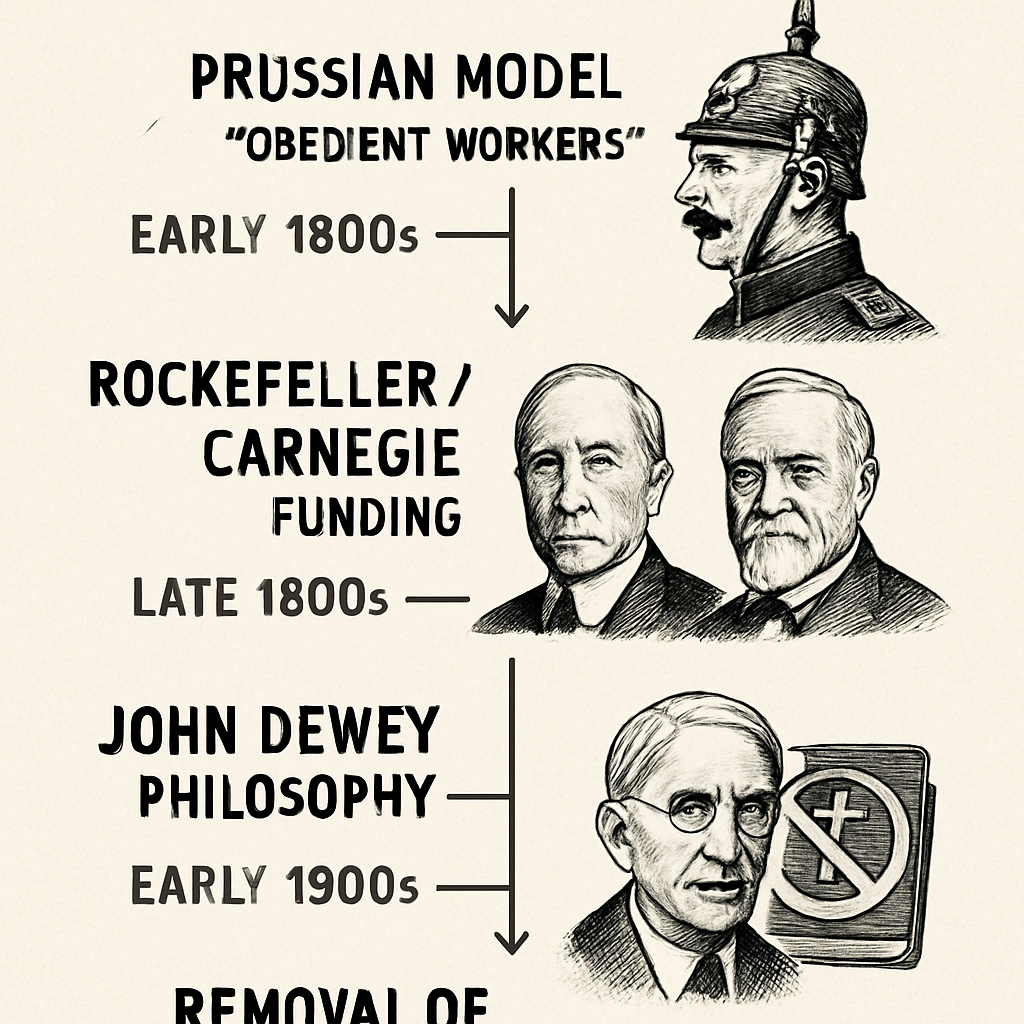
The history of education
Youth Edition - Ages 12-17
The History Behind Modern Schooling
Truth Carriers Education System
The history of education
Youth Edition - Ages 12-17
The History Behind Modern Schooling
Truth Carriers Education System
Welcome! Have you ever wondered why school looks the way it does? Why are kids put in classrooms by age? Why do bells ring every 45 minutes? Why is there so much focus on tests and grades?
Modern public schooling is actually pretty new—less than 200 years old! For most of history, parents taught their own children at home, just like your family does now. This workbook explores the real history behind the modern school system and why many families choose a different path.
The 6Rs Learning Method
The first law in America requiring children to go to school was passed in Massachusetts in 1852—that's less than 200 years ago! Before that, there was no law saying kids HAD to go to school.
Before public schools, America already had a very high literacy rate—over 90%! People could read just fine without government schools. Parents, churches, and communities taught children successfully for centuries.
1. The first compulsory school law was in in the year .
2. Before public schools, the American literacy rate was over %.
3. The U.S. Department of Education was created in .
4. One goal was to "" new immigrants.
In your own words, explain when and why compulsory schooling started:
1. Public school has existed since America was founded.
2. Before compulsory school, most Americans couldn't read.
3. Massachusetts was the first state with a school law.
"And you shall teach them diligently unto your children..."
R3: 1. Massachusetts, 1852 2. 90 3. 1979 4. Americanize
R5: 1. False 2. False 3. True
The modern school system wasn't invented in America. It came from Prussia (now part of Germany) in the early 1800s. But here's the thing—the Prussian school system wasn't designed to create great thinkers. It was designed to create obedient soldiers and factory workers.
Why would factory owners want workers who were trained to:
1. The modern school model came from (now part of Germany).
2. The Prussian system was designed to create obedient and factory workers.
3. visited Prussia in 1837 and brought the system to America.
4. Schools use to signal transitions, just like factories.
Match the Prussian feature to its purpose:
1. Age-graded classrooms ___ A. Creates factory-style thinking
2. Same curriculum for all ___ B. Prevents individual advancement
3. Bells for transitions ___ C. Removes parental influence
4. State-trained teachers ___ D. Standardizes ideas
Answers: 1. 2. 3. 4.
Explain to someone where the modern school system really came from and what it was designed to produce.
Person taught: Date:
R3: 1. Prussia 2. soldiers 3. Horace Mann 4. bells
R4: 1. B 2. D 3. A 4. C
John Dewey (1859-1952) is known as the "Father of Progressive Education." He didn't just want to teach kids reading, writing, and math. He wanted schools to change society.
| Before Dewey (Classical) | After Dewey (Progressive) |
|---|---|
| Great books & history | Social experiences |
| Absolute truth exists | Truth is relative |
| Memorization & logic | Learning by doing |
| Individual excellence | Group cooperation |
1. John Dewey is called the "Father of Education."
2. Dewey believed schools should be instruments of social .
3. Progressive education taught that truth is (not absolute).
4. Before Dewey, education focused on great and history.
1. John Dewey wanted schools to focus only on reading and math.
2. Progressive education teaches that truth is relative.
3. Dewey thought schools should change society.
R3: 1. Progressive 2. change 3. relative 4. books
R5: 1. False 2. True 3. True
The U.S. Department of Education was created in 1979. Since then, America has spent MORE money on education than ever before. But have the results improved?
| What Changed | 1970 | 2018 | Result |
|---|---|---|---|
| Per-student spending | ~$5,000 | ~$13,000 | +156% MORE |
| Reading scores (17-year-olds) | 285 | 287 | Almost no change |
| Math scores (17-year-olds) | 304 | 306 | Almost no change |
Spending went up 156%—more than doubled!
Test scores stayed almost exactly the same.
More money didn't equal better education.
Even more surprising:
1. The U.S. Department of Education was created in .
2. Per-student spending increased by %.
3. Despite more spending, test scores stayed almost .
4. In 1940, the literacy rate was %.
Without looking, write what you remember about education spending vs. results:
R3: 1. 1979 2. 156 3. flat/the same 4. 96
Scientists have studied homeschoolers to see how they compare to public school students. The results might surprise some people!
| Test | Homeschool Average | Public School Average |
|---|---|---|
| SAT | 1190 | 1060 |
| ACT | 26.5 | 21 |
| Achievement Tests | 65th-80th percentile | 50th percentile |
Homeschoolers typically score 15-30 percentile points HIGHER than public school students on standardized tests.
1. Homeschoolers score to percentile points higher on tests.
2. The average homeschool SAT score is .
3. Homeschoolers have a % college graduation rate.
4. % of studies showed positive outcomes for homeschoolers.
What advantages do you experience as a homeschooler?
R3: 1. 15 2. 30 3. 1190 4. 67 5. 78
This is probably the #1 question homeschoolers hear: "What about socialization?" Let's look at what the research actually says.
In real life, do adults work only with people their exact age? No! Public school is actually one of the ONLY places where you're locked in a room with 30 people born the same year as you.
1. % of studies showed homeschoolers performed better socially.
2. Homeschoolers typically have behavioral problems than public schoolers.
3. Real life involves -age interactions, not just same-age peers.
Practice responding to "What about socialization?" using research data.
Write your response:
R3: 1. 64 2. fewer 3. multi
Did you know that the U.S. Supreme Court has ruled multiple times that parents—not the government—have the right to direct their children's education?
This ruling said parents, not government, have primary authority over children's education.
This is THE key homeschool legal victory!
Parental rights in education are recognized as fundamental rights under the 14th Amendment to the Constitution. This is serious legal protection!
1. Pierce v. Society of Sisters said children are NOT the mere creature of the .
2. The key homeschool legal case was Wisconsin v. (1972).
3. Parental rights are considered rights under the Constitution.
1. Pierce v. Society of Sisters ___ A. Parents' fundamental right affirmed
2. Wisconsin v. Yoder ___ B. "Child is not creature of the State"
3. Troxel v. Granville ___ C. School laws can't override parental rights
Answers: 1. 2. 3.
R3: 1. State 2. Yoder 3. fundamental
R4: 1. B 2. C 3. A
Long before any government created schools, Yahuah already told parents exactly who should teach their children.
1. Deuteronomy 6:7 says to teach children .
2. Proverbs 22:6 says to " up a child in the way he should go."
3. Ephesians 6:4 addresses specifically about raising children.
4. Scripture assigns education to , not the government.
"Train up a child in the way he should go: and when he is old, he will not depart from it."
How does your family's homeschooling fulfill Yahuah's command for parent-led education?
R3: 1. diligently 2. Train 3. fathers 4. parents
Many families have serious concerns about what's taught in public schools:
A child in public school from K-12 spends approximately 14,000+ hours in school—more time than with any other influence except sleep!
Should we turn our children over to an institution that:
1. A child spends approximately hours in K-12 public school.
2. 1 Corinthians 15:33 warns that evil communications corrupt good .
3. Public schools teach moral (that truth is not absolute).
1. Public schools teach creation alongside evolution.
2. Students spend more waking hours at school than anywhere else.
3. Scripture warns about the influence of companions.
R3: 1. 14,000 2. manners 3. relativism
R5: 1. False 2. True 3. True
| Topic | Key Takeaway |
|---|---|
| History | Compulsory schooling is new (1852) and was designed for standardization |
| Prussian Model | Created for obedience, not critical thinking |
| John Dewey | Shifted focus from academics to social engineering |
| Spending | 156% more spending, flat results |
| Research | Homeschoolers score 15-30 percentile points higher |
| Socialization | Homeschoolers equal or better |
| Legal Rights | Parents have fundamental constitutional rights |
| Scripture | Parents are commanded to teach their children |
Your family isn't just "doing school at home." You're fulfilling the biblical mandate to raise the next generation in the fear and admonition of Yahuah. You're part of a movement that's producing better academic results, better social outcomes, and most importantly—young people who know Yahuah and His Word!
Without looking back, write eight key things you learned from this workbook:
Share with a friend or family member why homeschooling is important and what the research shows.
Person I shared with: Date:
Write why you're grateful for your homeschool education:
Review each lesson at these intervals for long-term memory:
| Lesson | Done | Day 1 | Day 3 | Day 7 | Day 21 | Day 60 |
|---|---|---|---|---|---|---|
| 1. When Did School Start? | ___ | ☐ | ☐ | ☐ | ☐ | ☐ |
| 2. The Prussian Model | ___ | ☐ | ☐ | ☐ | ☐ | ☐ |
| 3. John Dewey | ___ | ☐ | ☐ | ☐ | ☐ | ☐ |
| 4. More Money, Same Results | ___ | ☐ | ☐ | ☐ | ☐ | ☐ |
| 5. Homeschool Research | ___ | ☐ | ☐ | ☐ | ☐ | ☐ |
| 6. Socialization Myth | ___ | ☐ | ☐ | ☐ | ☐ | ☐ |
| 7. Legal Rights | ___ | ☐ | ☐ | ☐ | ☐ | ☐ |
| 8. What Scripture Says | ___ | ☐ | ☐ | ☐ | ☐ | ☐ |
| 9. Concerns About Public School | ___ | ☐ | ☐ | ☐ | ☐ | ☐ |
| 10. Understanding Your Calling | ___ | ☐ | ☐ | ☐ | ☐ | ☐ |
You now understand the real history behind modern education and why your family has chosen a different path. You're not just a student—you're part of a biblical movement of parent-led education!
"Study to shew thyself approved unto Elohim, a workman that needeth not to be ashamed, rightly dividing the word of truth." — 2 Timothy 2:15
TRUTH CARRIERS EDUCATION SYSTEM