Hidden Books of Antiquity: Understanding the Ancient Texts
TRUTH CARRIERS ACADEMY Youth Edition (Ages 12-17)
Jude 1:14-15
"And Enoch also, the seventh from Adam, prophesied of these, saying, Behold, Yahuah cometh with ten thousands of his set-apart ones, to execute judgment upon all..."
ABOUT THIS WORKBOOK
Did you know there are ancient books that aren't in your Bible but are quoted BY the Bible? One of these is the Book of Enoch - and Jude directly quotes it!
In this workbook, you'll explore:
Who Enoch was and why he never died
What the Book of Enoch teaches about fallen angels
Why some books are "canonical" and others are "apocryphal"
How to read these ancient texts with discernment
What the Dead Sea Scrolls revealed about Enoch
Goal: Learn to think critically about ancient texts without rejecting them completely or accepting them uncritically.
Student Name:
Date Started:
HOW TO USE THIS WORKBOOK
The 6 Rs Learning Method
1. RECEIVE Read each lesson carefully.
2. REFLECT Answer questions thoughtfully.
3. RECALL Close the book and write from memory.
4. RECITE Teach someone else what you learned.
5. REVIEW Come back on Day 1, 3, 7, 21.
6. RESPOND Apply what you learned.
LESSON 1: What is the Apocrypha?
A Word That Means "Hidden"
The word apocrypha comes from Greek and means "." These are ancient Jewish and Christian writings that exist OUTSIDE the normal Bible.
Important Distinction
"Not in the Bible" does NOT mean "worthless" or "demonic." Many apocryphal books contain historical value and help us understand how ancient believers thought!
Different Bibles, Different Books
Tradition
Old Testament Books
Includes Enoch?
Protestant
39 books
No
Roman Catholic
46 books
No
Ethiopian Orthodox
81 books total!
YES - fully canonical!
The Orthodox Church has kept the Book of Enoch as Scripture for over 1,500 years!
Multiple Choice
1. "Apocrypha" means:
○ A) Evil ○ B) Hidden ○ C) Lost ○ D) Forbidden
2. Which church includes Enoch as canonical Scripture?
○ A) Roman Catholic ○ B) Protestant ○ C) Ethiopian Orthodox ○ D) None
RECALL
What does "apocrypha" mean? Which church includes Enoch as Scripture?
LESSON 2: Who Was Enoch?
Genesis 5:24
"And Enoch walked with Elohim: and he was not; for Elohim took him."
The Man Who Never Died
Enoch was the generation from Adam. While everyone else in Genesis 5 "died," Enoch's record is different - Elohim simply "took him"!
Only Two People Never Died
In all of Scripture, only two people were taken to heaven without dying:
Enoch (Genesis 5:24)
Elijah (2 Kings 2:11 - taken up in a whirlwind)
Hebrews 11:5
"By faith Enoch was translated that he should not see death; and was not found, because Elohim had translated him: for before his translation he had this testimony, that he pleased Elohim."
Why Was Enoch Special?
The Bible says Enoch " with Elohim." This phrase means he had an incredibly close relationship with the Creator - so close that Elohim took him directly to heaven!
Multiple Choice
1. Enoch was the ___ generation from Adam:
○ A) Third ○ B) Fifth ○ C) Seventh ○ D) Tenth
2. What happened to Enoch?
○ A) He died like everyone else ○ B) Elohim took him without death ○ C) He disappeared ○ D) The Bible doesn't say
True or False
1. Many people in the Bible never died. ○ True ○ False
2. Enoch walked with Elohim. ○ True ○ False
RECALL
What makes Enoch unique? Write Genesis 5:24 from memory.
SCRIPTURE MEMORY: Genesis 5:24
"And Enoch walked with Elohim: and he was not; for Elohim took him."
LESSON 3: The Book of Enoch - An Overview
What's IN the Book of Enoch?
1 Enoch is divided into five major sections written over several centuries:
Section
Chapters
Content
Book of the Watchers
1-36
Fallen angels, Nephilim, judgment
Parables (Similitudes)
37-71
Messianic prophecies, "Son of Man"
Astronomical Book
72-82
Solar calendar, heavenly lights
Book of Dream Visions
83-90
Symbolic history of Israel
Epistle of Enoch
91-108
Warnings, prophecies, blessings
How Did We Get This Book?
The complete Book of Enoch survived in the language (Ethiopian), preserved by the Ethiopian Orthodox Church. Parts were also found in the Dead Sea Scrolls (in Aramaic)!
300-100 BCE: Most of 1 Enoch written in Aramaic
~400 CE: Enoch excluded from Western Christian canon
~500 CE: Ethiopian Church preserves Enoch as Scripture
1947-1956: Dead Sea Scrolls discovered with Enoch fragments!
Multiple Choice
1. The complete Book of Enoch survived in:
○ A) Hebrew ○ B) Greek ○ C) Ge'ez (Ethiopian) ○ D) Latin
2. The Book of Watchers teaches about:
○ A) Creation story ○ B) Fallen angels and Nephilim ○ C) Moses and the Exodus ○ D) David and Goliath
RECALL
Name the 5 sections of 1 Enoch.
LESSON 4: The Watchers - Fallen Angels
עִירִין (Irim) = "Watchers" - from the root meaning "to be awake, watchful"
Used in Daniel 4:13, 17, 23 for angelic beings
What Does 1 Enoch Say About the Watchers?
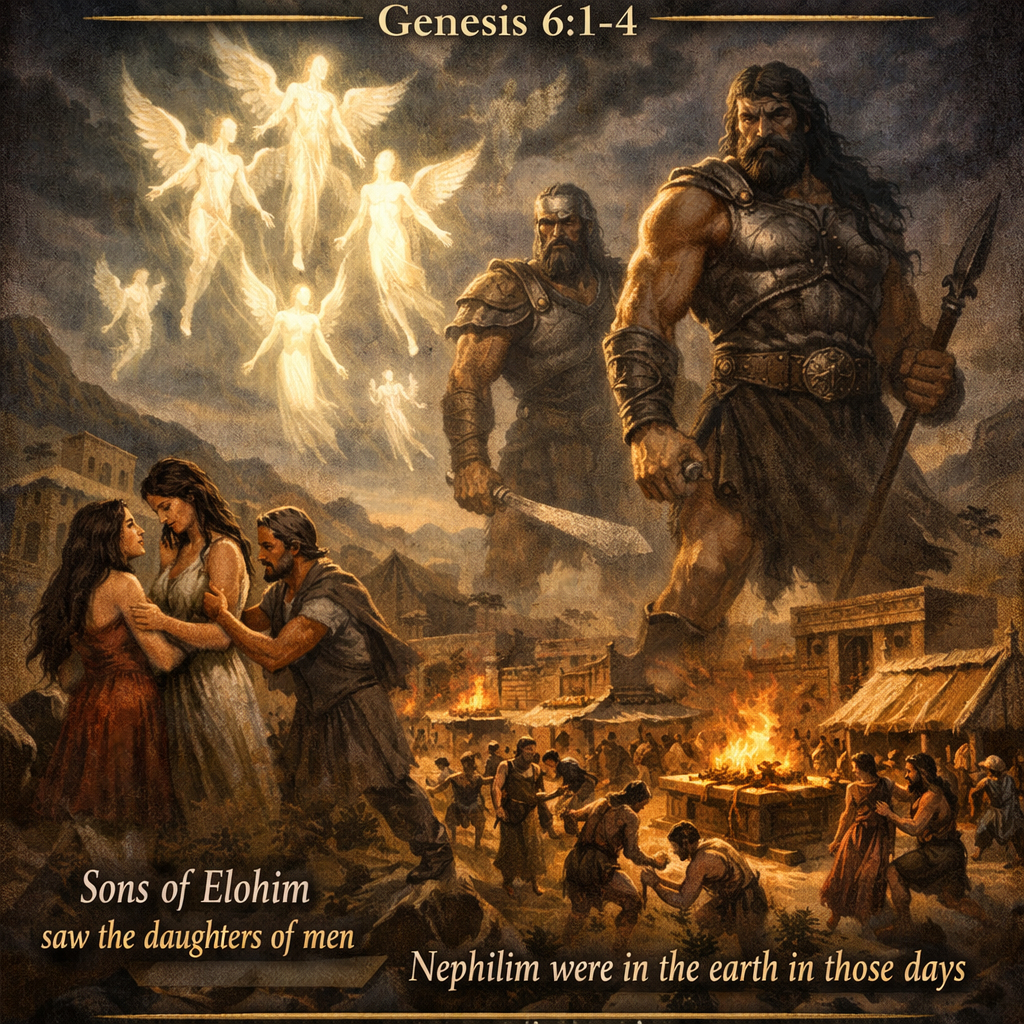
According to 1 Enoch, a group of 200 angels called "Watchers" made a terrible decision. They:
Jude 1:6
"And the angels which kept not their first estate, but left their own habitation, he hath reserved in everlasting chains under darkness unto the judgment of the great day."
2 Peter 2:4
"For if Elohim spared not the angels that sinned, but cast them down to Tartarus, and delivered them into chains of darkness..."
Interesting Word!
"Tartarus" (Greek) is used ONLY in 2 Peter 2:4 - nowhere else in Scripture! In Greek mythology, Tartarus was the deepest pit. Peter uses this word for where the fallen angels are imprisoned - just like 1 Enoch describes!
Multiple Choice
1. The "Watchers" in Hebrew is:
○ A) Nephilim ○ B) Irim ○ C) Seraphim ○ D) Cherubim
2. The children of the Watchers and human women were called:
○ A) Giants/Nephilim ○ B) Angels ○ C) Prophets ○ D) Elohim
True or False
1. Jude mentions angels who left their proper place. ○ True ○ False
2. Peter says the fallen angels are in Tartarus. ○ True ○ False
RECALL
What did the Watchers do according to 1 Enoch? How does Jude 1:6 confirm this?
LESSON 5: Jude Quotes Enoch!
Jude 1:14-15
"And Enoch also, the seventh from Adam, prophesied of these, saying, Behold, Yahuah cometh with ten thousands of his set-apart ones, to execute judgment upon all, and to convince all that are without Elohim..."
The Most Important Evidence
Jude, writing under inspiration of the Ruach HaKodesh (Holy Spirit), directly from 1 Enoch 1:9!
What Does This Tell Us?
Jude considered this prophecy AUTHENTIC - actually from Enoch
The Book of Enoch was known and respected in the 1st century
At minimum, THIS passage contains genuine prophecy
Does a Quote Make It All Scripture?
Not necessarily! The Apostle Paul also quoted Greek poets (Acts 17:28), but that doesn't make their entire works Scripture. However, Jude's quote IS significant because he calls Enoch a "" - one who speaks for Yahuah!
Multiple Choice
1. Jude quotes from:
○ A) Book of Jasher ○ B) 1 Enoch 1:9 ○ C) Book of Jubilees ○ D) Dead Sea Scrolls
2. Jude calls Enoch's words a:
○ A) Story ○ B) Legend ○ C) Prophecy ○ D) Opinion
RECALL
Why is Jude 1:14-15 so important for understanding the Book of Enoch?
TEACH-BACK CHALLENGE
Explain to someone how Jude quotes from the Book of Enoch.
Person taught: Date:
LESSON 6: Other Important Apocryphal Books
Book of Jasher
Joshua 10:13
"Is not this written in the Book of Jasher?"
The Bible itself references the Book of twice (Joshua 10:13, 2 Samuel 1:18). This proves such a book existed!
Caution!
The modern "Book of Jasher" available today may NOT be the original book referenced in Scripture. It was first published in the 1600s and 1800s. Treat with careful discernment!
Book of Jubilees
Called the "Little Genesis," Jubilees retells the stories from Genesis through Exodus with additional details. It emphasizes the importance of the calendar and keeping Yahuah's feasts. Found in the Dead Sea Scrolls!
Dead Sea Scrolls Discovery
In 1947, ancient scrolls were discovered near the Dead Sea in Israel. These included:
The oldest copies of Old Testament books
Multiple copies of 1 Enoch (in Aramaic!)
Copies of Jubilees
Community rules and other texts
This proved that 1 Enoch was genuinely ancient and highly valued by Jews before Yahusha's time!
Multiple Choice
1. The Book of Jasher is mentioned in:
○ A) Genesis and Exodus ○ B) Joshua and 2 Samuel ○ C) Matthew and Mark ○ D) Revelation only
2. The Dead Sea Scrolls were discovered in:
○ A) 1847 ○ B) 1947 ○ C) 2007 ○ D) 1777
RECALL
Name three things found in the Dead Sea Scrolls.
LESSON 7: Why Were These Books Excluded?
How the Canon Was Formed
The word "canon" means " rod" - a standard of measurement. Early believers used several criteria to determine which books belonged in Scripture:
Apostolic Authority: Was it written by an apostle or close associate?
Doctrinal Consistency: Does it align with established truth?
Universal Recognition: Did churches everywhere accept it?
Divine Character: Does it bear marks of inspiration?
Why Enoch Was Excluded
In the Western church (~400 CE), leaders like Jerome and Augustine excluded Enoch because:
It was written centuries after the actual Enoch lived
Some content seemed fantastical or extreme
It wasn't universally accepted by all churches
Ethiopian Perspective
The Ethiopian Church disagreed! They kept Enoch as canonical Scripture, believing it preserved genuine ancient traditions. Remember: "excluded" doesn't automatically mean "false."
Multiple Choice
1. "Canon" means:
○ A) Ancient book ○ B) Measuring rod/standard ○ C) Holy writing ○ D) Hidden text
2. One criterion for canonicity was:
○ A) How old the book was ○ B) Apostolic authority ○ C) How long the book was ○ D) What language it was in
RECALL
List 3 criteria used to determine if a book was canonical.
LESSON 8: Reading with Discernment
1 Thessalonians 5:21
"Test all things; hold fast what is good."
How to Approach Apocryphal Books
Neither wholesale acceptance nor complete rejection is wise. Here's a balanced approach:
Scripture First: Always compare claims against the 66 books of the Bible
Historical Value: These books help us understand ancient Jewish thought
Discernment Required: Some content may be reliable, some questionable
Avoid Extremes: Don't treat them as equal to Scripture OR as worthless
Common Errors to Avoid
ERROR 1: "If it's not in the Bible, it's demonic" - Jude quoted Enoch!
ERROR 2: "This book must be 100% true" - Use critical thinking!
ERROR 3: "I can build doctrines from apocryphal books alone" - No! Scripture is the standard.
Practical Guidelines
Use apocryphal books to:
Better understand the world of the New Testament writers
Explore historical details (like the Watchers)
See how ancient believers interpreted Scripture
Do NOT use them to:
Create new doctrines not found in Scripture
Override clear biblical teaching
Replace regular Bible study
Multiple Choice
1. The best approach to apocryphal books is:
○ A) Accept everything as Scripture ○ B) Reject everything as demonic ○ C) Test and discern with Scripture as the standard ○ D) Ignore them completely
2. 1 Thessalonians 5:21 says to:
○ A) Reject all new information ○ B) Test all things ○ C) Accept everything ○ D) Only read the Bible
RECALL
What are 2 good uses and 2 bad uses of apocryphal books?